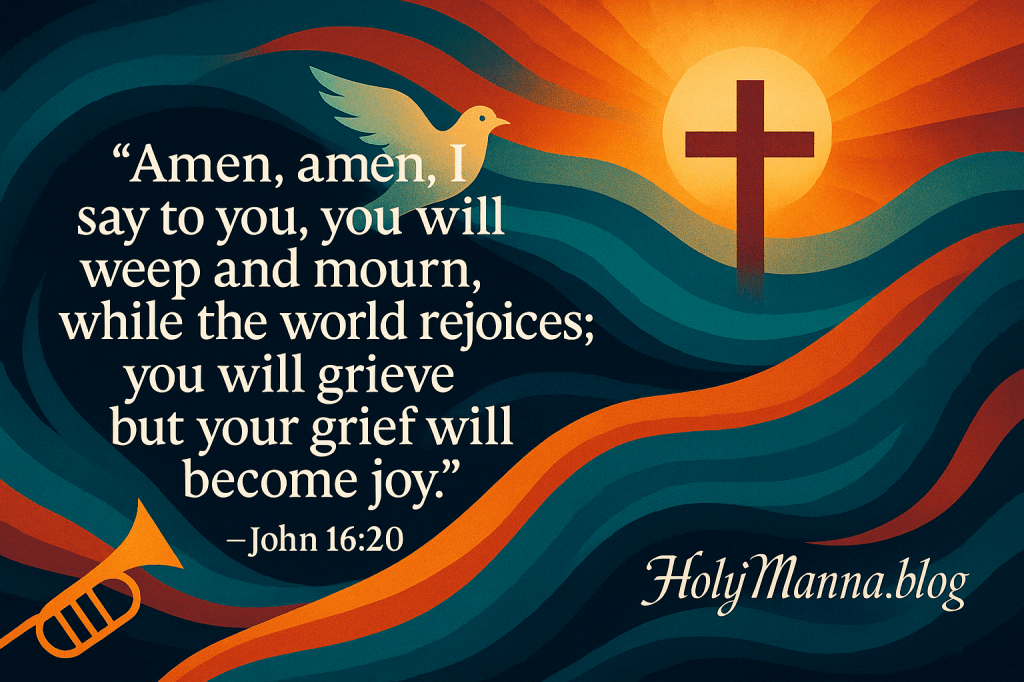
The Joy That Cannot Be Taken
There are moments in life when joy feels like a distant memory—overshadowed by trials, rejection, or spiritual exhaustion. Yet today’s readings invite us to consider a different kind of joy—one that is born not in the absence of suffering, but in the very heart of it. This is the joy that Paul discovers while preaching in Corinth under the threat of persecution. It is the joy proclaimed in Psalm 47 as all nations are called to celebrate the reign of the Most High. And it is the joy that Jesus promises to His disciples in The Gospel of John, even as He prepares them for His departure: a joy that no one can steal, because it flows from His victory over death.
Historically, these texts emerge from contexts of trial and tension. Paul is preaching in a Gentile-dominated Roman city, where Jewish leaders accuse him before the Roman proconsul. The early Church, still fragile and frequently misunderstood, faces the threat of political and religious suppression. Meanwhile, Jesus in John 16 is speaking during the Last Supper, giving His final words to disciples who are about to experience the scandal of the Cross. And yet, in all these moments of darkness and uncertainty, God is present—faithful, sovereign, and victorious. He speaks in visions, He is praised amid trumpet blasts, and He assures us that sorrow will not have the final word.
The unifying thread in today’s liturgy is the divine promise that grief will be turned into joy and fear into courage, not by human strength but by the nearness of God. Whether it is Paul emboldened by the Lord’s voice in a vision—“Do not be afraid. Go on speaking… for I am with you” (Acts 18:9-10), or Jesus assuring His disciples—“Your grief will become joy” (John 16:20), the readings remind us that Christian joy is not fleeting happiness. It is a resurrection joy: rooted in trust, sealed by the Holy Spirit, and anchored in the knowledge that God reigns over history, over suffering, and over the human heart. Where do you need to hear Christ’s words of encouragement today?
First Reading – Acts 18:9-18
Faith That Speaks Without Fear
Today’s first reading takes us deep into the missionary journey of St. Paul as he preaches in Corinth, a bustling and morally complex Roman city. The Acts of the Apostles, written by St. Luke, is more than a historical record—it’s a testimony of the Holy Spirit’s power animating the early Church. Corinth was known for its cosmopolitan diversity and notorious reputation for immorality, making it a challenging environment for evangelization. Paul’s mission here occurs after intense persecutions in places like Thessalonica and Athens. Spiritually and emotionally drained, Paul receives a divine vision with words that both comfort and commission him: “Do not be afraid. Go on speaking, and do not be silent, for I am with you” (Acts 18:9-10). This message mirrors today’s Gospel promise—joy and strength arise not from external peace, but from the enduring presence of God. In the face of rejection and accusation, Paul’s courage becomes a witness to the kind of joy that cannot be taken.
Acts 18:9-18
New American Bible (Revised Edition)
9 One night in a vision the Lord said to Paul, “Do not be afraid. Go on speaking, and do not be silent, 10 for I am with you. No one will attack and harm you, for I have many people in this city.” 11 He settled there for a year and a half and taught the word of God among them.
Accusations Before Gallio. 12 But when Gallio was proconsul of Achaia, the Jews rose up together against Paul and brought him to the tribunal, 13 saying, “This man is inducing people to worship God contrary to the law.” 14 When Paul was about to reply, Gallio spoke to the Jews, “If it were a matter of some crime or malicious fraud, I should with reason hear the complaint of you Jews; 15 but since it is a question of arguments over doctrine and titles and your own law, see to it yourselves. I do not wish to be a judge of such matters.” 16 And he drove them away from the tribunal. 17 They all seized Sosthenes, the synagogue official, and beat him in full view of the tribunal. But none of this was of concern to Gallio.
Return to Syrian Antioch. 18 Paul remained for quite some time, and after saying farewell to the brothers he sailed for Syria, together with Priscilla and Aquila. At Cenchreae he had his hair cut because he had taken a vow.
Detailed Exegesis
Verse 9 – “One night in a vision the Lord said to Paul, ‘Do not be afraid. Go on speaking, and do not be silent’”
God speaks directly into Paul’s fear, giving him a supernatural courage rooted in divine presence. The phrase “Do not be afraid” echoes the same reassurance given to prophets like Jeremiah and to the Virgin Mary at the Annunciation. Here, Paul is told not only to overcome fear but to actively persist in proclaiming the Gospel. This verse reveals the divine origin of Paul’s mission and underlines how God strengthens the heart when it trembles under human weakness.
Verse 10 – “For I am with you. No one will attack and harm you, for I have many people in this city.”
This assurance parallels Old Testament covenant language—God’s promise to be “with” His chosen ones. It also offers a hint at God’s hidden work: though Corinth may seem hostile, God already has hearts ready to receive the Word. This mysterious line—“I have many people in this city”—reminds us that evangelization is not entirely our doing; we are entering a field God has already prepared.
Verse 11 – “He settled there for a year and a half and taught the word of God among them.”
Paul responds to the vision not with passivity but with perseverance. Eighteen months is a long time in Paul’s fast-paced ministry, showing that divine reassurance bears the fruit of endurance. Teaching “the word of God” denotes more than preaching—it implies catechesis, formation, and the establishment of a Christian community in Corinth.
Verse 12 – “But when Gallio was proconsul of Achaia, the Jews rose up together against Paul and brought him to the tribunal”
The proconsul Gallio was a Roman official known historically for his impartiality and legal expertise. The “Jews” here likely refer to Jewish leaders who saw Paul’s preaching as a threat to traditional religious authority. The act of bringing Paul to the tribunal signifies an attempt to use Roman law to silence the Gospel, revealing both religious and political tensions.
Verse 13 – “Saying, ‘This man is inducing people to worship God contrary to the law.’”
Their accusation hinges on religious identity and legal authority. They accuse Paul of blasphemy and misguidance, hoping the Roman court will view his teachings as a civic threat. This parallels the Gospel narrative of Jesus being brought before Pilate—God’s messengers are often judged unjustly by worldly systems.
Verse 14 – “When Paul was about to reply, Gallio spoke to the Jews, ‘If it were a matter of some crime or malicious fraud, I should with reason hear the complaint of you Jews;’”
Gallio interrupts, essentially dismissing the case as internal religious debate. His attitude reflects the Roman Empire’s general approach to religious matters: tolerate internal diversity as long as public order is preserved. This unexpected legal protection allows the Gospel to continue spreading under Roman peace, a providential twist.
Verse 15 – “‘But since it is a question of arguments over doctrine and titles and your own law, see to it yourselves. I do not wish to be a judge of such matters.’”
Gallio’s words reflect God’s hidden hand even in secular governance. While his response may appear indifferent, it ends up shielding Paul. Gallio’s refusal to intervene prevents Paul from being punished for religious reasons—an early instance of de facto religious freedom under Roman oversight.
Verse 16 – “And he drove them away from the tribunal.”
The expulsion underscores Gallio’s firm dismissal. This act closes the case publicly and with authority, removing the threat of legal persecution for Paul in Corinth. It also shows that God’s promise of protection is already being fulfilled.
Verse 17 – “They all seized Sosthenes, the synagogue official, and beat him in full view of the tribunal. But none of this was of concern to Gallio.”
Sosthenes, possibly a convert or sympathizer, becomes a scapegoat. His beating indicates ongoing unrest and human injustice, even when law turns a blind eye. Yet this act doesn’t deter the mission—it highlights the cost of faith, a silent echo of the suffering that Christ’s followers must sometimes endure.
Verse 18 – “Paul remained for quite some time, and after saying farewell to the brothers he sailed for Syria, together with Priscilla and Aquila. At Cenchreae he had his hair cut because he had taken a vow.”
Paul’s vow—likely a Nazirite vow (cf. Numbers 6)—signals his deep personal devotion. He leaves Corinth spiritually strengthened, accompanied by trusted collaborators. Priscilla and Aquila become key figures in the early Church, and their presence here shows how community flourishes when rooted in courage and God’s promise.
Teachings from the Church
The Catechism teaches that the Church is apostolic because “she is founded on the apostles, continues to be taught, sanctified, and guided by the apostles through their successors” (CCC 857). Paul’s mission in Corinth is one expression of this apostolic foundation. His obedience to God’s vision and the perseverance that follows reflect what the Catechism later calls “apostolic courage”—a trait demanded of all who bear witness to Christ in hostile or indifferent cultures.
St. John Chrysostom, reflecting on the trials of Paul, once wrote, “The waves did not break him, nor the storms; but he was like a rock, standing firm, not shaken, not crushed” (Homilies on Acts). This inner stability is not born of personality or stoicism, but from a deep communion with Christ who speaks to His saints: “I am with you”. It is this same confidence that allowed the martyrs to go to their deaths singing hymns, and it should animate us in our trials, large or small.
Historically, Gallio’s verdict set a precedent that may have indirectly protected Christian preaching in the early years of the Church. Though the empire would later unleash brutal persecutions, moments like this show how God can even use pagan authority to preserve His Church. As Pope Benedict XVI noted, “History is not in the hands of dark powers, of chance, or of merely human choices. The Lord reigns, and His plans are carried out” (General Audience, Sept 6, 2006).
Reflection
This passage invites each of us to examine the fears and obstacles that keep us silent in our faith. Where are you afraid to speak truth? Where do you hesitate to act with courage because of opposition, rejection, or misunderstanding? The Lord’s words to Paul are His words to you: “Do not be afraid… for I am with you”. Evangelization—whether in a pulpit or in daily conversations—flows from the unshakable joy of knowing God is near. Like Paul, we are not alone in our mission. God has “many people in this city”—souls He is preparing to receive the Gospel. Our task is to speak, to love, and to trust.
In practical terms, this reading challenges us to persevere in prayer, study of Scripture, and bold witness in our communities. We may not stand before tribunals, but we do face cultural resistance, family misunderstanding, and internal doubt. Still, we are not called to results—we are called to faithfulness. Will you keep speaking? Will you keep loving when it costs something? Will you remain, even when others walk away? The joy that cannot be taken is found not in ease, but in obedience. Let us, like Paul, trust the One who speaks in visions, walks beside us in trial, and prepares the harvest before we even plant the seed.
Responsorial Psalm – Psalm 47:2-7
Praise That Shakes the Nations
The Psalms are the prayerbook of the Church—ancient hymns that express the full spectrum of human emotion in relation to God. Psalm 47 is a royal psalm, proclaiming the universal kingship of the Lord. Historically, it may have been sung during liturgical processions celebrating God’s reign, perhaps connected to the Ark of the Covenant being enthroned in Jerusalem (cf. 2 Samuel 6). This psalm goes beyond the boundaries of Israel, calling “all you peoples” to worship, reflecting the hope that the nations will come to know and praise the one true God. In today’s liturgy, it serves as a triumphant response to the First Reading, where Paul is told not to fear because “I have many people in this city”—a prophetic hint that God’s kingdom transcends cultural and political boundaries. Just as Paul preached the Gospel to Gentiles in Corinth, Psalm 47 rejoices in the gathering of all nations under God’s sovereign rule.
Psalm 47:2-7
New American Bible (Revised Edition)
2 All you peoples, clap your hands;
shout to God with joyful cries.
3 For the Lord, the Most High, is to be feared,
the great king over all the earth,
4 Who made people subject to us,
nations under our feet,
5 Who chose our heritage for us,
the glory of Jacob, whom he loves.
Selah
6 God has gone up with a shout;
the Lord, amid trumpet blasts.
7 Sing praise to God, sing praise;
sing praise to our king, sing praise.
Detailed Exegesis
Verse 2 – “All you peoples, clap your hands; shout to God with joyful cries.”
This is a call to universal worship. Not just Israel, but “all you peoples”—a foreshadowing of the Church’s mission to the nations. Clapping and shouting were part of joyful liturgical expression, symbolizing both reverence and jubilation. It reminds us that praise is not passive but deeply embodied, a full act of the soul and body.
Verse 3 – “For the Lord, the Most High, is to be feared, the great king over all the earth,”
The psalmist gives the reason for the praise: the Lord is “the Most High”, a title often associated with His supremacy over all false gods and earthly rulers. This is a holy fear—a deep awe of the divine majesty. In a world of regional deities and local powers, Israel proclaims that their God is “king over all the earth”.
Verse 4 – “Who made people subject to us, nations under our feet,”
This verse reflects the historical memory of God’s victories for Israel, particularly in the conquest of Canaan. But in the light of Christ, this dominion is reinterpreted as the spiritual authority of the Church, not through violence, but through love and truth. The nations are not crushed, but gathered, and the “feet” here point to Christ’s own dominion (cf. Ephesians 1:22).
Verse 5 – “Who chose our heritage for us, the glory of Jacob, whom he loves. Selah”
The psalmist marvels that God Himself chose Israel’s inheritance. The “glory of Jacob” refers to the covenant blessings passed down from the patriarchs. To pause at the word “Selah” is to enter into a moment of holy contemplation: that God’s love is not random, but deliberate and faithful.
Verse 6 – “God has gone up with a shout; the Lord, amid trumpet blasts.”
This verse may have originally celebrated the Ark’s ascent to Mount Zion, but it also prophetically points to the Ascension of Christ. The imagery of “trumpet blasts” evokes divine majesty and victory. It connects directly with the joy promised in the Gospel—Christ ascends not in defeat but in glory.
Verse 7 – “Sing praise to God, sing praise; sing praise to our king, sing praise.”
The repetition here is no accident—it intensifies the call to worship. God is not only the king of Israel but “our king”, a personal ruler who invites each of us to participate in His reign. The response of the believer is unceasing praise, a liturgy of the heart that spills over into every aspect of life.
Teachings from the Church
The Catechism of the Catholic Church emphasizes the cosmic and universal scope of Christ’s kingship: “Christ is Lord of the cosmos and of history. In him human history and indeed all creation are ‘set forth’ and transcendently fulfilled” (CCC 668). Psalm 47 echoes this truth—God is not a tribal deity but the rightful ruler of every nation and every heart. His sovereignty demands not just belief but worship, not just knowledge but song.
St. Augustine reflects beautifully on this psalm: “If you would sing praises, you must love. For the praise of God, which is sung with joy, is the fruit of love” (Enarrationes in Psalmos 47). True praise flows not merely from duty, but from desire. The heart that has encountered God can’t help but exalt Him. This kind of praise is not bound to Sunday worship—it’s a way of life, a response to the realization that Christ has conquered sin and death.
In early Christianity, Psalm 47 was frequently associated with the Ascension of Jesus. The line “God has gone up with a shout” was read as a prophecy of Christ rising to the Father’s right hand (cf. Acts 1:9). Even today, this psalm is often sung in Ascension liturgies. The trumpet blasts and joyful cries remind us that the reign of Christ is not abstract—it is here, now, and expanding through the Church’s mission. When Paul preaches in Corinth, and when we witness in our workplaces or homes, we participate in that same divine expansion.
Reflection
Do you live as though Christ is king? Do your habits, words, and priorities reflect the joy of knowing that God reigns? This psalm calls us not only to believe in God’s power but to rejoice in it. To clap our hands, to sing aloud, to praise without hesitation—these are not reserved for the emotionally expressive or liturgically inclined. They are the natural response of a heart set free.
Every act of praise is an act of defiance against despair. When we choose to sing despite trials, when we shout joyfully even amid suffering, we proclaim the Gospel more loudly than any sermon. Where in your life can you begin to praise God more intentionally? Is it in the middle of your commute, while doing dishes, or in moments of silent prayer? Joy doesn’t always feel like a mountaintop. Sometimes it’s a decision—a choice to worship the King who reigns even when we don’t yet see all things subject to Him.
Let us join in the psalmist’s litany: “Sing praise to God, sing praise; sing praise to our king, sing praise”. In doing so, we echo the praise of saints and angels and proclaim that no sorrow, fear, or trial can dethrone the King of Glory. Will you lift your voice today?
Holy Gospel – John 16:20-23
Joy Everlasting
Today’s Gospel takes place during the Last Supper discourse, a moment of deep intimacy and impending sorrow. Jesus is preparing His disciples for His Passion and Death, knowing they will be scattered, confused, and full of grief. In the chapters leading up to this, He has already washed their feet, foretold His betrayal, and promised the coming of the Holy Spirit. Now, He speaks with pastoral tenderness about the emotional turmoil they will experience—and the lasting joy that will follow. The Gospel of John, often called the “spiritual Gospel,” is structured to highlight not just the events of Christ’s life, but their theological meaning. Here, Jesus gives an image that ties together personal suffering, divine promise, and eschatological hope: a woman in labor. This moment of sorrow will give way to a joy so deep and secure that, as He says, “no one will take your joy away from you”. In light of today’s theme, this passage reveals the essence of Christian courage—enduring anguish with the trust that resurrection joy is not only possible, but inevitable.
John 16:20-23
New American Bible (Revised Edition)
20 Amen, amen, I say to you, you will weep and mourn, while the world rejoices; you will grieve, but your grief will become joy. 21 When a woman is in labor, she is in anguish because her hour has arrived; but when she has given birth to a child, she no longer remembers the pain because of her joy that a child has been born into the world. 22 So you also are now in anguish. But I will see you again, and your hearts will rejoice, and no one will take your joy away from you. 23 On that day you will not question me about anything. Amen, amen, I say to you, whatever you ask the Father in my name he will give you.
Detailed Exegesis
Verse 20 – “Amen, amen, I say to you, you will weep and mourn, while the world rejoices; you will grieve, but your grief will become joy.”
Jesus begins with the solemn double affirmation: “Amen, amen”, signaling a truth of deep importance. He acknowledges the painful paradox the disciples will face—they will mourn His death while the world (i.e., those opposed to Him) rejoices. But He immediately assures them that their grief will be transformed. Not replaced, not dismissed—“your grief will become joy”. This is the paschal mystery: suffering is not erased but transfigured by the Resurrection.
Verse 21 – “When a woman is in labor, she is in anguish because her hour has arrived; but when she has given birth to a child, she no longer remembers the pain because of her joy that a child has been born into the world.”
This image of childbirth is both natural and supernatural. In Scripture, “the hour” often refers to decisive moments of salvation. Jesus Himself has referred to His Passion as “His hour” (cf. John 12:23). Now He compares the coming suffering to labor pains—a process that is painful, but purposeful. The joy of new life doesn’t just follow the pain; it comes through it. The comparison also evokes Marian imagery: Mary’s sorrow at the Cross gives way to her joy at the Resurrection and Pentecost.
Verse 22 – “So you also are now in anguish. But I will see you again, and your hearts will rejoice, and no one will take your joy away from you.”
Here Jesus turns from metaphor to direct reassurance. The disciples’ present distress is real—“you are now in anguish”—but so is the promise: “I will see you again”. This is more than a brief resurrection appearance; it points to the enduring presence of the Risen Lord through the Holy Spirit. The joy that follows is not fleeting or circumstantial, but permanent: “no one will take your joy away from you”. This is the joy of the saints, the joy of heaven begun on earth.
Verse 23 – “On that day you will not question me about anything. Amen, amen, I say to you, whatever you ask the Father in my name he will give you.”
Jesus now refers to “that day”—a phrase often used in eschatological contexts to signify the time after His Resurrection and the sending of the Spirit. The confusion of the disciples will be resolved, and their prayers will gain new power. Asking the Father “in my name” doesn’t mean using a formula—it means praying as members of Christ’s Body, in unity with His will. This new intimacy with the Father flows directly from the joy of the Resurrection.
Teachings from the Church
The Catechism of the Catholic Church speaks powerfully to this transformation of suffering into joy: “By his Passion and death on the cross, Christ has given a new meaning to suffering: it can henceforth configure us to him and unite us with his redemptive Passion” (CCC 1505). Jesus does not promise the absence of anguish, but He gives it redemptive value. Like the woman in labor, we are called to see pain not as meaningless, but as part of a deeper birthing process in the life of grace.
St. Teresa of Ávila once wrote, “To suffer for God is the greatest joy that can be found in this life” (The Way of Perfection). Her mystical insight reveals the secret of the saints: joy is not the absence of sorrow, but the fruit of love that endures through it. The apostles learned this firsthand—every one of them would face persecution, and many would face martyrdom. Yet they would do so singing, praying, and proclaiming, because they had seen the Risen Christ. Their joy was not theoretical. It was personal. It was eternal.
Pope St. John Paul II, in his Apostolic Letter Salvifici Doloris, affirms this same truth: “Suffering, more than anything else, makes present in the history of humanity the force of the Redemption” (SD 27). This is why the Christian can rejoice even in anguish—because Christ has already walked through the valley of death and emerged victorious. In today’s Gospel, Jesus does not promise ease, but He promises Himself. And in His presence, our grief turns into glory.
Reflection
What pain in your life is Christ waiting to transform into joy? What part of your story feels like a labor pain that hasn’t yet brought new life? This Gospel is an invitation to hope. It tells us that we do not suffer in vain. Like the disciples in the upper room, we may feel disoriented, confused, or abandoned. But the Risen Jesus is coming—and when He does, “your hearts will rejoice”. This joy is not dependent on external circumstances. It is rooted in the abiding presence of God who never leaves us.
Today, take time to examine the sources of your sorrow. Name them in prayer. Offer them to the Father in Jesus’ name. Trust that, like a woman in labor, you are not alone. You are being prepared for something beautiful. Resurrection joy is not always loud or immediate, but it is sure. Can you believe that Christ will see you again? That He sees you even now? Let His promise echo in your soul: “No one will take your joy away from you.” And let that joy become your strength.
The Joy That Cannot Be Taken Away
Today’s readings lead us on a sacred journey—from the trembling heart of a missionary in Corinth to the thunderous praise of nations in Psalm 47, and finally to the quiet anguish of the Upper Room where Jesus promises joy through sorrow. In each passage, we find a God who does not abandon His people. He stands beside Paul and says, “Do not be afraid… for I am with you”. He is enthroned with shouts of praise, “the great king over all the earth”. And He looks tenderly at His disciples and assures them, “Your grief will become joy… no one will take your joy away from you”.
These are not poetic consolations—they are divine truths. The Christian life is not spared from fear, accusation, or anguish, but it is marked by something deeper: the indwelling presence of the Risen Lord. The kind of joy Jesus promises is not a passing feeling. It is a joy born in the labor of suffering, anchored in the promises of God, and sustained by a love that casts out fear. Whether we are preaching to a difficult crowd, clapping our hands in praise, or weeping through a night of sorrow, the Lord walks with us and leads us into a joy that is everlasting.
What fear is silencing your voice? What sorrow is weighing on your heart? Let today be an invitation to speak boldly, to worship joyfully, and to trust patiently. Christ has already overcome the world. The Gospel is still worth proclaiming. And the joy He gives is still breaking into our lives—quietly, powerfully, and forever. Let us live as people who believe this, who carry it into our homes, our workplaces, our cities. Let the joy of the Lord be your strength today… and may no one take it away from you.
Engage with Us!
We’d love to hear how today’s Word has touched your heart. Share your thoughts, questions, or personal reflections in the comments below—your voice could be the encouragement someone else needs today! Let’s grow together in faith and joy as a community rooted in Christ.
Reflection Questions:
First Reading – Acts 18:9-18
What fears or doubts might be holding you back from proclaiming your faith more boldly? Have you ever felt God’s reassurance in a moment of weakness or rejection? How did it strengthen you? Who are the “many people in this city” God may be preparing through your witness?
Responsorial Psalm – Psalm 47:2-7
Do you take time to praise God joyfully in your everyday life, even when things are hard? How does acknowledging God as King over all bring peace to your heart? In what ways can you become a witness of joy in your family or community?
Holy Gospel – John 16:20-23
What suffering or sorrow in your life are you being invited to see through the lens of resurrection? How have you experienced joy that no one could take away—joy rooted in God, not the world? What can you ask the Father today in Jesus’ name, trusting that He hears you?
Remember, your faith is not just a private treasure—it’s a gift meant to be lived out and shared. Let the joy of the Lord be your strength, and let everything you do be marked by the love, mercy, and courage that Jesus taught us. Walk boldly, speak joyfully, and love deeply… for He is with you.
Follow us on Instagram and Facebook for more insights and reflections on living a faith-filled life.

 Holy Manna!
Leave a comment