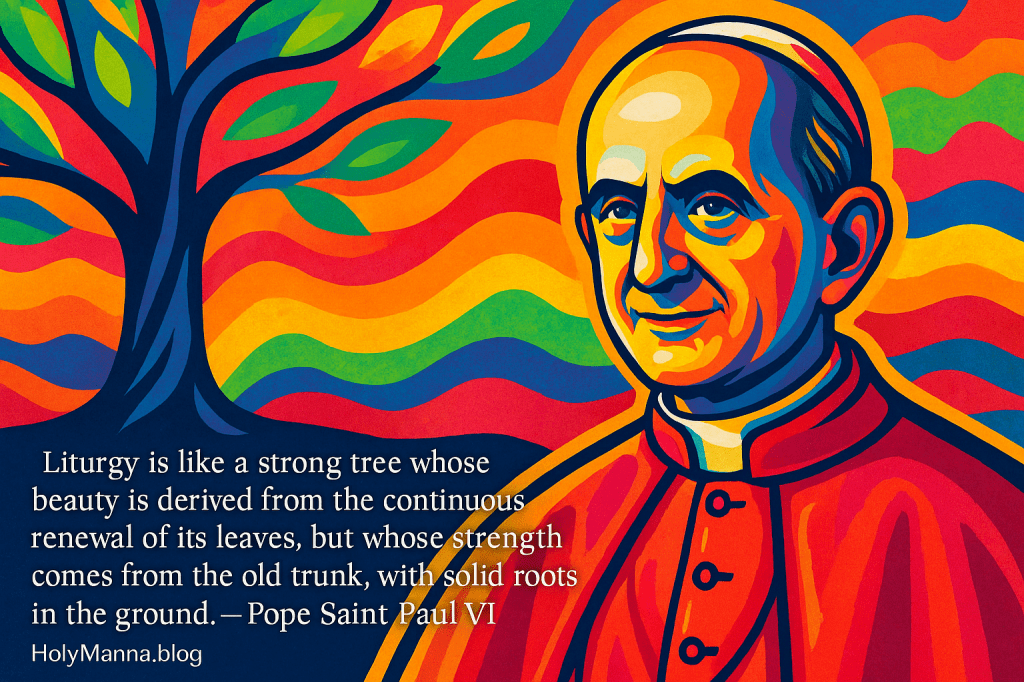
Crowned with Courage
To speak of Pope Saint Paul VI is to speak of a man who stood as a beacon of stability during one of the most turbulent times in modern Church history. His pontificate was not marked by ease or applause, but by an unshakable commitment to truth in a world increasingly allergic to absolutes. Elected during the Second Vatican Council, he took up the monumental task of steering the Church into the modern world while preserving her ancient identity. Though sometimes misunderstood, Paul VI was a man deeply in love with Christ and the Church. He longed not only to serve her faithfully but to help her reach every corner of the globe with the liberating message of the Gospel. His canonization in 2018 was not just a celebration of his legacy—it was a vindication of a man who suffered silently for his fidelity, and who now intercedes for a Church still wrestling with the very issues he foresaw.
A Quiet Fire
Born on September 26, 1897, in the small Italian town of Concesio, Giovanni Battista Montini was a quiet and intellectual child raised in a politically active and devout Catholic family. His father, Giorgio Montini, was a journalist and lawyer involved in Catholic social movements, while his mother, Giudetta Alghisi, nurtured her children’s faith with gentle strength. Young Giovanni often suffered from illness, which kept him from rough play or extended schooling, but he devoured books and showed early signs of a contemplative heart.
He was ordained a priest in 1920 and quickly rose through the ranks of the Vatican’s diplomatic service. As a close advisor to Pope Pius XII, Montini worked behind the scenes during World War II, coordinating relief efforts and advocating for persecuted Jews. In 1954, he was appointed Archbishop of Milan, Italy’s largest diocese, where he immersed himself in the pastoral needs of the working class. Known for walking through factories and talking to laborers, he embodied the Church’s option for the poor long before it became common parlance.
When he was elected pope in June 1963, Montini chose the name Paul VI, signaling his missionary zeal in the spirit of Saint Paul the Apostle. He did not seek the papacy, but he embraced it as a cross to be borne for the glory of God. With deep humility, razor-sharp intellect, and a fatherly heart, he continued the work of the Second Vatican Council and sought to apply its vision to a world brimming with both hope and confusion.
Miracles of the Mission
While Pope Saint Paul VI is not remembered for miraculous healings during his lifetime, his pontificate itself was a kind of miracle—proof that grace can sustain a man called to carry an impossible burden. His miracle was one of global missionary outreach. He was the first pope to travel outside Italy in modern times, visiting six continents and bringing the face of Peter to Catholics around the world. His historic pilgrimage to the Holy Land in 1964 was the first by a pope in over 1,000 years, and it marked the beginning of modern papal diplomacy and ecumenism. There he met with Patriarch Athenagoras I of Constantinople, an encounter that began the healing of the Great Schism of 1054. This was more than symbolic—it was the fruit of prayer, humility, and a sincere desire for unity in Christ.
Another spiritual miracle was his ability to remain faithful in solitude. After the publication of Humanae Vitae in 1968, Paul VI faced a torrent of criticism, even from within the Church. Yet he refused to change the teaching, because he knew it was not his to change. He once confided to a friend, “I have the feeling that the Lord has called me and bound me to this yoke, and that I must pull it alone for the good of all.” The miracle of Pope Saint Paul VI was not thunder and lightning, but the slow burning fire of obedience, fanned by the Holy Spirit, in a world cold to truth.
The Weight of the Keys
Paul VI’s pontificate was marked not by visible wounds, but by the invisible scars of rejection, betrayal, and isolation. After continuing the Second Vatican Council to its completion in 1965, he faced the massive task of interpreting and implementing its reforms. He was caught between those who felt the Church had changed too much and those who felt it had not changed enough. His decisions often pleased neither side. Yet, in the center stood a man of prayer, kneeling before the tabernacle, asking God for wisdom.
His deepest sorrow came in the aftermath of Humanae Vitae, the encyclical in which he reaffirmed the Church’s teaching on the sanctity of human life and the immorality of artificial contraception. Anticipating intense backlash, he nevertheless declared with fatherly love and prophetic boldness: “Every action which… renders procreation impossible is intrinsically evil” (Humanae Vitae 14). For this, he was ridiculed by the media, ignored by theologians, and even abandoned by brother bishops. Yet he stood firm, not out of rigidity, but out of charity—because truth is the most merciful guide.
His final years were marked by loneliness. He was the last pope to wear the papal tiara, but he laid it on the altar of Saint Peter’s Basilica as a gesture of humility. His health declined, but his faith never faltered. On August 6, 1978, the Feast of the Transfiguration, Paul VI died quietly at Castel Gandolfo. The Church lost a pope, but Heaven gained a saint whose suffering, though hidden, bore great fruit.
The Voice That Still Heals
Though his holiness was long recognized by many, the Church confirmed Pope Saint Paul VI’s sainthood through two miraculous healings. The first took place in California in the 1990s, when an unborn child was diagnosed with a severe brain defect. The doctors advised abortion, but the child’s parents, inspired by Paul VI’s defense of unborn life, prayed for his intercession. The child was born completely healthy, with no explanation other than divine grace. This healing was recognized as the miracle needed for his beatification in 2014.
The second miracle, leading to his canonization in 2018, was strikingly similar. Once again, an unborn child faced grave medical danger, and once again, the parents turned to Pope Saint Paul VI in prayer. The child was healed in utero and born safely. These miracles are not random—they are signs of Paul VI’s ongoing mission to protect the sanctity of human life and to remind us that every child is a gift from God.
Today, his tomb in the Vatican draws pilgrims from around the world. Many seek his intercession for courage in leadership, strength in suffering, and grace in upholding Church teachings amid cultural pressure. In these modern miracles, we see the hand of God affirming the quiet heroism of a pope who gave everything for the Church he loved.
Living the Tightrope
The life of Pope Saint Paul VI is a roadmap for every believer caught between a love for the world and a desire for holiness. He teaches us that the path of truth is rarely applauded, but always fruitful. He reminds us that being faithful does not mean being popular, and that standing for what is right may cost us everything—but in that cost is our crown.
In an age dominated by relativism and fear of offending others, Paul VI calls us to reclaim the courage of conviction. His writings, especially Evangelii Nuntiandi and Humanae Vitae, are prophetic documents that can still form and guide Catholic hearts today. He challenges us to be both missionaries and mystics—people who engage the world but never lose the sacred center that is Jesus Christ.
His silent endurance of suffering offers hope to those who feel unheard, misunderstood, or alone in their convictions. He reminds us that holiness is not reserved for the dramatic, but for those who suffer silently with love. He once said, “Modern man listens more willingly to witnesses than to teachers, and if he does listen to teachers, it is because they are witnesses.” In our homes, workplaces, and parishes, let us be those witnesses.
If you’re wrestling with cultural rejection, if you’re standing alone for Catholic truth, if you’re carrying a silent cross—Pope Saint Paul VI is your companion. His intercession is a source of strength, and his life a testimony that even in the shadows, the light of Christ endures.
Engage with Us!
How has the witness of Pope Saint Paul VI spoken to your life today? We’d love to hear your thoughts in the comments below.
Here are three questions to reflect on and share:
- How can I remain faithful to Christ even when the world pushes against me?
- What does it mean to live with both truth and compassion in my daily relationships?
- In what ways can I embrace the cross—be it criticism, suffering, or loneliness—for the sake of love?
Let’s continue to lift each other up in prayer, striving to live “in the name of the Lord”, and doing all things with love, as our Savior Jesus Christ did.
Pope Saint Paul VI, pray for us!🙏
Follow us on Instagram and Facebook for more insights and reflections on living a faith-filled life.

 Holy Manna!
Leave a comment