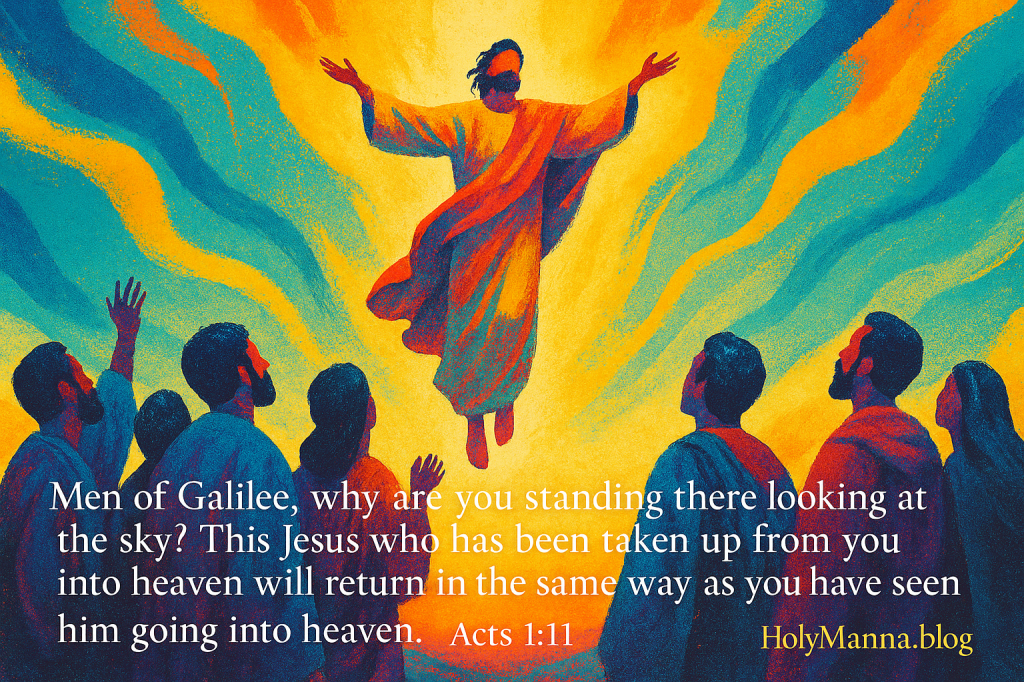
Lifted to Glory, Sent in Power
Have you ever watched someone walk away, knowing life would never be the same afterward? That’s the feeling today’s readings evoke. We stand with the disciples on the Mount of Olives, gazing up into the sky, hearts stirring with awe, uncertainty, and anticipation. But this is no ordinary farewell. Today we celebrate the Solemnity of the Ascension of the Lord—a mystery bursting with divine meaning. Jesus doesn’t simply leave; He ascends. And in doing so, He elevates our human nature into the very heart of heaven while launching the mission of the Church here on earth.
This moment in salvation history is not just about Jesus going “up”; it’s about what He empowers His followers to do going forward. In Acts 1:1–11, the risen Christ assures His apostles that the “promise of the Father”—the Holy Spirit—will come, giving them the strength to be His witnesses “to the ends of the earth.” Psalm 47 echoes this cosmic victory with the shout: “God has gone up with a shout, the Lord, amid trumpet blasts.” Ephesians 1:17–23 reveals what this enthronement means: Christ reigns supreme over all creation, and we, the Church, are His Body on earth. Then in Luke 24:46–53, we return to the Ascension, not with sadness, but with joy, as the disciples receive their mission with worship and praise.
To grasp the full weight of today’s feast, we must remember its Jewish roots. In biblical thought, clouds symbolize God’s presence (as in Exodus 13:21), and ascending a mountain often precedes divine encounter (think Mount Sinai or Mount Tabor). Jesus’ ascent into heaven is a royal procession—a return to the Father not in defeat but in triumph. It marks the culmination of the Paschal Mystery and the beginning of the Church’s public mission. Are you standing in awe like the disciples, or are you ready to be clothed with power and sent out as His witness?
First Reading – Acts 1:1–11
From Promise to Power: The Birth of Apostolic Mission
The Acts of the Apostles, written by St. Luke, is a continuation of his Gospel and serves as a crucial bridge between the life of Jesus and the life of the Church. Addressed to Theophilus—whose name means “lover of God”—Acts documents the outpouring of the Holy Spirit and the explosive growth of the early Christian community. Today’s reading recounts the Ascension, a turning point not only in salvation history but in the apostles’ understanding of their mission. This passage sets the stage for Pentecost, when the promised Holy Spirit will empower them to preach with authority and courage. Culturally, it reflects the Jewish expectation of the Messiah as one who would restore Israel politically. Religiously, it reveals that Jesus is inaugurating a kingdom not of this world, where the power of the Holy Spirit is the new law written on hearts, not stone tablets. The Ascension is not the end of Jesus’ work but its glorified continuation through the Church.
Acts 1:1-11
New American Bible (Revised Edition)
The Promise of the Spirit. 1 In the first book, Theophilus, I dealt with all that Jesus did and taught 2 until the day he was taken up, after giving instructions through the holy Spirit to the apostles whom he had chosen. 3 He presented himself alive to them by many proofs after he had suffered, appearing to them during forty days and speaking about the kingdom of God. 4 While meeting with them, he enjoined them not to depart from Jerusalem, but to wait for “the promise of the Father about which you have heard me speak; 5 for John baptized with water, but in a few days you will be baptized with the holy Spirit.”
The Ascension of Jesus. 6 When they had gathered together they asked him, “Lord, are you at this time going to restore the kingdom to Israel?” 7 He answered them, “It is not for you to know the times or seasons that the Father has established by his own authority. 8 But you will receive power when the holy Spirit comes upon you, and you will be my witnesses in Jerusalem, throughout Judea and Samaria, and to the ends of the earth.” 9 When he had said this, as they were looking on, he was lifted up, and a cloud took him from their sight. 10 While they were looking intently at the sky as he was going, suddenly two men dressed in white garments stood beside them. 11 They said, “Men of Galilee, why are you standing there looking at the sky? This Jesus who has been taken up from you into heaven will return in the same way as you have seen him going into heaven.”
Detailed Exegesis
Verse 1 – “In the first book, Theophilus, I dealt with all that Jesus did and taught”
Luke opens with a reminder that his Gospel chronicled Jesus’ earthly ministry. This verse affirms that Christian faith is rooted in the historical reality of Jesus’ life, teachings, death, and resurrection. Theophilus represents every disciple invited into deeper truth.
Verse 2 – “until the day he was taken up, after giving instructions through the holy Spirit to the apostles whom he had chosen.”
Jesus did not abandon His apostles without direction. He taught them through the Holy Spirit, already foreshadowing the Pentecost event. His “instructions” carried divine weight and were meant to shape the Church’s foundation.
Verse 3 – “He presented himself alive to them by many proofs after he had suffered, appearing to them during forty days and speaking about the kingdom of God.”
The forty days connect Jesus with other biblical periods of transformation (e.g., Moses on Sinai, Elijah’s journey, and Israel’s time in the desert). The “many proofs” underscore the Resurrection’s physical reality. Jesus taught about the “kingdom of God,” not as a geopolitical rule, but as God’s reign manifested through grace and truth.
Verse 4 – “While meeting with them, he enjoined them not to depart from Jerusalem, but to wait for ‘the promise of the Father about which you have heard me speak;’”
Jerusalem, the city of David and the Temple, becomes the launching point for the New Covenant. Jesus urges patient obedience—they are to wait for the Holy Spirit, not rush ahead on their own strength.
Verse 5 – “for John baptized with water, but in a few days you will be baptized with the holy Spirit.”
This contrast signals a new phase of God’s plan. John’s baptism symbolized repentance; the Holy Spirit’s baptism brings interior transformation and divine power, fulfilling Ezekiel 36:26–27: “I will put my Spirit within you.”
Verse 6 – “When they had gathered together they asked him, ‘Lord, are you at this time going to restore the kingdom to Israel?’”
The apostles still hope for a political Messiah. Their question reveals how human expectations can cloud spiritual realities. But Jesus gently redirects them to a bigger plan—one that includes the whole world, not just Israel.
Verse 7 – “He answered them, ‘It is not for you to know the times or seasons that the Father has established by his own authority.’”
This reminds us that God’s providence unfolds in His time. Jesus affirms the Father’s sovereign authority, teaching the apostles—and us—to trust without needing all the answers.
Verse 8 – “But you will receive power when the holy Spirit comes upon you, and you will be my witnesses in Jerusalem, throughout Judea and Samaria, and to the ends of the earth.”
This is the Great Commission of Acts. The apostles are called not merely to believe, but to witness—to proclaim and embody the Gospel. The geographical expansion mirrors the universal call of the Church: local, regional, and global evangelization.
Verse 9 – “When he had said this, as they were looking on, he was lifted up, and a cloud took him from their sight.”
Jesus’ Ascension is not abandonment, but exaltation. The cloud evokes the divine presence seen in the Exodus and the Transfiguration. It signals that Jesus enters heavenly glory, taking His place at the Father’s right hand.
Verse 10 – “While they were looking intently at the sky as he was going, suddenly two men dressed in white garments stood beside them.”
The two men—angelic messengers—echo those who announced Jesus’ Resurrection. Their presence signals divine affirmation and the continuity of God’s plan.
Verse 11 – “They said, ‘Men of Galilee, why are you standing there looking at the sky? This Jesus who has been taken up from you into heaven will return in the same way as you have seen him going into heaven.’”
This gentle rebuke redirects the apostles from awe to action. Jesus will return, but for now, the mission begins. It’s time to stop staring and start witnessing.
Teachings from the Church
The Catechism of the Catholic Church beautifully reflects on the Ascension in paragraphs 659–664. Paragraph 659 teaches: “Christ’s body was glorified at the moment of his Resurrection, as proved by the new and supernatural properties it subsequently and permanently enjoys. But during the forty days when he eats and drinks familiarly with his disciples and teaches them about the kingdom, his glory remains veiled under the appearance of ordinary humanity.” The Ascension is the unveiling of that hidden glory.
Paragraph 661 further explains: “This final stage stays closely linked to the first, that is, to his descent from heaven in the Incarnation. Only the one who ‘came from the Father’ can return to the Father: Christ Jesus.” This reinforces that the Ascension is not an end, but a return to divine intimacy, taking humanity with Him.
St. Augustine offers a powerful meditation on this mystery: “Why do we on earth not strive to be with Him in heaven in heart and mind, since we already possess His flesh in heaven?” This truth has historical depth too—in the early Church, the Ascension was celebrated with a vigil, and the day marked a transition from the presence of Jesus in the flesh to His presence in the Eucharist and in the Church through the Spirit.
Reflection
This reading invites us to pause and ask: Are we still looking at the sky, waiting for God to act, or are we living as Spirit-filled witnesses? Christ’s Ascension is not a departure from our lives, but an invitation into mission. We are not orphans—He sends us the Advocate, the Holy Spirit, who empowers us to preach, serve, and love in His name. In our families, parishes, workplaces, and online spaces, we are called to testify that Jesus is alive.
In practical terms, this means spending time in prayer, asking for the Holy Spirit to guide our decisions, and being bold in sharing our faith. Do we see ourselves as part of the Church’s mission to the ends of the earth? Even the smallest act of charity can become a witness when done in Jesus’ name. Let us not stand still in comfort or fear. The same Spirit that launched the apostles awaits us. Will we say yes to being sent?
Responsorial Psalm – Psalm 47:2–3, 6–9
The Triumph of the King of Glory
Psalm 47 is a royal enthronement hymn, likely sung during Israelite liturgical processions or national celebrations of God’s kingship. Its placement in today’s liturgy beautifully mirrors the event of the Ascension. In the Jewish imagination, God reigning from His holy throne was not merely symbolic; it was a real, cosmic truth. This psalm takes on new and deeper meaning when read through the lens of Christ’s Ascension. Jesus, having completed His mission on earth, is now enthroned at the right hand of the Father. The trumpet blasts, the praises, and the exultant joy of this psalm are fulfilled in the heavenly liturgy, echoed on earth in every Eucharistic celebration. Psalm 47 reminds us that Christ’s reign is not a future hope alone, but a present reality. He reigns now, and we, as His Church, are called to participate in and proclaim that reign with joyful worship.
Psalm 47:2-3, 6-9
New American Bible (Revised Edition)
2 All you peoples, clap your hands;
shout to God with joyful cries.
3 For the Lord, the Most High, is to be feared,
the great king over all the earth,
6 God has gone up with a shout;
the Lord, amid trumpet blasts.
7 Sing praise to God, sing praise;
sing praise to our king, sing praise.
8 For God is king over all the earth;
sing hymns of praise.
9 God rules over the nations;
God sits upon his holy throne.
Detailed Exegesis
Verse 2 – “All you peoples, clap your hands; shout to God with joyful cries.”
This opening verse is a call to universal praise. Not just Israel, but “all you peoples” are summoned to rejoice. It’s a prophetic foreshadowing of the Gospel going out to the nations, as Jesus commands in Acts 1:8. The clapping of hands and shouts of joy signify a liturgical expression of awe and thanksgiving. In the context of the Ascension, this verse invites all humanity to rejoice in the victory of Christ, who now intercedes for us from heaven.
Verse 3 – “For the Lord, the Most High, is to be feared, the great king over all the earth.”
This verse affirms the sovereignty of God. In the ancient world, to say a king ruled “over all the earth” was a bold political and theological statement. Here, it acknowledges that God—not Caesar, not any earthly ruler—is the true King. The phrase “to be feared” does not mean terror but reverence, awe, and submission. With Christ seated at the Father’s right hand, we recognize that His authority is above all earthly powers, fulfilling Ephesians 1:21.
Verse 6 – “God has gone up with a shout; the Lord, amid trumpet blasts.”
This verse is a direct Ascension image. The “going up” parallels Acts 1:9, where Jesus is lifted up into the clouds. The “shout” and “trumpet blasts” recall the fanfare of a king returning in triumph. In the Church, these echoes are heard in the liturgy—especially in Easter and Ascension celebrations—where we proclaim Christ’s victory not with somber tones, but with glory and jubilation.
Verse 7 – “Sing praise to God, sing praise; sing praise to our king, sing praise.”
This is a fourfold command to praise. The repetition emphasizes that praise is not optional—it is the natural response to God’s majesty. The psalmist shifts from describing what God has done to inviting the faithful into active participation. In light of Christ’s Ascension, we are reminded that liturgical worship is our way of joining the heavenly choir in glorifying the King of kings.
Verse 8 – “For God is king over all the earth; sing hymns of praise.”
Again the theme of universal kingship is stressed. The psalm urges us not only to recognize but to respond—“sing hymns of praise.” Christ’s dominion is not limited to Church or heaven; it extends over all creation. This verse challenges us to let every aspect of our life reflect His kingship—not just Sunday Mass, but work, family, and our moral decisions.
Verse 9 – “God rules over the nations; God sits upon his holy throne.”
The image of God seated on His throne is one of stability, judgment, and authority. The Ascension confirms that Christ now reigns with the Father in glory. As St. Paul writes in Philippians 2:9–10, “God greatly exalted him and bestowed on him the name that is above every name, that at the name of Jesus every knee should bend.” Psalm 47 thus finds its ultimate fulfillment in the glorified Christ.
Teachings from the Church
The Catechism of the Catholic Church affirms the cosmic authority of the risen and ascended Christ. Paragraph 668 declares: “Christ died and lived again, that he might be Lord both of the dead and of the living… Christ’s Ascension into heaven signifies his participation, in his humanity, in God’s power and authority.” In this light, Psalm 47 becomes a liturgical anthem for the Church—a response of joyful faith in the reign of the risen Lord.
St. John Chrysostom, in his homilies on the Psalms, reminds us that true kingship belongs to God alone. He writes: “What does it mean that He has gone up with a shout? That He conquered, not through weapons, but through the Cross. The trumpet sounds not for war, but for victory.” This echoes the Church’s teaching that Christ’s kingship is one of love, humility, and sacrificial self-gift—radically different from earthly dominion.
Historically, Psalm 47 was used in the Jewish Feast of Trumpets (Rosh Hashanah), symbolizing God’s enthronement and judgment. The early Church appropriated this psalm to celebrate Christ’s Ascension. Today, in our liturgy, its verses are often chanted with great festivity, especially in the Liturgy of the Hours and during Ascension Day Mass. The liturgical use reflects the Church’s unceasing proclamation that Jesus Christ reigns now and forever.
Reflection
In our daily lives, we often forget that we serve a risen and reigning King. Do we live as citizens of His Kingdom, or do we fall into the fear and confusion of a world that feels out of control? Psalm 47 invites us to lift our eyes and hearts to heaven. It challenges us to praise—not just in song, but through acts of trust, gratitude, and witness. When we choose joy in suffering, when we proclaim Christ’s name without shame, when we live with integrity in our homes and workplaces, we join the heavenly chorus that sings: “Sing praise to God, sing praise!”
Take time today to literally sing—a hymn, a psalm, or simply a song of thanksgiving from your heart. Praise reminds us who is really in charge. When was the last time you praised God not for what He’s done, but simply for who He is? Let your life be a trumpet blast declaring His kingship. Let your joy be contagious. In a world aching for hope, we are sent to shout with our lives: “God is king over all the earth!”
Second Reading – Ephesians 1:17–23
Eyes to See the King of Glory
St. Paul’s Letter to the Ephesians is one of the most theologically rich epistles in the New Testament, often referred to as the “Queen of the Epistles.” Written while Paul was imprisoned, likely in Rome, this letter was meant not only for the Church in Ephesus but for a broader Christian audience across Asia Minor. The portion proclaimed in today’s liturgy is a prayer—a soaring, Spirit-filled intercession that the hearts of believers would be enlightened to comprehend the majesty of Christ’s Ascension and His ongoing dominion. As we celebrate Jesus’ return to the Father, Paul invites us to see beyond the physical, into the spiritual inheritance we’ve received as members of Christ’s body. He calls us to recognize not just the authority of the risen Lord, but the hope, power, and riches made available to us through Him. In the context of the Ascension, this passage reveals the deeper consequence of Jesus being lifted up: we are lifted with Him, drawn into His divine life.
Ephesians 1:17-23
New American Bible (Revised Edition)
17 that the God of our Lord Jesus Christ, the Father of glory, may give you a spirit of wisdom and revelation resulting in knowledge of him. 18 May the eyes of [your] hearts be enlightened, that you may know what is the hope that belongs to his call, what are the riches of glory in his inheritance among the holy ones, 19 and what is the surpassing greatness of his power for us who believe, in accord with the exercise of his great might, 20 which he worked in Christ, raising him from the dead and seating him at his right hand in the heavens, 21 far above every principality, authority, power, and dominion, and every name that is named not only in this age but also in the one to come. 22 And he put all things beneath his feet and gave him as head over all things to the church, 23 which is his body, the fullness of the one who fills all things in every way.
Detailed Exegesis
Verse 17 – “that the God of our Lord Jesus Christ, the Father of glory, may give you a spirit of wisdom and revelation resulting in knowledge of him.”
Paul begins his prayer with a plea for spiritual illumination. The “spirit of wisdom and revelation” is not secret knowledge, but divine insight poured out by the Holy Spirit. To know God is not merely intellectual—it is relational, transformative. The Ascension shows us that Jesus, fully divine and fully human, has returned to the Father, and this truth is the foundation of Christian wisdom.
Verse 18 – “May the eyes of [your] hearts be enlightened, that you may know what is the hope that belongs to his call, what are the riches of glory in his inheritance among the holy ones,”
This verse is a powerful image: our hearts have eyes. Paul wants believers to perceive hope not as optimism, but as certainty rooted in Christ’s triumph. The “riches of glory” refer to the eternal life and divine communion that await the faithful. The Ascension doesn’t remove Jesus from us—it makes Him universally present to all who seek Him in holiness.
Verse 19 – “and what is the surpassing greatness of his power for us who believe, in accord with the exercise of his great might,”
Here, Paul emphasizes “power”—a key theme on the Feast of the Ascension. Christ’s exaltation isn’t distant from our lives; it unleashes the very “great might” of God in us. The same power that raised Christ is at work in every baptized soul. This transforms Christian living from struggle to victory.
Verse 20 – “which he worked in Christ, raising him from the dead and seating him at his right hand in the heavens,”
Paul roots our hope in history. The Resurrection and Ascension are not symbolic—they are real events. Christ now sits at the “right hand” of the Father, a position of honor, authority, and intercession. This language echoes Psalm 110:1 and was central to early Christian creeds.
Verse 21 – “far above every principality, authority, power, and dominion, and every name that is named not only in this age but also in the one to come.”
Paul proclaims Christ’s supremacy over all created powers—spiritual and temporal. In a culture steeped in fear of cosmic forces, this is liberating truth. No force—earthly or demonic—can rival the authority of the ascended Lord. His name reigns “not only in this age but also in the one to come.”
Verse 22 – “And he put all things beneath his feet and gave him as head over all things to the church,”
Christ is not only King of the universe—He is Head of the Church. The image “beneath his feet” evokes conquest, but His lordship is not domination—it is total gift. He is given to the Church, not to rule as tyrant, but to nourish, protect, and sanctify His Bride.
Verse 23 – “which is his body, the fullness of the one who fills all things in every way.”
This final verse is mystical and breathtaking. The Church is not just a community or institution—it is Christ’s “body” and “fullness.” As He fills all things from His heavenly throne, we are filled with Him on earth through the sacraments, prayer, and mission. This reveals the Ascension not as absence, but as intimate presence.
Teachings from the Church
The Catechism of the Catholic Church teaches in paragraph 668: “Christ died and lived again, that he might be Lord both of the dead and of the living… ‘All power in heaven and on earth has been given to me’ (Mt 28:18). Christ is Lord of the cosmos and of history. In him human history and indeed all creation are ‘set forth’ and transcendently fulfilled.” The Ascension affirms Jesus as the universal King and establishes His Church as the vehicle of His authority on earth.
In CCC 795 we read: “Christ and his Church thus together make up the ‘whole Christ’ (Christus totus). The Church is one with Christ. The saints are acutely aware of this unity: St. Augustine says, ‘Let us rejoice then and give thanks that we have become not only Christians, but Christ himself… for if he is the head, we are the members; he and we together are the whole man.’” This reflects Paul’s final line in today’s reading: the Church is His body and shares in His glory.
St. John Paul II reflected often on Ephesians 1, especially during his pontificate’s opening year. He said: “The Ascension does not distance the Lord from us. It enables the Church to be His presence in the world. The Church is now the visible sign of the invisible Christ, the extension of His mission until the end of time.” This powerful insight calls every Christian to embrace their identity and vocation with confidence.
Reflection
In a world that prizes visibility, fame, and immediate results, this reading calls us to live by faith, not by sight. Do we see the Church as the living Body of Christ, filled with divine power and destined for heavenly glory? When we lose sight of Christ’s Ascension, we risk reducing Christianity to mere morality or social work. But when our hearts are enlightened—when the eyes of our souls truly see—we begin to walk in the power of the Risen Lord.
Practically, this means reclaiming a spirit of prayer and praise. Spend time meditating on the dignity of being part of Christ’s Body. Receive the sacraments with intentionality. See your parish not just as a building, but as the dwelling of God’s fullness. Do you live as one who shares in the hope of His call? Do your decisions reflect confidence in His power at work in you?
This reading is a reminder that we are not powerless. Christ is enthroned, and He has not forgotten us. He reigns not just “up there,” but within His Church, within you. Let the light of that truth flood your heart today. Will you allow your life to reflect His surpassing greatness to the world around you?
Holy Gospel – Luke 24:46–53
From Blessing to Boldness: The Joy of an Ascending King
The Gospel of Luke is known for its sweeping narrative, rich with historical details and a deep concern for the marginalized, the joyful, and the prayerful. Written by the same author as Acts of the Apostles, it concludes not with a curtain drop, but with a heavenly lifting—Jesus’ glorious Ascension. In first-century Jewish culture, the Messiah was expected to reign on earth. But Jesus upended those expectations. His reign would be inaugurated not from a throne in Jerusalem but from heaven, after His suffering, death, and resurrection. This passage, uniquely Lukan, is filled with tenderness and mission: Jesus commissions, blesses, ascends, and leaves behind a community not in despair, but in praise. The Gospel ties directly into today’s central theme—Christ ascended in glory and sends His Church with joy and power. Luke’s account makes it clear: the story isn’t over. In fact, it’s just beginning.
Luke 24:46-53
New American Bible (Revised Edition)
46 And he said to them, “Thus it is written that the Messiah would suffer and rise from the dead on the third day 47 and that repentance, for the forgiveness of sins, would be preached in his name to all the nations, beginning from Jerusalem. 48 You are witnesses of these things. 49 And [behold] I am sending the promise of my Father upon you; but stay in the city until you are clothed with power from on high.”
The Ascension. 50 Then he led them [out] as far as Bethany, raised his hands, and blessed them. 51 As he blessed them he parted from them and was taken up to heaven. 52 They did him homage and then returned to Jerusalem with great joy, 53 and they were continually in the temple praising God.
Detailed Exegesis
Verse 46 – “And he said to them, ‘Thus it is written that the Messiah would suffer and rise from the dead on the third day’”
Jesus reminds His disciples that everything that occurred—the suffering, death, and resurrection—was foretold in Scripture. This divine plan wasn’t a detour; it was the path to glory. He connects their current experience with the prophetic Word, echoing passages like Isaiah 53 and Psalm 16:10. This reminds the Church that faith is rooted in fulfillment, not fantasy.
Verse 47 – “and that repentance, for the forgiveness of sins, would be preached in his name to all the nations, beginning from Jerusalem.”
The Ascension is not an end, but the launching pad of the Church’s mission. Jesus proclaims a universal Gospel—a message not limited to Israel but extended to “all the nations.” The heart of this mission is “repentance, for the forgiveness of sins”—the healing of broken humanity. The epicenter of this proclamation is Jerusalem, the city of both the Cross and the Resurrection.
Verse 48 – “You are witnesses of these things.”
This short yet powerful verse is a commissioning. The apostles are not just students; they are now bearers of truth. Witnessing is not passive observation—it’s active proclamation. Their authority stems not from expertise, but from intimacy with the risen Lord. In every age, Christians are called to the same vocation: to testify to what they have seen, heard, and come to believe.
Verse 49 – “And [behold] I am sending the promise of my Father upon you; but stay in the city until you are clothed with power from on high.”
Jesus reassures them with a promise—the Holy Spirit, “the promise of my Father,” as foretold in Joel 2:28 and Isaiah 44:3. But they must wait. This teaches patience, trust, and preparation. “Clothed with power from on high” signifies a total transformation. They will not act by their own strength, but by divine anointing.
Verse 50 – “Then he led them [out] as far as Bethany, raised his hands, and blessed them.”
Bethany, a place of friendship and miracles (as seen with Lazarus), becomes the location of Jesus’ final earthly act. Raising His hands in blessing echoes the role of the priest (see Numbers 6:24–26). His departure is not abandonment, but a final act of love and intercession.
Verse 51 – “As he blessed them he parted from them and was taken up to heaven.”
The Ascension happens in the context of blessing. This is significant—Jesus doesn’t leave in silence or mystery, but in glory and grace. His being “taken up” fulfills Daniel 7:13–14, where the Son of Man comes to the Ancient of Days and receives dominion. His humanity is now forever glorified in heaven.
Verse 52 – “They did him homage and then returned to Jerusalem with great joy,”
The disciples respond not with sorrow, but with worship. The Greek term for “homage” implies adoration reserved for God. This is a clear affirmation of Christ’s divinity. Their “great joy” is striking—it shows their understanding that His departure is victory, not loss.
Verse 53 – “and they were continually in the temple praising God.”
Their praise overflows into persistent liturgical worship. The temple, once a place of sacrifice, becomes the setting of Christian praise. Their hearts have been converted from fear to fire. This final verse leads directly into Acts, where this joy erupts into mission after Pentecost.
Teachings from the Church
The Catechism of the Catholic Church explains in paragraph 665: “Christ’s Ascension marks the definitive entrance of Jesus’ humanity into God’s heavenly domain, whence he will come again (cf. Acts 1:11); this humanity in the meantime hides him from the eyes of men (cf. Col 3:3).” The Ascension is not a vanishing, but a glorification. It assures us that our humanity is capable of heaven.
St. Leo the Great powerfully preached: “Our Redeemer’s visible presence has passed into the sacraments. Our faith is nobler and stronger because sight has been replaced by doctrine: the authority of what is taught takes the place of what is seen.” This helps us understand why the apostles rejoiced. The absence of Jesus in body became the presence of Jesus in mystery—in Word, Sacrament, and Church.
Historically, the Feast of the Ascension has been celebrated since at least the fourth century. St. Augustine noted it was universally kept throughout the Church. It is a Holy Day of Obligation because it proclaims Christ’s kingship and our shared destiny in Him. The Ascension proclaims that heaven is not only real, but open—and that the Church has work to do.
Reflection
This Gospel invites us to live as people of praise and mission. Do you recognize that Jesus reigns even now from heaven? Do you receive His blessing and live with the joy of His presence? Too often, we live as if the story ended at the Cross or even the Resurrection. But the Ascension tells us: the story continues through you.
This passage calls us to worship and witness. Make time for daily praise—through liturgy, Scripture, music, or silence. And from that place of blessing, step out into mission. Are you clothed with power from on high, or are you trying to live your faith in your own strength? Ask the Holy Spirit to fill you anew. Like the apostles, we must return to our “Jerusalem”—to the Church, to our vocations, to our neighbors—with joy and boldness.
Jesus has ascended, but He is not absent. He blesses us still. He intercedes for us. And He sends us forth with a message of forgiveness, freedom, and glory. Will you receive His blessing and become a joyful witness in your world today?
Heaven Our Home, Earth Our Mission
Today’s readings lift our eyes to heaven, not to escape the world, but to see it anew through the lens of Christ’s victory. In Acts 1, we watched the Lord ascend with a promise on His lips: “You will receive power when the Holy Spirit comes upon you.” In Psalm 47, we joined the chorus of all creation, clapping, shouting, and singing: “God has gone up with a shout… God is king over all the earth!” In Ephesians, we were invited to see with enlightened hearts the “surpassing greatness of his power for us who believe.” And in Luke 24, we stood on the hill of Bethany, where Christ lifted His hands in blessing and returned to the Father, as His disciples rejoiced and praised.
The Ascension is not a moment of absence but of empowerment. Christ’s departure is also our commission. The Lord reigns from heaven, but He continues His work through His Body—the Church. That means through you. Through your prayers, your worship, your acts of love and witness. He is not far. He is closer than ever, interceding for you, blessing you, sending you.
Are you ready to live as a witness to the risen and reigning Christ? Let today be a day of praise, trust, and renewed purpose. Look up, yes—but then look out. The world needs your voice, your faith, your light. Let heaven fill your heart, and let your feet carry that joy to the ends of the earth. You were made for glory. You were sent for mission. Let’s live it.
Engage with Us!
We’d love to hear how today’s readings spoke to your heart. Your insights, experiences, and questions can inspire others and build up our community of faith. Share your reflections in the comments below, and let’s grow together as disciples of our risen and ascended King!
Reflection Questions:
First Reading – Acts 1:1–11
What does it mean for you to be a witness to Christ “to the ends of the earth”? Are there areas in your life where you’re still “looking at the sky” instead of stepping into mission?
Responsorial Psalm – Psalm 47
How can praise become a more intentional part of your daily routine? Do you recognize Christ as King in every part of your life—your work, your family, your struggles?
Second Reading – Ephesians 1:17–23
What part of Paul’s prayer speaks most powerfully to your current spiritual needs? How can you open the “eyes of your heart” more fully this week?
Holy Gospel – Luke 24:46–53
What blessings has Christ poured out on you recently, and how have you responded? Are you living in a spirit of joy and mission, or do you find yourself spiritually stagnant?
Stay rooted in prayer, open to the Holy Spirit, and bold in sharing the hope that Christ has planted in your heart. Let your life be a hymn of praise and a beacon of love. And remember—everything we do, we do with the mercy, humility, and joy of Jesus who reigns forever.
Follow us on Instagram and Facebook for more insights and reflections on living a faith-filled life.

 Holy Manna!
Leave a comment