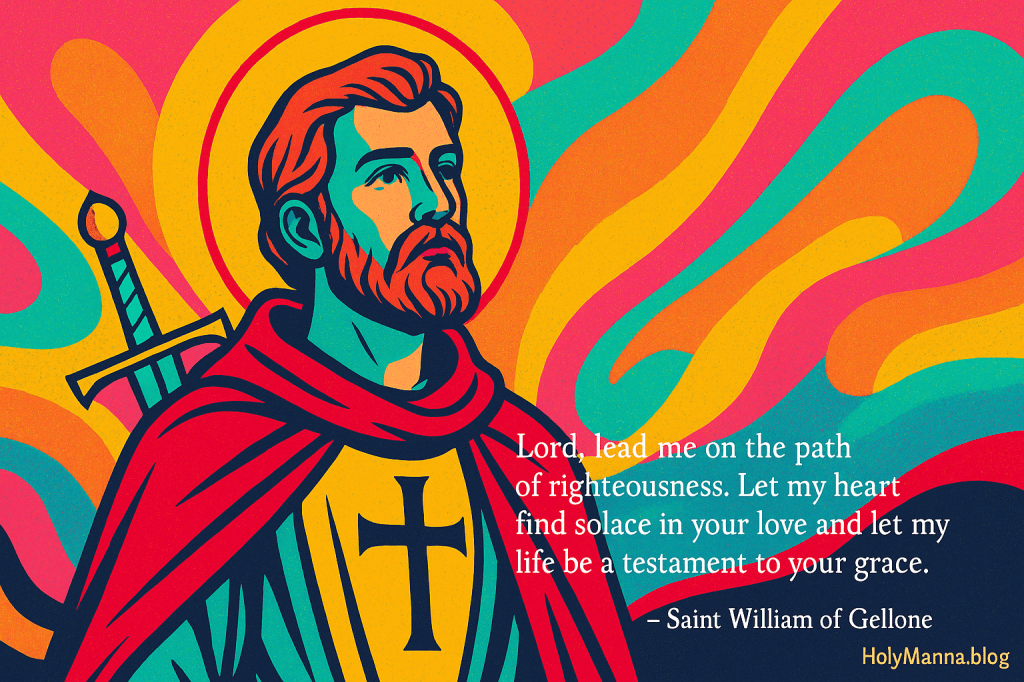
A Crown in the Desert
Among the noble knights of Christendom, few stories shine as brightly with paradox as that of Saint William of Gellone. A man of immense power and prestige—general, duke, cousin of Emperor Charlemagne—William could have secured his legacy through conquest alone. And yet, history remembers him not for the battles he won, but for the kingdom he chose to abandon. His greatest triumph came not on the battlefield but in the cloister, where he exchanged a warrior’s fame for the peace of prayer. Canonized for his radical humility and deep spiritual transformation, Saint William reminds us that the path to sainthood is not paved with gold or lined with crowds, but often hidden in the silence of obedience and the soil of conversion.
Saint William is honored today as a patron of those seeking spiritual renewal, of warriors turning to peace, and of all who long to lay their gifts before God in a radical act of surrender. His life bridges the world of chivalry and contemplation, a reminder that even the most powerful can—and should—kneel.
Bloodlines and Battles
William was born around the year 755 in the city of Toulouse, deep in the heart of the Frankish kingdom. His family was not merely aristocratic; they were entwined with the very roots of European power. His mother Aldana was believed to be a daughter of Charles Martel, the grandfather of Charlemagne. This made William not only noble by blood but royalty by alliance. Raised in a world of swords and scrolls, he was trained in war and courtly affairs, destined for greatness among men.
As a young nobleman, William entered the service of Charlemagne and quickly became one of his most trusted military leaders. He was appointed Duke of Aquitaine and later Count of Toulouse. His most famous campaign was against the Saracens in Spain, where he led the defense of Christian lands with valor and strategic brilliance. The Frankish victories in Barcelona and other regions were due in large part to his leadership. He was celebrated in songs and poems, even mythologized in later epic tales like The Chanson de Guillaume.
Yet something stirred within William—a hunger deeper than victory. Whether it was the weariness of war, a divine encounter, or the quiet witness of monastic life, we may never know the precise catalyst. But what is clear is that William underwent a profound interior conversion. The warrior began to see his sword not as a symbol of dominion, but as something to lay down at the feet of Christ.
Around 804, William founded a Benedictine monastery in a remote valley near Lodève, a region then called Gellone. Not only did he fund its construction, but he entered it himself as a simple monk. The man who once held command over soldiers now held a hoe in the garden. The nobleman who once wore silk now wore wool. The general who gave orders now received them. As The Catechism of the Catholic Church teaches: “To become a child in relation to God is the condition for entering the kingdom” (CCC 526). William embraced this childlike trust, choosing the cloister over the court.
Sacred Stillness
While Saint William may not have performed miracles that dazzled crowds or halted plagues, his life was infused with a quieter, more profound kind of wonder—the miracle of transformation. It is a miracle of no less power when a heart of pride is pierced by grace and converted into one of humility.
Monastic legends surrounding William speak of his fierce commitment to penance and prayer. He spent long nights in vigil, wept over his past sins, and performed the most menial tasks with joy. His love for the Holy Eucharist was described as “burning,” and it is said that he often fasted for days, not from discipline alone, but from a hunger for Christ. The brothers testified that a deep peace reigned in the monastery during his tenure, a peace they attributed to the divine presence that accompanied him.
In later poetic retellings—particularly The Song of William—angelic help is depicted during his battles. While not historical in the strict sense, these embellishments reflect what the medieval faithful intuited: that William’s life was touched by God, not only in battle, but more so in surrender.
The true miracle, perhaps, was that a man so exalted by the world could become so small before God. As Psalm 34 declares: “The Lord is close to the brokenhearted and saves those who are crushed in spirit” (Ps 34:18). William’s very soul became an offering, and in that offering, the miraculous took root.
From Warrior to Wounded
Although Saint William was not martyred by blood, he endured a lifelong martyrdom of the spirit. To voluntarily surrender status, wealth, comfort, and acclaim in a society that idolized them was no small death. He bore the scorn of those who could not understand his choice. He endured the physical hardships of monastic life—poor food, rough clothing, sleepless nights—and did so with joy. But the deepest cross may have been internal: resisting the temptation to return to his former glory.
Each day, he woke not to the applause of men but to the discipline of silence. His hands, once wielding a sword, now tilled soil and scrubbed floors. His voice, once commanding armies, now uttered psalms in low chant. His battle was not over—it had merely changed fields.
And yet he bore these crosses with serenity. There is no account of rebellion or regret in his years at Gellone. His was a martyrdom of the will, a laying down of self, which speaks directly to the call in Romans 12:1: “Present your bodies as a living sacrifice, holy and acceptable to God, which is your spiritual worship.”
In choosing the hidden life, William bore witness to the truth that suffering—freely chosen in love—becomes redemptive.
The Light After Death
Saint William died in the abbey he had founded, likely around the year 812. His body was laid to rest there, and almost immediately his tomb became a place of miracles. Pilgrims flocked to Gellone to seek healing, forgiveness, and spiritual direction. Testimonies arose of physical cures, of demonic oppressions lifted, and of hardened hearts softened after praying at his grave.
His reputation for holiness only grew. By the 11th century, he was venerated throughout France, and his relics were held with great reverence. The town that grew around the abbey was eventually renamed Saint-Guilhem-le-Désert, in his honor. Today, the site remains one of the most important pilgrimage destinations on the route to Santiago de Compostela.
His life inspired not only pilgrims, but poets and saints alike. He became a symbol of sanctified masculinity—a reminder that strength and sanctity are not opposed but united in Christ. His story spread across Europe, not because he conquered lands, but because he allowed himself to be conquered by God.
As The Catechism reminds us: “By canonizing some of the faithful, the Church recognizes the power of the Spirit of holiness within her” (CCC 828). The Spirit burned brightly in William—and continues to shine through his memory.
From Glory to Grace
The life of Saint William of Gellone is more than a tale from the distant past—it is a call to every Christian heart today. In an age of self-promotion, his silence speaks. In a culture of excess, his poverty preaches. In a world that worships fame, his anonymity in Christ inspires.
His witness reminds us that true greatness is not measured by earthly power, but by our willingness to serve. Like William, we may be called to walk away from something good in order to embrace something holy. His story dares us to ask: What am I clinging to that keeps me from God?
His journey also challenges those of us who fear change. If a man born into glory can embrace obscurity, what excuses do we have? If a warrior can become a monk, can we not become more prayerful, more humble, more generous? Saint William lived out the truth of CCC 2544: “Jesus enjoins his disciples to prefer him to everything and everyone, and bids them renounce all that they have for his sake and that of the Gospel.”
May we follow William’s lead—not necessarily to a cloister, but to the cloister of the heart, where we meet God in humility, obedience, and love.
Engage with Us!
How does Saint William’s story move your heart? Do you feel called to lay down something in your life for Christ? Join the conversation and let’s build a community that supports each other in choosing love, humility, and holiness.
Reflection Questions:
- What is something worldly you feel called to surrender to grow closer to Christ?
- How can you cultivate humility in your daily life, following Saint William’s example?
- Is there an area of your life where you are called to spiritual battle rather than comfort?
Let’s encourage one another to seek the Kingdom above all else. Share your reflections below and remember—do everything with love, as our Lord Jesus did.
Saint William of Gellone, pray for us!⚔️
Follow us on Instagram and Facebook for more insights and reflections on living a faith-filled life.

 Holy Manna!
Leave a comment