Our Universal Search for the Living God
Have you ever felt a longing you couldn’t quite explain—a hunger not for food or fame, but for meaning, truth, and transcendence? Today’s readings invite us into that sacred yearning and show us how God meets us in the middle of our searching. From the intellectual heights of ancient Athens to the promise of the Holy Spirit in the upper room, we are reminded that in every time and place, the human heart has always reached for something greater—someone greater.
In Acts of the Apostles, we witness St. Paul boldly addressing the philosophers of the Areopagus, people who prided themselves on wisdom yet still built an altar “To an Unknown God.” Paul does something deeply powerful here: he doesn’t mock their ignorance, but instead affirms their spiritual hunger and redirects it toward the truth of the God who “made the world and all that is in it” (Acts 17:24). His speech is a model of evangelization—recognizing the seeds of truth already present in another culture and gently unveiling the fullness of revelation in Christ. At the heart of this moment is a universal truth: every human being is created to seek God—not in idols of gold or silver, but in the living, personal God who “is not far from any one of us” (Acts 17:27).
Psalm 148 echoes this cosmic perspective, calling “all peoples… young men and women too, old and young alike” to praise the Lord—not just out of duty, but because “his name alone is exalted” (Psalm 148:12–13). This praise is not forced—it springs from revelation. And in The Gospel of John, Jesus assures us that this divine self-revelation will continue through the Spirit of truth, who will “guide you to all truth” and “declare to you the things that are coming” (John 16:13). From philosophy to praise to prophecy, today’s readings form a rich tapestry of humanity’s deepest longing and God’s loving response. What altar have you built in your heart—and will you let God reveal His name upon it?
First Reading – Acts 17:15, 22—18:1
Proclaiming the Unknown: A Gospel for All Cultures
Paul’s address at the Areopagus is one of the most iconic moments of evangelization in the early Church. Here we find him in Athens, the intellectual heart of the Greco-Roman world—a city that birthed philosophers like Socrates and Plato, steeped in polytheism, art, and debate. The Book of Acts, written by St. Luke, shows the expansion of the Church from Jerusalem to the ends of the earth, and this passage captures Paul’s masterful ability to translate the Gospel into the language of a pagan culture without compromising its truth. Surrounded by altars and idols, Paul speaks to a people groping in the dark for meaning, worshiping what they do not know. Today’s theme—the universal search for God and the Spirit’s role in guiding us to truth—is on full display here. This isn’t just a moment in Paul’s missionary journey; it’s a mirror of every Christian’s mission today: to proclaim the living God to a world filled with “unknown gods.”
Acts 17:15, 17:22—18:1
New American Bible (Revised Edition)
17:15 After Paul’s escorts had taken him to Athens, they came away with instructions for Silas and Timothy to join him as soon as possible.
Paul’s Speech at the Areopagus. 22 Then Paul stood up at the Areopagus and said:
“You Athenians, I see that in every respect you are very religious. 23 For as I walked around looking carefully at your shrines, I even discovered an altar inscribed, ‘To an Unknown God.’ What therefore you unknowingly worship, I proclaim to you. 24 The God who made the world and all that is in it, the Lord of heaven and earth, does not dwell in sanctuaries made by human hands, 25 nor is he served by human hands because he needs anything. Rather it is he who gives to everyone life and breath and everything. 26 He made from one the whole human race to dwell on the entire surface of the earth, and he fixed the ordered seasons and the boundaries of their regions, 27 so that people might seek God, even perhaps grope for him and find him, though indeed he is not far from any one of us. 28 For ‘In him we live and move and have our being,’ as even some of your poets have said, ‘For we too are his offspring.’ 29 Since therefore we are the offspring of God, we ought not to think that the divinity is like an image fashioned from gold, silver, or stone by human art and imagination. 30 God has overlooked the times of ignorance, but now he demands that all people everywhere repent 31 because he has established a day on which he will ‘judge the world with justice’ through a man he has appointed, and he has provided confirmation for all by raising him from the dead.”
32 When they heard about resurrection of the dead, some began to scoff, but others said, “We should like to hear you on this some other time.” 33 And so Paul left them. 34 But some did join him, and became believers. Among them were Dionysius, a member of the Court of the Areopagus, a woman named Damaris, and others with them.
Paul in Corinth. 18:1 After this he left Athens and went to Corinth.
Detailed Exegesis
Verse 15 – “After Paul’s escorts had taken him to Athens, they came away with instructions for Silas and Timothy to join him as soon as possible.”
This verse sets the stage. Paul has just fled persecution in Berea, and now he enters Athens alone, awaiting his companions. It’s a moment of transition and anticipation—Paul doesn’t rest; he prepares to proclaim Christ in one of the most spiritually confused yet intellectually alive cities of the ancient world. It reflects his courage and urgency in spreading the Gospel.
Verse 22 – “Then Paul stood up at the Areopagus and said: ‘You Athenians, I see that in every respect you are very religious.’”
The Areopagus was not only a rocky hill but also the council of elders who judged matters of philosophy, religion, and law. Paul’s approach is respectful; he acknowledges the Athenians’ religiosity rather than attacking it. This shows his pastoral wisdom: rather than condemning, he builds a bridge, affirming their desire for the divine.
Verse 23 – “For as I walked around looking carefully at your shrines, I even discovered an altar inscribed, ‘To an Unknown God.’ What therefore you unknowingly worship, I proclaim to you.”
Paul takes their openness and uses it as a doorway to truth. The “Unknown God” becomes his entry point to reveal the God of Israel and the Father of Jesus Christ. This verse is a model for inculturation: meeting people where they are and guiding them toward the fullness of revelation.
Verse 24 – “The God who made the world and all that is in it, the Lord of heaven and earth, does not dwell in sanctuaries made by human hands.”
This is a direct challenge to pagan idolatry and temple worship. Paul affirms the transcendence of God—He is Creator, not created. This echoes Isaiah 66:1, where God says, “Heaven is my throne, and the earth is my footstool.”
Verse 25 – “Nor is he served by human hands because he needs anything. Rather it is he who gives to everyone life and breath and everything.”
Paul refutes any notion of appeasing God through offerings as if God lacked something. Instead, God is the source of all life and sustains us. This introduces a radical idea for pagan listeners: a God who is self-sufficient, yet intimately involved with creation.
Verse 26 – “He made from one the whole human race to dwell on the entire surface of the earth, and he fixed the ordered seasons and the boundaries of their regions.”
This affirms the unity of humanity and God’s providential governance of history. It’s a counter to Greek elitism and Jewish exclusivism. All people are made by God, and history itself is ordered for divine purposes.
Verse 27 – “So that people might seek God, even perhaps grope for him and find him, though indeed he is not far from any one of us.”
This verse is deeply comforting. It acknowledges human spiritual blindness but also affirms God’s nearness. The word “grope” evokes a sense of desperation, yet hope—God is not elusive; He is waiting to be found.
Verse 28 – “For ‘In him we live and move and have our being,’ as even some of your poets have said, ‘For we too are his offspring.’”
Paul quotes pagan poets (likely Epimenides and Aratus) to affirm a truth of natural theology: all are made in God’s image and live by His sustenance. This technique shows how God has scattered traces of truth even outside of revelation.
Verse 29 – “Since therefore we are the offspring of God, we ought not to think that the divinity is like an image fashioned from gold, silver, or stone by human art and imagination.”
Now Paul turns to correction: if we are God’s offspring, God cannot be a product of our craft. This rebukes idolatry directly while grounding it in relational logic.
Verse 30 – “God has overlooked the times of ignorance, but now he demands that all people everywhere repent.”
Paul introduces accountability. The time of excusable ignorance is over because Christ has come. The Gospel now calls every person to metanoia—conversion of heart.
Verse 31 – “Because he has established a day on which he will judge the world with justice through a man he has appointed, and he has provided confirmation for all by raising him from the dead.”
The climax of the message: Jesus, the Risen One, is Judge of all. The resurrection is the divine “proof” of Jesus’ authority. This is where Paul boldly proclaims the central mystery of faith.
Verse 32 – “When they heard about resurrection of the dead, some began to scoff, but others said, ‘We should like to hear you on this some other time.’”
The reaction is mixed—some mock, some ponder. This shows the challenge of proclaiming resurrection in a culture that didn’t believe in bodily life after death. Evangelization always involves rejection and curiosity.
Verse 33 – “And so Paul left them.”
Paul doesn’t argue endlessly; he plants seeds and moves on. There’s wisdom in knowing when to stay and when to go.
Verse 34 – “But some did join him, and became believers. Among them were Dionysius, a member of the Court of the Areopagus, a woman named Damaris, and others with them.”
Despite opposition, fruit is borne. The Gospel touches the hearts of both a man of influence and a woman, signaling the Gospel’s universal reach.
Chapter 18, Verse 1 – “After this he left Athens and went to Corinth.”
Paul’s mission continues. He doesn’t rest in success or failure. The journey of spreading truth is ongoing.
Teachings of the Church and Saints
The Catechism affirms the universality of the human longing for God: “The desire for God is written in the human heart, because man is created by God and for God” (CCC 27). Paul’s sermon is a vivid example of this truth in action. Even in a city of idols, the human soul reaches out for its Creator. This aligns with the Church’s belief in natural revelation—that God can be known through creation and reason, even before the light of faith (CCC 36–38).
St. Justin Martyr, a philosopher-turned-Christian, similarly affirmed that seeds of truth exist in all cultures. He wrote, “Whatever things were rightly said among all men, are the property of us Christians” (Second Apology, 13). Paul’s quotation of pagan poets demonstrates this principle. Evangelization isn’t about importing something foreign, but about uncovering the fullness of what every heart already seeks.
Historically, this moment foreshadows the Church’s future engagement with culture—particularly the missionary work of the early Fathers like St. Irenaeus and St. Clement of Alexandria, who sought to show how Christ fulfills the deepest yearnings of pagan philosophy and mystery religions. Today, the Church continues this mission through inculturation, inviting every people and culture to recognize Christ as the fulfillment of their spiritual longing.
Reflection
Like the Athenians, we often build altars “to an unknown god” in our own lives—devoting ourselves to success, pleasure, or abstract spirituality without naming or surrendering to the true God. What would Paul find if he walked through your mind and heart today? Would he see a longing for God, hidden behind a thousand distractions?
This reading challenges us to name the Unknown in our own souls and allow the Holy Spirit to reveal Christ fully. Are we willing to repent of the idols we cling to? Do we proclaim the Gospel boldly in our culture, using the language and desires of the people around us to draw them toward truth?
Ask the Spirit of truth to reveal where God is already moving in your life. Take time today to reflect on any “altars” in your heart—places of devotion that need to be redirected. Trust that the same Spirit who guided Paul is also with you, whispering the name of the God who is “not far from any one of us” (Acts 17:27).
Responsorial Psalm – Psalm 148:1-2, 11-14
The Symphony of Creation: All Things Praise His Name
Psalm 148 is one of the final psalms in the Psalter, a crescendo of universal praise to the Lord that concludes the Book of Psalms with majestic exaltation. It belongs to a group known as the “Hallelujah Psalms,” which begin and end with the Hebrew exclamation Hallelujah—“Praise the Lord.” Rooted in Israel’s worship at the Temple, this psalm is liturgical in tone but cosmic in scope. It calls not only the people of Israel but all creation—sun, moon, sea creatures, kings, and children—to join in glorifying the name of the Lord. Within the context of today’s readings, Psalm 148 affirms the same universal longing and response we see in Acts: that all people and all things exist for the praise of the one true God, who is not far from us. This psalm reveals that praise is not just an emotional response—it is the proper posture of all beings toward the Creator.
Psalm 148:1-2, 11-14
New American Bible (Revised Edition)
All Creation Summoned to Praise
1 Hallelujah!
Praise the Lord from the heavens;
praise him in the heights.
2 Praise him, all you his angels;
give praise, all you his hosts.
11 Kings of the earth and all peoples,
princes and all who govern on earth;
12 Young men and women too,
old and young alike.
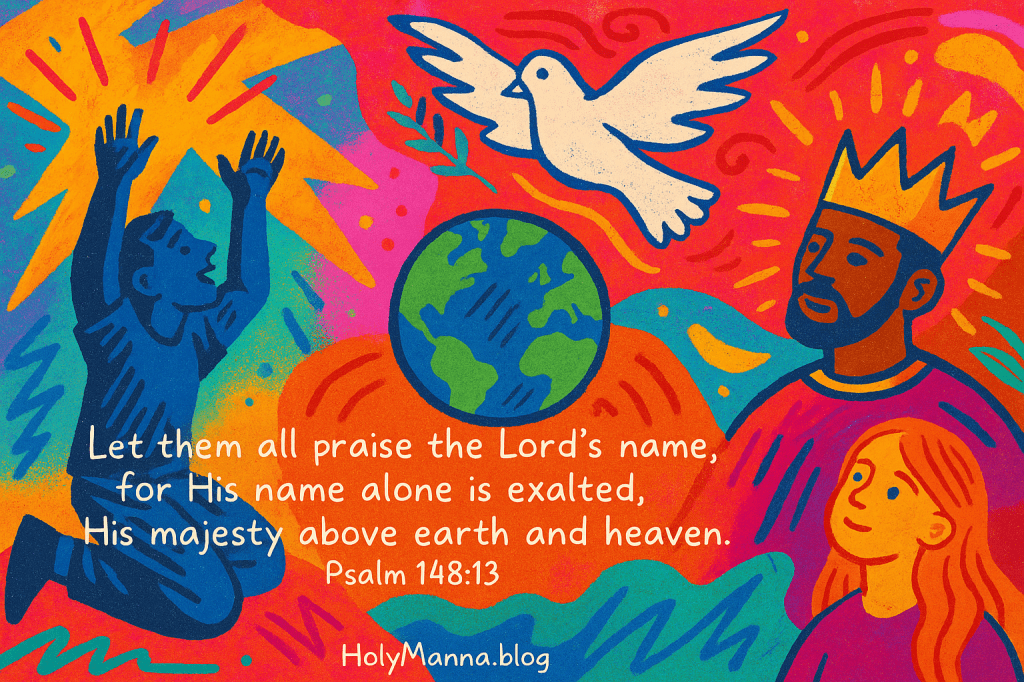
13 Let them all praise the Lord’s name,
for his name alone is exalted,
His majesty above earth and heaven.
14 He has lifted high the horn of his people;
to the praise of all his faithful,
the Israelites, the people near to him.
Hallelujah!
Detailed Exegesis
Verse 1 – “Praise the Lord from the heavens; praise him in the heights.”
The psalm begins with a command directed to the heavenly realm. It reminds us that praise begins not with us, but with the angels and celestial hosts. The heavens, often considered the domain of divine mystery, are already engaged in glorifying God. This line mirrors Revelation 5:11-12, where countless angels praise God around His throne.
Verse 2 – “Praise him, all you his angels; give praise, all you his hosts.”
The angelic orders are directly addressed here, reinforcing the belief in an invisible creation united with the visible in offering glory to God. The Church teaches that angels are servants and messengers of God (see CCC 329), and here they fulfill that role perfectly through continuous praise.
Verse 11 – “Kings of the earth and all peoples, princes and all who govern on earth;”
This verse expands the call to praise to include human authority. No one is exempt—neither the high nor the low. Earthly rulers are reminded of their subordination to divine majesty. In a world where power is often abused, this verse reorients leadership as a form of service before God.
Verse 12 – “Young men and women too, old and young alike.”
Every generation, every gender, every stage of life is summoned to praise. This verse destroys all barriers to worship and reveals that giving glory to God is not just for the “holy” or “religious,” but for every human soul. It resonates with Joel 2:28, which proclaims that God will pour out His Spirit upon all flesh—young and old, male and female.
Verse 13 – “Let them all praise the Lord’s name, for his name alone is exalted, his majesty above earth and heaven.”
This is the central theological point of the psalm: God alone is worthy of exaltation. His name—the fullness of His presence and identity—is lifted above all creation. The phrase “his majesty above earth and heaven” reminds us of God’s transcendence and uniqueness.
Verse 14 – “He has lifted high the horn of his people; to the praise of all his faithful, the Israelites, the people near to him. Hallelujah!”
The “horn” symbolizes strength and victory. God has exalted His people—particularly Israel—as a sign of His covenant love. Yet in the light of the New Testament, this verse points toward Christ, the true “horn of salvation” raised for us (Luke 1:69), through whom the covenant is extended to all who believe.
Teachings of the Church and Saints
The Catechism teaches that “because creation comes from God’s goodness, it shares in that goodness—‘And God saw that it was good… very good’” (CCC 299). Psalm 148 reflects this fundamental truth by calling every element of creation to fulfill its purpose in praising God. This praise is not forced but is the natural response of beings who recognize their dependence on the Creator. The psalm echoes the universal call to holiness, rooted in the order of creation itself.
St. Francis of Assisi famously embodied this psalm in his Canticle of the Creatures, where he addresses Brother Sun, Sister Moon, and even Sister Death with reverent love. His life reminds us that recognizing the sacredness of creation leads us to humility, praise, and solidarity with all beings. In a fragmented world, this cosmic vision is healing and profoundly Catholic.
St. Basil the Great once taught, “A single plant, a blade of grass, is enough to make us praise the Creator” (Hexaemeron). This is the spirituality of Psalm 148: to see the grandeur of God reflected in all things and to respond with gratitude and awe. Whether we are princes or paupers, old or young, praise is the great equalizer and unifier. It aligns our hearts with heaven and reminds us that our lives are not our own—they are a liturgy, meant to glorify God.
Reflection
When was the last time you praised God not for what He has done, but simply for who He is? This psalm invites us into that kind of pure, unfiltered worship—a praise that rises like incense not from circumstances, but from awe. Do we see our daily lives as opportunities to join the song of the angels?
Take time today to offer intentional praise. Step outside and join creation: the wind, the birds, the light. Look at the people around you—young and old, strong and frail—and recognize each as a living psalm. Do you lead others into praise by the way you speak, serve, and love? Let Psalm 148 become your personal prayer, a reminder that your voice is needed in the great symphony of creation. Praise is not optional—it is what you were made for. Hallelujah!
Holy Gospel – John 16:12–15
Guided into Glory: The Spirit Who Reveals All
In these tender words from The Gospel of John, Jesus prepares His disciples for the mystery of the Holy Spirit’s coming. This passage is part of the Farewell Discourse (John 13–17), delivered during the Last Supper. At this moment, Jesus is speaking not to crowds, but intimately to His closest friends, knowing that His Passion is near. John’s Gospel emphasizes the divine identity of Christ and the unity between the Father, Son, and Holy Spirit. Today’s reading perfectly complements our theme of divine revelation in the midst of human searching. Just as Paul pointed the Athenians to the true God and Psalm 148 summoned all creation to praise Him, Jesus now promises the Spirit of truth who will guide believers into all truth. This is not merely knowledge—it is communion with the living God. The Spirit does not speak in isolation, but reveals the depths of Jesus’ identity and mission, bringing clarity and continuity to all that has been said.
John 16:12-15
New American Bible (Revised Edition)
12 “I have much more to tell you, but you cannot bear it now. 13 But when he comes, the Spirit of truth, he will guide you to all truth. He will not speak on his own, but he will speak what he hears, and will declare to you the things that are coming. 14 He will glorify me, because he will take from what is mine and declare it to you. 15 Everything that the Father has is mine; for this reason I told you that he will take from what is mine and declare it to you.
Detailed Exegesis
Verse 12 – “I have much more to tell you, but you cannot bear it now.”
Jesus acknowledges the limitations of the disciples. They are not yet ready to receive the fullness of divine truth. This reflects His mercy and understanding—He does not overwhelm them, but prepares their hearts gradually. It is a reminder that growth in faith is a journey, and that God speaks to us in due time.
Verse 13 – “But when he comes, the Spirit of truth, he will guide you to all truth. He will not speak on his own, but he will speak what he hears, and will declare to you the things that are coming.”
This is a profound promise. The Holy Spirit is not a separate voice, but one in perfect unity with the Father and the Son. His mission is to guide, not to innovate or replace. The Greek word for “guide” (hodēgēsei) implies leading someone on a path they cannot walk alone. The “things that are coming” refer both to the unfolding events of salvation history and the deeper mysteries of the faith that the Spirit will unveil over time through the Church.
Verse 14 – “He will glorify me, because he will take from what is mine and declare it to you.”
The Holy Spirit’s role is not to draw attention to Himself, but to glorify Christ. He takes what belongs to Jesus—the divine truth, the mysteries of the Kingdom—and makes them known to the disciples. This verse affirms the unity of the Trinity: what belongs to the Son also belongs to the Spirit.
Verse 15 – “Everything that the Father has is mine; for this reason I told you that he will take from what is mine and declare it to you.”
This concluding verse anchors the entire passage in the life of the Trinity. The Father, Son, and Holy Spirit are distinct, yet wholly united. The Spirit’s teaching is not new doctrine but the eternal truth of the Father made visible in Christ and brought to fullness in the believer. Here, Jesus unveils the divine economy—how salvation is revealed progressively yet fully within the life of the Church.
Teachings of the Church and Saints
The Catechism teaches that the Holy Spirit is “the interior Master of Christian life” who “leads us to all truth by working in the Church” (CCC 797–798). This Gospel passage is foundational for understanding the Spirit’s role in the development of doctrine and our personal growth in holiness. “By this power of the Spirit, God’s children can bear much fruit. He who has grafted us onto the true vine will make us bear ‘the fruit of the Spirit’” (CCC 736).
St. John Henry Newman’s development of doctrine is rooted in this passage. He explained that truth does not change, but our understanding of it can deepen over time through the guidance of the Holy Spirit. As he wrote, “To live is to change, and to be perfect is to have changed often”—meaning not doctrinal inconsistency, but spiritual maturation under the Spirit’s gentle hand.
St. Gregory of Nazianzus described the Holy Spirit as “the light that shows us the light”, pointing always to Christ. This mirrors today’s Gospel: the Spirit reveals Jesus, not through new revelations outside of Christ, but by drawing the faithful more deeply into the mystery of His life, death, and resurrection. This is how the Spirit continues Christ’s mission, forming saints across centuries and cultures.
Reflection
Have you ever paused to ask the Holy Spirit to guide your thoughts, your day, or your decisions? In a world filled with noise and false claims of truth, Jesus’ promise is a lifeline: “He will guide you to all truth.” But this guidance requires openness. The disciples had to wait, to listen, and to let go of their expectations.
What truths are you resisting because you’re not yet ready to bear them? Are there areas in your life where you’ve silenced the Spirit out of fear, pride, or complacency? Invite the Holy Spirit into those places. Make space for Him in your daily prayer, and trust that He speaks not with confusion, but clarity.
Today, ask for the grace to be guided. Let the Spirit of truth lead you deeper into Scripture, into the sacraments, and into the heart of Christ. Let Him glorify Jesus in you. The Spirit’s voice is not strange or distant. He speaks the words of the Father, revealing the Son. Will you listen? Will you follow?
Let the Spirit Lead You Home
Today’s readings form a sacred symphony of revelation, desire, and divine intimacy. In Acts, we saw St. Paul proclaiming the God who is “not far from any one of us” (Acts 17:27) to a people stumbling in spiritual darkness. In Psalm 148, we joined all creation—angels, kings, children, and elders—in lifting a song of praise to the one whose name is “exalted… above earth and heaven” (Psalm 148:13). And in The Gospel of John, Jesus gently prepares His disciples for what is to come by promising the Holy Spirit, who will “guide you to all truth” (John 16:13), revealing everything that the Father has entrusted to the Son.
The thread that binds these passages is the assurance that our yearning for truth is not in vain. The God we seek has already come near. He is not hidden behind idols or distant stars; He is present in the praise of creation, in the words of the prophets, and in the whispers of the Holy Spirit within our hearts. He is the answer to the unnamed altar we have all built somewhere deep within our souls. And He has a name: Jesus Christ, risen and glorified.
Are you ready to let the Spirit guide you into deeper truth? Today, dare to name the unknown places in your life and invite the Spirit to fill them with the light of Christ. Praise God not only with your lips, but with your life. Speak His name with joy. Share Him with those still searching. And most of all, trust that even now, He is drawing you into the eternal mystery where, “in Him we live and move and have our being” (Acts 17:28).
Engage with Us!
We’d love to hear how God spoke to your heart through today’s readings. The Holy Spirit reveals truth uniquely to each soul, and your insights could bless someone else on their journey. Share your thoughts, questions, or favorite verses in the comments below. Let’s grow together in faith, praise, and truth.
Reflection Questions
First Reading – Acts 17:15, 22—18:1
What “unknown gods” have you placed your trust in without realizing it? How can you, like Paul, use respectful dialogue and truth to share the Gospel with those around you? Are there places in your life where God is calling you to move forward with courage, even if you’re alone?
Responsorial Psalm – Psalm 148:1-2, 11-14
Do you view all of creation—your body, your work, your surroundings—as called to praise the Lord? How can you lead others, especially in your family or community, into a life of praise? What does it mean to you personally that God’s name is “exalted” above all else?
Holy Gospel – John 16:12–15
Are you letting the Holy Spirit guide your thoughts and actions, or are you trying to carry everything on your own? What truths might Jesus be waiting to reveal to you when you are ready to bear them? In what ways can you glorify Jesus today by living out the truths the Spirit has taught you?
May you live each day with a heart open to truth, a spirit lifted in praise, and a will surrendered to the loving guidance of the Holy Spirit. Let everything you do be marked by the love and mercy that Jesus taught us—always seeking, always praising, always proclaiming the God who is not far from any one of us.
Follow us on Instagram and Facebook for more insights and reflections on living a faith-filled life.

 Holy Manna!
Leave a comment