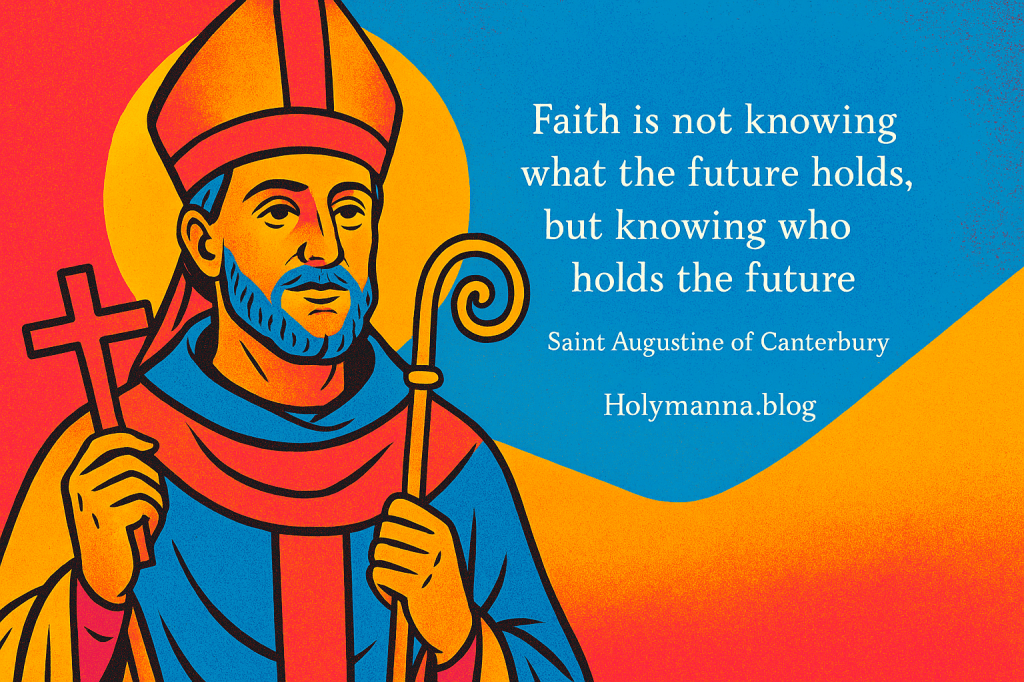
The Flame That Lit a Nation
Saint Augustine of Canterbury stands as one of the most foundational figures in the history of Christianity in England. He was not a martyr drenched in blood nor a wonderworker whose life was filled with dramatic healings. Instead, he was a monk of quiet strength, firm obedience, and unwavering faith, chosen by divine providence to bring the light of Christ to an entire nation. His title as “Apostle to the English” is not just honorary—it is rooted in the actual transformation of Anglo-Saxon England from a land of pagan traditions to a realm shaped by the teachings of Jesus Christ. It is through Augustine’s courage, perseverance, and fidelity to the call of the Holy Spirit that the roots of the Church took hold in British soil, bearing fruit for centuries to come. Sent by one of the greatest popes in Church history—Pope Saint Gregory the Great—Augustine’s mission was a leap into the unknown. What awaited him was not just cultural barriers but the risk of rejection, violence, and failure. And yet, his legacy stands today, immortalized in the very foundations of Canterbury Cathedral, the mother church of English Christianity.
Rome’s Quiet Monk, England’s Reluctant Apostle
Little is known about Augustine’s early life, but what we do know paints the portrait of a humble and obedient servant of God. He was likely born in the late 6th century in Rome, the heart of the Christian world at the time. Augustine entered the Benedictine monastery of Saint Andrew, which had been founded by Pope Gregory I himself. There he lived in obscurity, practicing the monastic rule, praying, studying Scripture, and growing in holiness. It was not ambition that brought Augustine into the pages of Church history—it was obedience.
Pope Gregory, having been moved to compassion by the sight of Anglo-Saxon slaves in the Roman marketplace, felt a strong calling to send missionaries to the distant land of Britain. Augustine, known for his leadership and virtue, was appointed to lead the mission. Initially hesitant and even fearful—so much so that he and his fellow monks considered turning back—Augustine ultimately surrendered his will to that of his pope and spiritual father. What would have happened if he had given in to fear? How often do we let fear keep us from our mission?
Arriving on the shores of Kent in 597, Augustine and his forty companions were greeted not with swords but with curiosity. King Æthelberht, the pagan ruler of Kent, was married to Queen Bertha, a Christian Frankish princess who had already paved the way for Christianity in the court. Through respectful dialogue, holy example, and the evident peace that radiated from these foreign monks, King Æthelberht was eventually baptized by Augustine. This baptism was no small event—it led to the conversion of over 10,000 subjects within that same year. The mass conversions were not the result of pressure or military power but of the witness of a holy life. Pope Gregory quickly sent reinforcements and sacred vessels from Rome, appointing Augustine as the first Archbishop of Canterbury. From there, Augustine laid the structure for the English Church, ordaining bishops, founding monasteries, and securing the future of Christianity in the land.
Conversions and Crosses
While Saint Augustine of Canterbury is not widely known for sensational miracles like levitations or visions, the works of grace accomplished through his hands were nothing short of miraculous. The most awe-inspiring miracle of all was the sweeping conversion of a pagan kingdom—one of the earliest mass conversions in Christian history. Imagine thousands of men, women, and children coming forward to receive baptism, abandoning old gods for the promise of eternal life in Jesus Christ.
According to the Venerable Bede, the historian-monk whose writings preserve much of this history, Augustine entered Canterbury not with warriors but with monks, in a solemn procession, chanting the litany of the saints, holding a silver cross and an image of our Savior. The townspeople, unaccustomed to such reverence and unity, were deeply moved. “They bore the cross of silver and the image of our Lord and Savior painted on a board, and singing the litany, they offered up their prayers to the Lord for their own eternal salvation and for that of those to whom they were come.” (Bede, Ecclesiastical History of the English People).
Though some minor healings are attributed to his prayers, it was the sheer depth of spiritual transformation that marked his mission as miraculous. Augustine’s holiness—his prayerful silence, his dignity, his charity—became the living proof of the Gospel’s power. Isn’t that the kind of miracle our world most desperately needs today? A holiness that speaks louder than words?
Not All Martyrs Bleed
Augustine’s path was not paved in rose petals. Though spared the sword of martyrdom, he suffered trials that tested both his faith and resolve. The first challenge was the very mission itself—a call that took him from the stability of Roman monastic life to the rugged, unknown lands of Anglo-Saxon England. He faced not only linguistic and cultural barriers but also suspicion and resistance from the local Church leaders in Britain, especially from the Celtic bishops who viewed Augustine and his Roman ways with skepticism.
There were political pressures as well. Converting King Æthelberht was a victory, but with it came expectations and complications. Augustine had to balance the purity of the Gospel with the practicalities of governing a newly Christian kingdom. He encountered division, misunderstanding, and at times outright rejection. In a famous meeting with British bishops, Augustine tried to unify the Roman and Celtic practices but failed to win their support.
Yet through it all, he remained firm. He suffered no physical martyrdom, but endured the martyrdom of rejection, misunderstanding, and isolation. His trust in God’s timing, his refusal to retaliate or impose, and his enduring charity make him a model of interior martyrdom—a white martyrdom that the Church so deeply honors.
A Legacy Carved in Stone and Spirit
Saint Augustine of Canterbury died around the year 604, likely in Canterbury, the city he had made his spiritual home. He was buried in the Church of Saints Peter and Paul, which he had helped to build just outside the walls of the city. This church later became known as St. Augustine’s Abbey and quickly turned into a center of pilgrimage and devotion. Miracles were reported at his tomb—healings, conversions, and graces received by those who came in faith.
Though his physical presence was gone, his spiritual impact only grew. The structures he put in place—monasteries, bishoprics, catechetical instruction—endured long after him. The seeds he planted continued to blossom through the lives of saints, scholars, and missionaries who followed in his footsteps. Even the Venerable Bede, writing over a century later, recognized the foundational role Augustine played in England’s salvation.
In 1884, Pope Leo XIII gave formal recognition to this legacy by naming Augustine “Apostle of the English.” Pilgrimages to Canterbury continued for centuries, and even today, relics of the saint inspire devotion among the faithful. Though the cathedral is now Anglican, the Catholic Church still venerates Augustine as one of her greatest missionary bishops. His feast remains a day of deep reflection and gratitude for all that God accomplished through one man’s obedience.
Lessons from the Apostle to the English
Saint Augustine of Canterbury offers a lesson that is both ancient and urgently modern. We live in a time where many hearts have grown cold to the Gospel, where evangelization feels like speaking into the wind. Yet Augustine reminds us that the most powerful way to preach is to live with holiness, peace, and unwavering fidelity to God’s call. He did not come with eloquence or miracles, but with prayer, obedience, and love. And through him, God transformed a nation.
How might our own lives become instruments of such transformation? Are we willing to obey when it’s hard, to evangelize by example, to trust that God can do much through our little?
Whether we are parents, teachers, coworkers, or friends, we each have a mission field—our own Canterbury. May we walk into it with the same humility and courage that led a Roman monk to become the father of English Christianity.
Let us ask for his intercession today, especially for those called to missionary work, and for our own nations, that they too may be brought back to the heart of Christ. As The Catechism of the Catholic Church reminds us, “The desire to evangelize is born of true love.” (CCC 851). May that love fill our hearts, just as it filled the heart of Saint Augustine.
Engage with Us!
We’d love to hear your thoughts. How does Saint Augustine’s missionary journey inspire you? What challenges are you facing that call for humble faith?
Here are 3 questions to reflect on today:
- Have I ever hesitated to do something God was calling me to out of fear? How can I imitate Augustine’s courage and obedience?
- In what ways can I bring the Gospel into the “pagan” corners of my life—work, friendships, or social media?
- What can I learn from Augustine’s example of peaceful evangelization and trust in God’s timing?
Share your thoughts below and let’s grow in faith together. Let’s strive to be missionaries in our own time and place, doing all things with love, as our Lord Jesus did.
Saint Augustine of Canterbury, pray for us! 🔥
Follow us on Instagram and Facebook for more insights and reflections on living a faith-filled life.

 Holy Manna!
Leave a comment