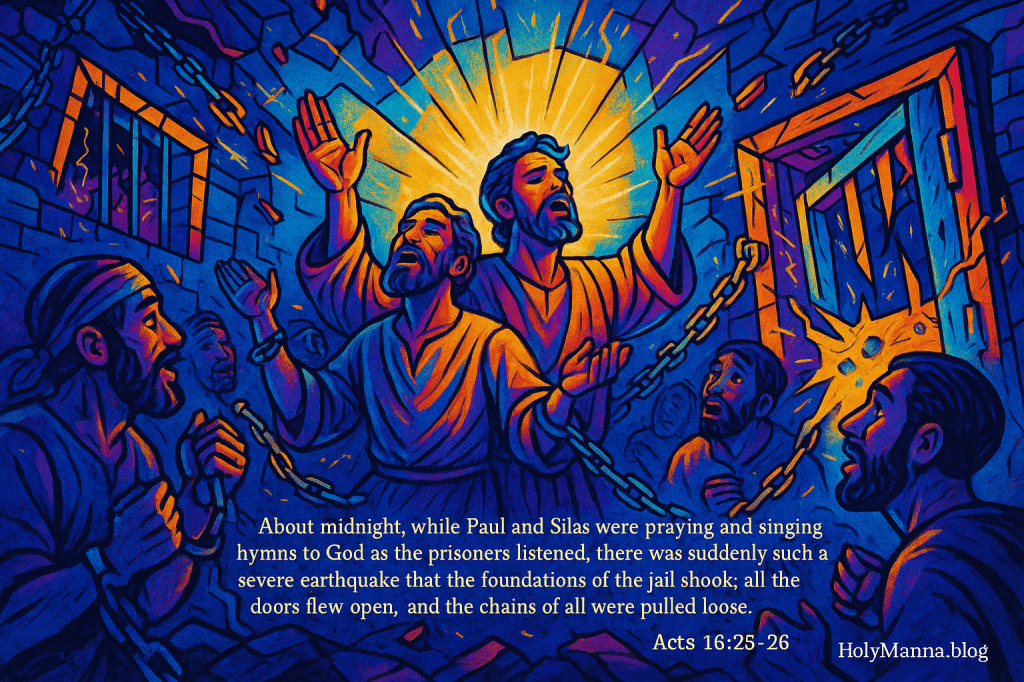
Chains Break, Hearts Awaken
Have you ever found yourself imprisoned by circumstances beyond your control—wounded, waiting, wondering where God is? Today’s readings invite us into that very place: the midnight hour of suffering and mystery, where faith is tested and the Spirit moves most powerfully. Whether it’s Paul and Silas behind bars, the psalmist surrounded by enemies, or the disciples grieving Christ’s departure, each passage brings us face to face with the tension between despair and divine intervention. What if your darkest trial was actually the setting for your deepest transformation?
The central theme weaving through today’s Scriptures is deliverance through faith and the power of the Holy Spirit. In Acts 16, we witness a miraculous jailbreak—not just of chains and prison doors, but of hardened hearts. Paul and Silas, though beaten and imprisoned, choose to sing praises, prompting an earthquake that sets captives free and leads a desperate jailer to ask, “What must I do to be saved?”. The Responsorial Psalm echoes with this same spirit of liberation: “Though I walk in the midst of dangers, you guard my life” (Psalm 138). It’s a song of gratitude from one who has cried out and been answered. Meanwhile, in John 16, Jesus prepares His disciples for His departure, promising that “if I do not go, the Advocate will not come to you”—a bold assurance that His absence will usher in a new, deeper presence through the Holy Spirit.
Historically, Acts 16 unfolds during Paul’s second missionary journey, when the early Church faced intense persecution. Yet it is precisely in these harsh conditions that the Gospel spreads most dramatically. The Roman jailer’s conversion signifies the radical inclusivity of salvation—faith breaking into the heart of the empire. Similarly, Psalm 138, attributed to David, reflects a deep trust in God’s covenant faithfulness amidst political threat and personal danger. Jesus’ farewell discourse in The Gospel of John offers both warning and comfort; He is forming His disciples to walk by faith, not sight, trusting in the Spirit’s power to convict, guide, and sanctify. These readings remind us that God often allows the shaking of our foundations not to destroy us, but to set us free. What prison is He preparing to break open in your life today?
First Reading – Acts 16:22–34
Songs in the Midnight Hour
The Acts of the Apostles is often called the Gospel of the Holy Spirit because it chronicles how the Spirit moved in and through the early Church. Today’s passage drops us into the missionary adventures of Saints Paul and Silas as they face violent persecution in Philippi—a Roman colony in Macedonia. This city, proud of its Roman identity, would have seen Paul’s message as both socially disruptive and politically subversive. The charge against them wasn’t merely religious but rooted in the cultural resistance of Roman citizens to what they viewed as foreign and Jewish customs. In this context, their brutal beating, imprisonment, and miraculous deliverance set the stage for a divine breakthrough. The story we read today is more than an inspiring tale; it’s a profound testament to the unstoppable nature of the Gospel when lived in radical trust. It reflects today’s theme of deliverance through faith and the power of the Holy Spirit, revealing how the Spirit shatters physical chains and softens hardened hearts.
Acts 16:22-34
New American Bible (Revised Edition)
22 The crowd joined in the attack on them, and the magistrates had them stripped and ordered them to be beaten with rods. 23 After inflicting many blows on them, they threw them into prison and instructed the jailer to guard them securely. 24 When he received these instructions, he put them in the innermost cell and secured their feet to a stake.
Deliverance from Prison. 25 About midnight, while Paul and Silas were praying and singing hymns to God as the prisoners listened, 26 there was suddenly such a severe earthquake that the foundations of the jail shook; all the doors flew open, and the chains of all were pulled loose. 27 When the jailer woke up and saw the prison doors wide open, he drew [his] sword and was about to kill himself, thinking that the prisoners had escaped. 28 But Paul shouted out in a loud voice, “Do no harm to yourself; we are all here.” 29 He asked for a light and rushed in and, trembling with fear, he fell down before Paul and Silas. 30 Then he brought them out and said, “Sirs, what must I do to be saved?” 31 And they said, “Believe in the Lord Jesus and you and your household will be saved.” 32 So they spoke the word of the Lord to him and to everyone in his house. 33 He took them in at that hour of the night and bathed their wounds; then he and all his family were baptized at once. 34 He brought them up into his house and provided a meal and with his household rejoiced at having come to faith in God.
Detailed Exegesis
Verse 22 – “The crowd joined in the attack on them, and the magistrates had them stripped and ordered them to be beaten with rods.”
This verse plunges us into the chaos and injustice of mob violence. Paul and Silas are not given a fair trial, reflecting the prejudice of the pagan authorities. Roman beatings with rods were a common punishment and deeply humiliating, especially for Paul, who was himself a Roman citizen (as we find out later in the chapter). Their suffering becomes a participation in Christ’s own Passion, echoing 1 Peter 2:20—“But if you suffer for doing good and endure it, this is a grace before God.”
Verse 23 – “After inflicting many blows on them, they threw them into prison and instructed the jailer to guard them securely.”
The violence intensifies, but so does the foreshadowing of divine intervention. The jailer receives strict orders, reflecting the paranoia and fear surrounding Paul’s perceived threat. Yet the stage is being set: what begins as an attempt to silence the Gospel becomes a setup for salvation.
Verse 24 – “When he received these instructions, he put them in the innermost cell and secured their feet to a stake.”
The innermost cell would have been dark, damp, and guarded. Securing their feet in stocks was meant to ensure they couldn’t escape—but also to increase their suffering. The irony is rich: in trying to bind the apostles, the enemy unwittingly binds himself for a miracle.
Verse 25 – “About midnight, while Paul and Silas were praying and singing hymns to God as the prisoners listened,”
Midnight symbolizes the deepest darkness—and yet, from it springs the greatest light. Their response isn’t despair, but worship. This is a moment of radical faith. They choose to praise, and the prisoners listen—perhaps for the first time encountering a God who brings joy in suffering.
Verse 26 – “There was suddenly such a severe earthquake that the foundations of the jail shook; all the doors flew open, and the chains of all were pulled loose.”
God acts. The earthquake is not just natural—it is supernatural. The imagery evokes Exodus and the shaking of Mount Sinai, reminding us that the same God who delivered Israel now liberates through Christ. The fact that all the doors open and all the chains fall reveals the communal nature of God’s deliverance.
Verse 27 – “When the jailer woke up and saw the prison doors wide open, he drew [his] sword and was about to kill himself, thinking that the prisoners had escaped.”
Roman jailers were held personally responsible for their prisoners. Death was the penalty for escapees under Roman law, so the jailer sees no hope. He prepares for suicide—ironically, the very moment God is preparing his salvation.
Verse 28 – “But Paul shouted out in a loud voice, ‘Do no harm to yourself; we are all here.’”
Paul’s words save the jailer’s life. But more than that, they introduce mercy. Instead of vengeance or escape, Paul offers compassion. This moment is a picture of Christian love—rescuing both physically and spiritually.
Verse 29 – “He asked for a light and rushed in and, trembling with fear, he fell down before Paul and Silas.”
The jailer, once in control, is now humbled. His request for light is symbolic—he is literally and spiritually in the dark, now seeking illumination. His fear is not of punishment, but awe in the face of divine power and mercy.
Verse 30 – “Then he brought them out and said, ‘Sirs, what must I do to be saved?’”
This is the climax. The earthquake, the songs, the mercy—they all lead to this one question. It is the question every human heart must ask. The jailer, a Roman pagan, recognizes the presence of a higher truth and longs for it.
Verse 31 – “And they said, ‘Believe in the Lord Jesus and you and your household will be saved.’”
Paul’s answer is immediate and direct. Faith in Jesus is the doorway to salvation—not only for the individual, but for the whole household, reflecting the communal nature of grace and the Church’s teaching on the domestic Church.
Verse 32 – “So they spoke the word of the Lord to him and to everyone in his house.”
Evangelization happens right there. The Word is proclaimed—not just to the jailer, but to his family. Faith is never a private matter in Scripture; it’s meant to ripple outward.
Verse 33 – “He took them in at that hour of the night and bathed their wounds; then he and all his family were baptized at once.”
Healing and baptism go hand in hand. The man who once chained them now cares for them. Baptism follows immediately, echoing the Church’s understanding that the grace of God, when received in faith, calls for immediate sacramental response (CCC 1226).
Verse 34 – “He brought them up into his house and provided a meal and with his household rejoiced at having come to faith in God.”
The story ends in Eucharistic tones—conversion, table fellowship, and rejoicing. What began in violence ends in joy. This is the full arc of Christian redemption: suffering, deliverance, and shared communion.
Teachings
The Catechism of the Catholic Church teaches that the Holy Spirit is “the master of the interior life,” and that He “opens the minds of the faithful to understand the things of God” (CCC 737). The jailer’s conversion is a perfect example of this interior awakening. The Spirit not only shakes the prison walls, but also the foundations of the man’s heart. The trembling fear that leads to the question, “What must I do to be saved?”, is a sign of the Spirit’s convicting presence (John 16:8), just as Jesus promised in today’s Gospel.
Saint John Chrysostom, commenting on this passage, marveled at how “Paul and Silas convert not merely by preaching but by suffering.” Their joyful witness in the midst of pain reveals the paradox of Christian power: when we are weak, He is strong (2 Corinthians 12:10). This reflects the mystery of redemptive suffering—how God draws souls not in spite of our wounds, but often through them.
Historically, this moment in Philippi is significant as one of the earliest recorded conversions of a Roman official. It illustrates the universal scope of salvation and the beginnings of the Church spreading to the Gentile world. As Pope Benedict XVI once said, “The Church is born from the faith of simple hearts opened by the Holy Spirit.” This Roman jailer, once ready to take his own life, becomes the father of a household Church.
Reflection
In our own lives, we all encounter prisons—sometimes of our own making, sometimes inflicted by others. These can be places of fear, addiction, discouragement, or even just the silence of unanswered prayer. But this passage reminds us that God can still send earthquakes. He can still open prison doors. The key is to respond like Paul and Silas: with worship, trust, and readiness to proclaim the Good News. What chains is God calling you to sing through today? What jailers is He asking you to show mercy to? And most importantly, when someone asks you, “What must I do to be saved?”—will you be ready to answer, not just with words, but with your life?
Responsorial Psalm – Psalm 138:1–3, 7–8
Gratitude in the Midst of Danger
Psalm 138 is a psalm of thanksgiving traditionally attributed to King David. Set against a backdrop of adversity, it reveals a heart that praises God not after deliverance, but in the very presence of enemies. This makes it especially powerful in light of today’s theme: deliverance through faith and the power of the Holy Spirit. The psalmist models unwavering trust in the Lord’s mercy and faithfulness—qualities that transcend earthly threats. This psalm likely arose from a context of military or political danger, common in David’s life, yet its language is deeply spiritual. It speaks of divine response to human prayer, heavenly assistance in times of peril, and God’s enduring commitment to His creation. It pairs beautifully with Paul and Silas’s midnight worship in prison, and with Jesus’ promise in John 16 that the Spirit will come to strengthen His followers. Whether in chains or on a throne, faith finds its strength in praising the name of the Lord.
Psalm 138:1-3, 7-8
New American Bible (Revised Edition)
Hymn of a Grateful Heart
1 Of David.
I thank you, Lord, with all my heart;
in the presence of the angels to you I sing.
2 I bow low toward your holy temple;
I praise your name for your mercy and faithfulness.
For you have exalted over all
your name and your promise.
3 On the day I cried out, you answered;
you strengthened my spirit.
7 Though I walk in the midst of dangers,
you guard my life when my enemies rage.
You stretch out your hand;
your right hand saves me.
8 The Lord is with me to the end.
Lord, your mercy endures forever.
Never forsake the work of your hands!
Detailed Exegesis
Verse 1 – “I thank you, Lord, with all my heart; in the presence of the angels to you I sing.”
This opening verse expresses full-hearted gratitude. The Hebrew word used here for “heart” implies the seat of will and intention—not merely emotion. Praising God “in the presence of the angels” shows awareness of the heavenly liturgy. Earthly worship is not isolated—it joins the eternal praise before the throne of God, as described in Revelation 4. This is a bold and public declaration of faith, mirroring how Paul and Silas sang in prison.
Verse 2 – “I bow low toward your holy temple; I praise your name for your mercy and faithfulness. For you have exalted over all your name and your promise.”
Here, the psalmist physically expresses humility, bowing toward the temple—a sign of reverence and covenantal worship. “Name” and “promise” are deeply loaded terms. God’s name represents His very being; His promise recalls the covenant. To exalt His name and promise means to declare His Word as supreme and trustworthy. It echoes Isaiah 55:11: “So shall my word be that goes forth from my mouth; it shall not return to me void.”
Verse 3 – “On the day I cried out, you answered; you strengthened my spirit.”
This verse shifts from proclamation to testimony. God not only hears but responds—His answer comes in the form of interior strength. This spiritual fortitude is not circumstantial but relational. As with the jailer who found hope through Paul’s voice in the darkness, the soul finds strength through God’s presence.
Verse 7 – “Though I walk in the midst of dangers, you guard my life when my enemies rage. You stretch out your hand; your right hand saves me.”
This is a vivid image of divine intervention. To walk “in the midst of dangers” evokes Psalm 23’s valley of death. Yet God does not remove all danger—He guards life through it. His “right hand” is a common biblical symbol of power and deliverance (Exodus 15:6). This verse proclaims the same confidence Paul must have felt even with his feet in stocks.
Verse 8 – “The Lord is with me to the end. Lord, your mercy endures forever. Never forsake the work of your hands!”
The final verse is both a declaration and a plea. “To the end” affirms God’s ongoing presence; “mercy endures forever” anchors the prayer in covenant love (hesed in Hebrew). The request—“Never forsake the work of your hands”—shows trust and humility, acknowledging that we are God’s creation and He will not abandon what He has lovingly made.
Teachings
The Catechism of the Catholic Church teaches that prayer of thanksgiving is one of the essential forms of Christian prayer: “Thanksgiving characterizes the prayer of the Church which, in celebrating the Eucharist, reveals and becomes more fully what she is” (CCC 2637). In Psalm 138, David exemplifies this spirit of thanksgiving not in comfort, but in crisis. This teaches us that gratitude is not the fruit of favorable circumstances but the fruit of faith. The psalmist’s heart is fixed on God’s unchanging nature, not on changing outcomes.
Saint Augustine beautifully commented on this psalm, saying, “Let us praise God in the presence of the angels, because the angels praise Him and desire that we, too, praise Him” (Enarrationes in Psalmos). Augustine saw the unity between heaven and earth in our worship—something echoed in the Mass, when we proclaim, “with angels and archangels… we sing the hymn of your glory.” Psalm 138 is therefore a liturgical invitation to align our hearts with the eternal praise of God’s mercy and truth.
Historically, this psalm would have been prayed by the Israelites in times of both personal and national danger. It was not abstract; it was forged in real distress. The faith that sustains the psalmist is not a passive optimism, but a battle-tested conviction that God’s covenant love—His chesed—is more enduring than any threat. It reminds us that even in exile, even in persecution, Israel could sing. And so can we. As Saint Paul later wrote, “Give thanks in all circumstances; for this is the will of God for you in Christ Jesus” (1 Thessalonians 5:18).
Reflection
When you feel surrounded by stress, anxiety, or spiritual dryness, do you lift your voice in thanks? Psalm 138 challenges us to cultivate a spirit of praise not just after the storm, but in the middle of it. It teaches us to orient our hearts toward heaven, to pray with angels, to sing even when surrounded by enemies. In the words of the psalmist, “On the day I cried out, you answered”—have you cried out lately, or are you holding it in? Do you trust that He will stretch out His hand and save you? Today, take time to bow your heart, recall His promises, and give thanks. What would happen if your prayer today was not “get me out,” but “thank You for being with me in it”?
Holy Gospel – John 16:5–11
The Hidden Gift of Departure
This passage from The Gospel of John forms part of Jesus’ Farewell Discourse—the long and deeply intimate dialogue He shares with His disciples on the night before His Passion. Historically and spiritually, this moment captures the turning point of salvation history. Jesus prepares to leave them, not to abandon them, but to transition their relationship with Him into something even deeper and more mystical: life in the Spirit. In the context of Jewish thought, the idea of an Advocate (Paraklētos in Greek) was radical—someone who not only intercedes but dwells within. Jesus’ promise of the Holy Spirit reveals the coming shift from the physical to the spiritual, from external observance to internal transformation. This Gospel fits seamlessly with today’s theme of deliverance through faith and the power of the Holy Spirit. Just as Paul and Silas were sustained and led by the Spirit, so too must the disciples be prepared to receive this divine gift—one that brings conviction, justice, and truth, even in sorrow.
John 16:5-11
New American Bible (Revised Edition)
5 But now I am going to the one who sent me, and not one of you asks me, ‘Where are you going?’ 6 But because I told you this, grief has filled your hearts. 7 But I tell you the truth, it is better for you that I go. For if I do not go, the Advocate will not come to you. But if I go, I will send him to you. 8 And when he comes he will convict the world in regard to sin and righteousness and condemnation: 9 sin, because they do not believe in me; 10 righteousness, because I am going to the Father and you will no longer see me; 11 condemnation, because the ruler of this world has been condemned.
Detailed Exegesis
Verse 5 – “But now I am going to the one who sent me, and not one of you asks me, ‘Where are you going?’”
Jesus opens with a sorrowful observation. Though He has told them repeatedly of His impending return to the Father, the disciples are fixated on their own loss. Their failure to ask where He is going reveals their grief and confusion. This verse subtly confronts the human tendency to focus on suffering rather than divine purpose. Jesus points them back to the Father—to the bigger picture of redemptive mission.
Verse 6 – “But because I told you this, grief has filled your hearts.”
This verse expresses Jesus’ tender awareness of their emotional state. He does not rebuke their sorrow; He names it. There is deep comfort in knowing that our Lord sees our sadness and meets us there. Yet, the Gospel also reminds us that sorrow is not the end—it is often the soil in which greater faith grows.
Verse 7 – “But I tell you the truth, it is better for you that I go. For if I do not go, the Advocate will not come to you. But if I go, I will send him to you.”
This is the heart of the passage. Jesus presents a paradox: His leaving is necessary for something greater. The Advocate—the Holy Spirit—will not come unless He departs. Why? Because Jesus’ glorification through the Cross and Resurrection prepares the way for the Spirit to dwell in believers. The Spirit is not a consolation prize but the fulfillment of Christ’s work. As CCC 729 states, “Only when the hour has arrived for his glorification does Jesus promise the coming of the Holy Spirit, since his Death and Resurrection will fulfill the promise made to the Fathers.”
Verse 8 – “And when he comes he will convict the world in regard to sin and righteousness and condemnation:”
The Spirit’s mission is to unveil truth—not just comfort but clarity. The Greek word for “convict” (elenxei) implies a persuasive exposure of reality. The Spirit’s role is not merely emotional or mystical—it is judicial and revelatory. This aligns with the Church’s teaching that the Spirit is “the interior teacher” who leads believers into all truth (CCC 797).
Verse 9 – “Sin, because they do not believe in me;”
Unbelief is the root of sin. This is a piercing statement. Sin is not just moral failure—it is rejection of the One who is Truth. Faith in Jesus is not an optional virtue; it is the foundational response to God’s self-revelation. The Spirit’s first act is to confront the world with this truth.
Verse 10 – “Righteousness, because I am going to the Father and you will no longer see me;”
Jesus’ return to the Father validates His righteousness. His absence is not a loss but a confirmation of His divine identity. The Spirit helps us perceive this spiritual reality—that Jesus’ departure is not defeat but enthronement. Righteousness is now measured not by law but by Christ, and the Spirit reveals this standard.
Verse 11 – “Condemnation, because the ruler of this world has been condemned.”
Satan, the deceiver and accuser, has been judged. This is a cosmic declaration of victory. The Spirit testifies to the fact that evil no longer has the final word. The Cross did not just atone for sin—it disarmed the powers of darkness (Colossians 2:15). The Spirit comes to proclaim and apply this victory in the lives of believers.
Teachings
The Catechism of the Catholic Church explains the indispensable role of the Holy Spirit in the life of the Church and the believer. CCC 684 says, “Through his grace, the Holy Spirit is the first to awaken faith in us and to communicate to us the new life, which is to ‘know the Father and the one whom he has sent, Jesus Christ.’” Without the Spirit, we cannot even begin the journey of salvation. Jesus’ promise of the Advocate is not abstract; it is the personal outpouring of divine life into our souls.
Saint Cyril of Jerusalem wrote, “The Holy Spirit comes gently and makes himself known by his fragrance. He is not felt as a burden, for he is light, very light. Rays of light and knowledge go before him.” This beautifully complements today’s Gospel, where Jesus speaks not of loss but of gift. The Spirit is gentle, yet powerful—He convicts without crushing, reveals without overwhelming. His mission is to glorify Christ and bring us into communion with the Father.
Historically, the promise of the Advocate was fulfilled at Pentecost, when the Holy Spirit descended upon the apostles with fire and wind (Acts 2). From that moment, fear turned into boldness, and the Gospel spread like wildfire. Jesus’ words in John 16 anticipate that day. The apostles needed to be emptied of self-reliance and filled with divine power. The same holds true for us today. The Spirit does not come to decorate our lives, but to transform them from within.
Reflection
Are you willing to let go of what is familiar so that God can give you what is greater? So often we cling to the visible, the tangible, the comfortable—yet Jesus tells us it is better for us that He goes. What is He asking you to release so that the Advocate can come in fullness? The Spirit wants to convict—not to shame you, but to awaken you. He wants to show you the truth about your sin, but also the beauty of righteousness and the finality of evil’s defeat. Will you invite Him into your heart today, not just as a comforter, but as a guide into truth? Let this be the moment you stop resisting the Advocate and start listening to Him. How is the Spirit already stirring in your life, and how can you respond with faith, like the disciples did on Pentecost?
When Chains Fall and Spirits Rise
Today’s readings draw us into a divine pattern: suffering, surrender, and supernatural grace. In Acts 16, we watched prison walls tremble and chains fall as Paul and Silas turned their agony into worship. In Psalm 138, we joined David in giving thanks even while surrounded by dangers, confident in God’s enduring mercy. And in John 16, we heard Jesus Himself prepare our hearts for the gift of the Holy Spirit—an Advocate who comes to convict, to console, and to lead us into all truth. Across all three passages, we see one powerful truth: God delivers those who trust Him—not always by removing the storm, but by meeting us within it.
Whether you feel imprisoned by external circumstances or held captive by fear, doubt, or sin, today’s Word reminds you that God has not forsaken the work of His hands. The midnight hour may seem silent, but heaven is moving. The same Spirit who opened prison doors and emboldened apostles wants to dwell in you. Will you welcome Him today? Will you praise even before the chains fall, trusting that your worship is a weapon, your cry is heard, and your soul is not alone?
Let this be your call to action: open your heart to the Holy Spirit. Invite Him into the locked rooms of your life. Praise God in the midst of your battles. Trust in the Advocate who convicts not to condemn, but to heal. And when someone around you asks, “What must I do to be saved?”, be ready to respond—through your words, your witness, and your unwavering joy. This is the faith that shakes foundations. This is the praise that breaks chains. This is the life we are called to live in Christ.
Engage with Us!
We’d love to hear how today’s readings moved your heart. How did the Holy Spirit speak to you through the Word? Share your reflections in the comments below so that we can grow together as a community of faith. Whether it’s a moment of insight, a personal connection, or a simple prayer, your voice matters and may bless someone else.
Reflection Questions
First Reading – Acts 16:22–34:
When have you experienced God’s presence most clearly during a time of suffering or confinement? What “chains” in your life might the Lord be asking you to praise through today? How can your witness—especially in hardship—help lead others to ask, “What must I do to be saved?”
Responsorial Psalm – Psalm 138:1–3, 7–8:
What does it mean for you to give thanks in the presence of angels? Can you name a moment when God strengthened your spirit after you cried out to Him? How might daily gratitude deepen your trust in God’s enduring mercy?
Holy Gospel – John 16:5–11:
What is Jesus asking you to let go of so the Advocate can come more fully into your life? How has the Holy Spirit convicted you—gently or powerfully—toward truth and healing? Are you open to the Spirit not just as a comforter, but as a transforming presence in your heart?
Go forth today with confidence in God’s mercy. May your heart be open to the Holy Spirit, your lips ready to praise in all circumstances, and your life be a living testimony to the love and freedom Jesus has given us. Let every step you take echo His truth, and may all you do be done with the love and mercy that our Lord taught us.
Follow us on Instagram and Facebook for more insights and reflections on living a faith-filled life.

 Holy Manna!
Leave a comment