Hearts Opened, Truth Proclaimed
Have you ever had your heart suddenly opened—by a word, a moment, or a person—and known, without a doubt, that God was speaking to you? Today’s readings lead us into the mysterious and beautiful work of the Holy Spirit, who moves unseen through history, cultures, and hearts, always guiding us to Christ. Whether it’s Lydia by the riverside, the joyful faithful praising God with tambourines, or Jesus warning His disciples of coming trials, the Spirit is present in every moment—opening, empowering, and sending forth.
The central thread tying these readings together is the divine initiative of the Holy Spirit to open hearts and empower testimony. In Acts 16, we encounter Lydia, a businesswoman in Philippi, whose heart is opened by the Lord to receive the Gospel from Paul—a moment that marks the Church’s entry into Europe. This is no small detail. Philippi was a Roman colony steeped in imperial pride and pagan practices, yet it is here, by a quiet riverbank, that the Spirit begins to claim territory for the Kingdom. Psalm 149 bursts forth with praise for this victory of God in His people: “The Lord takes delight in his people, honors the poor with victory”. It reminds us that divine glory is not reserved for palaces or power, but for the humble who let God move through them.
Finally, in The Gospel of John, Jesus promises the coming of the Advocate, the Holy Spirit, who will not only defend but also embolden the disciples to testify amid rejection and persecution. He tells them these things ahead of time—not to discourage, but to strengthen: “I have told you this so that you may not fall away”. This is the same Spirit that opened Lydia’s heart and fills the psalmist’s song. The invitation today is clear: Will we allow our hearts to be opened anew by the Spirit, even in unexpected places or painful trials? Will we dare to praise and proclaim, no matter the cost?
First Reading – Acts 16:11–15
Where the River Meets the Heart
The Acts of the Apostles is often called the Gospel of the Holy Spirit. Written by St. Luke, it documents the missionary journey of the early Church and the spread of the Gospel from Jerusalem to the ends of the earth. Today’s passage brings us to Philippi, a leading city in the Roman province of Macedonia—present-day northern Greece. It is the first recorded moment of Christian evangelization in Europe. This is monumental: the Gospel crosses into a new continent not through a grand temple or royal court, but beside a quiet river, where a group of women had gathered for prayer. Lydia, a Gentile businesswoman, becomes the first European convert, showing us that the Spirit blows where it wills, often beginning the greatest movements of God in the humblest of places. Her story is a powerful witness to today’s theme: hearts opened and truth proclaimed through the Spirit.
Acts 16:11-15
New American Bible (Revised Edition)
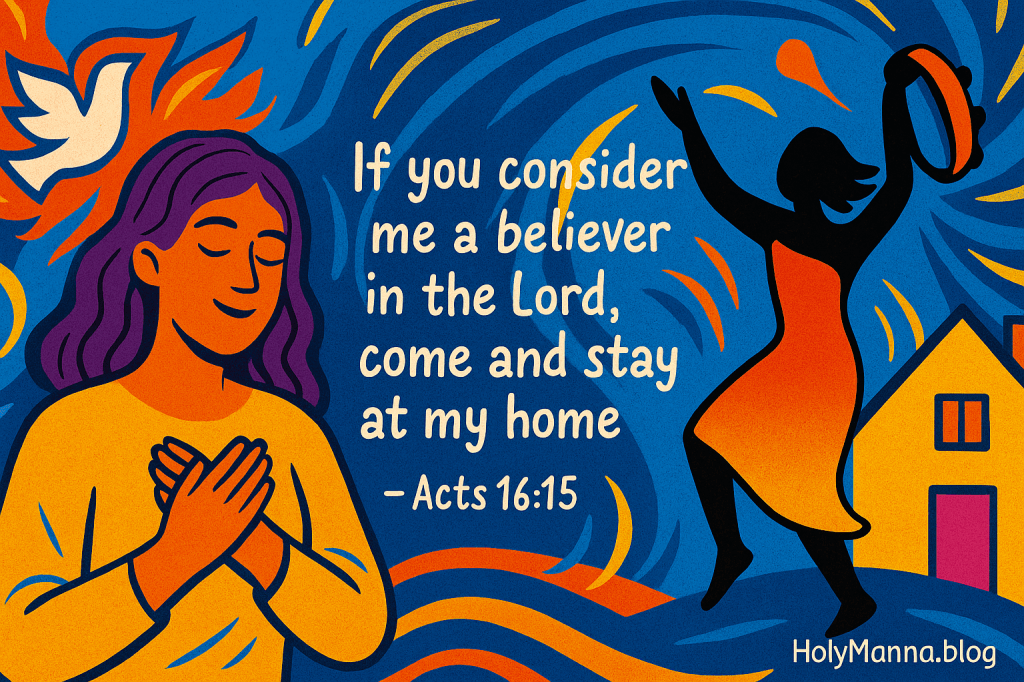
Into Europe. 11 We set sail from Troas, making a straight run for Samothrace, and on the next day to Neapolis, 12 and from there to Philippi, a leading city in that district of Macedonia and a Roman colony. We spent some time in that city. 13 On the sabbath we went outside the city gate along the river where we thought there would be a place of prayer. We sat and spoke with the women who had gathered there. 14 One of them, a woman named Lydia, a dealer in purple cloth, from the city of Thyatira, a worshiper of God,[b] listened, and the Lord opened her heart to pay attention to what Paul was saying. 15 After she and her household had been baptized, she offered us an invitation, “If you consider me a believer in the Lord, come and stay at my home,” and she prevailed on us.
Detailed Exegesis
Verse 11 – “We set sail from Troas, making a straight run for Samothrace, and on the next day to Neapolis”
This verse details the beginning of Paul’s journey into Europe. Troas was a significant port city in Asia Minor, and the straight route to Samothrace—a mountainous island—suggests favorable winds, perhaps symbolizing divine favor. The swiftness of this journey indicates the urgency and clarity of their mission, guided by the Holy Spirit.
Verse 12 – “And from there to Philippi, a leading city in that district of Macedonia and a Roman colony. We spent some time in that city.”
Philippi was not only an important city; it was a Roman colony, meaning it was governed by Roman law and often populated by retired Roman soldiers. This setting would have carried the weight of imperial pride and pagan customs. Paul’s presence there as a Jewish Christian would have been culturally provocative, yet it is here that God chooses to sow seeds of faith. This verse introduces the setting as a contrast to the quiet, faithful hearts that will receive the Gospel.
Verse 13 – “On the sabbath we went outside the city gate along the river where we thought there would be a place of prayer. We sat and spoke with the women who had gathered there.”
Paul and his companions seek a place of prayer, possibly because Philippi had no synagogue. Jewish tradition often required ten men to form a synagogue, so the absence of one suggests a small Jewish population. Instead, they find faithful women gathered by the river—an echo of Moses being drawn from the Nile, and now, a new birth of faith begins. The setting is deeply symbolic: water, prayer, and openness.
Verse 14 – “One of them, a woman named Lydia, a dealer in purple cloth, from the city of Thyatira, a worshiper of God, listened, and the Lord opened her heart to pay attention to what Paul was saying.”
Lydia is a remarkable figure: economically independent, socially respected (as a dealer in purple, a luxury item), and spiritually seeking. She is described as a “worshiper of God,” meaning she was a Gentile who revered the God of Israel but had not fully converted. The key line is “the Lord opened her heart”—a testament to grace. Conversion is never solely the result of human persuasion but divine initiative.
Verse 15 – “After she and her household had been baptized, she offered us an invitation, ‘If you consider me a believer in the Lord, come and stay at my home,’ and she prevailed on us.”
Lydia’s response is immediate and total. She and her household are baptized, indicating not only personal faith but communal transformation. Her hospitality is the fruit of her conversion. Just as Abraham welcomed angels, Lydia now welcomes apostles of Christ. The phrase “she prevailed on us” shows her persistence—not for her sake, but for the sake of the mission.
Teachings
The Catechism of the Catholic Church teaches that the Church is missionary by nature because it is sent by Christ and animated by the Holy Spirit. “The Holy Spirit is the protagonist, ‘the principal agent of the whole of the Church’s mission’” (CCC 852). Lydia’s story reflects this truth: it is the Spirit who draws her to the riverside, opens her heart, and prompts her generous response. Like Mary at the Annunciation, Lydia says yes to the divine call, embodying the Church’s earliest mission in Europe.
St. John Chrysostom praised Lydia’s example, noting, “Though a woman and a foreigner, she shows greater zeal than men”. Her immediate hospitality and leadership in her household make her a kind of matriarch of the European Church. The Fathers recognized her as proof that the Spirit’s work transcends boundaries of gender, class, and ethnicity—uniting all in the body of Christ. The witness of her faith echoes the early Church’s conviction that the Spirit is poured out upon all flesh (cf. Joel 2:28, Acts 2:17).
Historically, Philippi became a flourishing Christian community, later receiving one of Paul’s most tender epistles: The Letter to the Philippians. The roots of that Church trace back to this moment by the river. This reminds us that great Christian legacies often begin with the simple faith of one person whose heart was opened by grace and who said yes. Lydia’s story is also a reminder of the Church’s earliest multicultural roots—a Gentile convert leading her household to Christ in a Roman colony is a striking image of the Church as Catholic, universal, and Spirit-driven.
Reflection
The story of Lydia invites us to examine our own hearts: Are we open to divine interruptions, to moments of unexpected evangelization, to offering our homes and our hearts to Christ and His messengers? Like Lydia, we may find ourselves beside rivers we did not plan to visit, only to discover that God has been waiting for us there. In our daily lives, we can emulate her by making space for prayer, listening attentively to God’s word, and offering concrete acts of hospitality to those around us. Will you let the Lord open your heart today—and will you let Him make it a home for others, too?
Responsorial Psalm – Psalm 149:1–6, 9
Praise That Wields Power
The Book of Psalms is the heart of Israel’s prayer life—a sacred collection of songs and poetry that speak to every human emotion and experience in relation to God. Psalm 149 is one of the final psalms, forming part of the “Hallelujah Psalms” that close the Psalter. Its exuberant tone celebrates the joy of God’s people and their participation in divine victory. This psalm was likely sung during liturgical processions or festivals and reflects the spiritual mindset of a people who knew that worship was both their identity and their weapon. In the context of today’s readings, it complements the First Reading from Acts 16 and the Gospel of John by illustrating what happens when the Spirit opens hearts: joy overflows, praise rises, and God’s faithful take their place in His plan—not as passive recipients, but as empowered witnesses.
Psalm 149:1-6, 9
New American Bible (Revised Edition)
Praise God with Song and Sword
1 Hallelujah!
Sing to the Lord a new song,
his praise in the assembly of the faithful.
2 Let Israel be glad in its maker,
the people of Zion rejoice in their king.
3 Let them praise his name in dance,
make music with tambourine and lyre.
4 For the Lord takes delight in his people,
honors the poor with victory.
5 Let the faithful rejoice in their glory,
cry out for joy on their couches,
6 With the praise of God in their mouths,
and a two-edged sword in their hands,
9 To execute the judgments decreed for them—
such is the glory of all God’s faithful.
Hallelujah!
Detailed Exegesis
Verse 1 – “Hallelujah! Sing to the Lord a new song, his praise in the assembly of the faithful.”
This call to praise invites the faithful to respond with a “new song,” a phrase often used in Scripture to signify fresh revelation or divine intervention. The “assembly of the faithful” refers to the ḥasidim, the devout ones committed to covenant faithfulness. This verse reminds us that praise is communal and ever-renewing—our song must grow as God continues to act in new ways.
Verse 2 – “Let Israel be glad in its maker, the people of Zion rejoice in their king.”
This verse names God as both Creator (“maker”) and King. It acknowledges His authority over all aspects of life. In rejoicing in God as King, Israel confesses that their identity and protection come not from political alliances or military might, but from the Lord Himself. This aligns beautifully with Lydia’s story—her conversion was not merely personal, but a submission to the Kingship of Christ.
Verse 3 – “Let them praise his name in dance, make music with tambourine and lyre.”
Here we see an embodied form of worship—praise expressed with movement and instruments. This joyful praise reflects the holistic nature of biblical worship: body and soul united in glorifying God. It also underscores the joy that comes when the Spirit moves, as seen in the early Church’s spontaneous acts of praise and unity.
Verse 4 – “For the Lord takes delight in his people, honors the poor with victory.”
This is one of the most intimate lines in the psalm. The idea that God “delights” in His people is deeply comforting. He is not a distant deity but a loving Father who honors the lowly and grants victory to the humble. It echoes Mary’s Magnificat in Luke 1, where God is praised for lifting up the lowly. Lydia, a woman of faith and hospitality, becomes a reflection of this divine preference.
Verse 5 – “Let the faithful rejoice in their glory, cry out for joy on their couches.”
The reference to “couches” suggests a domestic setting—perhaps even rest or intimacy. Worship, then, is not confined to temple walls but extends into everyday life. Rejoicing in one’s “glory” refers to the honor of being God’s chosen people. This verse hints at the peaceful confidence that comes from knowing one’s place in God’s plan.
Verse 6 – “With the praise of God in their mouths, and a two-edged sword in their hands”
A dramatic image, this verse unites praise and spiritual power. The “two-edged sword” can be understood spiritually, much like in Hebrews 4:12: “Indeed, the word of God is living and effective, sharper than any two-edged sword.” This verse signifies that praise and God’s Word are weapons in the hands of the faithful—tools for advancing the Kingdom and resisting evil.
Verse 9 – “To execute the judgments decreed for them—such is the glory of all God’s faithful. Hallelujah!”
This concluding verse affirms that God’s faithful participate in His divine justice. It’s not about human vengeance, but about aligning with God’s will and establishing His order on earth. The “glory” here is not worldly fame but spiritual authority—living in communion with the truth and participating in God’s redemptive work.
Teachings
The Catechism of the Catholic Church teaches that praise is the form of prayer that recognizes most immediately that God is God: “It lauds God for His own sake and gives Him glory, quite beyond what He does, but simply because HE IS” (CCC 2639). This pure form of worship is what Psalm 149 calls us into. It is the song of those who know they are chosen, loved, and sent.
St. Augustine comments on this psalm, saying: “This praise is not with lips alone but with life itself. The sword in their hands is the sharpness of the word that cuts through sin and leads to truth.” Augustine recognizes that true praise must be lived, not just spoken. It becomes a light that shines in darkness and a strength that confronts evil—not through violence, but through the spiritual authority given to God’s faithful.
Historically, this psalm was beloved in the liturgies of Israel and early Christianity alike. Its imagery inspired early monastic traditions that saw spiritual warfare and worship as two sides of the same coin. It speaks especially to Christians in times of persecution or marginalization: even when the world resists the truth, the praise of God continues to shake the heavens and bring about His justice.
Reflection
This psalm invites us to become a people of praise and power. Do we praise God only when things go well, or do we declare His goodness with tambourines and swords in hand—joy and truth together? In our world today, where many are afraid to speak the truth or feel unequipped for spiritual battles, this psalm reminds us that the Spirit equips us with everything we need. Our “new song” may be a prayer whispered in suffering, a word of encouragement to someone lost, or the peaceful witness of someone whose heart, like Lydia’s, has been opened. What song will you sing today—and will you let your praise become a sword of truth in God’s hands?
Holy Gospel – John 15:26–16:4
Testify with Truth and Fire
The Gospel of John is distinct among the four Gospels for its deeply theological tone and emphasis on the divinity of Christ. Today’s passage comes from the Farewell Discourse, chapters 13–17, where Jesus prepares His disciples for His departure, the coming trials, and the gift of the Holy Spirit. Culturally and religiously, this was a pivotal moment for the apostles—they were still expecting a Messianic kingdom of power, and Jesus instead speaks of persecution, witness, and the mysterious Advocate. These words would remain etched in their hearts as they faced rejection, exile, and martyrdom. Within today’s theme, this Gospel seals the message: it is the Holy Spirit who opens hearts, empowers testimony, and strengthens the faithful in the face of hatred and misunderstanding.
John 15:26-16:4
New American Bible (Revised Edition)
15:26 “When the Advocate comes whom I will send you from the Father, the Spirit of truth that proceeds from the Father, he will testify to me. 27 And you also testify, because you have been with me from the beginning.
16:1 “I have told you this so that you may not fall away. 2 They will expel you from the synagogues; in fact, the hour is coming when everyone who kills you will think he is offering worship to God. 3 They will do this because they have not known either the Father or me. 4 I have told you this so that when their hour comes you may remember that I told you.
Jesus’ Departure; Coming of the Advocate. “I did not tell you this from the beginning, because I was with you.
Detailed Exegesis
Verse 26 – “When the Advocate comes whom I will send you from the Father, the Spirit of truth that proceeds from the Father, he will testify to me.”
Jesus introduces the Advocate (Paraklētos in Greek), a term meaning counselor, helper, or one who stands by. This is the Holy Spirit, the third Person of the Trinity, who will continue the work of Christ after His ascension. He is the “Spirit of truth,” proceeding eternally from the Father, as the Church professes in the Creed. This verse underlines the Trinitarian mission: the Spirit is sent by the Son, from the Father, and His mission is to testify to Christ. This is foundational for understanding how the Church, like Lydia, is born and sustained through divine initiative.
Verse 27 – “And you also testify, because you have been with me from the beginning.”
The disciples are called to bear witness—not as outsiders, but as those who have walked with Jesus, heard His words, and seen His works. Their testimony will be rooted in personal encounter. This verse links their future mission to their past experience. Like the Apostles, every Christian is called to witness from their encounter with Christ. The Holy Spirit does not replace their voice; He empowers it.
Verse 1 – “I have told you this so that you may not fall away.”
Jesus speaks with pastoral tenderness. The Greek word used here for “fall away” is skandalisthēte, meaning to stumble or be scandalized. Forewarned is forearmed. By telling them of the persecution to come, He is giving them a spiritual anchor. This verse reminds us that the life of faith is not without trial, but with divine preparation, we can remain rooted.
Verse 2 – “They will expel you from the synagogues; in fact, the hour is coming when everyone who kills you will think he is offering worship to God.”
This chilling prophecy came true quickly in the life of the early Church. Expulsion from the synagogue meant losing one’s place in the religious and social life of the Jewish community. Worse yet, religious violence would be committed in God’s name. Saul of Tarsus, before becoming Paul, embodied this exact warning. Jesus exposes the danger of religiosity without relationship—a zeal not enlightened by the Spirit of truth.
Verse 3 – “They will do this because they have not known either the Father or me.”
Jesus diagnoses the root of the persecution: ignorance of God. This verse mirrors John 17:3—“Now this is eternal life, that they should know you, the only true God, and the one whom you sent, Jesus Christ.” True knowledge of God is relational, not merely doctrinal. Those who persecute do so thinking they are defending truth, yet they have missed the very presence of Truth incarnate.
Verse 4 – “I have told you this so that when their hour comes you may remember that I told you. I did not tell you this from the beginning, because I was with you.”
Jesus again comforts His disciples by preparing them. The “hour” refers to a divinely permitted season of trial. He had not spoken of these things earlier because His physical presence was their protection. Now, as He prepares to return to the Father, He equips them with memory and prophecy—a spiritual compass for dark times.
Teachings
The Catechism of the Catholic Church teaches that the Holy Spirit is the one who “makes present the mystery of Christ” and that “When the Father sends his Word, he always sends his Breath. In their joint mission, the Son and the Holy Spirit are distinct but inseparable” (CCC 689). This Gospel passage reflects that joint mission perfectly: the Spirit will continue to make Jesus known, even after His ascension, through the living witness of the Church.
Pope St. John Paul II wrote powerfully about the Holy Spirit as the source of strength for Christian testimony: “The Holy Spirit enables the disciples and the Church to bear witness to Christ with courage, clarity and love, even in the face of misunderstanding and persecution” (Dominum et Vivificantem, 25). The Spirit is not a distant force but an intimate companion, giving voice to our faith in hostile environments. He turns human fear into divine boldness.
In the early Church, this teaching was not merely abstract—it was lived. St. Stephen, the first martyr, spoke by the power of the Holy Spirit even as stones crushed his body. St. Ignatius of Antioch wrote on his way to martyrdom, “Now I begin to be a disciple… let me become the food of the beasts, through whom it will be granted me to reach God”. These saints fulfilled today’s Gospel: they remembered Jesus’ words, and they testified, even unto death.
Reflection
Jesus’ words today are as urgent and tender now as they were then. Are you ready to testify—not just with words, but with your life? Are you willing to stand for truth, even when it costs you popularity, comfort, or position? The Advocate has not changed. The Spirit who empowered the apostles, opened Lydia’s heart, and inspired the psalmist’s praise still dwells in you. When your faith is tested—at work, among friends, in the silence of your heart—remember that Jesus has already prepared you for that moment. Will you speak the truth, and let the Spirit speak through you? Will you be His witness, even in a world that misunderstands?
Hearts Set on Fire, Voices Raised in Truth
Today’s readings come together like a divine symphony: the Spirit moves across continents and cultures, opens hearts by the riverside, calls forth praise from the faithful, and strengthens disciples to testify through trials. In Acts 16, we saw how the Spirit led Paul and his companions into Macedonia, where Lydia, a woman of faith and influence, opened her heart and her home to Christ. In Psalm 149, we were invited to sing a new song, praising God not just in the temple but in every corner of our lives—with joy in our hearts and truth in our hands. And in The Gospel of John, Jesus speaks with deep love and foresight, promising the Holy Spirit who will empower us to bear witness when the world pushes back.
The central thread is clear: the Holy Spirit not only prepares the way for the Gospel but also prepares our hearts to receive it and our voices to proclaim it. The same Advocate who opened Lydia’s heart now opens ours. The same Spirit who inspired psalms of praise now lifts our voices in worship and courage. And the same Lord who warned His disciples of coming persecution also gave them the very strength to endure it with peace and power.
Will you allow the Holy Spirit to ignite your heart like Lydia’s? Will your daily life become a psalm of praise? Will you let your testimony—your words, your love, your courage—become the sword of truth in a world longing for meaning? Today, let’s take one bold step in faith: invite the Spirit into your heart anew, and ask Him to show you where He wants you to testify. Whether by a riverbank, around a dinner table, or in a difficult conversation, He is with you. Let your heart be opened, your life be praise, and your voice be truth.
Engage with Us!
We’d love to hear how the Holy Spirit is moving in your life. What stirred your heart in today’s readings? Share your thoughts, testimonies, or prayer intentions in the comments below—your story might inspire someone else on their journey of faith. Take a few moments to reflect on these questions and join the conversation!
Reflection Questions
First Reading – Acts 16:11–15:
How has the Lord opened your heart in unexpected places or through unexpected people? What areas of your life—like Lydia’s home—can become a space of welcome for the Gospel?
Responsorial Psalm – Psalm 149:1–6, 9:
What does it look like to “sing a new song” to the Lord in your current season of life? How can praise become your spiritual strength during moments of trial or weakness?
Holy Gospel – John 15:26–16:4:
What fears or pressures keep you from testifying to the truth of Jesus? How can you rely more deeply on the Holy Spirit to speak and act with courage and love?
Stay rooted in prayer, guided by the Spirit, and ready to witness. Live your faith with the confidence that you are never alone. Let every word, every act, and every moment of your life reflect the love and mercy Jesus taught us. Keep going, beloved—God is at work in you.
Follow us on Instagram and Facebook for more insights and reflections on living a faith-filled life.

 Holy Manna!
Leave a comment