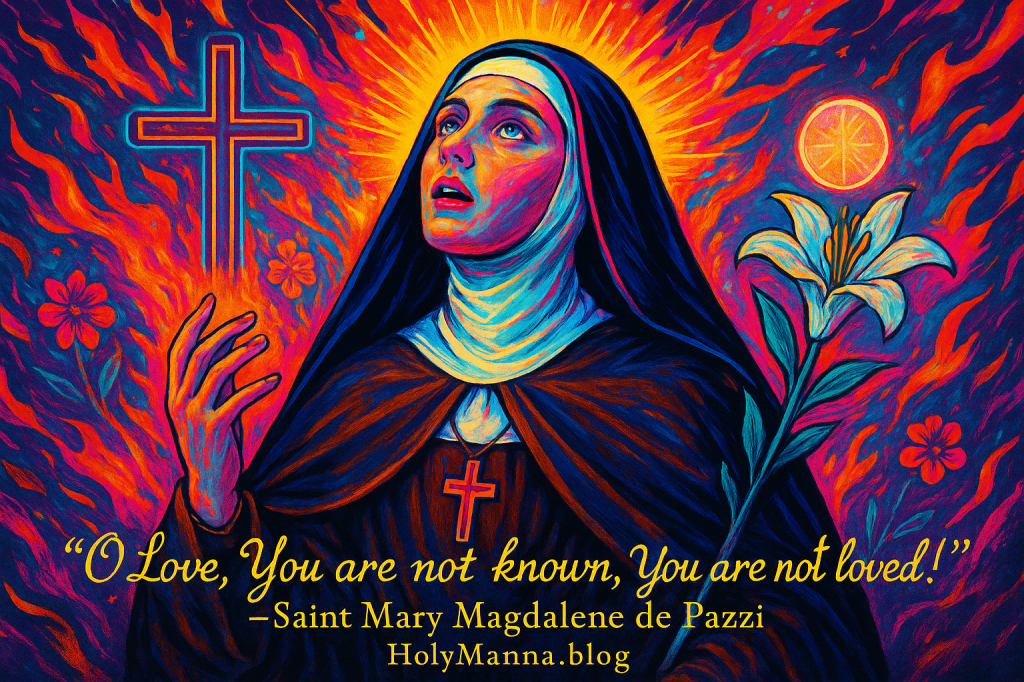
A Mystic Set Aflame
Saint Mary Magdalene de Pazzi is one of the most luminous examples of mysticism in the Catholic Church—a Carmelite nun whose soul was entirely inflamed with divine love. Her life was anything but ordinary. She lived during a time of Church upheaval and renewal, yet in the hidden silence of the cloister, she waged spiritual battles, received divine revelations, and burned with a love for Jesus that few could comprehend. She is best known for her ecstatic visions, her passionate desire for Church reform, and her complete union with Christ Crucified. Canonized in 1669 by Pope Clement IX, she became a patron of those who suffer with spiritual dryness, illness, or mental anguish—because she herself endured all these trials and more with unwavering faith. In her union with the Trinity, her soul became like fire, consuming all in love and offering her life as a living sacrifice for the renewal of the Church.
A Rose in Florence
Caterina de’ Pazzi was born on April 2, 1566, in the grand and bustling city of Florence, Italy. Her family was among the nobility, the famous Pazzi family, known not only for its wealth but also for its entanglement in Florentine political drama. Despite her privileged upbringing, young Caterina showed signs of extraordinary holiness. At the age of ten, she received her First Communion and experienced her first ecstasy—an event so profound that it forever sealed her heart for Christ. From then on, she would often be found in quiet contemplation, mortifying her desires and withdrawing from worldly pleasures.
Drawn to the Carmelite ideal of silence, prayer, and penance, Caterina entered the convent of Santa Maria degli Angeli at the age of sixteen. There she took the name Mary Magdalene, after the beloved disciple who had been forgiven much and loved much. From the very beginning of her religious life, Mary Magdalene de Pazzi embraced a spirituality of intense sacrifice. She longed to suffer with Christ and for Christ—not in a passive or romantic way, but with the fierce devotion of someone who deeply grasped the redemptive value of suffering. She is remembered most vividly for her ecstatic visions and the passionate phrases that burst from her soul in moments of union with God—cries like, “O Love, You are not known, You are not loved!” That anguished longing for souls to know and return the love of Christ became the driving force of her life.
Her spiritual writings, including The Forty Days, Revelations and Understandings, and The Renewal of the Church, are treasures of mystical theology. Dictated while she was in ecstasy and transcribed by fellow nuns, these texts overflow with deep insights into divine love, the Eucharist, and the Holy Trinity. She was not just a visionary; she was a reformer, a teacher, and a prophet whose life continues to speak powerfully to the Church today.
Visions of Glory
Saint Mary Magdalene de Pazzi’s life was marked by a continuous outpouring of the supernatural. Her soul, so open to the movements of the Holy Spirit, became a vessel through which God made His presence known in the visible world. Just days after her profession of vows, she was gifted with forty days of intense mystical ecstasies following each reception of the Eucharist. These were no ordinary moments of prayer—they were full-body encounters with the divine. She spoke aloud with Jesus, the Blessed Virgin Mary, and various saints, often unaware of her surroundings. Her sisters would document her words, many of which formed the basis of her mystical writings.
During these ecstatic states, her body would sometimes become rigid, her face transfigured with joy or sorrow depending on the vision she was experiencing. Witnesses recounted moments where she levitated or lost awareness of time entirely. She received visions of the Trinity, was shown the depths of purgatory, and cried out for the sins of the world with deep, maternal anguish. In one powerful vision, she saw the Church in need of purification and offered herself as a victim soul for its reform. Her prophetic knowledge astonished her community, as she would often speak truths about the hidden states of souls or foretell future events with accuracy and humility.
Even beyond her visions, Mary Magdalene was known for miraculous healings. Several sick sisters recovered after her prayers, and she once cured a young boy of paralysis by making the sign of the cross over him. Yet, she never sought attention for these events. Her miracles were never a show—they were simply the fruit of an intimate relationship with the living God.
A Hidden Passion
Saint Mary Magdalene de Pazzi did not wear the crown of martyrdom in the traditional sense, but her life was a long and painful passion. In her final years, she endured a five-year period of complete spiritual desolation. No longer did she receive the ecstasies and consolations that had filled her earlier religious life. Instead, she was plunged into the abyss of darkness, tormented by thoughts of abandonment and despair. These years were marked by terrible physical suffering—paralysis, extreme fevers, vomiting, and exhaustion.
But even more intense was her interior crucifixion. She described the agony of feeling completely abandoned by God, crying out from the depths of her soul, much like Jesus in Psalm 22, “My God, my God, why have You forsaken me?” And yet, she never stopped loving. She never stopped hoping. Every moment of pain she offered for others—especially for priests, whom she loved dearly and desired to see sanctified.
Some of her suffering came even from within her own community. Not all of her sisters understood the depth of her mystical experiences. Some doubted her or questioned her visions. Yet she obeyed with humility, accepting correction and choosing silence rather than defense. In all of this, she lived out what she called the “martyrdom of love,” proving that true holiness is forged not in glory but in quiet fidelity.
A Legacy of Light
When Saint Mary Magdalene de Pazzi died on May 25, 1607, at the age of forty-one, her convent was filled with the scent of flowers. It was a supernatural fragrance, described by many as a sign of her sanctity. Her sisters immediately began to witness healings and answered prayers through her intercession. When her body was exhumed years later, it was found to be incorrupt, and it remains visible today in Florence at the Carmelite Monastery of Santa Maria Maddalena de’ Pazzi.
Pilgrims began flocking to her tomb, many reporting miraculous cures of physical and spiritual ailments. Those suffering from mental distress, chronic illness, or despair found hope in invoking her name. One mother claimed her dying child was restored to life after placing a relic of Mary Magdalene near him. Others spoke of unexplainable peace and clarity after praying before her remains. Over time, devotion to her spread not just in Italy, but throughout the Catholic world.
Her canonization only confirmed what the faithful already knew: she was a saint not because of her visions, but because of her love. A love that endured pain, misunderstanding, and abandonment. A love that never asked for recognition but burned quietly for the glory of God.
Burning for Love
Saint Mary Magdalene de Pazzi is not a saint easily understood, but she is one urgently needed. Her life is a bold reminder that the path to holiness is not about spiritual fireworks, but about interior surrender. In a noisy world, she calls us into the silence of the heart. In a distracted Church, she reminds us that renewal begins not with programs, but with prayer.
She invites each of us to fall in love with Jesus—to truly fall, to lose ourselves in Him. Her passionate cries echo through time: “O Love, You are not loved!” She challenges us to ask: Am I living a life that gives Christ joy? Am I loving Him with everything I have?
We may not experience mystical ecstasies, but we can all make space for Christ in our hearts through silence, Eucharistic adoration, frequent Confession, and acts of hidden charity. Her love for priests also calls us to pray fervently for our spiritual shepherds. Like her, we can offer our little sufferings for the renewal of the Church and the salvation of souls.
Are you ready to become a living flame?
Can you embrace silence and suffering as pathways to intimacy with Jesus?
Will you, like Mary Magdalene de Pazzi, cry out with all your soul: “O Love, You are not loved!”?
💬 Engage with Us!
We would love to hear how Saint Mary Magdalene de Pazzi speaks to your heart. Share your thoughts in the comments, and let us grow together in our walk of faith.
🙏 Reflection Questions:
- How do I respond when I experience dryness in prayer or feel distant from God?
- What concrete steps can I take to deepen my prayer life and love for the Eucharist, as Mary Magdalene de Pazzi did?
- Am I offering my daily sufferings and trials for the sanctification of others, especially for priests and the Church?
Let us support each other in our faith journeys and strive to do all things with love, just as our Lord Jesus did.
Saint Mary Magdalene de Pazzi, pray for us! 🔥
Follow us on Instagram and Facebook for more insights and reflections on living a faith-filled life.

 Holy Manna!
Leave a comment