Led by the Spirit, Bound in Love
Have you ever been caught in the middle of a decision—torn between tradition and truth, unsure which way leads to peace? Today’s readings take us deep into that tension, but they don’t leave us there. They invite us to witness how the early Church, guided by the Holy Spirit, emerged from confusion into clarity, from division into unity, and from fear into peace. This is not merely a story of the past—it is a call to each of us, right now, to become temples of the living God, carriers of His presence and bearers of His peace in a world desperate for both.
In the Acts of the Apostles, we encounter the Church’s first major doctrinal conflict—whether Gentile converts must follow Jewish customs, like circumcision, to be saved. The apostles, rather than fracturing, come together in prayerful discernment, seeking not their own opinions but the will of the Holy Spirit. Their decision—to lift unnecessary burdens—paves the way for unity among diverse believers. This is echoed in Psalm 67, where all nations are called to rejoice and praise the God who judges with fairness and blesses abundantly. In a time when tribal divisions defined identity, the Spirit was already doing something radically new: forming one Church out of many peoples.
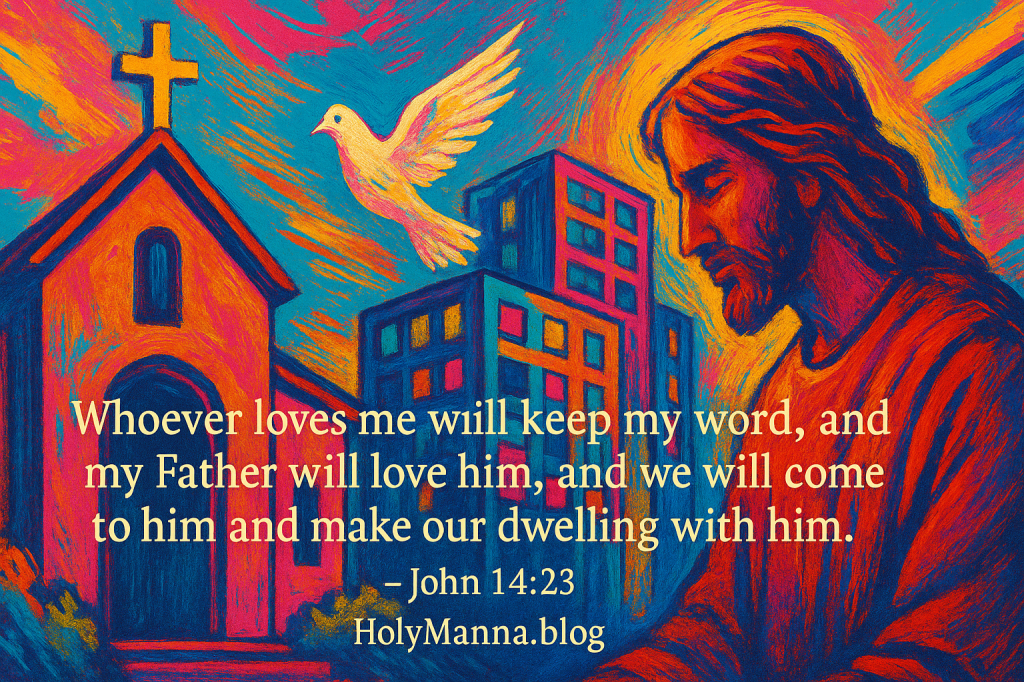
This vision reaches its peak in Revelation, where the heavenly Jerusalem descends radiant with God’s glory, needing no temple because “its temple is the Lord God almighty and the Lamb” (Revelation 21:22). And in the Gospel of John, Jesus promises that those who love Him and keep His word will become dwelling places of God Himself. “We will come to him and make our dwelling with him” (John 14:23). The Advocate—the Holy Spirit—is the unifying thread, reminding us of everything Christ has taught, and filling us with a peace the world cannot give. Are you allowing the Spirit to shape your decisions and your community? Where might God be inviting you to choose peace over pride, unity over division, and love over legalism?
First Reading – Acts 15:1–2, 22–29
The Spirit That Frees, Not Burdens
The Acts of the Apostles records the vibrant and often turbulent growth of the early Church, and today’s reading takes us to a pivotal moment: the Council of Jerusalem. As Gentiles entered the faith in large numbers, questions erupted—should they be required to follow Jewish laws, especially circumcision? For many Jewish Christians, these customs were sacred markers of covenant identity. But through prayerful discernment, the apostles, guided by the Holy Spirit, chose not to impose the Mosaic law upon Gentile converts. This was a radical and Spirit-led shift from external legalism to internal faith and love as the markers of salvation. Today’s theme—unity through the Holy Spirit and love—is powerfully displayed in this moment of apostolic wisdom and courage. The apostles, rooted in tradition yet responsive to God’s movement, embody how the Church is both historical and ever new.
Acts 15:1-2, 22-29
New American Bible (Revised Edition)
Council of Jerusalem. 1 Some who had come down from Judea were instructing the brothers, “Unless you are circumcised according to the Mosaic practice, you cannot be saved.” 2 Because there arose no little dissension and debate by Paul and Barnabas with them, it was decided that Paul, Barnabas, and some of the others should go up to Jerusalem to the apostles and presbyters about this question.
Letter of the Apostles. 22 Then the apostles and presbyters, in agreement with the whole church, decided to choose representatives and to send them to Antioch with Paul and Barnabas. The ones chosen were Judas, who was called Barsabbas, and Silas, leaders among the brothers. 23 This is the letter delivered by them: “The apostles and the presbyters, your brothers, to the brothers in Antioch, Syria, and Cilicia of Gentile origin: greetings. 24 Since we have heard that some of our number [who went out] without any mandate from us have upset you with their teachings and disturbed your peace of mind, 25 we have with one accord decided to choose representatives and to send them to you along with our beloved Barnabas and Paul, 26 who have dedicated their lives to the name of our Lord Jesus Christ. 27 So we are sending Judas and Silas who will also convey this same message by word of mouth: 28 ‘It is the decision of the holy Spirit and of us not to place on you any burden beyond these necessities, 29 namely, to abstain from meat sacrificed to idols, from blood, from meats of strangled animals, and from unlawful marriage. If you keep free of these, you will be doing what is right. Farewell.’”
Detailed Exegesis
Verse 1 – “Some who had come down from Judea were instructing the brothers, ‘Unless you are circumcised according to the Mosaic practice, you cannot be saved.’”
This verse reveals the conflict at the heart of the early Church. Some Jewish Christians clung to the Law of Moses, particularly circumcision, as a prerequisite for salvation. Their insistence reveals a deeper anxiety: Can Gentiles truly be part of the covenant people without becoming Jews first? This sets the stage for a larger question—what truly saves us? The Church’s response would affirm salvation by grace through faith in Christ, not by external rituals.
Verse 2 – “Because there arose no little dissension and debate by Paul and Barnabas with them, it was decided that Paul, Barnabas, and some of the others should go up to Jerusalem to the apostles and presbyters about this question.”
The Church doesn’t avoid conflict—it faces it. Paul and Barnabas, themselves missionaries to the Gentiles, confront this false teaching head-on. But rather than acting independently, they seek unity by going to the apostles and elders in Jerusalem. This is an early model of synodality and ecclesial authority: the Church gathers to discern truth together under the guidance of the Holy Spirit.
Verse 22 – “Then the apostles and presbyters, in agreement with the whole church, decided to choose representatives and to send them to Antioch with Paul and Barnabas. The ones chosen were Judas, who was called Barsabbas, and Silas, leaders among the brothers.”
Unity and consensus mark this decision. The apostles, in agreement with the whole Church, select respected men to accompany Paul and Barnabas. This affirms both the decision and the community’s support. It also shows the early Church’s pastoral care—choosing leaders not just to deliver a message, but to accompany the people in understanding and living it.
Verse 23 – “This is the letter delivered by them: ‘The apostles and the presbyters, your brothers, to the brothers in Antioch, Syria, and Cilicia of Gentile origin: greetings.’”
The address shows fraternal love and inclusivity. The leaders of the Church do not speak from above but alongside—as brothers to brothers. This language affirms the dignity and belonging of Gentile Christians in the family of God.
Verse 24 – “Since we have heard that some of our number [who went out] without any mandate from us have upset you with their teachings and disturbed your peace of mind…”
The letter clarifies that the earlier teachers were not authorized. False teaching causes not just confusion, but spiritual distress. The apostles act to restore peace and unity through truth and clarity—a hallmark of the Church’s magisterial role.
Verse 25 – “We have with one accord decided to choose representatives and to send them to you along with our beloved Barnabas and Paul…”
This reiterates unity—with one accord. Paul and Barnabas are named not just as missionaries but as beloved. Their credibility is affirmed, healing any mistrust that may have arisen.
Verse 26 – “Who have dedicated their lives to the name of our Lord Jesus Christ.”
Here the apostles highlight what truly marks a Christian: not circumcision, but dedication to Christ. This verse centers the whole debate on what matters most—Jesus.
Verse 27 – “So we are sending Judas and Silas who will also convey this same message by word of mouth.”
Oral teaching, alongside written, ensures clarity and prevents misinterpretation. This reflects the Church’s use of both Sacred Scripture and Sacred Tradition (CCC 80), two pillars through which the Holy Spirit continues to teach the faithful.
Verse 28 – “It is the decision of the holy Spirit and of us not to place on you any burden beyond these necessities…”
This is the heart of the passage. The Church, in humility, acknowledges that her decision is in union with the Holy Spirit. What freedom and grace! The Spirit lifts burdens, while still calling believers to moral integrity. Unity and mercy triumph over legalism.
Verse 29 – “…to abstain from meat sacrificed to idols, from blood, from meats of strangled animals, and from unlawful marriage. If you keep free of these, you will be doing what is right. Farewell.”
These requirements are minimal, aimed at fostering communal unity and moral clarity. They also reflect Jewish-Gentile sensitivities of the time. The emphasis is not on ritual purity but on avoiding scandal and preserving peace.
Teachings
The Church’s discernment at the Council of Jerusalem is a foundational moment in her history, showing how apostolic authority, tradition, and the guidance of the Holy Spirit work together. The Catechism of the Catholic Church teaches: “The Holy Spirit… guides the Church in all truth and renews her in every age” (CCC 2632). What we see in this reading is not merely an ancient event, but the Holy Spirit actively forming doctrine through the living Magisterium—a model that continues to this day.
St. John Henry Newman, in his work On the Development of Christian Doctrine, emphasized that true development in doctrine always maintains continuity with apostolic teaching, even as it responds to new circumstances. The Council of Jerusalem is a clear example. The apostles, in fidelity to Christ, recognize that the old law has found its fulfillment in the new covenant of grace. “The Church, in her Magisterium, constantly reaffirms the primacy of grace in salvation”, as Pope Benedict XVI also affirmed.
This moment also echoes Jesus’ words in Matthew 11:30: “My yoke is easy, and my burden light.” The Holy Spirit, rather than adding layers of obligation, calls us to the essential moral and sacramental life rooted in love and faith. The Church has always been careful to distinguish between disciplines that serve unity in particular eras and eternal truths that transcend culture. In Acts 15, we see this pastoral sensitivity at work—honoring the truth while making room for the growth of the Body of Christ.
Reflection
Have you ever felt burdened by religious expectations—either your own or those imposed by others? Today’s reading reminds us that the Spirit of God is not one of slavery, but of sonship and peace. We are not saved by rituals or cultural conformity, but by our faith in Jesus Christ and our openness to the Spirit. Yet, we are also reminded that freedom in Christ does not mean freedom from responsibility. We are called to live lives of integrity, love, and concern for the unity of the Body.
In your own life, how can you imitate the humility and openness of the apostles—listening to others, discerning together, and trusting the Holy Spirit to guide difficult decisions? Do you see the Church as a source of unity, or have past wounds made it hard to trust her authority? This passage invites us to rediscover the Church not as a burdensome institution, but as a Spirit-filled mother who desires our peace.
Today, let us pray for the grace to resist the temptation to judge others by external measures. May we, like the apostles, courageously listen to the Spirit and boldly proclaim the Gospel of freedom. And may our lives reflect that holy tension of truth and love, tradition and renewal, all held together by the Spirit of unity.
Responsorial Psalm – Psalm 67:2–3, 5–6, 8
The Blessing That Draws All Nations
Psalm 67 is a hymn of praise and petition, traditionally attributed to King David or the temple musicians of his era. It reflects a deep yearning for God’s blessing—not merely for the sake of Israel but so that all nations might come to know and worship the one true God. This psalm was likely sung during harvest festivals or national celebrations, where the community acknowledged God’s providence and prayed for His continued favor. It beautifully complements today’s theme of unity through the Holy Spirit: as the early Church discerned how to include the Gentiles without burden, this psalm prophetically envisioned a time when all peoples would praise the Lord together, not divided by ritual laws but united by His light and justice.
Psalm 67:2-3, 5–6, 8
New American Bible (Revised Edition)
2 May God be gracious to us and bless us;
may his face shine upon us.
Selah
3 So shall your way be known upon the earth,
your victory among all the nations.
5 May the nations be glad and rejoice;
for you judge the peoples with fairness,
you guide the nations upon the earth.
Selah
6 May the peoples praise you, God;
may all the peoples praise you!
8 May God bless us still;
that the ends of the earth may revere him.
Detailed Exegesis
Verse 2 – “May God be gracious to us and bless us; may his face shine upon us.”
This opening verse echoes the priestly blessing from Numbers 6:24–26. To ask that God’s face “shine” is to desire His favor, His presence, and His intimate love. In Jewish understanding, the shining face of God meant covenant relationship and protection. The psalmist’s plea is both personal and communal—a cry not for wealth or victory, but for divine closeness.
Verse 3 – “So shall your way be known upon the earth, your victory among all the nations.”
Here the prayer expands globally. God’s blessings are never meant to be hoarded. When His goodness is manifest in the lives of His people, it becomes a witness to the world. This verse links Israel’s holiness with its mission. It anticipates the Church’s call to evangelize, echoing the apostolic mission seen in Acts 15—that all peoples might know the saving way of God.
Verse 5 – “May the nations be glad and rejoice; for you judge the peoples with fairness, you guide the nations upon the earth.”
Unlike pagan gods, the Lord is just and universal. This verse portrays God not as tribal or partial, but as a fair and righteous judge over all people. His guidance is not domination, but fatherly care. The nations rejoice not in conquest, but in being rightly governed by a holy and loving God.
Verse 6 – “May the peoples praise you, God; may all the peoples praise you!”
Repetition emphasizes the desire that worship not be confined to Israel. The psalmist dreams of a time when every tribe, tongue, and nation will raise their voice to the one Creator. This anticipates the eschatological vision in Revelation 7:9, where a multitude from every nation worships the Lamb. It is a prayer aligned with heaven.
Verse 8 – “May God bless us still; that the ends of the earth may revere him.”
The psalm closes with a renewal of the initial petition: for continued blessing. But again, it is not self-centered. The psalmist longs for God’s blessing to become a magnet that draws the world into awe and reverence. The goal is not Israel’s greatness but God’s universal glory.
Teachings
This psalm illuminates a core truth of the Church’s mission: we are blessed to be a blessing. The Catechism of the Catholic Church teaches, “The desire for God is written in the human heart… because man is created by God and for God” (CCC 27). Psalm 67 expresses this desire not only for the individual soul, but for all nations. The Church, as the new Israel, inherits this call—to receive divine blessing and then share it through witness, mercy, and truth.
St. Irenaeus, writing in the second century, said, “The glory of God is man fully alive, and the life of man is the vision of God.” The vision of Psalm 67 is one where all humanity becomes fully alive through the radiant presence of God. This presence is not reserved for a select few but offered universally through the Church’s sacramental and evangelical life. When Christians live with joy and integrity, the nations indeed come to know the Lord’s ways.
Historically, this psalm has also shaped Christian missionary spirituality. During the rise of monasticism, many communities would pray it daily, asking that their contemplation would overflow into evangelization. The Church today continues this impulse, especially in the New Evangelization. As Pope St. John Paul II taught, “The Church is missionary by her very nature” (Redemptoris Missio, 62), and her mission is to reveal the saving love of God to the ends of the earth.
Reflection
Do you see God’s blessings in your life as gifts to be shared? So often we focus on the material aspects of blessing, but this psalm reminds us that the truest blessing is God’s presence and guidance. When we live in that light—when His face shines upon us—it changes the way we work, pray, speak, and love. Our lives become signs to others, pointing them toward the Father.
In your daily routines—at work, in your family, among friends—are you drawing others into God’s joy, justice, and peace? How might your gratitude become a song that invites others to praise? Like Israel of old, we are called not to hoard grace but to radiate it. Let this psalm shape your heart into a sanctuary of praise, and may your joy become contagious, leading others into the reverence and love of our God.
Second Reading – Revelation 21:10–14, 22–23
The City of Light and Communion
The Book of Revelation is a mystical and apocalyptic vision granted to St. John during his exile on the island of Patmos. While often associated with dramatic symbols and end-times prophecy, today’s passage offers a breathtaking glimpse into the eternal destiny of the Church: the New Jerusalem. Unlike earthly cities marked by division, darkness, and decay, this heavenly city gleams with divine glory. The passage follows a long narrative arc from suffering and persecution to ultimate communion with God. For early Christians, many of whom faced martyrdom or marginalization, this vision was more than poetry—it was hope. In light of today’s readings, the New Jerusalem represents the fruit of unity through the Holy Spirit, where there is no need for external law or temple, because “the Lord God almighty and the Lamb” are the very center. The boundaries that once separated Jew from Gentile, temple from world, are dissolved in the radiant light of communion.
Revelation 21:10-14, 22-23
New American Bible (Revised Edition)
10 He took me in spirit to a great, high mountain and showed me the holy city Jerusalem coming down out of heaven from God. 11 It gleamed with the splendor of God. Its radiance was like that of a precious stone, like jasper, clear as crystal. 12 It had a massive, high wall, with twelve gates where twelve angels were stationed and on which names were inscribed, [the names] of the twelve tribes of the Israelites. 13 There were three gates facing east, three north, three south, and three west. 14 The wall of the city had twelve courses of stones as its foundation, on which were inscribed the twelve names of the twelve apostles of the Lamb.
Detailed Exegesis
Verse 10 – “He took me in spirit to a great, high mountain and showed me the holy city Jerusalem coming down out of heaven from God.”
Being taken “in spirit” signifies that this is a divine revelation—not mere imagination. The “great, high mountain” echoes biblical moments like Moses on Sinai, where God reveals His covenant. The descent of Jerusalem from heaven shows that the true city of God is not built by human hands, but is a gift from above, prepared for a redeemed people.
Verse 11 – “It gleamed with the splendor of God. Its radiance was like that of a precious stone, like jasper, clear as crystal.”
The imagery of glory and light signals divine presence. Jasper, clear and brilliant, symbolizes purity and majesty. This radiance is not from the city itself, but from God who dwells within. The beauty of the city reflects the holiness of its inhabitants, purified and glorified by grace.
Verse 12 – “It had a massive, high wall, with twelve gates where twelve angels were stationed and on which names were inscribed, [the names] of the twelve tribes of the Israelites.”
The twelve gates symbolize fullness and access for all. The mention of the twelve tribes shows continuity with the Old Covenant—Israel remains foundational to God’s plan. The walls offer security, not separation. Angels guarding the gates speak to the sacredness of entry into God’s presence.
Verse 13 – “There were three gates facing east, three north, three south, and three west.”
This cardinal arrangement emphasizes universality. People from all directions—from every nation and corner of the earth—are welcomed. It reflects the inclusive mission of the Church and fulfills Psalm 67’s prayer: that all nations may come to know and worship the Lord.
Verse 14 – “The wall of the city had twelve courses of stones as its foundation, on which were inscribed the twelve names of the twelve apostles of the Lamb.”
Here the New Covenant is affirmed. The apostles—chosen by Christ and empowered by the Holy Spirit—form the foundation of this eternal city. The imagery of foundation stones highlights the Church’s apostolic identity. Salvation history is not discarded but fulfilled.
Verse 22 – “I saw no temple in the city, for its temple is the Lord God almighty and the Lamb.”
This verse marks a radical shift. The temple had been the center of Jewish worship, the place of sacrifice and presence. But now, in the fullness of time, the mediating structures are no longer necessary. God is immediately and permanently present. Heaven is pure communion—no veil, no ritual separation.
Verse 23 – “The city had no need of sun or moon to shine on it, for the glory of God gave it light, and its lamp was the Lamb.”
In this new reality, even creation’s lights pale before divine radiance. The Lamb, Jesus Christ, is both sacrifice and source of light. This light is not just illumination but revelation—the fullness of truth, beauty, and peace. It is the light we long for even now, amid the shadows of our earthly journey.
Teachings
The Catechism of the Catholic Church teaches that “the Church… will receive her perfection only in the glory of heaven” (CCC 1045). The New Jerusalem represents this perfected Church—radiant, universal, and founded upon the apostles. It is the fulfillment of God’s plan to dwell with His people, where “God will be all in all” (1 Corinthians 15:28). In this vision, heaven is not an escape from the world but its transfiguration—what the Church is meant to be fully, eternally.
St. Augustine beautifully describes this future reality in The City of God, where he contrasts the earthly city built on self-love with the heavenly city built on the love of God. The New Jerusalem is that eternal city of love, where “there will be no more death or mourning, wailing or pain” (Revelation 21:4). The absence of a temple teaches us that worship will be face-to-face, no longer through signs and sacraments, but in eternal communion.
The absence of sun or moon also recalls the Transfiguration, where Jesus’ face shone like the sun. As Pope Benedict XVI taught, “Jesus is the light of the world, the true sun that dispels all darkness” (Jesus of Nazareth). In heaven, there will be no more night, no more doubt or confusion, for all will be clear in the light of Christ. This hope sustains the Church in times of persecution and confusion: what we await is not a return to the past, but a glorious unveiling of God’s eternal dwelling among us.
Reflection
Have you ever caught a glimpse of heaven—a moment of profound peace, radiant joy, or beauty that left you speechless? These moments are foretastes of the New Jerusalem. But this vision is not only for the future—it is meant to shape how we live now. We are called to build our lives on the foundation of the apostles, to be radiant with holiness, and to open wide the gates of our hearts to people from every direction.
Do you see the Church as a city of light, or has her brokenness obscured your view? Ask the Holy Spirit to purify your vision, to help you see the Church not just in her earthly struggles but in her heavenly destiny. What if every Mass, every act of mercy, every prayer, were a stone being set in the walls of the New Jerusalem? Today’s reading calls us to live as citizens of heaven now—shining with Christ’s light, walking in communion, and longing for the day when we will see God face to face.
Holy Gospel – John 14:23–29
The Indwelling Peace of Love
This Gospel passage from John 14 is part of Jesus’ farewell discourse—an intimate moment during the Last Supper where Christ prepares His disciples for His departure. The atmosphere is tender and heavy; the apostles are anxious, sensing the coming separation. Jesus offers them profound consolation rooted in love, obedience, and the indwelling presence of the Holy Spirit. The Gospel of John, often called the “spiritual Gospel,” emphasizes divine intimacy and eternal truths more than chronological details. Today’s reading is a spiritual cornerstone, revealing the very heart of Trinitarian life: “Whoever loves me will keep my word, and my Father will love him, and we will come to him and make our dwelling with him.” In the context of today’s theme of unity through the Holy Spirit, Jesus reveals that divine peace, clarity, and communion are possible—not in the distant future, but now, through love and fidelity to His word.
John 14:23-29
New American Bible (Revised Edition)
23 Jesus answered and said to him, “Whoever loves me will keep my word, and my Father will love him, and we will come to him and make our dwelling with him. 24 Whoever does not love me does not keep my words; yet the word you hear is not mine but that of the Father who sent me.
25 “I have told you this while I am with you. 26 The Advocate, the holy Spirit that the Father will send in my name—he will teach you everything and remind you of all that [I] told you. 27 Peace I leave with you; my peace I give to you. Not as the world gives do I give it to you. Do not let your hearts be troubled or afraid. 28 You heard me tell you, ‘I am going away and I will come back to you.’ If you loved me, you would rejoice that I am going to the Father; for the Father is greater than I. 29 And now I have told you this before it happens, so that when it happens you may believe.
Detailed Exegesis
Verse 23 – “Jesus answered and said to him, ‘Whoever loves me will keep my word, and my Father will love him, and we will come to him and make our dwelling with him.’”
This verse is a profound Trinitarian promise. Love is not just sentiment—it expresses itself in obedience. The reward for such love is astonishing: the indwelling of the Father and the Son. The Greek word used for “dwelling” (monē) implies a permanent abode, not a passing visit. This is the mystical life—God choosing to reside in the soul of the believer, fulfilling His promise from Leviticus 26:12: “I will walk among you and be your God, and you shall be my people.”
Verse 24 – “Whoever does not love me does not keep my words; yet the word you hear is not mine but that of the Father who sent me.”
Jesus clarifies that disobedience stems from a lack of love. This is not a threat, but a sober truth. To reject His word is to reject the One who sent Him—the Father. Here we see the inseparable unity of the Trinity. Every command of Christ is a direct transmission of the Father’s will.
Verse 25 – “I have told you this while I am with you.”
Jesus acknowledges the moment—He is still physically present, but soon that will change. His words are like seeds planted before the darkness of the Passion. They are meant to sustain the disciples through fear and uncertainty.
Verse 26 – “The Advocate, the holy Spirit that the Father will send in my name—he will teach you everything and remind you of all that [I] told you.”
This is the great promise of Pentecost. The Holy Spirit will not only teach but also remind. This is key for the Church’s memory and living tradition. The Spirit ensures that the Church does not invent doctrine but remains faithful to Christ’s teaching. The term “Advocate” (Paraklētos) implies a helper, intercessor, and guide—one who walks beside us.
Verse 27 – “Peace I leave with you; my peace I give to you. Not as the world gives do I give it to you. Do not let your hearts be troubled or afraid.”
Here Jesus offers a gift unlike any other—His peace. This peace is not the absence of conflict but the presence of God. It’s the same peace that sustains martyrs, consoles the grieving, and calms anxious hearts. It is a fruit of the Holy Spirit (Galatians 5:22), rooted not in circumstances but in divine presence.
Verse 28 – “You heard me tell you, ‘I am going away and I will come back to you.’ If you loved me, you would rejoice that I am going to the Father; for the Father is greater than I.”
Jesus reframes the sorrow of His departure. Love does not cling possessively. To love Jesus is to desire what is best for Him—and that is His glorification with the Father. The statement that the Father is “greater” does not deny Jesus’ divinity but reflects His incarnate submission within the Trinity.
Verse 29 – “And now I have told you this before it happens, so that when it happens you may believe.”
Jesus prepares His disciples not just emotionally but spiritually. By foretelling the future, He strengthens their faith. This verse emphasizes the pedagogical role of Jesus—He instructs so that belief may flourish when trials come.
Teachings
The Catechism of the Catholic Church affirms this indwelling of the Trinity as central to Christian life: “To live in heaven is ‘to be with Christ.’ The elect live ‘in Christ,’ but they retain, or rather find, their true identity, their own name” (CCC 1025). Heaven begins now in the heart that receives and obeys Christ. The promise of divine indwelling is not only eschatological but present—every soul that loves and obeys becomes a living tabernacle.
St. Teresa of Ávila, in her Interior Castle, describes the soul as a beautiful mansion with many rooms. The innermost chamber, she says, is where God dwells in union with the soul. This Gospel passage undergirds that mystical reality. “We will come to him and make our dwelling with him” is not poetic exaggeration; it is the lived experience of saints who surrendered fully in love and obedience.
Pope Benedict XVI once wrote, “Only by being in the image of the Son… can man become free” (Jesus of Nazareth). Obedience is not slavery but freedom—it opens the soul to peace and truth. The Advocate, the Holy Spirit, continues to guide the Church, reminding her of all that Christ taught, and empowering believers to live in communion with God. This reading shows us the heartbeat of the Christian life: love that listens, obeys, and abides.
Reflection
Do you believe that God wants to make His home in you? Not visit, not bless from afar—but dwell within you, intimately and permanently? This is the radical truth of the Gospel. It demands a response: love that is lived out in obedience, trust that remains firm in trial, and a surrender that welcomes the Spirit’s guidance.
What kind of home are you preparing for God in your heart? Is it cluttered with fear, distracted by noise, or open and receptive? Today’s reading invites us to create space for the Advocate—to let His light clarify our minds, His peace steady our hearts, and His presence remind us of Christ’s words. The world offers fleeting peace, shallow comfort, and short-lived success. But Jesus gives a peace that remains, even when the cross looms near.
Let us resolve today to live as those in whom God dwells. To love Jesus not merely with emotion, but through the daily “yes” of fidelity. To listen for the Spirit’s voice amid the chaos. And to trust that, even when we don’t understand, God’s promises are sure: “Do not let your hearts be troubled or afraid.”
A Dwelling Place for God
Today’s readings form a breathtaking mosaic of unity, peace, and divine presence. From the early Church’s courageous discernment in Acts 15, to the psalmist’s song of global praise in Psalm 67, to the radiant vision of the New Jerusalem in Revelation 21, and finally to Jesus’ tender promise in John 14, we are reminded again and again: God does not desire distant followers—He longs to dwell with us.
The Holy Spirit, sent by the Father in the name of the Son, is the living bond that draws all people into communion. In the First Reading, we saw the Spirit guiding the apostles to remove unnecessary burdens and open wide the gates of grace. In the Psalm, we echoed the prayer that God’s blessing would lead all nations to revere Him. In Revelation, we glimpsed our destiny as citizens of a city where God Himself is the light. And in the Gospel, we heard the astonishing truth that “we will come to him and make our dwelling with him”—not in some future moment, but here and now, in hearts that love and obey.
What kind of dwelling are you offering to the Lord today? Is your heart open to the Spirit’s gentle guidance, or are you clinging to burdens He longs to lift? Let today be the day you clear out the noise, the fear, and the clutter—and invite God to make His home in you. Ask the Holy Spirit to teach you, to remind you, and to shape you into a living tabernacle of Christ’s peace. You are not alone. You are not forgotten. You are not meant to carry the weight of the world. “Peace I leave with you; my peace I give to you.” Open the door to that peace today, and let Him come in.
Engage with Us!
We’d love to hear how God is speaking to your heart through today’s readings. Share your thoughts, prayers, or experiences in the comments below—your voice may be the encouragement someone else needs today. As we walk this journey of faith together, let’s keep each other rooted in the truth and love of Christ.
Reflection Questions:
First Reading – Acts 15:1–2, 22–29
What burdens—spiritual, emotional, or cultural—might God be asking you to release? How can you discern the voice of the Holy Spirit when facing difficult decisions within your community or family?
Responsorial Psalm – Psalm 67:2–3, 5–6, 8
Do you view God’s blessings as something to share or something to protect? In what ways can your life reflect God’s justice and goodness so that others may come to praise Him?
Second Reading – Revelation 21:10–14, 22–23
How does the image of the New Jerusalem inspire you in your daily life? What areas of your heart still need God’s light to shine and transform them into a dwelling place for Him?
Holy Gospel – John 14:23–29
What does it mean to you personally that God wants to make His home in you? How do you experience the peace that Jesus promises, even when the world feels overwhelming?
Be encouraged today to live as a child of the light—open to the Spirit, grounded in truth, and overflowing with the peace of Christ. Let every word, action, and intention be done with the love and mercy Jesus taught us, so that your life may become a radiant reflection of His dwelling within you.
Follow us on Instagram and Facebook for more insights and reflections on living a faith-filled life.

 Holy Manna!
Leave a comment