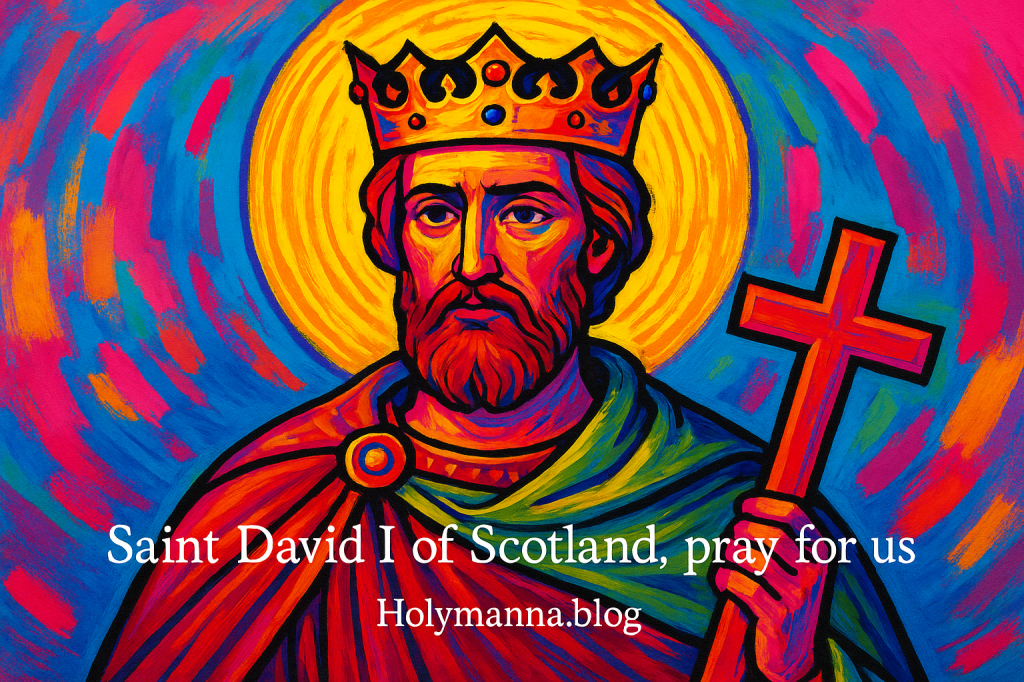
A Crown Rooted in Christ
Saint David I of Scotland (c. 1084–1153) stands out as a remarkable witness to what it means to rule with a heart conformed to Christ. In an age when many kings ruled with sword and ambition, David governed with mercy, justice, and a profound love for God. His feast is celebrated on May 24, and he remains a beloved figure not only for his royal wisdom but for his commitment to building up the Church and uplifting the poor. Though he held immense political power, David chose the path of service, founding monasteries, feeding the hungry, and bringing the light of faith to regions that had been dimmed by spiritual neglect. His life challenges us to ask: What would leadership look like if it were rooted in the Gospel?
Often referred to as a “second Constantine” for his support of the Church, David is revered not for conquering kingdoms, but for expanding the Kingdom of God. His commitment to ecclesiastical reform transformed the spiritual landscape of Scotland, setting the foundation for centuries of Catholic life and devotion. His memory endures not just in abbeys and chronicles but in the hearts of those who still look to him as a model of Christian kingship.
The Making of a Holy King
Born into both political and spiritual royalty, Saint David I was the youngest son of King Malcolm III of Scotland and Saint Margaret of Scotland, a canonized queen known for her profound piety, love for the poor, and reforming zeal. Raised in a court where the faith was alive and actively practiced, David absorbed the virtues of prayer, fasting, and justice from a young age. The holy example of his mother deeply shaped his heart and planted seeds of sanctity that would flourish throughout his life.
After the death of his father, David spent much of his youth in the royal court of England under the care of his sister and her husband, King Henry I. This exposure to continental Church reformers—particularly the Cluniac and Gregorian reform movements—deepened his understanding of the Church’s role in society and further nourished his vocation as a just ruler. His marriage to Matilda of Huntingdon brought him lands and influence, and upon his brother Alexander I’s death in 1124, David ascended the throne.
Unlike many monarchs of his era, David did not view his kingship as a path to self-glorification. He ruled not from a desire to dominate, but to serve. He championed religious orders, encouraged the building of churches, and personally endowed monasteries, understanding that the soul of a nation was shaped as much by its altars as by its armies. “He was a man devoted to God…a man of great sanctity,” wrote the historian William of Newburgh, offering a testimony to David’s deeply Christian rule. Every decision he made as king was marked by an earnest desire to lead as Christ led—through sacrifice, humility, and love.
The Quiet Wonders of a King
While Saint David I may not be known for the dramatic, spectacular miracles that adorn the lives of other saints, his entire reign was suffused with spiritual wonder. In fact, the miracles of David were less about supernatural spectacle and more about the transformation of society through grace-filled leadership. His life testifies to the miracle of a heart so united with God that justice and compassion overflowed into the lives of all his subjects.
One popular legend tells of a hunting expedition near what is now Holyrood Abbey. As the story goes, David was nearly gored by a wild stag when he saw a glowing cross between the animal’s antlers. As the beast charged, it miraculously halted, sparing his life. In thanksgiving, David founded a grand abbey on that very site—Holyrood Abbey—which would go on to become one of the most important religious centers in medieval Scotland. This miraculous intervention was seen by many as a divine confirmation of David’s mission to sanctify his reign.
Beyond this, the true miracle of David’s life was his extraordinary compassion for the poor. Contemporary sources speak of his daily practice of feeding the hungry with his own hands and his generous almsgiving, often done in secret. His justice was also considered miraculous by his subjects, for he administered the law with mercy, protecting widows, orphans, and the marginalized. His reforms didn’t just change laws—they changed hearts, bringing about a renaissance of faith in his kingdom. In this way, Saint David’s reign itself became a miracle—a living icon of Christian charity and holy order.
The Weight of the Crown
Saint David I did not ascend the throne without resistance. His claim to the Scottish crown came during a time of tension and shifting alliances. Some viewed his English ties with suspicion, while others feared the monastic and ecclesiastical reforms he was promoting would upset the established power structures. Political rebellions and military confrontations, particularly with other claimants and with English nobles, marked his rule with periods of conflict and anxiety.
Moreover, David suffered profound personal grief. He lost his beloved wife and several of his children, sorrows that brought him to his knees in prayer and taught him to rely solely on God. These wounds deepened his compassion and made his leadership more tender. Rather than becoming embittered, David poured his suffering into service, becoming even more devoted to building places of worship, ministering to the poor, and uplifting the clergy.
Though not martyred by sword or flame, David lived a kind of daily martyrdom through sacrificial love and burdensome responsibility. He carried the cross of kingship with grace, embodying the words of Christ: “Whoever wishes to be great among you shall be your servant” (The Gospel of Matthew 20:26). In the daily struggles of leadership, political negotiation, and emotional loss, David demonstrated that sainthood is not reserved for cloisters alone, but can flourish even in the heart of royal courts.
A Saint’s Enduring Light
Saint David I died on May 24, 1153, in Carlisle, England. He was laid to rest in Dunfermline Abbey, alongside his mother Saint Margaret, whose holiness had first inspired his own. Even in death, David’s sanctity continued to touch lives. Though never formally canonized by Rome, he has long been venerated by the people of Scotland and by the monastic communities he established.
Pilgrims visited his tomb for centuries, praying for healing, wisdom, and peace. Many testified to answered prayers, unexplained healings, and divine consolations received through his intercession. His monasteries became not only centers of prayer and learning but also sites of pilgrimage and refuge, providing spiritual and physical nourishment to countless souls.
The abbeys David founded—Melrose, Holyrood, Kelso, and many others—stood for centuries as testaments to his commitment to Christ and the Church. Even today, their ruins speak of a time when a king dared to build a nation not just with walls, but with altars and sacraments. Through his legacy, Saint David continues to draw hearts to God, shepherding his people from beyond the veil.
Wearing Your Own Crown with Grace
Saint David I of Scotland challenges every one of us to examine how we use the power and influence we hold—no matter how small or great. Whether we are parents, teachers, leaders, or simply friends, we all have opportunities to lead with love and to build up others rather than dominate them. David shows us that true greatness is measured by the depth of one’s service and the sincerity of one’s heart.
His life invites us to ask: What kind of kingdom am I building with my daily choices? Are we ruling with justice in our homes, practicing mercy in our workplaces, and uplifting others with the grace and peace of Christ? Saint David’s example reminds us that God can sanctify even the most mundane responsibilities if they are offered with love.
He also reminds us that personal loss and suffering do not disqualify us from holiness—in fact, they may deepen our reliance on God and open our hearts more fully to His grace. Like David, we are called to be both strong and tender, both firm in truth and rich in mercy.
Let us strive to build a life that echoes David’s reign: rooted in the Eucharist, generous in compassion, and fearless in faith.
Engage with Us!
What part of Saint David’s life speaks most to you? Have you ever experienced leadership as a spiritual calling? Let’s journey together.
Reflection Questions:
- How can I use the influence I have—whether large or small—to reflect Christ’s love and justice?
- In what ways am I called to build the “Church” in my life, as Saint David built monasteries in Scotland?
- What worldly responsibilities or attachments can I surrender to God to become more like Saint David?
Let’s encourage one another in the comments and pray for each other. May we all live with purpose, humility, and love—just as our Lord Jesus and Saint David I of Scotland did.
Saint David I of Scotland, pray for us! 👑
Follow us on Instagram and Facebook for more insights and reflections on living a faith-filled life.

 Holy Manna!
Leave a comment