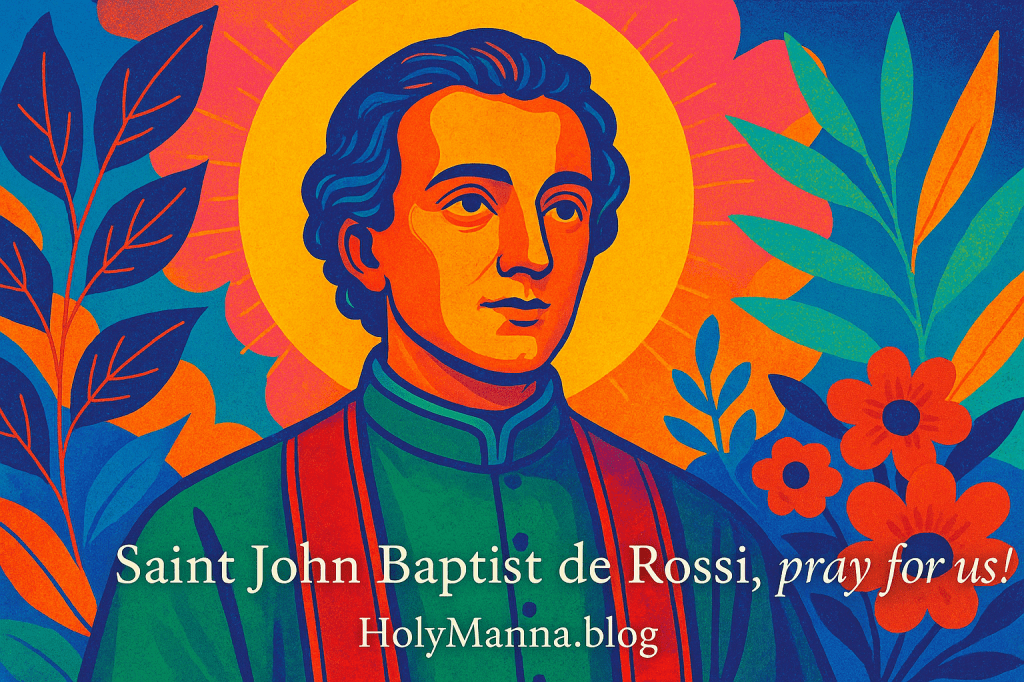
A Gentle Light in the Eternal City
In the heart of Rome, where grandeur often overshadows humility, there once lived a man whose quiet holiness illuminated the darkest alleys and loneliest souls. Saint John Baptist de Rossi didn’t perform grand theological feats or die dramatically for the faith. Instead, he walked gently through the streets, bringing the mercy of Christ to the forgotten and the broken. Known as the “Apostle of the Abandoned,” John’s life was a beautiful witness to the Gospel of Luke’s call: “He has anointed me to bring good news to the poor” (Luke 4:18). Revered today as a model of pastoral charity and hidden sanctity, his legacy continues to touch hearts through the example of a priest who gave everything for the sake of love.
Though he never established a religious order or wrote profound theological treatises, his greatness lay in the day-to-day acts of love that defined his priesthood. His life shows us that sainthood is not about being seen, but about seeing—truly seeing those most often overlooked. And in them, seeing Christ Himself.
A Journey of Surrender
Giovanni Battista de’ Rossi was born on February 22, 1698, in Voltaggio, a picturesque hill town nestled in the Ligurian Apennines of northern Italy. His parents, Charles de Rossi and Frances Anfossi, were devout Catholics who raised their children in the faith, teaching them to love God and neighbor with sincerity. From an early age, Giovanni stood out for his intelligence and deep interior life. Those who knew him as a boy could already sense that he had a heart set apart for something greater.
When he was just twelve, a wealthy Roman couple took notice of his potential and sponsored his education in Rome, where he entered the Jesuit-run Roman College. There, his devotion flourished amidst rigorous classical and theological training. Later, he continued his studies at the Dominican College of Saint Thomas Aquinas—today known as the Angelicum—where his reputation for holiness only grew. Despite a debilitating battle with epilepsy, which could have disqualified him from priesthood, Giovanni’s determination and spiritual resilience moved his superiors. Through years of prayer, humility, and discernment, he was ordained to the priesthood in 1721, at the age of twenty-three.
Rather than seeking prestige or a comfortable parish, John chose the path of poverty and pastoral charity. He served as a confessor, chaplain, and spiritual father to the sick, the imprisoned, and the homeless. As a canon of Santa Maria in Cosmedin, he had a regular income—but he gave it all to the poor. His days were filled with service: hearing confessions for hours, visiting hospitals and prisons, and walking the narrow alleys of Rome to find souls in need. He was especially drawn to those most alienated from society—criminals, the mentally ill, the terminally ill—and he brought them all the healing balm of God’s mercy.
In every encounter, he mirrored Christ’s words: “Whatever you did for one of these least brothers of mine, you did for me” (Matthew 25:40). His life was not marked by public acclaim, but by a daily crucifixion of his own will, offered with joy and meekness. He was a man consumed by love, and that love left a holy fragrance in every place he visited.
Whispers of Heaven
Unlike some saints known for dramatic supernatural events, Saint John Baptist de Rossi’s miracles were of a quieter, yet equally profound, nature. His entire priestly life was one of unseen graces poured out in hidden places. The miracles attributed to him were often spiritual rather than physical—though no less divine.
He had an extraordinary gift for hearing confessions. Many reported that he could read souls, gently revealing sins that penitents were too afraid or ashamed to confess. He did not use this gift to judge or shame, but to heal and restore. Hardened hearts melted under the warmth of his compassion. Criminals on death row, mentally ill patients abandoned in asylums, and weary workers found in him a priest who saw them, listened to them, and loved them as Christ would.
One story speaks of a notorious thief who had never confessed and was considered a hopeless case. After a single visit from Fr. John, the man wept like a child and returned to the sacraments. In the hospitals of Rome, nurses testified that patients calmed at his touch. Some said that the pain lessened when he prayed with them. Many sensed a holy presence around him that brought peace and comfort.
Perhaps most miraculously, despite his own epilepsy and fragile health, he never ceased his ministry. He would sometimes collapse in public, his body convulsing. Yet he would rise, give thanks to God, and continue on his way. His very perseverance was a miracle—one that testified to the power of grace sustaining a weak vessel for mighty works.
The Cross He Carried
Saint John Baptist de Rossi never died at the stake or in a prison cell, but he knew martyrdom in the form of daily suffering. His epilepsy was a heavy cross. At a time when such conditions were deeply misunderstood, he faced suspicion and ridicule. Episodes could strike at any moment—sometimes during Mass, sometimes on the street—causing embarrassment and fear. Yet never once did he use it as an excuse to stop serving. Instead, he embraced it as a means of union with the suffering Christ.
He also endured spiritual trials. Known for his deep interior life, he wrestled with scrupulosity, a painful condition where the conscience becomes excessively anxious over sin. He constantly questioned if he had done enough for God, or if he had failed in his duties. These dark nights of the soul could have led to despair, but John clung tightly to the Eucharist and to Our Lady. He would often spend long hours in front of the tabernacle, pouring out his heart like the psalmist: “Why are you cast down, my soul? Hope in God, for I shall again praise Him” (Psalm 42:11).
Despite his quiet heroism, not everyone understood or supported him. Some fellow priests accused him of being too lenient, too generous, too preoccupied with “undesirables.” He bore their criticisms without bitterness, offering them as sacrifices for their own holiness.
His health finally broke under the weight of his relentless charity. After years of pushing himself beyond human limits, he died on May 23, 1764, worn out by love. His was a martyrdom not of blood, but of the heart—a slow, beautiful pouring-out of self until nothing remained but Christ.
The Saint Who Still Walks Among the Poor
Death did not silence Saint John Baptist de Rossi’s voice of compassion. In the years following his passing, stories of miraculous healings and spiritual conversions began to circulate around Rome. Pilgrims who visited his tomb at Santa Maria in Cosmedin spoke of physical healings—paralytics who walked, sick children who recovered after prayer, and countless individuals who received unexpected peace and consolation.
One particularly well-known story tells of a young woman who had been bedridden for years. After a novena to the saint and a visit to his tomb, she rose and walked. Others who suffered from mental torment or addiction reported relief after invoking his intercession.
His canonization in 1881 by Pope Leo XIII recognized not only these miracles but also the profound holiness of his ordinary life. Today, his relics continue to draw visitors who seek hope and healing. Though his name may not be as famous as others, his power before God is undeniable. The same gentle heart that once walked the streets of Rome is now glorified in Heaven, still seeking the poor, the abandoned, and the broken—bringing them to Jesus.
Becoming the Hidden Saints of Today
Saint John Baptist de Rossi is a mirror of Jesus for our time—especially for those who feel they have nothing to offer. He had no status, no worldly strength, no public acclaim. Yet his life burned with divine fire. In him, we see what it means to truly follow Christ: to serve, to suffer, and to love without seeking anything in return.
What would our lives look like if we loved this way?
We often search for purpose in big achievements, but John shows us that true greatness lies in how we love the person in front of us—especially when they cannot repay us. In the sick, we meet Christ. In the imprisoned, we meet Christ. In the tired, the irritable, the forgotten—we meet Christ. If we want to imitate John, we must first ask for the eyes to see as he did.
And what about our own crosses? We all carry burdens—be it illness, anxiety, loneliness, or failure. Like John, we can either flee from them or embrace them as paths to deeper communion with Christ. As Saint Paul teaches, “My power is made perfect in weakness” (2 Corinthians 12:9). John’s life is proof of that truth.
His witness challenges us to ask: Who have I overlooked? Who in my daily life needs the mercy of God through me? How can I allow my pain to become a source of grace for others?
Let us not miss the opportunity to become saints—not on a stage, but in the kitchen, the hospital, the office, and the confessional. As The Catechism of the Catholic Church reminds us: “The works of mercy are charitable actions by which we come to the aid of our neighbor in his spiritual and bodily necessities” (CCC 2447).
Let us become instruments of that mercy.
Engage with Us!
What does Saint John Baptist de Rossi inspire in you? We’d love to hear your thoughts in the comments below.
Reflection Questions:
- Are there “hidden corners” in your life where God might be calling you to serve others more deeply?
- How do you respond to people who are sick, forgotten, or spiritually broken?
- What personal crosses might you embrace more joyfully, following the example of Saint John Baptist de Rossi?
Let us walk together in faith, support one another in love, and serve with the tenderness of Christ. May we never forget that every act of love, no matter how small, brings the Kingdom of God closer to earth.
Saint John Baptist de Rossi, pray for us! 🕊️
Follow us on Instagram and Facebook for more insights and reflections on living a faith-filled life.

 Holy Manna!
Leave a comment