Chosen for Love, Sent in Unity
There’s a quiet joy that settles into the soul when we realize we are not alone on this journey of faith. Today’s readings invite us into that joy—a harmony born of divine love, wise leadership, and the unshakable truth that Christ calls us His friends. From the apostolic Church navigating conflict with Spirit-led clarity, to the psalmist waking the dawn with praise, to Jesus commanding His disciples to love as He loves—each passage beats with one resounding heart: we are chosen, unified, and sent forth by love.
In the first century, the early Church found itself facing real division. Gentile converts in Antioch were confused and burdened by conflicting messages about Mosaic law. Acts 15 captures a crucial moment of discernment: the Council of Jerusalem. This was not mere administration—it was a moment of grace. The apostles, under the inspiration of the Holy Spirit, clarified what was essential for communion. Their decision was not only doctrinal but pastoral, preserving the unity of the Church while honoring the diverse cultural backgrounds of its members. In the ancient world, where cultural divides often bred suspicion, the Church’s response modeled a radically different way: communion through love and truth.
And it is Christ Himself who defines the shape of that love in The Gospel of John: “This is my commandment: love one another as I love you”. This is not a love of convenience but one of costly friendship—“to lay down one’s life for one’s friends”. The command to love is both a calling and an identity. We are not slaves but friends, chosen and sent to bear fruit that will remain. Paired with Psalm 57, which lifts a heart steadfast in praise, today’s readings speak into our daily call to love boldly, discern wisely, and walk joyfully in the unity Christ died to give us. What might change in your life if you truly believed you were chosen for this kind of love today?
First Reading – Acts 15:22–31
The Spirit, the Church, and the Healing Power of Unity
There’s a pivotal moment in today’s first reading that opens a window into the very heartbeat of the early Church. Taken from The Acts of the Apostles, written by St. Luke, this passage recounts the resolution of the first major theological controversy: must Gentile converts to Christianity follow Jewish ceremonial laws? More than a legal question, this was a challenge to the Church’s identity and mission. The Council of Jerusalem, which this passage recounts, shows the apostles acting in communion with the whole Church, seeking clarity not through rigidity but through the gentle authority of love and the guidance of the Holy Spirit. In a cultural context where Jews and Gentiles had long been separated by dietary laws, customs, and history, the Church’s decision to relieve Gentiles of these burdens was not just pastoral—it was revolutionary. Today’s theme of love-fueled unity is perfectly embodied here: the Church, listening to the Spirit, prioritizes peace and communion over human tradition.
Acts 15:22-31
New American Bible (Revised Edition)
Letter of the Apostles. 22 Then the apostles and presbyters, in agreement with the whole church, decided to choose representatives and to send them to Antioch with Paul and Barnabas. The ones chosen were Judas, who was called Barsabbas, and Silas, leaders among the brothers. 23 This is the letter delivered by them: “The apostles and the presbyters, your brothers, to the brothers in Antioch, Syria, and Cilicia of Gentile origin: greetings. 24 Since we have heard that some of our number [who went out] without any mandate from us have upset you with their teachings and disturbed your peace of mind, 25 we have with one accord decided to choose representatives and to send them to you along with our beloved Barnabas and Paul, 26 who have dedicated their lives to the name of our Lord Jesus Christ. 27 So we are sending Judas and Silas who will also convey this same message by word of mouth: 28 ‘It is the decision of the holy Spirit and of us not to place on you any burden beyond these necessities, 29 namely, to abstain from meat sacrificed to idols, from blood, from meats of strangled animals, and from unlawful marriage. If you keep free of these, you will be doing what is right. Farewell.’”
Delegates at Antioch. 30 And so they were sent on their journey. Upon their arrival in Antioch they called the assembly together and delivered the letter. 31 When the people read it, they were delighted with the exhortation.
Verse-by-Verse Exegesis
Verse 22 – “Then the apostles and presbyters, in agreement with the whole church, decided to choose representatives and to send them to Antioch with Paul and Barnabas. The ones chosen were Judas, who was called Barsabbas, and Silas, leaders among the brothers.”
This verse illustrates how the early Church functioned synodally—discerning together, under the guidance of the Holy Spirit. The decision to send trusted leaders reflects a deep pastoral care for the Gentile believers, and a commitment to unity.
Verse 23 – “This is the letter delivered by them: ‘The apostles and the presbyters, your brothers, to the brothers in Antioch, Syria, and Cilicia of Gentile origin: greetings.’”
The letter opens with an affirmation of brotherhood. The apostles identify themselves not as rulers, but as brothers—modeling a fraternal spirit that mirrors Christ’s words in John 15, where He calls His disciples friends, not slaves.
Verse 24 – “Since we have heard that some of our number [who went out] without any mandate from us have upset you with their teachings and disturbed your peace of mind…”
The Church acknowledges the damage done by unauthorized teaching. This verse underscores the importance of apostolic authority and shows concern not just for doctrinal clarity, but for the interior peace of the faithful.
Verse 25 – “…we have with one accord decided to choose representatives and to send them to you along with our beloved Barnabas and Paul…”
Unity is emphasized—“with one accord.” This shows that the decision came through prayerful discernment and consensus. The phrase “beloved Barnabas and Paul” also expresses deep affection and respect for these missionary leaders.
Verse 26 – “…who have dedicated their lives to the name of our Lord Jesus Christ.”
Their mission is Christ-centered. Their authority is not self-appointed, but flows from a life of sacrificial witness. This echoes Jesus’ teaching: “Greater love has no one than this, to lay down one’s life for one’s friends” (John 15:13).
Verse 27 – “So we are sending Judas and Silas who will also convey this same message by word of mouth.”
The dual method—written and spoken—shows the Church’s commitment to clarity. It also reflects the Catholic understanding that both Scripture and Tradition carry apostolic authority.
Verse 28 – “‘It is the decision of the holy Spirit and of us not to place on you any burden beyond these necessities…”
This profound phrase shows the Church discerning in the Spirit. The language is humble yet authoritative. The goal is not control, but freedom in Christ.
Verse 29 – “…namely, to abstain from meat sacrificed to idols, from blood, from meats of strangled animals, and from unlawful marriage. If you keep free of these, you will be doing what is right. Farewell.’”
The guidelines given are minimal and pastoral, meant to preserve unity between Jewish and Gentile believers. The emphasis is on communal harmony and basic moral clarity.
Verse 30 – “And so they were sent on their journey. Upon their arrival in Antioch they called the assembly together and delivered the letter.”
The response is active and immediate. The Church does not delay in offering clarity and encouragement to her members.
Verse 31 – “When the people read it, they were delighted with the exhortation.”
The fruit of true apostolic teaching is joy. The Gentile believers rejoice, not because rules were removed, but because they felt seen, loved, and confirmed in the faith.
Teachings of the Church
The Catechism teaches: “The task of interpreting the Word of God authentically has been entrusted solely to the Magisterium of the Church” (CCC 100). In Acts 15, we see the first instance of this living Magisterium at work. The apostles and presbyters, led by the Holy Spirit, clarify doctrine without burdening the faithful—showing that authority in the Church exists to serve and to liberate. This model has guided the Church through every age, especially in moments of division or confusion.
St. Irenaeus, writing in the 2nd century, emphasized the authority of apostolic succession when he said: “Wherever the bishop appears, there let the people be; just as wherever Jesus Christ is, there is the Catholic Church” (Against Heresies, Book III). The presence of Judas and Silas as living witnesses, sent from Jerusalem, exemplifies this early practice of apostolic mission and authority, one that continues in bishops today.
The Church’s commitment to unity in truth is not merely institutional—it is deeply pastoral. As CCC 814 teaches: “From the beginning, this one Church has been marked by a great diversity… But sin and the burden of its consequences constantly threaten the gift of unity. And so the Apostle has to exhort Christians to maintain the unity of the Spirit in the bond of peace.” Today’s reading is an embodiment of that very exhortation. In every age, the Church is called to discern, with love, how to preserve unity while remaining faithful to Christ.
Reflection: Choosing Unity in the Spirit
How quick are we to divide over disagreements—on Church matters, cultural differences, or personal preferences? The early Church didn’t ignore conflict; it met it with prayer, dialogue, and the Spirit’s wisdom. The apostles show us a path forward: not giving in to pressure, but discerning together in love. When was the last time you listened for the Spirit in a disagreement?
In our homes, our parishes, and online, we are faced with opportunities to choose communion over competition, and love over being right. The apostles’ example teaches us to act with humility, to value the dignity of others, and to build up the Body of Christ. Are you willing to submit your will to the greater good of unity in the Church?
Today’s reading is not only about ancient debates. It’s a living Word reminding us that the Holy Spirit still speaks, still guides, and still heals division when we make room for Him. What burden might the Lord be asking you to release today—for the sake of peace, love, and unity?
Responsorial Psalm – Psalm 57:8–10, 12
Awaken the Dawn
Psalm 57 emerges from a place of danger, written by David while hiding from King Saul in a cave. Historically, this psalm belongs to a collection of laments and praises that reflect the emotional and spiritual highs and lows of Israel’s greatest king. Despite being pursued and under threat, David does not cry out in bitterness—he sings. His heart clings to God’s steadfast love, and in that trust, he finds the courage to praise even before deliverance arrives. Culturally, this is radical: to give glory not after the victory, but in the midst of fear. Religiously, it reveals a deeply personal and trusting relationship with the God of Israel, a God whose mercy transcends the heavens. Within today’s theme of love-fueled unity and joyful obedience, this psalm acts as a soul’s response to the freedom and guidance offered by God and His Church—a call to praise that springs from a heart anchored in divine love.
Psalm 57:8-10
New American Bible (Revised Edition)
8 My heart is steadfast, God,
my heart is steadfast.
I will sing and chant praise.
9 Awake, my soul;
awake, lyre and harp!
I will wake the dawn.
10 I will praise you among the peoples, Lord;
I will chant your praise among the nations.
12 Exalt yourself over the heavens, God;
may your glory appear above all the earth.
Verse-by-Verse Exegesis
Verse 8 – “My heart is steadfast, God, my heart is steadfast. I will sing and chant praise.”
The repetition here reveals the firmness of David’s faith. “Steadfast” implies a heart that will not be moved by fear or circumstance. This verse calls us to root our emotions and desires in God’s constancy. Singing becomes an act of resistance against despair and a declaration of trust in God’s goodness.
Verse 9 – “Awake, my soul; awake, lyre and harp! I will wake the dawn.”
David is not content with internal praise—he calls his soul and his instruments to action. “I will wake the dawn” suggests that praise comes even before daylight, before clarity or deliverance. This anticipatory worship aligns with the spirit of joyful obedience, praising God in expectation, not just in hindsight.
Verse 10 – “I will praise you among the peoples, Lord; I will chant your praise among the nations.”
This verse reveals David’s missionary heart. His praise is not private but public. He intends to proclaim God’s greatness beyond Israel, foreshadowing the Church’s call to evangelize all nations. In light of Acts 15, where Gentiles are welcomed into the Church, this verse becomes even more poignant—praise is no longer confined to one people but opens to all.
Verse 12 – “Exalt yourself over the heavens, God; may your glory appear above all the earth.”
The psalm closes with a cry for God’s glory to transcend the cosmos. David’s personal praise expands into a universal doxology. His heart’s desire is not just for personal safety but for God’s majesty to be known everywhere—a vision of unity that mirrors Christ’s command to love universally and sacrificially.
Teachings of the Church
The Catechism of the Catholic Church teaches that prayer of praise “lauds God for his own sake and gives him glory quite beyond what he does, but simply because HE IS” (CCC 2639). David’s prayer in Psalm 57 is precisely this: not a petition for rescue, but an exaltation of who God is. This teaches us that praise is not merely a reaction—it is a virtue, a decision of the will to glorify God amid uncertainty.
St. Augustine, reflecting on the Psalms, said: “He who sings prays twice… singing brings joy to one’s heart and praise to God’s throne.” David’s example illustrates that singing is not just a cultural act but a spiritual weapon, capable of lifting the soul into divine intimacy. This has echoed through centuries of Christian worship, especially in the Liturgy of the Hours and the Mass.
Liturgically, the psalms are the heart of the Church’s prayer, forming the backbone of both personal devotion and communal worship. Psalm 57, proclaimed as today’s responsorial, invites the Church not only to remember David’s story but to join in his courage. In a fragmented world, singing God’s praise among the nations becomes a prophetic act—one that reaffirms our identity and mission as chosen, unified, and joyfully obedient followers of Christ.
Reflection: Singing in the Shadow, Trusting in the Light
How often do we wait for circumstances to improve before we offer God our praise? Psalm 57 flips that script. David doesn’t wait for the victory to be won—he wakes the dawn with song, proclaiming God’s faithfulness in the middle of uncertainty. What would it look like for you to sing before the breakthrough, to thank God before the answer comes?
In moments of spiritual dryness or fear, we’re tempted to withdraw. But today’s psalm teaches us to lead our own hearts with praise, to wake up our souls, and to reorient our focus toward the One whose glory is above all the earth. Are you letting your praise be louder than your panic?
This week, choose to begin each day with a short hymn or psalm—even a whispered “Glory to God.” Let your heart learn the rhythm of steadfastness through repetition and trust. How might your daily praise be a witness to others that your joy is rooted in something higher than your circumstances?
Holy Gospel – John 15:12–17
Called, Chosen, and Commanded to Love
The Gospel of John is the most intimate and theological of the four Gospels. Written later than the synoptics, it offers a deeply reflective portrait of Jesus’ identity and mission. Today’s passage comes from the Last Supper discourse—Jesus’ final words to His disciples before His Passion. These are not casual teachings but parting instructions from the Bridegroom to His beloved friends. Historically and religiously, this moment is soaked in solemnity. Jesus is preparing His apostles for life without His physical presence, and He gives them the commandment that will define the Church: “Love one another as I love you.” This command is not just moral—it is sacramental, shaping how the community of believers will live, serve, and die. In light of today’s theme, Jesus’ words anchor the unity and joyful obedience we see modeled in Acts 15 and Psalm 57. The Church exists because Christ chose us—and His love becomes the law by which we flourish.
John 15:12-17
New American Bible (Revised Edition)
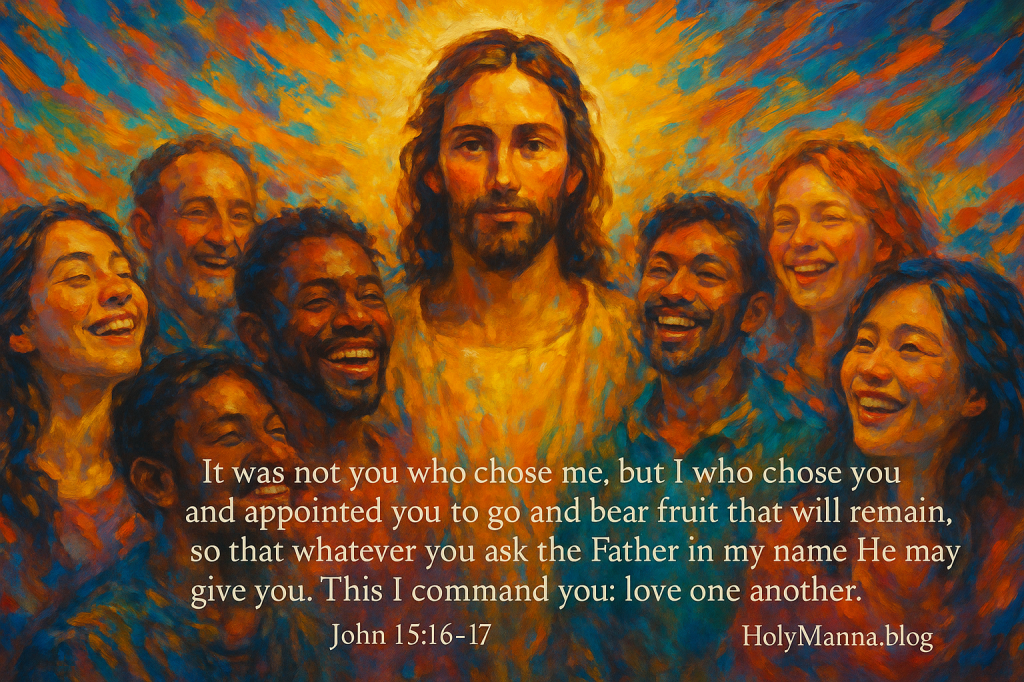
12 This is my commandment: love one another as I love you. 13 No one has greater love than this, to lay down one’s life for one’s friends. 14 You are my friends if you do what I command you. 15 I no longer call you slaves, because a slave does not know what his master is doing. I have called you friends, because I have told you everything I have heard from my Father. 16 It was not you who chose me, but I who chose you and appointed you to go and bear fruit that will remain, so that whatever you ask the Father in my name he may give you. 17 This I command you: love one another.
Verse-by-Verse Exegesis
Verse 12 – “This is my commandment: love one another as I love you.”
Jesus distills all His teachings into one commandment. The standard of love is not our own preference or affection—it is His love. A love that forgives enemies, washes feet, breaks bread with traitors, and climbs the cross. To love like Jesus is to empty oneself in total gift.
Verse 13 – “No one has greater love than this, to lay down one’s life for one’s friends.”
Here Jesus defines the deepest expression of love: sacrificial self-giving. This verse foreshadows the Cross and sets the measure for Christian love. In a world obsessed with self-preservation, Christ calls His followers to courageous, vulnerable, life-giving love.
Verse 14 – “You are my friends if you do what I command you.”
Friendship with Jesus is not casual companionship—it requires obedience. This obedience is not servile but loving, a response to being known and chosen. We are not followers out of duty but participants in divine intimacy.
Verse 15 – “I no longer call you slaves, because a slave does not know what his master is doing. I have called you friends, because I have told you everything I have heard from my Father.”
This is a radical shift. In Jewish tradition, few were considered friends of God—Abraham, Moses. Now Jesus invites all disciples into that privileged space. He reveals the Father’s will and calls us friends, not because we deserve it, but because He desires communion with us.
Verse 16 – “It was not you who chose me, but I who chose you and appointed you to go and bear fruit that will remain, so that whatever you ask the Father in my name he may give you.”
Jesus reminds the disciples that their vocation is rooted in His initiative. This choosing is not random—it’s for mission. The “fruit that will remain” echoes the lasting legacy of love: conversions, vocations, acts of mercy. Prayer, rooted in mission and obedience, becomes powerful.
Verse 17 – “This I command you: love one another.”
Jesus bookends His teaching with the same command, reinforcing that love is not an option. It is the very fabric of discipleship. Without it, the Church cannot live, much less bear fruit.
Teachings of the Church
The Catechism of the Catholic Church teaches: “The new commandment of Jesus to love one another as he has loved us is the law of the Gospel. It ‘summarizes the entire Law,’ and expresses the Father’s entire will” (CCC 1970). This Gospel reading is not simply poetic; it is foundational. Everything from the sacraments to the structure of the Church must be rooted in this divine love. The commandment is not external—it is written on our hearts by the Holy Spirit (cf. CCC 1965–1966).
St. Thomas Aquinas taught that “to love is to will the good of the other”, and this Gospel raises that love to its highest form: willing the good of the other even at great cost to oneself. In calling us His friends, Jesus elevates our dignity beyond mere servanthood. As St. Catherine of Siena once wrote: “Love transforms one into what one loves.” When we obey this command, we are transformed into the likeness of Christ, who is love itself.
Historically, this Gospel passage has inspired countless saints and martyrs. St. Maximilian Kolbe, who laid down his life for another prisoner in Auschwitz, lived out verse 13 with chilling fidelity. The command to love is not abstract—it becomes flesh in the lives of believers who choose to serve, forgive, and even die for others. It’s this witness that made the early Church so compelling to the pagan world, and it remains the lifeblood of Christian mission today.
Reflection: A Love That Changes Everything
Love is not a sentiment. It is a command. Jesus does not suggest love—He demands it. And not just any love, but His love: patient, enduring, crucified. Are you willing to love those who don’t love you back? Are you willing to be last, to forgive first, to serve without reward? These are not easy demands, but they are the only path to true friendship with Jesus.
We often seek validation, influence, or success, but Jesus reminds us: “It was not you who chose me, but I who chose you.” This truth uproots pride and replaces it with purpose. Do you live each day knowing you have been handpicked by Christ to bear fruit in this world?
Begin today by asking for the grace to love radically. Forgive someone who hurt you. Spend time with someone who feels forgotten. Choose silence over gossip, patience over complaint. What fruit are you bearing in your relationships? In your workplace? In your family? Let Christ’s words echo in your soul: “This I command you: love one another.”
Chosen, Loved, and Sent
Today’s readings form a beautiful tapestry woven with the golden thread of divine love. In Acts 15, we witnessed how the early Church, faced with conflict, responded not with division but with Spirit-led discernment and pastoral mercy. The apostles did not impose unnecessary burdens but lifted hearts, fostering unity among Jewish and Gentile believers alike. Their decision, formed in love and guided by the Holy Spirit, bore the fruit of peace and joy.
From the hidden cave of Psalm 57, David teaches us that praise is not reserved for after the storm—it is the anchor we cling to in the midst of it. His steadfast heart becomes a model for ours, reminding us that trust in God’s love is never misplaced. When we awaken the dawn with song, we proclaim to the world that God’s mercy is greater than our fears and His glory stretches beyond the heavens.
Finally, in John 15, Jesus speaks the words that define our identity: “I have called you friends”. To be chosen by Christ is to be loved beyond measure and sent with a purpose—to bear fruit that lasts. And the mark of that fruit? “Love one another as I love you.” This love builds the Church, sustains our mission, and draws souls into the heart of the Father.
You were not made for isolation or indifference. You were made to belong—to the Church, to Christ, to one another. What is one way you can choose communion over division today? How is Jesus inviting you to lay down your life in love, in small or great ways? Let today be more than a reading—let it be a response. Lift your heart in praise, trust in His call, and go forth in joy. You are chosen. You are loved. Now go—bear fruit that will remain.
Engage with Us!
We’d love to hear how today’s readings spoke to your heart. Share your thoughts, prayers, or personal experiences in the comments below. Your reflections could be the encouragement someone else needs today!
Reflection Questions
First Reading – Acts 15:22–31
How do you respond when faced with conflict in your faith community or family? Have you ever felt burdened by unnecessary expectations in your spiritual life? How can today’s reading free you to focus on what really matters?
Responsorial Psalm – Psalm 57:8–10, 12
What helps you remain steadfast when life feels uncertain or overwhelming?
How can you “wake the dawn” with praise even before your circumstances change?
Holy Gospel – John 15:12–17
What does it mean to you personally that Jesus calls you His friend?
How can you practice sacrificial love today—in your family, your workplace, or even toward a stranger?
Let these questions draw you deeper into Christ’s heart. May each step you take today be filled with faith, guided by hope, and done with the love and mercy that Jesus taught us. Never forget: you are chosen, called, and sent—so go out and be His light to the world.
Follow us on Instagram and Facebook for more insights and reflections on living a faith-filled life.

 Holy Manna!
Leave a comment