Heaven’s Peacemaker
There is a reason why Saint Rita of Cascia is often called the Patroness of Impossible Causes. Her story is not one of instant sanctity or angelic ease. Instead, it is one of raw humanity, deep suffering, and astonishing grace. She lived through a difficult marriage, the murder of her husband, the death of her children, and rejection from religious life—all before becoming a nun at 36. And yet, through it all, she clung to Christ with unwavering faith. Her name has become synonymous with hope for the hopeless, peace in the midst of violence, and healing where there seems to be only ruin. Her feast day, May 22, is celebrated worldwide, particularly by those desperately seeking a miracle or reconciliation. With her thorn-scarred forehead and rose-scented miracles, Saint Rita draws us close to a suffering Christ and whispers to the brokenhearted: “Nothing is impossible with God” (Luke 1:37).
From Roccaporena to the Cross
Born in 1381 in the quiet mountain village of Roccaporena in Umbria, Italy, Saint Rita was the only child of elderly, devout parents, Antonio and Amata Lotti. They were known in the region for their role as peacemakers in the bloody feuds that plagued Italian families during the Middle Ages. Rita was a gentle and spiritual child. From a very young age, she expressed a strong desire to consecrate her life to God, spending hours in prayer and showing remarkable obedience.
But like many holy souls, her path to sanctity was not a straight one. At just 12 years old, her parents arranged her marriage to Paolo Mancini, a man of hot temper and violent tendencies, in hopes of giving her a stable life. What followed were nearly 18 years of emotional hardship. Paolo was cruel and unfaithful, and their home was filled with tension and fear. Yet Rita endured with grace, never retaliating, and constantly praying for his conversion. Her prayers were answered—Paolo had a genuine change of heart and began living more virtuously. But peace was short-lived. He was murdered as part of a political vendetta.
Rita’s grief only deepened when her two sons, overcome with anger, plotted revenge. She begged God to stop them from spilling blood. “Let them die rather than fall into mortal sin,” she is said to have prayed. Both sons died shortly afterward of illness, leaving Rita a widow and childless, but also free to pursue the religious vocation she had long desired.
When she sought entry into the Augustinian convent in Cascia, she was initially denied because of the political tensions surrounding her husband’s death. Undeterred, she brokered peace between the rival families involved in the feud. Only after this reconciliation—an act both humanly improbable and spiritually heroic—was she allowed to take the habit. She lived the rest of her days as a cloistered nun, practicing intense prayer, fasting, and charity, becoming a spiritual mother to many. She is remembered not just as a nun, but as a bride, mother, widow, and peacemaker who walked every station of suffering with Christ.
Thorns and Winter Roses
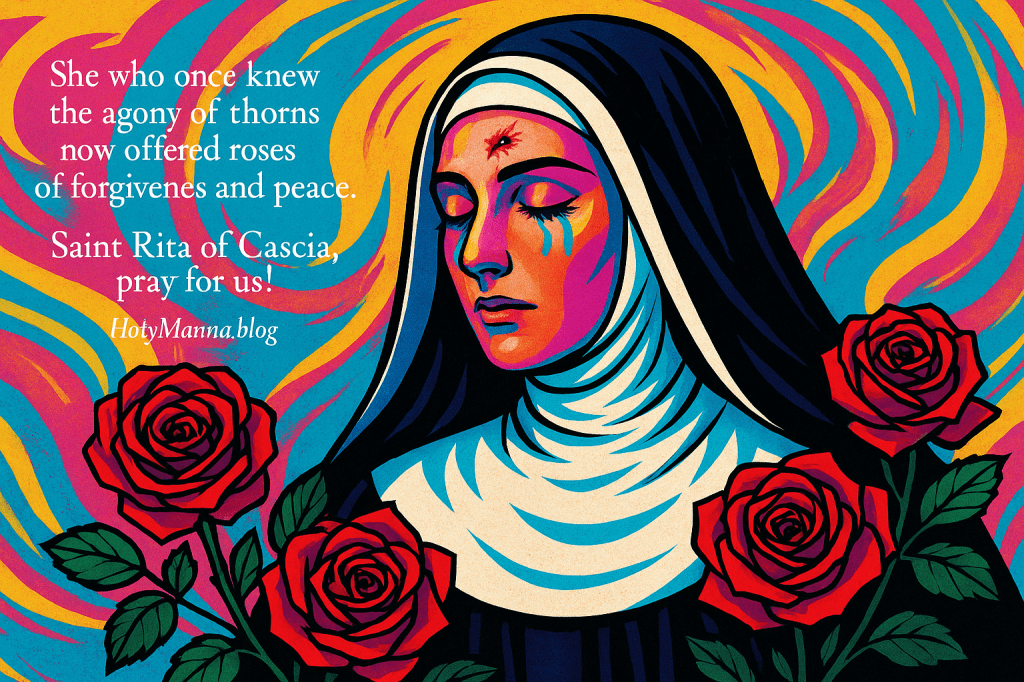
The miracles of Saint Rita are both mystical and tender, reflecting her unique intimacy with the sufferings of Christ. The most dramatic sign of her sanctity came one day as she prayed fervently before a crucifix, asking to share in Jesus’ Passion. In that moment, a thorn from His crown pierced her forehead. The wound never healed. For the next fifteen years, she bore this stigmata, a festering, painful sore that emitted such an unpleasant odor that she had to live in seclusion from her fellow nuns. Yet Rita did not complain. She saw it as a precious gift—her share in the agony of her Savior.
But Saint Rita’s miracles were not only marked by pain. Near the end of her life, as she lay dying and bedridden during a frigid Italian winter, she made a simple request to her cousin: to bring her a rose from her family’s garden. Though it was January and the earth frozen, her cousin made the journey. To her astonishment, she found a single vibrant red rose blooming among the frost-covered bushes. She brought it back to Rita, who received it with joy. This miracle became one of her most famous and symbolic, and today, devotees of Saint Rita often bring roses to her shrine as a sign of trust in her powerful intercession. “Ask Saint Rita, and she will give you a rose in winter,” many Catholics say.
Carrying the Cross Without Bitterness
Though Saint Rita was not killed for her faith, the Church honors her as a spiritual martyr, one whose entire life was consumed in sacrifice. She suffered in nearly every human way possible—through betrayal, grief, violence, sickness, isolation, and rejection. She knew what it meant to feel alone, misunderstood, and abandoned. And yet, she never gave into despair. She chose Christ, again and again.
After receiving the stigmata, Rita’s wound became a trial of its own. The other sisters avoided her because of the odor. She was excluded from communal activities, often spending time alone in her cell. This physical isolation was paired with spiritual dryness—periods where God seemed distant and silent. But still she prayed, loved, and served. Her obedience was complete, her humility radical. She took on the lowest tasks in the convent without complaint. She once was commanded to water a dead stick planted in the ground. She did so obediently for years, and one day, the stick miraculously sprouted leaves and grew into a flourishing vine that still thrives today in Cascia.
Saint Rita’s martyrdom was that of daily, hidden fidelity. “She who once knew the agony of thorns now offered roses of forgiveness and peace,” a biographer once said. Her silent suffering, offered in union with Christ, became a source of grace for the world.
The Incorrupt Bride of Christ
When Saint Rita died on May 22, 1457, the convent bell rang of its own accord. Her wound was miraculously healed, and her face, once scarred, became radiant. Her body, to this day, remains incorrupt—an enduring sign of God’s favor. Her tomb in the Basilica of Saint Rita in Cascia has become a site of pilgrimage, where the scent of roses is often reported and where thousands travel annually seeking healing and hope.
Many miracles have been documented since her death. The blind have received sight. The sick have been healed. Families have been reconciled. Saint Rita has a special place in the hearts of those facing desperate situations: cancer patients, victims of abuse, struggling marriages, infertility, and those clinging to faith when all else seems lost. Her relics, particularly the thorn from her forehead and the rose from her garden, are venerated with deep devotion.
In 1900, Pope Leo XIII canonized her, declaring her the “Precious Pearl of Umbria.” Her feast day is now celebrated globally, particularly in Italy, Latin America, and the Philippines. Churches and shrines dedicated to her bear witness to the lives she continues to touch from heaven.
Forgiveness, Perseverance, and the Power of Redemptive Suffering
Saint Rita’s life is a divine invitation to suffer well. Not to seek out pain, but to allow our inevitable trials to become fertile ground for grace. In a world obsessed with control, comfort, and revenge, she offers a radically different path: surrender, patience, and mercy. “Do not repay evil with evil, but overcome evil with good” (Romans 12:21). Rita’s life is a homily on this verse.
What would happen if, like Rita, we forgave even those who hurt us the most? If we prayed for our enemies instead of harboring resentment? If we trusted that God could use even our deepest wounds for His glory? Rita teaches us that the most heroic lives are often the most hidden—spent in service, silence, and steadfast prayer.
We can follow her example in simple yet powerful ways: by reconciling with those we’ve distanced ourselves from, by praying for the conversion of difficult people in our lives, by embracing our present suffering as a share in the Cross. We don’t need to seek extraordinary visions or miracles. We only need to live with extraordinary love.
If you’re facing a situation that feels hopeless, know that you are not alone. Saint Rita is praying for you. And she reminds you with every rose: “With God, all things are possible” (Matthew 19:26).
Engage with Us! 🌹
Have you ever faced an “impossible” situation where only faith got you through? Or experienced healing through prayer? We’d love to hear your story.
Reflection Questions:
- Where in your life are you being invited to forgive someone deeply?
- What “impossible cause” in your heart might you entrust to Saint Rita’s intercession today?
- How can you unite your daily struggles to the suffering of Christ for the good of others?
Let’s encourage one another on this path of faith. May we, like Saint Rita, do all things with love—even amidst wounds—and trust that “our thorns, in Christ, can bloom into roses.”
Saint Rita of Cascia, pray for us! 🌹
Follow us on Instagram and Facebook for more insights and reflections on living a faith-filled life.

 Holy Manna!
Leave a comment