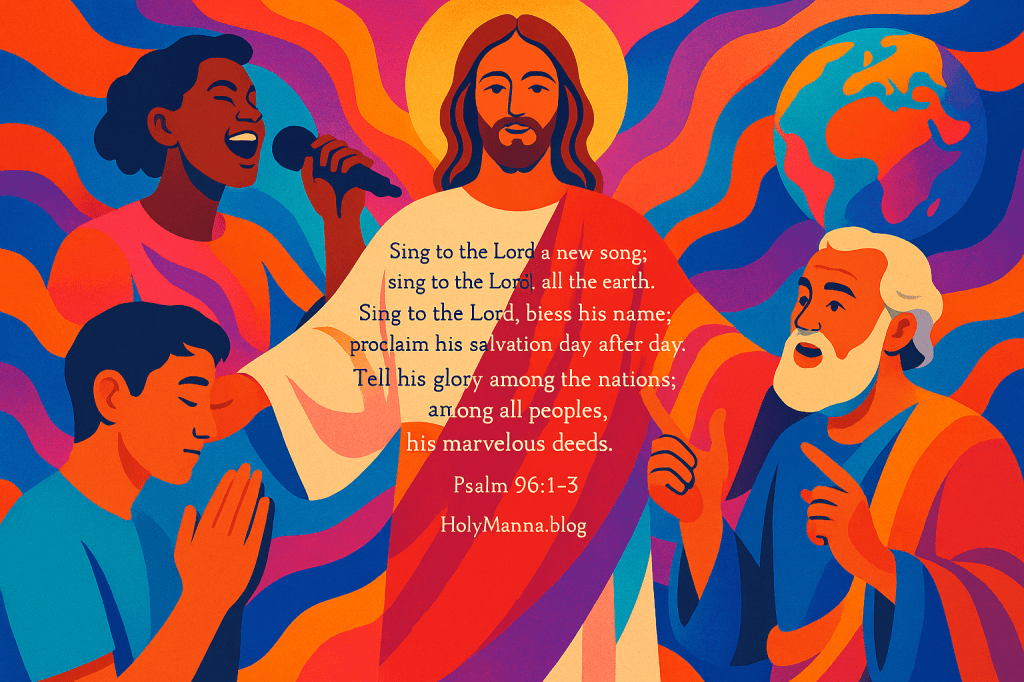
Grace, Joy, and the Family of God
Have you ever felt like an outsider—longing to belong, to be seen, to be welcomed into something bigger than yourself? Today’s readings offer a powerful invitation into the very heart of God, who makes room for everyone willing to respond to His call of love. From the early Church’s struggles to include Gentile converts, to the psalmist’s joyful proclamation to all nations, to Jesus’ tender call to remain in His love, we are drawn into the universal and joyful reality of salvation offered to all through grace.
The First Reading from Acts 15 brings us into the intensity of the Council of Jerusalem, a pivotal moment in Church history. The early Christian community—mostly Jewish—faced a major question: Should Gentile believers be required to follow the Mosaic Law to be saved? Peter’s bold declaration—“We believe that we are saved through the grace of the Lord Jesus, in the same way as they”—marked a dramatic shift. It was no longer about lineage or legal observance, but about a purified heart through faith. This was a radical, culture-breaking moment that revealed God’s desire to form one family, not bound by ethnicity but by grace.
Psalm 96 picks up this expansive vision with joyful urgency—“Tell his glory among the nations; among all peoples, his marvelous deeds”—while The Gospel of John brings it home to the soul with Jesus’ words: “Remain in my love… so that my joy may be in you and your joy may be complete.” Together, these readings show us that God’s plan has always been to unite the nations, to pour out His Spirit on all flesh, and to draw every human heart into joyful, loving communion with Him. This is not only a doctrinal truth—it is an invitation to intimacy, unity, and mission. Are you living as someone joyfully grafted into the family of God today?
First Reading – Acts 15:7–21
The Spirit Who Welcomes All
Have you ever wondered how the Church became truly universal—how the faith of a small Jewish sect grew into a global Body of Christ? Today’s first reading places us at the heart of that transformation: the Council of Jerusalem. The Acts of the Apostles, written by St. Luke, is often called the “Gospel of the Holy Spirit” because it chronicles the Spirit’s work in spreading the Church from Jerusalem to the ends of the earth. In Acts 15, the early Church confronts a crucial dilemma: Must Gentile converts follow the Mosaic Law, especially circumcision, to be saved? For Jewish Christians, the Law was deeply tied to identity, covenant, and fidelity to God. But Peter, Paul, Barnabas, and James—guided by the Holy Spirit—announce something revolutionary: “We are saved through the grace of the Lord Jesus, in the same way as they”. Today’s passage invites us to embrace the truth that God’s grace is not exclusive, but radically inclusive—forming one family in Christ.
Acts 15:7-21
New American Bible (Revised Edition)
7 After much debate had taken place, Peter got up and said to them, “My brothers, you are well aware that from early days God made his choice among you that through my mouth the Gentiles would hear the word of the gospel and believe. 8 And God, who knows the heart, bore witness by granting them the holy Spirit just as he did us. 9 He made no distinction between us and them, for by faith he purified their hearts. 10 Why, then, are you now putting God to the test by placing on the shoulders of the disciples a yoke that neither our ancestors nor we have been able to bear? 11 On the contrary, we believe that we are saved through the grace of the Lord Jesus, in the same way as they.” 12 The whole assembly fell silent, and they listened while Paul and Barnabas described the signs and wonders God had worked among the Gentiles through them.
James on Dietary Law. 13 After they had fallen silent, James responded, “My brothers, listen to me. 14 Symeon has described how God first concerned himself with acquiring from among the Gentiles a people for his name. 15 The words of the prophets agree with this, as is written:
16 ‘After this I shall return
and rebuild the fallen hut of David;
from its ruins I shall rebuild it
and raise it up again,
17 so that the rest of humanity may seek out the Lord,
even all the Gentiles on whom my name is invoked.
Thus says the Lord who accomplishes these things,
18 known from of old.’
19 It is my judgment, therefore, that we ought to stop troubling the Gentiles who turn to God, 20 but tell them by letter to avoid pollution from idols, unlawful marriage, the meat of strangled animals, and blood. 21 For Moses, for generations now, has had those who proclaim him in every town, as he has been read in the synagogues every sabbath.”
Verse-by-Verse Exegesis
Verse 7 – “After much debate had taken place, Peter got up and said to them, ‘My brothers, you are well aware that from early days God made his choice among you that through my mouth the Gentiles would hear the word of the gospel and believe.’”
Peter reminds the council that God had already chosen him to bring the Gospel to the Gentiles, as seen with Cornelius in Acts 10. His phrase “from early days” emphasizes that this was not a sudden innovation but part of God’s original plan.
Verse 8 – “And God, who knows the heart, bore witness by granting them the holy Spirit just as he did us.”
The heart-knowing God—kardiognōstēs in Greek—sees beyond externals. Peter points to the Spirit’s descent upon the Gentiles as divine proof that they belong without needing to adopt Jewish customs.
Verse 9 – “He made no distinction between us and them, for by faith he purified their hearts.”
The old distinctions are dissolved in Christ. Faith, not ritual purity, is now the path to holiness. This anticipates St. Paul’s later teaching: “There is neither Jew nor Greek… for you are all one in Christ Jesus” (Galatians 3:28).
Verse 10 – “Why, then, are you now putting God to the test by placing on the shoulders of the disciples a yoke that neither our ancestors nor we have been able to bear?”
Peter calls the Law a yoke—not evil, but burdensome—and warns that demanding Gentiles to carry it would be testing God’s mercy. This is a call to trust grace, not impose extra weights.
Verse 11 – “On the contrary, we believe that we are saved through the grace of the Lord Jesus, in the same way as they.”
This is the Gospel in a sentence. Salvation is unmerited, offered by grace alone, and equally available to all—Jew or Gentile, new believer or seasoned disciple.
Verse 12 – “The whole assembly fell silent, and they listened while Paul and Barnabas described the signs and wonders God had worked among the Gentiles through them.”
The miracles performed among Gentiles confirm the Spirit’s activity. The silence signals reverence—a holy pause in the midst of divine testimony.
Verse 13 – “After they had fallen silent, James responded, ‘My brothers, listen to me.’”
James, respected leader of the Jerusalem Church, speaks with authority. His invitation to listen mirrors the posture of discernment and unity.
Verse 14 – “Symeon has described how God first concerned himself with acquiring from among the Gentiles a people for his name.”
James references Peter (Symeon) and affirms that Gentiles, too, are now God’s people—echoing covenant language traditionally applied to Israel.
Verses 15–18 – “The words of the prophets agree with this… ‘so that the rest of humanity may seek out the Lord, even all the Gentiles on whom my name is invoked.’”
Quoting Amos 9, James shows that Scripture anticipated this moment. The rebuilt “hut of David” (the restored Kingdom) is not just for Israel—it’s a tent open to all.
Verse 19 – “It is my judgment, therefore, that we ought to stop troubling the Gentiles who turn to God.”
James makes a clear pastoral decision: remove unnecessary barriers to conversion. The Church’s mission is to invite, not to complicate.
Verse 20 – “But tell them by letter to avoid pollution from idols, unlawful marriage, the meat of strangled animals, and blood.”
These few requirements—rooted in Leviticus 17–18—preserve moral clarity and table fellowship between Jews and Gentiles. They promote unity without imposing full Mosaic observance.
Verse 21 – “For Moses, for generations now, has had those who proclaim him in every town, as he has been read in the synagogues every sabbath.”
James acknowledges the ongoing influence of Moses. His point: Gentiles will encounter the Law in synagogue contexts; there’s no need to mandate it as a salvation requirement.
Teachings from the Church
The Catechism of the Catholic Church explains this moment with clarity in CCC 1987: “The grace of the Holy Spirit has the power to justify us, that is, to cleanse us from our sins and to communicate to us the righteousness of God through faith in Jesus Christ and through Baptism.” This reflects the Council of Jerusalem’s core conviction—salvation is the work of the Spirit, not of the law, and it comes through faith.
St. John Chrysostom writes: “Where faith flourishes, there is no need of the law… Faith does not abolish the law, but fulfills it through love.” (Homily on Romans 10) This is precisely what Peter and James declare: that Gentile hearts have been purified by faith, not abolished from moral responsibility but transformed by the Spirit to live out God’s will freely.
This council foreshadows the Church’s future ecumenical efforts and missionary zeal. As the Second Vatican Council affirms in Lumen Gentium 13: “All men are called to this catholic unity… into this catholic unity and towards it, in various ways, belong or are related all who are justified by faith in baptism.” The same Spirit that broke cultural barriers in Acts continues to call all nations to unity in Christ’s body.
Reflection
How often do we place unnecessary burdens—on ourselves, our families, or newcomers to the faith? This reading invites us to consider the ways we might make faith harder than it needs to be. God doesn’t demand perfection before offering His grace—He purifies hearts by faith and then transforms them. Do I approach God as someone trying to earn His love, or do I receive it freely and joyfully? Just as the apostles discerned with humility and openness to the Spirit, we too are called to listen, include, and proclaim that “we are saved through the grace of the Lord Jesus”. Today, let’s be bridge-builders of grace. Let’s welcome others into the joy of salvation without fear or favoritism. Who in your life needs to hear that they belong in the family of God—not because of what they’ve done, but because of who He is?
Responsorial Psalm – Psalm 96:1–3, 10
A New Song for All Nations
Today’s responsorial psalm, Psalm 96, is a joyful anthem that echoes the theme of universality and grace from our first reading. Set within the broader context of Israel’s hymnody, this psalm was likely composed during the post-exilic period, when the people of God were being reconstituted and reoriented around Temple worship after returning from Babylon. The psalm is a call to all creation—not just Israel—to worship the Lord. It is deeply missionary in spirit, proclaiming God’s sovereignty and calling every nation to recognize His rule. This fits perfectly with today’s readings: the Gospel is not for a select few, but a gift for all peoples, all cultures, all nations. The psalm becomes both a praise and a prophecy—declaring the kingship of God that will one day be acknowledged by every heart.
Psalm 96:1-3, 10
New American Bible (Revised Edition)
God of the Universe
1 Sing to the Lord a new song;
sing to the Lord, all the earth.
2 Sing to the Lord, bless his name;
proclaim his salvation day after day.
3 Tell his glory among the nations;
among all peoples, his marvelous deeds.
10 declare among the nations: The Lord is king.
The world will surely stand fast, never to be shaken.
He rules the peoples with fairness.
Verse-by-Verse Exegesis
Verse 1 – “Sing to the Lord a new song; sing to the Lord, all the earth.”
The phrase “new song” signifies a fresh act of salvation—something God has done that demands renewed praise. It is not just Israel that is invited to sing, but “all the earth.” This universal invitation foreshadows the inclusion of the Gentiles, as celebrated in the First Reading. It proclaims that salvation is too great to be confined to one people—it must become the song of the world.
Verse 2 – “Sing to the Lord, bless his name; proclaim his salvation day after day.”
Praise becomes proclamation. To bless the Lord’s name is to declare His character—holy, just, merciful. The phrase “proclaim his salvation” (Hebrew: yeshuah, which shares roots with the name Yeshua, or Jesus) reminds us that daily praise is itself an act of evangelization. This verse links directly to the Church’s daily mission: to proclaim Jesus as Savior continuously, not only in word, but in life.
Verse 3 – “Tell his glory among the nations; among all peoples, his marvelous deeds.”
The command to “tell” God’s glory reveals the psalm’s missionary impulse. It’s not enough to know the Lord privately—His “marvelous deeds” must be shared. This verse reflects the apostolic witness in Acts 15, where Paul and Barnabas recount miracles among the Gentiles. The call to mission predates the Church—it’s embedded in Israel’s worship.
Verse 10 – “Declare among the nations: The Lord is king. The world will surely stand fast, never to be shaken. He rules the peoples with fairness.”
This verse proclaims God’s kingship not just over Israel, but over “the nations.” His reign brings stability (“never to be shaken”) and justice (“with fairness”). In a time when pagan rulers claimed divine authority, this psalm was both a bold confession and a subversive hope: that one true King rules with righteousness, not oppression. It invites us to see the world as upheld not by empires, but by divine providence.
Teachings from the Church
The Catechism of the Catholic Church reminds us that evangelization is not merely a task, but a fruit of worship: “The Church evangelizes and is herself evangelized by the beauty of the liturgy, which is both the source and summit of her life” (CCC 1074). Psalm 96 exemplifies this liturgical dynamism. It turns praise into proclamation, and proclamation into mission. When we sing a “new song,” we’re not merely making music—we’re bearing witness to salvation history, fulfilled in Christ.
St. John Paul II wrote in Redemptoris Missio: “The mission of Christ the Redeemer, which is entrusted to the Church, is still very far from completion… an overall view of the human race shows that this mission is still only beginning” (RM 1). Psalm 96 captures this longing. Its verses are not just poetic—they are prophetic. They anticipate the day when all nations will recognize the Lord, and they call us to hasten that day by sharing the Gospel with boldness and joy.
The Church Fathers often saw this psalm as fulfilled in Christ. St. Augustine writes: “This new song is the song of grace; it is sung not with the old man, but with the new. Let the whole earth sing, not just Judea” (Exposition on the Psalms, 96). Here we hear the echo of Peter’s proclamation in Acts 15: grace purifies all hearts, and all are invited to sing. The song of salvation resounds from Jerusalem to the ends of the earth.
Reflection
This psalm invites us to sing—out loud, with joy, and with the conviction that God’s saving work is for everyone. But are we singing a new song, or still clinging to old divisions? Do we carry the joy of the Gospel into our daily conversations, our workplaces, and even our social media? When we live in praise, we become living witnesses that “the Lord is king” and that His rule brings hope, not fear. We can “sing a new song” each day by choosing joy over complaint, witness over silence, and mission over comfort. How is God calling you to proclaim His marvelous deeds today? And what song does your life sing to those around you—one of grace and welcome, or one of fear and exclusion? Let your voice rise with the psalmist’s: “Sing to the Lord, all the earth!”
Holy Gospel – John 15:9–11
The Joy That Flows from Obedient Love
Today’s Gospel draws us into the upper room—into the sacred heart of Christ on the night before His Passion. The Gospel of John, written by the beloved disciple, is profoundly theological and contemplative, unveiling the mysteries of Jesus’ identity and mission. These few verses are part of the Farewell Discourse (John 13–17), where Jesus offers His most intimate teachings before His crucifixion. He speaks not only as a teacher, but as a Bridegroom preparing His bride, the Church, for the sorrow of His departure and the gift of the Holy Spirit. These words are soaked in love, anchored in obedience, and directed toward joy. In the context of today’s theme, this passage teaches us that inclusion in the divine life is not only an act of grace, but a call to remain—to dwell—in the love of Christ through obedience. This “remaining” is the path to complete joy, not just for a chosen few, but for all who receive Him in faith.
John 15:9-11
New American Bible (Revised Edition)
9 As the Father loves me, so I also love you. Remain in my love. 10 If you keep my commandments, you will remain in my love, just as I have kept my Father’s commandments and remain in his love.
11 “I have told you this so that my joy may be in you and your joy may be complete.
Verse-by-Verse Exegesis
Verse 9 – “As the Father loves me, so I also love you. Remain in my love.”
Jesus roots His love for the disciples in the eternal love of the Trinity. The love between the Father and Son is the source and model of His love for us—divine, faithful, without measure. The command to “remain in my love” implies constancy and communion. In Greek, meno means to abide, dwell, or make one’s home. This is not a fleeting emotion but a daily state of being. It is a love that must be lived in, like a house we never leave.
Verse 10 – “If you keep my commandments, you will remain in my love, just as I have kept my Father’s commandments and remain in his love.”
Jesus reveals the key to remaining: obedience. Not blind compliance, but a loving alignment with the will of God. His own obedience to the Father, which will soon take Him to the cross, becomes the pattern for our discipleship. Obedience is not opposed to love—it is the way love is expressed and deepened. This verse links today’s Gospel to the First Reading: the apostles reject legalism not to dismiss commandments, but to call believers into a deeper, Spirit-filled obedience born of faith and grace.
Verse 11 – “I have told you this so that my joy may be in you and your joy may be complete.”
Christ’s final aim is joy—His joy, not the world’s. This joy comes not from comfort or pleasure, but from union with God. It is a fruit of abiding love and faithful obedience. The Greek word for “complete” (plēroō) implies fullness, perfection, overflowing abundance. In a world chasing happiness, Jesus promises a joy that endures suffering and transcends circumstance. This verse also echoes today’s psalm: “Sing to the Lord a new song!”—the song of redeemed joy.
Teachings from the Church
The Catechism of the Catholic Church teaches that love and obedience are inseparable: “To love is to will the good of another. All other affections have their source in this first movement of the heart toward the good” (CCC 1766). Jesus’ command to remain in His love through obedience is not a demand for servitude but an invitation to live in the will of God, which is always for our good. When we live this way, we become rooted in divine charity, which perfects all our actions.
St. Thérèse of Lisieux, Doctor of the Church, grasped this deeply when she wrote: “Jesus does not demand great actions from us but simply surrender and gratitude. It is love alone that counts.” Her little way of obedience in love offers a practical roadmap for daily holiness. She, like Christ, reminds us that obedience is not primarily about rules, but about remaining close to the One who loves us.
Pope Benedict XVI, in Deus Caritas Est, reflects this Gospel truth: “God’s will is not a law imposed upon us from without, but is the inner measure of love itself, and thus the joy of love” (DCE 17). Jesus’ words are not commands to rob us of freedom, but invitations into the deepest freedom—the ability to love as He loves, and to experience a joy that no world or sorrow can take away.
Reflection
This Gospel is a gentle but powerful invitation. Do I remain in Jesus’ love? Not just when I feel inspired or joyful, but when love feels like sacrifice, when obedience is hard? Christ is not offering a shallow, momentary joy—He wants us to experience “my joy… and your joy may be complete.” This happens when we keep His commandments not out of fear, but from a heart rooted in love. In daily life, this means saying yes to God in small ways: forgiving someone who has hurt us, prioritizing prayer over distraction, standing firm in truth even when it costs us. It means loving without conditions. Where is Jesus inviting you to remain today—not just to visit, but to dwell? And what one command is He asking you to trust and obey so that His joy may be in you? Let His words guide you: “Remain in my love.”
One Family, One Joy
Today’s readings come together like the harmonies of a sacred hymn—distinct voices proclaiming a single truth: salvation is a gift of grace, extended to all, rooted in love, and crowned with joy. In Acts, we witnessed the early Church proclaiming that God makes no distinction—He purifies hearts by faith, not by human customs or burdens. In Psalm 96, we joined the whole earth in singing a new song, announcing to every nation that “The Lord is king”. And in John’s Gospel, we heard Jesus’ own voice calling us to remain in His love through obedience, promising a joy that is complete.
These readings reveal a God who is not distant or exclusive, but near, inclusive, and tender. He is not seeking perfect rule-followers, but beloved children who will trust Him, obey Him, and dwell in His love. The Apostles remind us that we don’t need to earn our way into God’s family—it is grace that welcomes us. The psalmist reminds us that we were made to proclaim this joy to the world. And Jesus reminds us that remaining in His love is the surest path to lasting joy.
So let today be a homecoming. Come home to grace. Let go of the burdens you’ve placed on yourself or others. Rest in the truth that you are loved, chosen, and called—not because you deserve it, but because God delights in you. How will you remain in His love today? How will your life sing a new song that invites others to do the same? You belong to the family of God. Stay close. Walk in grace. And let your joy be full.
Engage with Us!
We’d love to hear how today’s Word spoke to your heart. Share your reflections, experiences, or prayers in the comments below. Your voice might be the encouragement someone else needs today. Let’s grow together in faith and love as one family in Christ.
Reflection Questions:
First Reading – Acts 15:7–21
What “yokes” or burdens—internal or external—have you placed on yourself or others in the spiritual journey? How can you become a voice of welcome and mercy like Peter, Paul, and James were in the early Church?
Responsorial Psalm – Psalm 96:1–3, 10
What is the “new song” God is inviting you to sing in your life right now? In what ways can you proclaim His marvelous deeds to the people around you, especially those who don’t yet know Him?
Holy Gospel – John 15:9–11
What does it mean for you personally to “remain in His love”? Which of Jesus’ commandments do you find hardest to live, and how might trusting in His love help you obey joyfully?
Remember: the life of faith is not about perfection, but about love. Walk forward today knowing that you are held by grace, called to obedience, and destined for joy. Let everything you do be marked by the mercy, humility, and love of Jesus.
Follow us on Instagram and Facebook for more insights and reflections on living a faith-filled life.

 Holy Manna!
Leave a comment