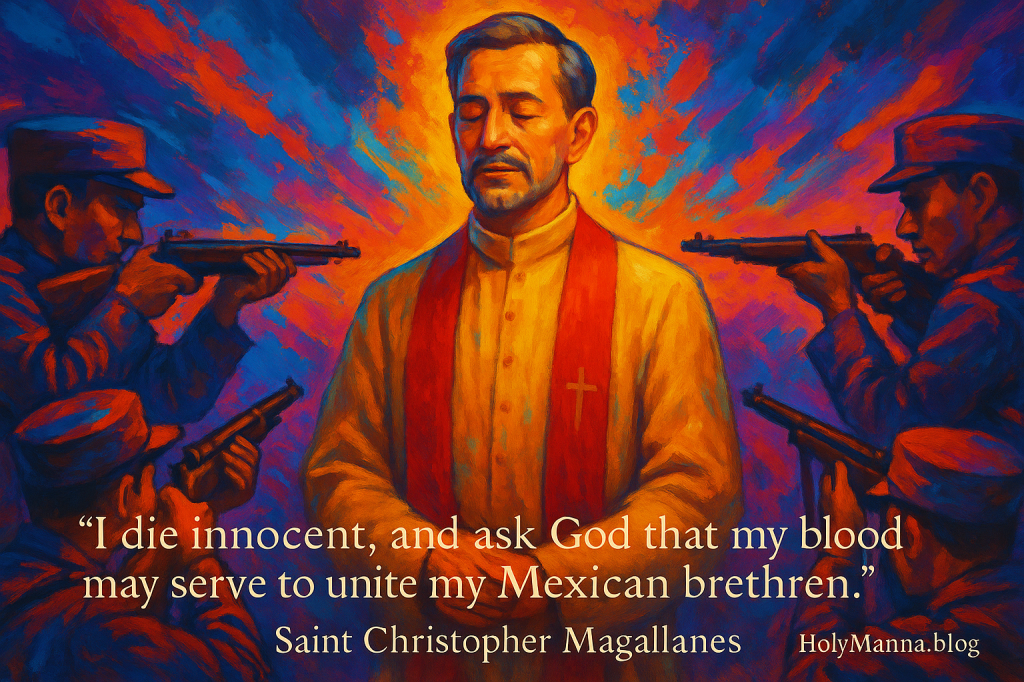
The Courageous Shepherd of Mexico
In the shadow of political tyranny and religious oppression, one man stood tall—Saint Christopher Magallanes, a Mexican priest whose courage and fidelity to Christ ignited a fire of faith that could not be extinguished. His name is forever linked to the Cristero War, a violent conflict in 1920s Mexico where the Catholic Church was violently suppressed. Though born of humble origins, Fr. Magallanes rose to become not just a parish priest but a defender of the truth, a father to the oppressed, and a spiritual general on the frontlines of persecution. What makes him so revered today is not only his brave defiance of unjust laws, but also his deep love for his people and his unwavering devotion to God’s call—even unto death. Canonized by Pope John Paul II in the year 2000, he reminds us all that the blood of the martyrs is the seed of the Church. His feast day, observed on May 21st, is a call to remember the cost of discipleship and the beauty of a faith that never surrenders.
Seeds of a Shepherd
Born on July 30, 1869, in the small village of Totatiche in Jalisco, Mexico, Christopher Magallanes was the son of poor farmers. His early years were filled with toil and simplicity, working the rugged land of the Sierra Madre Occidental alongside his family. Yet, even in the dirt and hardship of rural life, something sacred was planted within him. As a boy, he was drawn to prayer and the teachings of the Church, and he often lingered after Mass to ask questions about the Scriptures and the saints. That holy curiosity eventually blossomed into a calling. At the age of 19, he entered the seminary at Guadalajara, where he studied theology and philosophy with fervor. Ordained to the priesthood in 1899, he returned to his hometown as its beloved pastor.
But Fr. Magallanes was no ordinary priest. He believed that faith had to be embodied—that the Gospel should touch every corner of human life. He established schools to teach carpentry and agriculture, provided food for the hungry, built a dam to support local farming, and actively evangelized in the mountainous regions inhabited by indigenous communities. His vision of priesthood was deeply incarnational: bringing Christ into the classroom, the field, and the home. His love was pastoral and practical, deeply rooted in service and prayer. He was admired not only for his homilies but for his tireless labor for the poor. In everything he did, he sought to live out the words of The Catechism of the Catholic Church: “The Church’s love for the poor is a part of her constant tradition” (CCC 2444).
As political tensions mounted and the Mexican government outlawed public worship, Fr. Christopher’s fidelity only deepened. He didn’t retreat; he resisted—not with weapons, but with the sacraments, with truth, and with an indomitable heart. In a time when seminaries were shut down, he courageously founded a clandestine one, hiding young seminarians and forming them in the faith under the threat of death. Saint Christopher Magallanes became a father not only to his parish but to a new generation of priests formed in the catacombs of persecution.
Hidden Miracles
Though there are no canonized miracles attributed to Saint Christopher during his earthly life in the traditional sense—no blind eyes opened or lame limbs healed—his very ministry was miraculous in its endurance, boldness, and impact. His miracles were the kind that do not call attention to themselves but instead quietly transform the world. In a time when religious acts were punished with death, he continued to celebrate Mass in secret, hear confessions, and baptize new Christians. He shepherded his flock in caves, barns, and behind closed doors. The hidden seminaries he founded—at enormous personal risk—managed to thrive and produce holy priests in the face of government surveillance and violence. That they survived as long as they did is itself a sign of divine protection and providence.
What also struck many was his gift for discernment and spiritual consolation. Parishioners spoke of how his words seemed to know their hearts. He could calm the most anxious soul with a single glance or a whispered prayer. His homilies were simple but searing, and many remembered how they left church feeling seen, known, and loved by God. He truly embodied the Good Shepherd who lays down his life for his sheep. In every quiet act of service, he revealed the love of Christ—a love that heals not only bodies, but souls.
The Crown of Martyrdom
In 1926, the Mexican government, under President Plutarco Elías Calles, enacted the Calles Law, a piece of legislation that criminalized all expressions of Catholic faith. Public worship, religious education, and even wearing clerical clothing in public became acts punishable by imprisonment or death. The Church was driven underground. Churches were closed, religious orders disbanded, and priests hunted like criminals.
Fr. Christopher was deeply committed to peace. He preached against the use of violence, encouraging his people not to take up arms but to remain steadfast in prayer and love. Nonetheless, his commitment to training new priests in secret led to false accusations of inciting rebellion. On May 21, 1927, while en route to celebrate a clandestine Mass, he was arrested by federal soldiers. He was given no trial, no opportunity to plead his case. His only crime was his love for Christ and the Church.
In prison, Fr. Christopher radiated serenity. He encouraged his fellow prisoners, offered absolution, and prayed unceasingly. Even in the darkest dungeon, his faith was a light to others. On the day of his execution, he refused a blindfold. As he faced the firing squad, he looked directly at his executioners and said: “I die innocent, and ask God that my blood may serve to unite my Mexican brethren.”
He then blessed his killers, forgave them, and was shot. His final act on earth was one of intercession and mercy—a true imitation of Christ on the Cross. Alongside him was Saint Agustín Caloca, a young priest who died with equal valor, saying: “We are here by the will of God and we die for Him.”
Their blood watered the parched soil of the Church in Mexico, and their names were etched into the eternal litany of the saints.
Legacy of Glory
After their deaths, stories began to circulate of soldiers converting after witnessing the serene martyrdom of the priests they killed. Others reported miraculous healings through the intercession of Fr. Magallanes and his companions. Though not all these accounts were formally recognized by the Church, their consistency and devotion inspired a movement of remembrance and hope. Pilgrimages began to his birthplace in Totatiche, where people came to pray at the site of his early ministry. His grave became a place of healing and reconciliation, especially for those struggling with fear, injustice, or priestly vocations.
Over time, devotion to the Cristero Martyrs became a cornerstone of Mexican Catholic identity. Their witness gave rise to a new zeal among the faithful. The underground seminary that Fr. Christopher once directed inspired others to take up the mantle of forming holy priests—even in hostile environments. At his canonization Mass in Rome, the Church officially recognized the enduring fruit of his sacrifice. The Catechism teaches us that “Martyrdom is the supreme witness given to the truth of the faith” (CCC 2473), and Fr. Magallanes gave that witness with every breath.
Today, he is honored not only in Mexico but throughout the world. Churches bear his name, and his feast day is celebrated by clergy and laity alike as a symbol of fidelity under fire. His relics are venerated, and his prayers are sought by those who suffer under tyranny, by seminarians, and by priests facing persecution.
Living the Legacy
The life and death of Saint Christopher Magallanes challenge us to live with courage, to love without compromise, and to serve even when it costs us everything. He reminds us that holiness is not theoretical—it is a lived response to grace, especially in times of trial. He teaches us that the heart of priesthood is self-giving love, and that all Christians are called to witness to Christ, even when it is unpopular, dangerous, or misunderstood.
His story speaks powerfully to us today in a world that often ridicules or sidelines faith. Are we willing to suffer inconvenience, misunderstanding, or even rejection for the sake of the Gospel? Do we respond to persecution with vengeance or with forgiveness? Fr. Christopher shows us a third way: faithful resistance in love. He was not a fighter, but a shepherd. He didn’t curse his enemies—he blessed them. He didn’t hide from his calling—he fulfilled it to the end.
Let us follow his example by deepening our sacramental lives, defending the faith with charity, and mentoring the next generation with hope. Let us never forget that the Church is built not on the powerful, but on the faithful. And may we, like Fr. Christopher, be able to say with joy, “My life is not my own; it belongs to Christ.”
💬 Engage with Us!
What stirs in your heart as you reflect on the life of Saint Christopher Magallanes? We’d love to hear your thoughts in the comments below. Let’s grow in faith together.
✨ Reflection Questions:
- Have I ever been afraid to show my faith publicly? What held me back?
- How can I be more courageous in defending my beliefs in my workplace, school, or family?
- What spiritual or corporal work of mercy can I commit to this week in honor of Saint Christopher?
Let us walk together in faith and support each other, always striving to love as Christ loved—even to the point of sacrifice.
Saint Christopher Magallanes, pray for us!🙏
Follow us on Instagram and Facebook for more insights and reflections on living a faith-filled life.

 Holy Manna!
Leave a comment