Remaining in Christ, Remaining in His Church
There’s a quiet ache in every human heart to belong, to be grafted into something greater than itself—a family, a mission, a love that endures. Today’s readings speak to that deep yearning by reminding us that fruitfulness in the Christian life depends on remaining: remaining in Christ, remaining in communion with His Church, and remaining rooted in truth. We are not called to be solo branches, detached and flailing in the wind. We are called to remain in the Vine, sustained and pruned by the loving hand of the Father, that we might grow into disciples who glorify Him through abundant spiritual fruit.
In the First Reading from Acts 15:1–6, we enter the early Church at a crossroads, wrestling with a profound question: must Gentile converts become Jews—through circumcision and Mosaic Law—to be saved? This wasn’t just a theological quibble; it cut to the core of identity, tradition, and belonging. The Council of Jerusalem becomes a pivotal moment, where unity is preserved through communion with the apostles and presbyters, not through personal opinion or cultural nostalgia. The Church chooses to gather, to discern together under the guidance of the Holy Spirit, and in doing so, shows us that staying rooted in apostolic authority is essential to remaining in Christ.
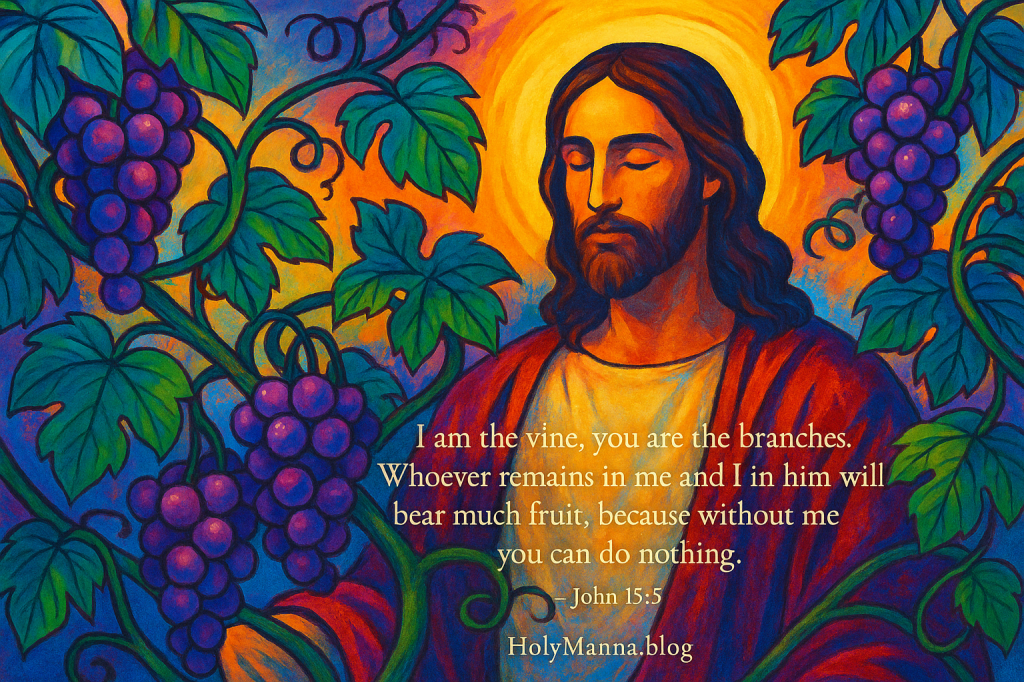
This theme of connection flows beautifully into Psalm 122, which sings of joyful pilgrimage to Jerusalem—the city of unity, justice, and worship. It is within her walls that the tribes gather, not only to give thanks but to be ordered toward the Lord. And in The Gospel of John 15:1–8, Jesus makes this spiritual reality explicit: “I am the vine, you are the branches”. The life of God courses through us only when we remain in Him. Apart from Him, we can do nothing. Just as the early Church bore fruit by remaining in Christ through communal discernment, so too are we called to abide, to stay, and to grow—not apart from the Body, but deeply intertwined with it. Are you rooted today? Or are you resisting the pruning that leads to true growth?
First Reading – Acts 15:1–6
Unity at the Crossroads: Discerning Truth in Community
The Acts of the Apostles, often called the Gospel of the Holy Spirit, narrates the explosive growth of the early Church and the missionary journeys that took the message of Jesus beyond Jewish borders. By chapter 15, the Church faces its first major doctrinal crisis: can Gentiles become full members of the Christian community without first adopting the Mosaic Law, particularly circumcision? This was not merely a question of ritual—it challenged the very identity and unity of the Church. The early Christian community, born from Jewish roots but expanding rapidly among Gentiles, now had to discern how to uphold the integrity of the Gospel while remaining faithful to Christ’s mission of universal salvation. This moment—what becomes the Council of Jerusalem—models for us the necessity of remaining in communion with apostolic authority when discerning complex matters of faith. It ties perfectly into today’s theme: remaining in Christ means remaining within the structure and discernment of His Church.
Acts 15:1-6
New American Bible (Revised Edition)
Council of Jerusalem. 1 Some who had come down from Judea were instructing the brothers, “Unless you are circumcised according to the Mosaic practice, you cannot be saved.” 2 Because there arose no little dissension and debate by Paul and Barnabas with them, it was decided that Paul, Barnabas, and some of the others should go up to Jerusalem to the apostles and presbyters about this question. 3 They were sent on their journey by the church, and passed through Phoenicia and Samaria telling of the conversion of the Gentiles, and brought great joy to all the brothers. 4 When they arrived in Jerusalem, they were welcomed by the church, as well as by the apostles and the presbyters, and they reported what God had done with them. 5 But some from the party of the Pharisees who had become believers stood up and said, “It is necessary to circumcise them and direct them to observe the Mosaic law.”
6 The apostles and the presbyters met together to see about this matter.
Detailed Exegesis
Verse 1 – “Some who had come down from Judea were instructing the brothers, ‘Unless you are circumcised according to the Mosaic practice, you cannot be saved.’”
This verse reveals the source of controversy: Judaizers, Jewish Christians from Judea, were teaching that Mosaic circumcision was necessary for salvation. This was rooted in the covenant of Abraham (cf. Genesis 17:10-14), but their stance revealed a misunderstanding of the new covenant in Christ, which fulfills rather than replicates the Law.
Verse 2 – “Because there arose no little dissension and debate by Paul and Barnabas with them, it was decided that Paul, Barnabas, and some of the others should go up to Jerusalem to the apostles and presbyters about this question.”
The division became serious enough to warrant consultation with the Church’s highest authority. This is a model of humility and ecclesial obedience: even Paul, an apostle and theologian, submits the question to the wider Church for discernment. It’s a powerful witness to the early Church’s commitment to unity and fidelity.
Verse 3 – “They were sent on their journey by the church, and passed through Phoenicia and Samaria telling of the conversion of the Gentiles, and brought great joy to all the brothers.”
Their journey wasn’t just administrative—it was evangelistic. As they passed through Gentile regions, their testimony about conversions brought joy. This reflects how the Holy Spirit was already confirming the legitimacy of Gentile inclusion, preparing hearts for the decision to come.
Verse 4 – “When they arrived in Jerusalem, they were welcomed by the church, as well as by the apostles and the presbyters, and they reported what God had done with them.”
The delegation is received with warmth and openness. They report what God had done, not what they had accomplished—emphasizing divine initiative and providence in the spread of the Gospel.
Verse 5 – “But some from the party of the Pharisees who had become believers stood up and said, ‘It is necessary to circumcise them and direct them to observe the Mosaic law.’”
Here the objection is stated again, but now from Christian Pharisees. These believers were still steeped in a legalistic worldview. This sets the stage for the Church’s decisive clarification of what salvation in Christ entails: not works of the Law, but faith working through love (cf. Galatians 5:6).
Verse 6 – “The apostles and the presbyters met together to see about this matter.”
This marks the first council of the Church—a gathering of bishops and elders to resolve doctrinal disputes through prayerful discernment. It is a biblical affirmation of the Church’s magisterial authority and collegial decision-making, guided by the Holy Spirit.
Teachings
The Council of Jerusalem represents the beginning of what the Church would later articulate as her magisterium—the living teaching office of the Church. The Catechism of the Catholic Church teaches, “The task of interpreting the Word of God authentically has been entrusted solely to the Magisterium of the Church, that is, to the Pope and to the bishops in communion with him” (CCC 100). This principle ensures doctrinal unity and preserves the integrity of faith across time and cultures.
St. Augustine writes of the importance of obedience to the Church’s authority: “I would not believe the Gospel unless the authority of the Catholic Church moved me” (Against the Epistle of Manichaeus, 5.6). In this light, Acts 15 is not just a story of debate—it’s the Spirit-led foundation of ecclesial trust. The apostles, under divine guidance, navigate complex cultural and theological differences to proclaim the freedom and universality of the Gospel.
Historically, this moment foreshadowed all future ecumenical councils, including Nicaea, Trent, and Vatican II. Each gathered under the same authority and guidance to resolve doctrinal issues and protect the unity of the faith. It also clarifies what salvation is not: it is not conformity to cultural norms or human rituals, but grace through faith in Jesus Christ, within the communion of His Church. This is the same truth proclaimed throughout the centuries in every sacrament, every catechesis, and every Eucharist.
Reflection
This reading challenges us to consider how we respond to disagreement, complexity, or tradition in our own walk with Christ. Are we quick to lean on our personal opinions or preferences, or do we seek guidance from the Church and those with wisdom in the faith? Like Paul and Barnabas, are we willing to take our questions to the heart of the Church, to be taught and pruned?
In our polarized world, this passage offers a blueprint for discerning truth in love: through community, dialogue, and fidelity to the apostolic tradition. It also invites us to trust that the Holy Spirit is truly at work in the Church—even when decisions require patience or humility. What area of your life needs to be brought into deeper communion with the Church today? Remaining in Christ is not a solitary act; it is a communal one, lived out in obedience, unity, and love.
Are you rooted in the teachings of Christ’s Church—or just reaching for fruit without the Vine?
Responsorial Psalm – Psalm 122:1–5
The Joy of Belonging: Ascending Toward Unity
Psalm 122 is one of the “Songs of Ascents,” a collection of psalms (Psalms 120–134) sung by pilgrims journeying up to Jerusalem for the great Jewish feasts. It captures the awe, longing, and joy of arriving at the Holy City—a place not just of architecture and history, but of spiritual communion and justice. For ancient Israel, Jerusalem symbolized unity: the city where the tribes came together to worship the Lord, the seat of the Davidic throne, and the location of the Temple, where heaven touched earth. In the context of today’s readings, this psalm complements the account from Acts 15 and the words of John 15 by emphasizing the joy and spiritual security that comes from remaining in the place God has established—whether that’s the physical city of Jerusalem or the spiritual household of the Church. Are our hearts filled with joy at the thought of dwelling in God’s house and living in harmony with His people?
Psalm 122:1-5
New American Bible (Revised Edition)
A Pilgrim’s Prayer for Jerusalem
1 A song of ascents. Of David.
I rejoiced when they said to me,
“Let us go to the house of the Lord.”
2 And now our feet are standing
within your gates, Jerusalem.
3 Jerusalem, built as a city,
walled round about.
4 There the tribes go up,
the tribes of the Lord,
As it was decreed for Israel,
to give thanks to the name of the Lord.
5 There are the thrones of justice,
the thrones of the house of David.
Detailed Exegesis
Verse 1 – “I rejoiced when they said to me, ‘Let us go to the house of the Lord.’”
The psalmist expresses joy not just at arriving in Jerusalem, but even at the invitation to journey there. This reveals a heart oriented toward worship and communion. In the same way, we are called to rejoice when invited to the sacraments, to Mass, and to community prayer—these are our pilgrimages into the Lord’s house.
Verse 2 – “And now our feet are standing within your gates, Jerusalem.”
Having arrived, the pilgrim stands within the sacred boundaries of the holy city. This is not only a physical arrival but a spiritual one—standing in God’s presence and in unity with His people. This image echoes our own spiritual progress when we stand firm within the Church, participating in its sacramental life.
Verse 3 – “Jerusalem, built as a city, walled round about.”
This verse praises the design and strength of Jerusalem, seen as both beautiful and secure. The city was a symbol of unity and divine order. Likewise, the Church—often called the “New Jerusalem”—is built upon the foundation of the apostles, with Christ as the cornerstone (cf. Ephesians 2:20), offering spiritual protection and coherence.
Verse 4 – “There the tribes go up, the tribes of the Lord, as it was decreed for Israel, to give thanks to the name of the Lord.”
This line highlights the communal and covenantal dimension of worship. All twelve tribes—diverse and spread across the land—would ascend together in obedience to God’s law. It mirrors how Catholics today, from every nation and language, gather at the altar to give thanks, fulfilling their baptismal calling.
Verse 5 – “There are the thrones of justice, the thrones of the house of David.”
Jerusalem was not only the religious center but also the seat of justice. God’s rule was expressed through the Davidic dynasty, a type of Christ’s eternal kingship. The Church, guided by Christ the King and shepherded by apostolic authority, continues to be the place where mercy and justice meet.
Teachings
Psalm 122 teaches that worship is not a solitary endeavor but a communal ascent. The Catechism reminds us that “It is in the Church, in communion with all the baptized, that the Christian fulfills his vocation” (CCC 2030). Just as the tribes of Israel journeyed together to give thanks, so are we called to live out our faith in the community of believers, under the guidance of the Magisterium and nourished by the sacraments.
St. Cyprian of Carthage famously wrote, “He can no longer have God for his Father who has not the Church for his mother” (On the Unity of the Church, 6). The walls of Jerusalem, built for unity and protection, reflect the structure of the Church, which guards the deposit of faith and invites all into communion. Remaining within her gates is not confinement, but freedom—a freedom to live in truth, worship rightly, and bear fruit as disciples of Christ.
Throughout history, the Church has been seen as the fulfillment of the heavenly Jerusalem. The Second Vatican Council teaches, “The Church is the place where humanity must rediscover its unity and salvation” (Gaudium et Spes, 1). Like the joyful pilgrim of Psalm 122, we too are called to ascend—to rise above division, skepticism, or indifference—and enter into the joy of belonging to the house of the Lord. Every Mass is our spiritual Jerusalem; every “Amen” a step toward unity in Christ.
Reflection
This psalm reminds us to reflect on our attitude toward communal worship and Church life. Do we rejoice when invited to the house of the Lord, or do we grumble, delay, or isolate? Joyful participation in the Church’s liturgy is not just an obligation—it’s our homecoming, our ascent toward heaven. When we understand the Mass as the new Jerusalem, our hearts begin to burn with the same desire as the psalmist’s.
In a world that often values individualism and spiritual consumerism, Psalm 122 calls us back to the beauty of the gathered people of God. What would it look like for you to embrace your role within the Body of Christ more deeply this week? Whether that means attending daily Mass, reaching out to someone at your parish, or spending time in Eucharistic adoration, take a step toward the gates of the Lord’s house.
Are your feet standing within the walls of Jerusalem—or are you still lingering at a distance?
Holy Gospel – John 15:1–8
Remain in Me: The Vine That Gives Life
These words of Jesus come from His Farewell Discourse in the Gospel of John, chapters 13 through 17, spoken during the Last Supper. In this intimate setting, Jesus prepares His disciples for His departure by offering them not just comfort but deep spiritual instruction. The image of the vine and the branches is drawn from Old Testament imagery—Israel was often described as a vine that God had planted (cf. Isaiah 5:1–7, Psalm 80). But here, Jesus declares something radical: “I am the true vine”. In doing so, He redefines the source of covenantal life, no longer as ethnic or ritual belonging to Israel, but as a living, organic communion with Himself. This passage not only affirms Jesus’ divinity and central role in salvation but also offers a clear and compelling call to remain in Him if we are to bear fruit. In light of today’s theme, this Gospel passage shows us that remaining in Christ is the heart of discipleship, and that such communion is expressed and safeguarded through life in the Church.
John 15:1-8
New American Bible (Revised Edition)
The Vine and the Branches. 1 “I am the true vine, and my Father is the vine grower. 2 He takes away every branch in me that does not bear fruit, and every one that does he prunes so that it bears more fruit. 3 You are already pruned because of the word that I spoke to you. 4 Remain in me, as I remain in you. Just as a branch cannot bear fruit on its own unless it remains on the vine, so neither can you unless you remain in me. 5 I am the vine, you are the branches. Whoever remains in me and I in him will bear much fruit, because without me you can do nothing. 6 Anyone who does not remain in me will be thrown out like a branch and wither; people will gather them and throw them into a fire and they will be burned. 7 If you remain in me and my words remain in you, ask for whatever you want and it will be done for you. 8 By this is my Father glorified, that you bear much fruit and become my disciples.
Detailed Exegesis
Verse 1 – “I am the true vine, and my Father is the vine grower.”
Jesus identifies Himself as the true vine—emphasizing that all life-giving connection flows through Him, surpassing the symbolic vine of Israel. God the Father is the one who tends, nurtures, and prunes. This verse introduces the profound Trinitarian dynamic of divine intimacy and care, setting the tone for the entire teaching.
Verse 2 – “He takes away every branch in me that does not bear fruit, and every one that does he prunes so that it bears more fruit.”
The Father’s love is not passive—it is transformative. Branches that bear no fruit are cut off, while those that do are pruned, sometimes painfully, to bear more. This is a warning and a comfort. It challenges spiritual complacency and affirms that suffering, when united to God, becomes fruitful purification.
Verse 3 – “You are already pruned because of the word that I spoke to you.”
Christ’s word has a cleansing power. By listening to and internalizing His teaching, the disciples have already been prepared. This verse affirms the sanctifying power of the Word of God, a theme echoed in Hebrews 4:12 and CCC 103: “The Church has always venerated the Scriptures as she venerates the Lord’s Body”.
Verse 4 – “Remain in me, as I remain in you. Just as a branch cannot bear fruit on its own unless it remains on the vine, so neither can you unless you remain in me.”
This is the heart of the passage. The word “remain” (Greek: meno) is repeated often in this chapter and implies deep, ongoing communion. Just as a branch cut off from a vine will wither and die, so too the soul detached from Christ becomes spiritually barren. The verse invites ongoing intimacy, not one-time belief.
Verse 5 – “I am the vine, you are the branches. Whoever remains in me and I in him will bear much fruit, because without me you can do nothing.”
Jesus reinforces our identity and dependence. We are not self-sustaining. All spiritual fruit—virtue, mission, holiness—flows from union with Him. This verse humbles us and dismantles any illusions of self-reliance in the spiritual life.
Verse 6 – “Anyone who does not remain in me will be thrown out like a branch and wither; people will gather them and throw them into a fire and they will be burned.”
Here Jesus offers a sober warning: to reject Him is to embrace spiritual death. The image of fire recalls judgment. This verse emphasizes that remaining in Christ is not optional for disciples; it is essential for eternal life.
Verse 7 – “If you remain in me and my words remain in you, ask for whatever you want and it will be done for you.”
Union with Christ aligns our desires with His. When His Word shapes our hearts, our petitions become conformed to His will. This is not a blank check, but a promise that prayer flowing from deep communion is powerful and effective.
Verse 8 – “By this is my Father glorified, that you bear much fruit and become my disciples.”
God is glorified not simply by our belief, but by the fruit that belief bears. Discipleship is proven in fruitfulness—charity, humility, courage, service. This final verse shows that remaining in Christ is not a passive state but an active, fruitful life.
Teachings
The Catechism teaches that “Communion with Jesus is the source of all spiritual fruitfulness” (CCC 2074). This passage from John 15 is perhaps the clearest Gospel articulation of that truth. It reminds us that sanctity, mission, and even salvation itself are not the result of our efforts but the overflow of divine life within us—received through grace, sustained through the sacraments, and expressed through love.
St. Teresa of Avila writes, “All blessings come to us through our Lord. He will teach us, for in beholding His life we find that He is the best example” (The Way of Perfection, ch. 22). This “beholding” is what it means to remain: not just to glance at Jesus occasionally, but to dwell in Him continually. Saints bear fruit not because they are great, but because they remain attached to the Vine in faith and prayer.
The Church herself is the vineyard of the Lord, as described in Lumen Gentium 6: “The Church, accordingly, is seen as a cultivated field, the tillage of God… the true vine is Christ who gives life and fruitfulness to the branches, that is, to us, who through the Church remain in Christ”. Remaining in Christ is not merely private devotion but ecclesial fidelity. Just as the branches must remain in the vine, so too must we remain in the Church Christ established to bear lasting fruit.
Reflection
This Gospel calls us to examine whether we are truly remaining in Christ—or simply visiting Him from time to time. Do we abide in Him through daily prayer, reception of the sacraments, and faithfulness to His Word? Do we allow ourselves to be pruned through trials, correction, and the demands of love, or do we resist the Gardener’s hand?
Remaining in Christ also calls for perseverance. When we feel dry or distant, when prayer is difficult or suffering tempts us to despair, these are the moments when remaining matters most. Are we willing to stay, even when it costs something? It is only by staying close to the Vine that we learn to love like Him, serve like Him, and suffer with Him.
What kind of fruit is your life producing? If the answer is unclear or painful, don’t despair—run to the Vine. Let His Word cleanse you, let His Church nourish you, and let His Spirit bear fruit in you. Without Him, we can do nothing—but with Him, even our wounds can become wine.
Grafted Into Glory: Remaining Where Life Flows
From the council halls of Jerusalem to the pilgrim’s joyful arrival in Zion, and finally to the intimacy of the Upper Room, today’s readings form a powerful symphony of unity, fidelity, and divine intimacy. Acts 15 shows us a Church that discerns truth together, remaining anchored in the apostolic foundation established by Christ. Psalm 122 sings of the joy and peace found in the house of the Lord—where all tribes ascend as one, and where justice and worship meet. John 15 draws the image inward, reminding us that we are not merely invited guests in the Lord’s house—we are living branches, invited to remain in the Vine and bear eternal fruit.
What ties all of these together is the call to remain. To stay rooted when the world demands change. To abide in love when division is easier. To seek communion when individualism tempts us to isolate. We remain in Christ when we trust His Church, when we enter joyfully into communal worship, and when we allow His Word and sacraments to shape every part of our lives. This is not passive waiting—it is active, fruitful discipleship.
How is God inviting you to remain in Him today? Perhaps He is calling you to deeper trust in the Church, renewed fervor in the Eucharist, or a quiet return to daily prayer. Wherever you find yourself, remember that the Vine never lets go of the branch first. He remains. Always. Now it’s our turn. Will you remain with Him and let your life bear fruit that glorifies the Father?
Engage with Us!
We’d love to hear how God is speaking to your heart through today’s readings. Share your thoughts, experiences, or prayers in the comments below! Whether you’re wrestling with a verse, feeling inspired, or have a testimony of how you’re learning to remain in Christ, your voice is a gift to this community. Let’s grow together in faith, rooted in the Word and alive in the Spirit.
Reflection Questions
First Reading – Acts 15:1–6
How do I respond when faced with tension or disagreement within the Church or among fellow believers? Am I willing to seek truth in communion with the Church, or do I try to resolve spiritual questions on my own?
Responsorial Psalm – Psalm 122:1–5
Do I rejoice when called to enter into worship and community with others? What steps can I take to build unity in my parish, family, or faith circles this week?
Holy Gospel – John 15:1–8
Am I truly remaining in Christ, or am I living disconnected from the Vine? What pruning is the Father doing in my life right now—and how am I responding to it?
Stay rooted, brothers and sisters. Let His Word dwell in you richly, let His love prune and shape you, and let every step be taken with the mercy, courage, and compassion of Jesus. Remain in Him—and your life will bear fruit that lasts.
Follow us on Instagram and Facebook for more insights and reflections on living a faith-filled life.

 Holy Manna!
Leave a comment