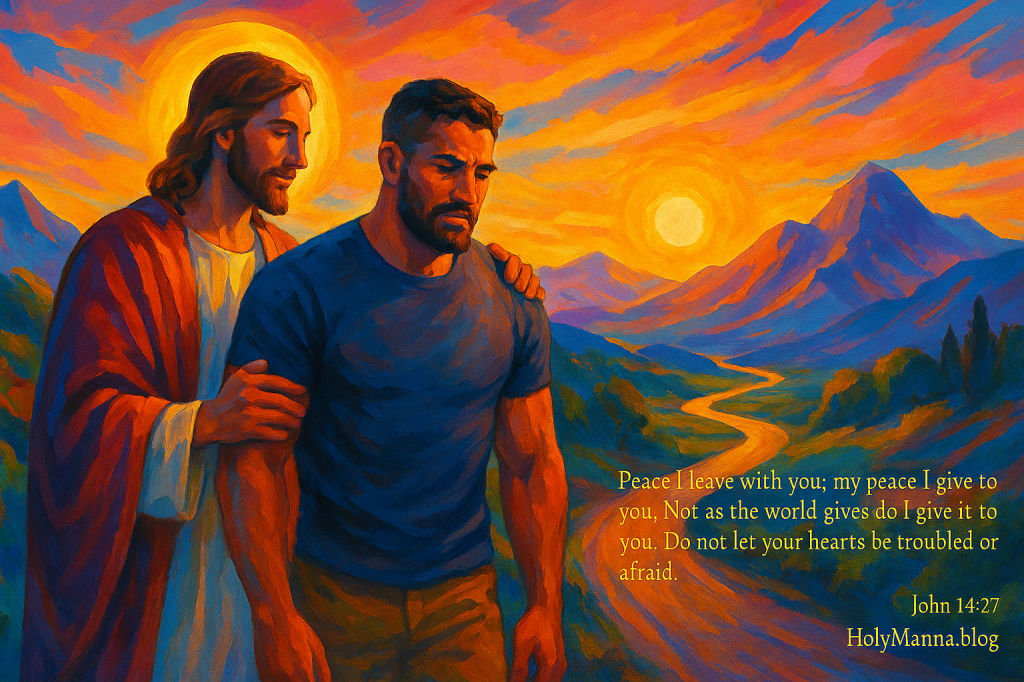
Peace in the Fire
Have you ever felt like doing the right thing only made life harder? Like every step of faith seemed to invite resistance, misunderstanding, or even pain? Today’s Mass readings speak straight into that tension, offering not only an honest look at the trials of discipleship but a radiant hope rooted in the peace of Christ. Through the bloody stones hurled at Paul, the victorious praise of Psalm 145, and the serene yet firm words of Jesus in The Gospel of John, we are reminded that suffering is not a detour—it’s part of the road to glory.
In the first reading from Acts 14:19–28, we meet Paul at one of the lowest physical points of his ministry—stoned, presumed dead, and dragged out of the city. And yet, not only does he rise again, but he doubles down on his mission, strengthening believers and courageously proclaiming: “It is necessary for us to undergo many hardships to enter the kingdom of God”. These were no empty words. For early Christians, persecution was an expected cost of following Christ. Yet amid this pain, we also witness the birth and growth of the Church, nourished by prayer, fasting, and trust in the Lord’s grace. This wasn’t just historical fact—it was fulfillment of Jesus’ promise that His Church would endure (cf. Matthew 16:18).
That promise is anchored in today’s Gospel (John 14:27–31), where Christ speaks peace into the storm before it arrives. “Peace I leave with you; my peace I give to you. Not as the world gives do I give it to you”—these words become a spiritual weapon for every believer who suffers for the sake of the Kingdom. Jesus isn’t offering escape but divine peace: the deep assurance that the Father’s will is good, even when the world rages. As we reflect on this message, Psalm 145 reminds us that God’s dominion endures through all generations and that “The Lord is trustworthy in all his words, and loving in all his works”. Taken together, these readings challenge us to embrace hardship with praise on our lips and courage in our hearts. Are you willing to follow Christ even when the path is marked with suffering?
First Reading – Acts 14:19–28
Rising Through the Stones
The Acts of the Apostles is often referred to as the Gospel of the Holy Spirit, chronicling the early Church’s explosive growth, missionary journeys, and fierce trials after Christ’s Ascension. Today’s passage comes from the closing segment of Paul’s first missionary journey with Barnabas. They have journeyed through what is now modern-day Turkey, proclaiming the Gospel in synagogues, towns, and cities, and facing opposition at nearly every stop. In this section, Paul is not just rejected—he is physically assaulted and left for dead outside the city of Lystra. Yet, through this brutal event, the resilience and power of the early Christian mission shines all the more brightly. This reading directly ties into today’s theme: suffering for the Gospel is not a sign of failure, but a path to transformation. It is precisely through persecution that the Church grows and faith is strengthened.
Acts 14:19-28
New American Bible (Revised Edition)
19 However, some Jews from Antioch and Iconium arrived and won over the crowds. They stoned Paul and dragged him out of the city, supposing that he was dead. 20 But when the disciples gathered around him, he got up and entered the city. On the following day he left with Barnabas for Derbe.
End of the First Mission. 21 After they had proclaimed the good news to that city and made a considerable number of disciples, they returned to Lystra and to Iconium and to Antioch. 22 They strengthened the spirits of the disciples and exhorted them to persevere in the faith, saying, “It is necessary for us to undergo many hardships to enter the kingdom of God.” 23 They appointed presbyters[a] for them in each church and, with prayer and fasting, commended them to the Lord in whom they had put their faith. 24 Then they traveled through Pisidia and reached Pamphylia. 25 After proclaiming the word at Perga they went down to Attalia. 26 From there they sailed to Antioch, where they had been commended to the grace of God for the work they had now accomplished. 27 And when they arrived, they called the church together and reported what God had done with them and how he had opened the door of faith to the Gentiles. 28 Then they spent no little time with the disciples.
Verse-by-Verse Exegesis
Verse 19 – “However, some Jews from Antioch and Iconium arrived and won over the crowds. They stoned Paul and dragged him out of the city, supposing that he was dead.”
This verse highlights the fierce opposition that followed Paul from city to city. The Jews from Antioch and Iconium had previously rejected the Gospel, and their arrival in Lystra leads to Paul being stoned—one of the harshest punishments under Jewish custom, typically reserved for blasphemers. That Paul is “supposed dead” indicates how violent the attack was. This moment mirrors the persecution Jesus Himself endured and sets the tone for the life of every disciple: the Gospel is a call to the cross before the crown.
Verse 20 – “But when the disciples gathered around him, he got up and entered the city. On the following day he left with Barnabas for Derbe.”
Miraculously, Paul survives. His return to the city that had just tried to kill him reveals both divine intervention and an astonishing fearlessness. The gathering of disciples around him may even have included prayer, possibly a scene of healing. Paul’s resilience in immediately continuing the mission reminds us of Christ’s own rising after rejection and death.
Verse 21 – “After they had proclaimed the good news to that city and made a considerable number of disciples, they returned to Lystra and to Iconium and to Antioch.”
Paul and Barnabas do not avoid the cities that had rejected and attacked them. Instead, they return to confirm the fledgling Christian communities. This is missionary courage in action—a testimony that evangelization means both proclamation and perseverance.
Verse 22 – “They strengthened the spirits of the disciples and exhorted them to persevere in the faith, saying, ‘It is necessary for us to undergo many hardships to enter the kingdom of God.’”
This verse forms the heart of the reading. The Christian journey is not free from hardship—in fact, hardship is a necessary part of entering the kingdom. Paul’s words are not pessimistic but realistic and deeply hopeful. The phrase “It is necessary” (Greek: dei) recalls Jesus’ own statement in Luke 24:26: “Was it not necessary that the Messiah should suffer these things and enter into his glory?”
Verse 23 – “They appointed presbyters for them in each church and, with prayer and fasting, commended them to the Lord in whom they had put their faith.”
This verse marks a foundational moment in the development of Church structure. Presbyters (the early form of what would become the priesthood) are appointed to lead local churches. This affirms apostolic succession and the importance of prayer, fasting, and discernment in ecclesial appointments. It also shows Paul and Barnabas entrusting the churches not to themselves, but to God.
Verse 24 – “Then they traveled through Pisidia and reached Pamphylia.”
This brief travel note connects the journey geographically and shows the continued forward motion of the mission. Every city becomes a seedbed for new Christian life.
Verse 25 – “After proclaiming the word at Perga they went down to Attalia.”
Again, the mission continues. Despite physical suffering, they never abandon their proclamation. Each city is a testimony to the living Word.
Verse 26 – “From there they sailed to Antioch, where they had been commended to the grace of God for the work they had now accomplished.”
This verse returns us to the starting point. Antioch was the launching pad for their mission, and now it is the site of testimony. Their journey ends as it began—with grace.
Verse 27 – “And when they arrived, they called the church together and reported what God had done with them and how he had opened the door of faith to the Gentiles.”
This is a moment of great rejoicing. The door of faith is now open to the Gentiles—a radical development in salvation history. It is not their effort that is praised but what God has done through them. This line echoes the joyful praise of Psalm 145, declaring God’s reign across all peoples and generations.
Verse 28 – “Then they spent no little time with the disciples.”
After the storm, rest. Paul and Barnabas remain with the community, offering further teaching, presence, and love. Ministry is not only about moving forward—it is also about being rooted in communion.
Teachings
The Catechism of the Catholic Church teaches us that suffering is not meaningless but has redemptive value when united with Christ. CCC 618 declares: “The cross is the unique sacrifice of Christ, the ‘one mediator between God and men.’ But because in His incarnate divine person He has in some way united Himself to every man, ‘the possibility of being made partners, in a way known to God, in the paschal mystery’ is offered to all men.” Paul’s stoning and perseverance reflect this profound truth: we participate in Christ’s redemptive suffering when we remain faithful in trial.
St. John Chrysostom once preached on the perseverance of the apostles: “Do not think it is a small thing to fall into dangers every day, to be scourged, to be stoned, to be dragged, to be led away, to be beheaded, to be crucified. This is the crown of victory, not punishment.” The early Church Fathers recognized what Paul himself declared: these sufferings are not defeats but crowns.
Historically, the courage of the apostles laid the groundwork for the rapid expansion of the Church despite persecution from both Jews and Romans. The very fact that Paul and Barnabas returned to hostile cities shows the boldness of early Christianity. As Lumen Gentium notes: “The Church, while it slowly grows, is continually led by the Holy Spirit through the way of the cross.” (LG 8). This first missionary journey is both blueprint and prophecy for the Church in every age.
Reflection
This reading pierces through any illusions we may hold about a comfortable Christianity. Following Christ will involve sacrifice, and possibly rejection, suffering, or even humiliation. But it also brings an unshakeable peace and purpose. Like Paul, we are called to rise after being struck down, to encourage one another, and to trust that even our hardships are forming us for the kingdom. Are there ways in your life where you’ve faced hardship for doing what is right or faithful? How might God be using that very trial to strengthen your witness?
We are also reminded that the mission of the Church is communal. Paul doesn’t work alone—he travels with Barnabas, gathers disciples, appoints presbyters, and returns to report to the Church. How can we lean more into the support of our faith communities in difficult times? Perhaps today, the Lord is inviting you to endure a hardship not with grumbling, but with courage—and with the knowledge that this, too, is part of entering the Kingdom of God.
Responsorial Psalm – Psalm 145:10–13, 21
Praise that Perseveres
Psalm 145 is a majestic hymn of praise attributed to King David, celebrating the eternal kingship, mercy, and might of the Lord. It is an acrostic poem, with each verse beginning with a successive letter of the Hebrew alphabet—symbolizing the completeness of God’s glory and faithfulness. Today’s selected verses are drawn from the heart of this psalm and echo the central message of the other readings: in the face of adversity and suffering, God remains worthy of praise, and His dominion is everlasting. While Paul and Barnabas face rejection and persecution in Acts, their trust in God’s providence is mirrored by the psalmist’s unwavering confidence. This liturgical response lifts our eyes toward the reign of God that transcends all earthly trials and invites us to participate in the eternal praise of His name.
Psalm 145:10-13, 21
New American Bible (Revised Edition)
10 All your works give you thanks, Lord
and your faithful bless you.
11 They speak of the glory of your reign
and tell of your mighty works,
12 Making known to the sons of men your mighty acts,
the majestic glory of your rule.
13 Your reign is a reign for all ages,
your dominion for all generations.
The Lord is trustworthy in all his words,
and loving in all his works.
21 My mouth will speak the praises of the Lord;
all flesh will bless his holy name forever and ever.
Verse-by-Verse Exegesis
Verse 10 – “All your works give you thanks, Lord and your faithful bless you.”
This verse affirms the universality of God’s glory. Not only humans, but all of creation—“all your works”—responds to God’s goodness. The “faithful,” those who endure in trust and obedience, offer a special kind of blessing, one that is both conscious and chosen. This is a key connection to the perseverance seen in Acts 14; even in hardship, the faithful are called to bless and not curse.
Verse 11 – “They speak of the glory of your reign and tell of your mighty works,”
The faithful are not silent—they testify. Their praise has both vertical (adoration to God) and horizontal (evangelization) dimensions. In a world where God’s rule is often challenged or hidden behind suffering, speaking of His glory becomes a countercultural act of courage.
Verse 12 – “Making known to the sons of men your mighty acts, the majestic glory of your rule.”
This verse emphasizes witness. Just as Paul and Barnabas “reported what God had done with them” to the Church, the psalmist calls the faithful to make God’s deeds known publicly. God’s rule is not abstract—it is revealed in tangible acts of salvation, healing, and provision.
Verse 13 – “Your reign is a reign for all ages, your dominion for all generations. The Lord is trustworthy in all his words, and loving in all his works.”
Here lies the eternal foundation of our hope. Unlike worldly kingdoms, God’s reign is timeless and faithful. In suffering, when all else feels unstable, this verse anchors the soul. “The Lord is trustworthy in all his words” means we can rely on every promise of Christ, including the promise of His peace and final victory.
Verse 21 – “My mouth will speak the praises of the Lord; all flesh will bless his holy name forever and ever.”
The psalmist’s personal commitment opens into a universal hope: that “all flesh” will one day join in the eternal praise of God. This is eschatological—pointing to the fulfillment of all things in Christ. It anticipates the day when every hardship will be swallowed by glory, and all creation will sing in unison.
Teachings
The Catechism of the Catholic Church reminds us that praise is the highest form of prayer. In CCC 2639 we read: “Praise is the form of prayer which recognizes most immediately that God is God. It lauds God for his own sake and gives him glory quite beyond what he does, but simply because HE IS.” Psalm 145 calls us into this kind of prayer—praise that doesn’t wait for good circumstances, but flows from the knowledge of who God is: eternal, trustworthy, and loving.
St. Augustine, reflecting on the Psalms, wrote: “To praise God is nothing other than to be united with the heavenly choir… and when we are in pain and still praise, we are angels on earth.” This insight helps us understand the psalmist’s resolve to speak the Lord’s praises amid trials. In the context of Paul’s suffering in Acts, praise becomes a weapon against despair and a witness to the joy that suffering cannot steal.
Historically, psalms like this were sung during pilgrimages to the Temple and in synagogue worship. They trained the hearts of God’s people to view history—not through the lens of current suffering—but through the lens of God’s unshakeable reign. In Christian liturgy, Psalm 145 continues to form our souls in trust, orienting our worship toward heaven, even when the road on earth is marked by hardship. Its refrain calls every generation to echo Paul’s words: “It is necessary for us to undergo many hardships to enter the kingdom of God.”
Reflection
Psalm 145 invites us to make praise a daily habit, especially when we face suffering or discouragement. When things feel unstable, we are reminded that God’s dominion is not shaken, and His love endures. What might it look like to praise God today in the midst of something painful or unresolved? Rather than waiting for the storm to pass, we are called to lift our voices now, joining the saints and angels who never cease singing.
Our mouths are meant to speak the praises of the Lord, even when our hearts are heavy. How can you cultivate a spirit of praise that overflows into your speech, your attitude, and your relationships? Perhaps this week, you might memorize part of this psalm or sing it aloud during prayer. Let your praise become a declaration: that the reign of God is present even when unseen, and that His loving works endure in every generation—including ours.
Holy Gospel – John 14:27–31
The Peace That Withstands the Cross
These verses from The Gospel of John come from Jesus’ Farewell Discourse during the Last Supper—His final and most intimate teaching to His disciples before the Passion. In the face of imminent suffering and death, Jesus speaks with calm, unwavering authority about peace, obedience, and trust in the Father. Unlike the synoptic Gospels, John emphasizes the divine identity and mission of Christ through theological depth and spiritual intimacy. Today’s Gospel fits seamlessly into the theme of persevering through suffering with divine peace, echoing what Paul lived in Acts 14 and what the psalmist proclaimed in Psalm 145. Jesus prepares His followers not by promising escape from trial, but by bestowing a gift the world cannot give: His peace. As opposition closes in, He remains resolute in love for the Father and in fulfilling the mission entrusted to Him—a model for all believers enduring tribulation.
John 14:27-31
New American Bible (Revised Edition)
27 Peace I leave with you; my peace I give to you. Not as the world gives do I give it to you. Do not let your hearts be troubled or afraid. 28 You heard me tell you, ‘I am going away and I will come back to you.’ If you loved me, you would rejoice that I am going to the Father; for the Father is greater than I. 29 And now I have told you this before it happens, so that when it happens you may believe. 30 I will no longer speak much with you, for the ruler of the world[c] is coming. He has no power over me, 31 but the world must know that I love the Father and that I do just as the Father has commanded me. Get up, let us go.
Verse-by-Verse Exegesis
Verse 27 – “Peace I leave with you; my peace I give to you. Not as the world gives do I give it to you. Do not let your hearts be troubled or afraid.”
Jesus offers His disciples peace—not a mere absence of conflict, but the fullness of shalom: harmony, completeness, and communion with God. His peace is radically different from the fleeting, conditional peace the world offers. This is a divine interior stillness that remains even amid chaos. The double imperative—“Do not let your hearts be troubled or afraid”—echoes throughout Scripture (cf. Isaiah 41:10, Philippians 4:6), inviting trust over fear.
Verse 28 – “You heard me tell you, ‘I am going away and I will come back to you.’ If you loved me, you would rejoice that I am going to the Father; for the Father is greater than I.”
Jesus invites His disciples into a deeper love—one that rejoices even when love seems to require absence. His return to the Father is not abandonment but glorification. The phrase “the Father is greater than I” does not deny Christ’s divinity but reflects the mystery of the Trinity: in His human nature, Christ submits to the Father, pointing to the source of divine mission and love.
Verse 29 – “And now I have told you this before it happens, so that when it happens you may believe.”
Jesus forewarns them not to frighten, but to deepen faith. When the Passion unfolds, His words will be a lamp in the darkness. Prophetic foresight becomes a source of later consolation. In this, He shows that suffering, when understood in the light of truth, becomes a catalyst for belief.
Verse 30 – “I will no longer speak much with you, for the ruler of the world is coming. He has no power over me,”
Jesus acknowledges the approach of His betrayal and death. The “ruler of the world” is Satan, who exerts influence over fallen humanity. Yet Christ is not his victim—He states clearly: “He has no power over me.” This declaration affirms Jesus’ authority and divine will. The Passion is not Satan’s victory but God’s fulfillment of redemptive love.
Verse 31 – “But the world must know that I love the Father and that I do just as the Father has commanded me. Get up, let us go.”
The mission of Christ is rooted in love for the Father and obedience to His will. Even the path to the Cross is an act of love. Jesus’ final command—“Get up, let us go”—ushers His disciples into Gethsemane and into the reality of shared suffering. The moment for action has come; faith must now walk with Him into the fire.
Teachings
The Catechism of the Catholic Church explains the divine peace of Christ in CCC 260 with profound clarity: “The ultimate end of the whole divine economy is the entry of God’s creatures into the perfect unity of the Blessed Trinity… God’s purpose is to gather us into His Son’s peace.” Jesus’ gift of peace is not passive—it is a foretaste of eternal communion with God. In suffering, that peace sustains and transforms us.
St. Teresa of Ávila, who endured many trials and mystical sufferings, wrote: “Let nothing disturb you, let nothing frighten you. All things are passing. God never changes. Patience obtains all things. Whoever has God lacks nothing. God alone suffices.” This echoes Christ’s own words in the Gospel today. Her life models the truth that inner peace in Christ does not remove suffering, but reorients the soul in love and obedience.
In the context of salvation history, the Passion was not a defeat but the supreme revelation of God’s love. Jesus’ peaceful obedience to the Father unveils a love that conquers death. As CCC 609 teaches: “By embracing in His human heart the Father’s love for men, Jesus ‘loved them to the end.’ For He so loved us that He freely accepted His Passion and death, in obedience to the Father’s will.” This Gospel moment is thus the hinge upon which the drama of salvation turns—divine peace preceding redemptive suffering.
Reflection
Jesus’ words today invite us to face our own trials with trust rather than fear. Do you believe that Christ’s peace is more powerful than the chaos around you? His invitation is not to a life of ease, but to a heart anchored in Him. We must remember that peace is not the absence of struggle, but the presence of Christ in the midst of it.
When the pressures of the world threaten to overwhelm us, we can recall: “Do not let your hearts be troubled or afraid.” These are not suggestions—they are commands rooted in divine assurance. What if we treated this verse like a daily anchor—repeating it in moments of stress, fear, or temptation? Jesus wants to give us a peace the world cannot touch. He also shows us that obedience to the Father’s will is the path to that peace, even when it leads through suffering.
As you reflect today, ask yourself: Where am I afraid to follow Christ more radically? How can I remain in His peace when the world pulls me in other directions? May we, like Jesus, love the Father so deeply that we are willing to follow His will with courage, even when it costs us everything. “Get up, let us go.”
Peace on the Path of Perseverance
Today’s readings weave a tapestry of courageous witness, unshakable praise, and divine peace. In Acts 14, we walk beside Paul as he is stoned and left for dead—only to rise again and continue proclaiming the Gospel with boldness. His words ring in our ears: “It is necessary for us to undergo many hardships to enter the kingdom of God.” Yet this hardship is not without hope. In Psalm 145, we are reminded that God’s reign is eternal, His works are loving, and His promises are trustworthy. Even when the world shakes, God is unshaken. And in The Gospel of John, Jesus offers His peace—a peace not as the world gives—before walking into the garden of betrayal and the Passion. “Do not let your hearts be troubled or afraid.” His peace doesn’t remove the suffering—it transforms it.
Together, these readings teach us that following Christ means walking through fire with the calm of heaven in our hearts. Hardship is not a sign of abandonment, but a sacred participation in the very life and mission of Jesus. His peace isn’t a fragile feeling, but a gift grounded in obedience to the Father and confidence in the Resurrection. Suffering, when joined to Christ, becomes sanctifying. Praise, when offered in trial, becomes powerful. And peace, when received from Jesus, becomes enduring.
So take heart, dear reader. What stones have been thrown your way lately? What fear has troubled your heart? Christ calls you today to rise with Him, praise the Father, and walk in His peace. Let us pray for the grace to endure our hardships with the faith of Paul, the praise of David, and the peace of Christ. The path is narrow and often hard—but the Kingdom is near, and the King walks with us. Will you rise again today and follow Him?
Engage with Us!
We’d love to hear how today’s readings spoke to your heart. Your journey, insights, and questions can be a light to others walking the same path. Share your reflections in the comments below—let’s grow together as a community rooted in Christ’s peace and strengthened through faith.
Reflection Questions:
First Reading – Acts 14:19–28
When have you experienced hardship for standing firm in your faith?
How can you encourage someone else to persevere in their spiritual walk today?
Responsorial Psalm – Psalm 145:10–13, 21
What mighty works of God have you witnessed in your own life?
How can praise become part of your daily response to both joy and suffering?
Holy Gospel – John 14:27–31
What does the peace of Christ mean to you personally?
Is there an area in your life where you need to let go of fear and trust the Father more fully?
May you go forward today with hearts open to God’s will, minds rooted in His Word, and lives shining with His mercy. Walk the narrow path with courage, speak His praise with joy, and do everything with the love and mercy Jesus taught us. Let your witness be a light to the world—firm, faithful, and full of peace.
Follow us on Instagram and Facebook for more insights and reflections on living a faith-filled life.

 Holy Manna!
Leave a comment