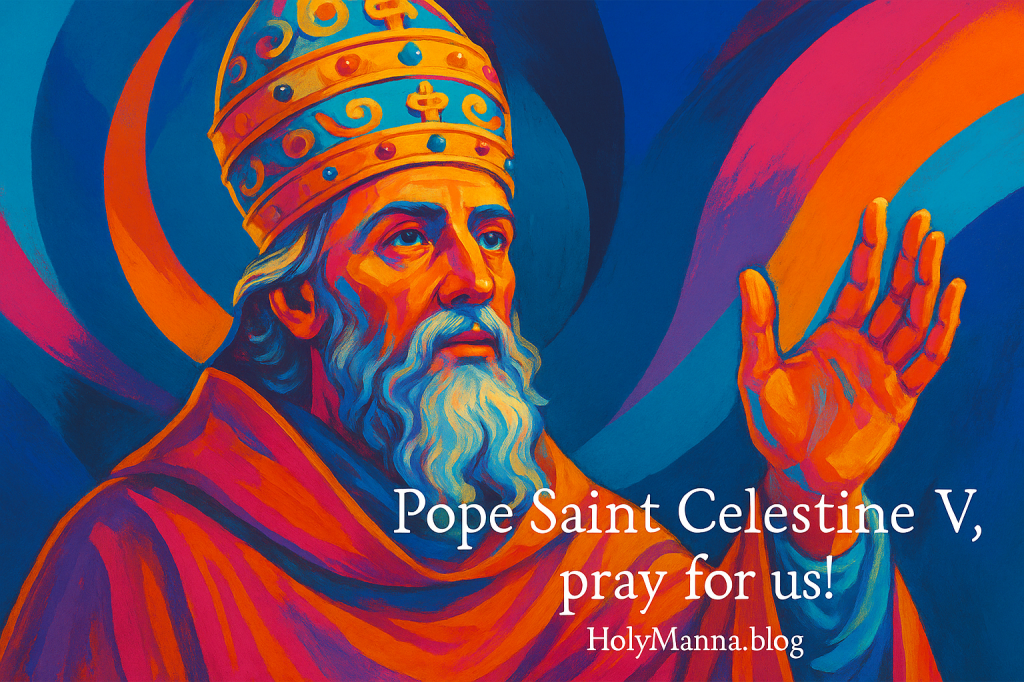
A Saint Between Heaven and Earth
Few saints embody the mystery of divine paradox like Saint Celestine V. He was a hermit who became pope, a mystic drawn to caves who was called to the throne of Peter, and a man who chose obscurity over power in the most radical act of humility the Church had ever seen. His life is a luminous witness to the Beatitudes, especially “Blessed are the poor in spirit” (Matthew 5:3). In an age of corruption and ecclesial politics, Celestine’s holiness shone like a beacon. He is remembered not only for his remarkable ascetic life but also for his historic and saintly resignation from the papacy—an act of courage and surrender to God’s will. Though he reigned as pope for only five months, the legacy of his sanctity and simplicity has endured for over 700 years. His feast day is celebrated on May 19, and he remains a model of humility and spiritual detachment in the face of worldly acclaim.
From the Mountains to the Keys of Heaven
Pietro Angelerio was born in 1209 near Isernia, in the rugged and mountainous region of the Kingdom of Naples. He was the eleventh of twelve children in a devout peasant family, raised in the faith and shaped by poverty and simplicity. Even as a young boy, Pietro displayed a remarkable inclination toward solitude and prayer. After joining a Benedictine monastery and pursuing theological studies, he felt a stronger pull toward the eremitic life. In his twenties, he withdrew to a desolate cave on Mount Morrone in the Abruzzi, where he lived in harsh conditions, fasting, praying, and practicing extreme penance.
His reputation for holiness grew despite his efforts to avoid recognition. Others, inspired by his fervor and spiritual authority, gathered around him. Though he never sought to found a religious order, his followers became the Celestines, a branch of the Benedictines formally approved by the Church in 1264. Pietro led them with discipline and devotion, always emphasizing the need for silence, detachment from the world, and complete abandonment to God’s providence.
In 1294, following a two-year conclave stalemate after the death of Pope Nicholas IV, Pietro—then in his eighties—sent a prophetic letter to the cardinals, warning them of divine judgment if they did not elect a pope. Moved by his holiness and perhaps out of desperation, the cardinals elected him. Despite his initial resistance, Pietro saw the call as God’s will and accepted, becoming Pope Celestine V. It was a dramatic and unprecedented moment: a hermit pope, mounted on a donkey, riding into Naples to be crowned. But the very virtues that made him holy also made him vulnerable in the realm of papal politics. He found himself overwhelmed, manipulated, and deeply uneasy.
Hidden Wonders
While Saint Celestine V is not known for dramatic public miracles like some of the more flamboyant saints, his entire life was seen by contemporaries as infused with the miraculous. The most remarkable “miracle,” in the eyes of many, was his very existence: a man who had renounced everything, living in the harshest conditions, radiating joy, peace, and divine wisdom. His caves became places of pilgrimage during his lifetime. Visitors testified to miraculous healings, conversions of heart, and deliverance from spiritual affliction after spending time in his presence or hearing his counsel.
One tale recounts how he calmed a violent storm with the sign of the cross while traveling with disciples. Another tells of a dying man brought to his mountain retreat who recovered his health after Celestine prayed over him and anointed him with oil. But more than physical healings, it was Celestine’s ability to read hearts, console the desperate, and inspire repentance that made his contemporaries see him as a living conduit of God’s mercy.
His asceticism was also viewed as a kind of miracle. He would go days with only water and herbs, sleep on the bare ground, and still radiate joy and kindness. Those who met him often left convinced they had encountered a man touched by the Divine.
The Weight of the Keys
The greatest hardship of Saint Celestine’s life came not in the mountains, but in the Vatican. Upon accepting the papacy, he was swept into a maelstrom of politics and corruption. Though he tried to govern with simplicity, creating new cardinals and issuing decrees for clerical reform, he lacked the administrative experience needed to govern the Church. Worse, powerful figures, particularly Cardinal Benedetto Caetani, began to exploit his innocence.
Celestine longed for the silence of his cave. The duties of the papacy became an unbearable burden. After much prayer and discernment, he made an astonishing decision—he would resign the papacy. On December 13, 1294, he declared before the Church and the world that he was stepping down, citing his “desire for humility, a purer life, and a clear conscience before God.”
His resignation shocked Christendom. Many accused him of cowardice, but history—and the Church—would recognize it as an act of deep obedience and spiritual clarity. His successor, Pope Boniface VIII, fearing that Celestine could become a rival anti-pope, confined him to a small cell in the castle of Fumone, where he spent the last ten months of his life in prayer, cold, and silence.
He died in 1296, at the age of 87. Though not martyred in the traditional sense, his unjust imprisonment and the suffering he endured for his fidelity to God’s will have led many to see him as a white martyr—a man who died to self, ambition, and finally, to worldly freedom, for the sake of divine truth.
Echoes from Heaven
After his holy death, Saint Celestine V was venerated by the faithful with great devotion. His tomb, located in the Basilica of Santa Maria di Collemaggio in L’Aquila, quickly became a site of pilgrimage. Countless miracles were reported by those who visited his remains. People came seeking healing, deliverance, and hope, and many returned testifying to miraculous recoveries from illnesses, peace after years of torment, and spiritual transformation.
One of the most noted miracles involved a paralyzed child who, after being placed on Celestine’s tomb by desperate parents, rose and walked. Another testimony describes a woman suffering from demonic oppression who was freed after invoking Celestine’s intercession with heartfelt prayer.
Centuries later, the prophetic nature of his resignation was acknowledged in a profound way. In 2009, Pope Benedict XVI visited Celestine’s tomb, laying his papal pallium upon it. Just four years later, Benedict would follow in Celestine’s footsteps, becoming the first pope to resign in nearly 600 years. That act of humility echoed Celestine’s and reminded the Church that obedience to the Holy Spirit must always surpass attachment to office.
Canonized in 1313 by Pope Clement V, Celestine’s memory lives on not just in relics and miracles, but in the hearts of all who see in him a spiritual father who chose Christ over comfort, silence over applause, and truth over power.
A Call to Holy Surrender
The life of Saint Celestine V is a challenge to every generation. In a culture that prizes ambition, recognition, and staying on top at all costs, Celestine reminds us that losing the world can mean gaining the Kingdom. He did not view success by earthly standards, but by fidelity to God’s will. He teaches us that humility is not weakness, but the strength to follow Christ no matter the cost.
How often do we cling to roles, titles, and expectations out of fear or pride? How often do we silence God’s call because it leads us down an unexpected road? Celestine asks us to let go—to trust, to retreat into the heart of God when the noise becomes too loud.
He also models for us the beauty of detachment, prayer, and radical surrender. His cave was a cathedral of grace. His cell, a sanctuary of peace. We, too, can build interior caves in our hearts, places of stillness where God speaks and heals.
If you’re overwhelmed, if you’re unsure of your calling, if you long for rest from the demands of your world—turn to Saint Celestine V. Ask his intercession. And above all, remember that God does not always call the capable, but He always graces the obedient.
Engage with Us!
We’d love to hear your thoughts on this humble and bold saint. Share your reflections in the comments below.
Reflection Questions:
- What worldly ambitions or titles might God be inviting you to surrender for a deeper walk with Him?
- How can you cultivate humility and silence in your daily routine?
- Have you ever felt called to something unexpected like Saint Celestine? How did you respond?
Let us support one another in our journeys of faith, always striving to do everything with love—just as our Lord Jesus did.
Pope Saint Celestine V, pray for us! 🙏
Follow us on Instagram and Facebook for more insights and reflections on living a faith-filled life.

 Holy Manna!
Leave a comment