The Living God in a World of Idols
Have you ever longed for something more than what the world offers—more than the shiny distractions, the empty affirmations, or the fleeting comfort of success and approval? Deep in every human heart is a yearning for what is real, enduring, and divine. Today’s readings invite us into the tension between false worship and true faith, between the idols we create and the God who creates us. Through signs, psalms, and the Savior’s words, we are called to turn away from the illusions of the world and allow the living God to dwell within us.
In Acts 14:5–18, Paul and Barnabas face the unsettling reality of being mistaken for gods after performing a miraculous healing. Their reaction—tearing their garments and crying out that they are merely human—reveals the early Church’s struggle to preach the one true God to a pagan world steeped in mythology and idolatry. Meanwhile, Psalm 115 contrasts lifeless, man-made idols with the Lord who “made heaven and earth,” underscoring the futility of trusting in anything other than the Creator. This tension between human invention and divine revelation was central in both Jewish and Greco-Roman contexts. Idolatry wasn’t just about golden statues—it was about misplaced trust, a theme as relevant today as it was in the ancient world.
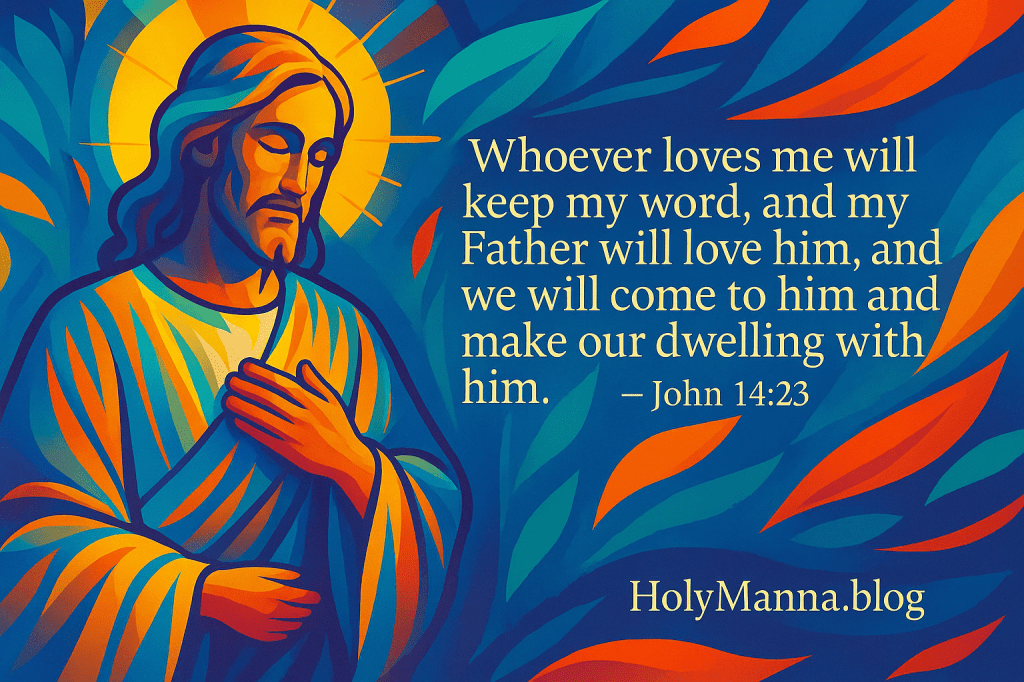
But the Gospel shifts us from external signs to intimate encounter. In John 14:21–26, Jesus promises that “whoever loves me will keep my word, and my Father will love him, and we will come to him and make our dwelling with him”. Unlike idols made with hands, God Himself desires to make His home in our hearts through love and obedience. The Advocate—the Holy Spirit—will not only teach us but remind us of all Jesus has said. What a stunning reversal: while the world seeks gods to manipulate, the living God seeks to inhabit and transform us. What are the idols in your life that need to be torn down so God can take up His dwelling within you?
First Reading – Acts 14:5–18
Tearing the Veil of Idolatry
The Acts of the Apostles is more than a chronicle of early Christian adventures—it is the living testimony of the Holy Spirit’s movement through the fledgling Church, animating and guiding its mission. Today’s passage brings us into the heart of Paul and Barnabas’s missionary work as they journey through Lystra in Lycaonia, a culturally pagan region deeply shaped by Greco-Roman mythology. It’s crucial to recognize that the Gentiles of this area were steeped in polytheism, attributing divine powers to everything from celestial bodies to local legends. Into this context bursts the radical claim of the apostles: there is only one living God, the Creator of all. Their proclamation is not merely spiritual; it’s confrontational—it dismantles entire worldviews. This episode draws us deeply into the day’s central theme: turning from false worship to the living God who reveals Himself through love, not spectacle.
Acts 14:5-18
New American Bible (Revised Edition)
5 When there was an attempt by both the Gentiles and the Jews, together with their leaders, to attack and stone them, 6 they realized it and fled to the Lycaonian cities of Lystra and Derbe and to the surrounding countryside, 7 where they continued to proclaim the good news.
Paul and Barnabas at Lystra. 8 At Lystra there was a crippled man, lame from birth, who had never walked. 9 He listened to Paul speaking, who looked intently at him, saw that he had the faith to be healed, 10 and called out in a loud voice, “Stand up straight on your feet.” He jumped up and began to walk about. 11 When the crowds saw what Paul had done, they cried out in Lycaonian, “The gods have come down to us in human form.” 12 They called Barnabas “Zeus” and Paul “Hermes,” because he was the chief speaker. 13 And the priest of Zeus, whose temple was at the entrance to the city, brought oxen and garlands to the gates, for he together with the people intended to offer sacrifice.
14 The apostles Barnabas and Paul tore their garments when they heard this and rushed out into the crowd, shouting, 15 “Men, why are you doing this? We are of the same nature as you, human beings. We proclaim to you good news that you should turn from these idols to the living God, ‘who made heaven and earth and sea and all that is in them.’ 16 In past generations he allowed all Gentiles to go their own ways; 17 yet, in bestowing his goodness, he did not leave himself without witness, for he gave you rains from heaven and fruitful seasons, and filled you with nourishment and gladness for your hearts.” 18 Even with these words, they scarcely restrained the crowds from offering sacrifice to them.
Detailed Exegesis
Verse 5 – “When there was an attempt by both the Gentiles and the Jews, together with their leaders, to attack and stone them”
This verse sets the scene with tension. Both Jews and Gentiles, normally at odds religiously and culturally, are united here in hostility toward Paul and Barnabas. The Gospel’s disruptive power threatens all who are clinging to worldly power, comfort, or control. It’s a stark reminder that the truth is often met with violent resistance.
Verse 6 – “They realized it and fled to the Lycaonian cities of Lystra and Derbe and to the surrounding countryside”
The apostles’ flight is not cowardice—it’s prudence. Their mission isn’t to seek martyrdom recklessly but to continue spreading the Gospel. Jesus Himself told His disciples in Matthew 10:23, “When they persecute you in one town, flee to the next.” Their movement continues God’s plan.
Verse 7 – “Where they continued to proclaim the good news”
Despite opposition, the mission does not pause. Proclaiming the kerygma—the core message of salvation through Jesus—remains central. Evangelization doesn’t stop when it’s inconvenient. Instead, it adapts and presses forward with courage and hope.
Verse 8 – “At Lystra there was a crippled man, lame from birth, who had never walked”
Luke emphasizes the totality of this man’s condition. His healing will not just be physical but symbolic: a witness to the power of faith and a metaphor for spiritual restoration. The healing mirrors those performed by Jesus and shows that the apostles act by His authority.
Verse 9 – “He listened to Paul speaking, who looked intently at him, saw that he had the faith to be healed”
Paul’s discernment of faith reveals the spiritual dynamics at play. Healing is not magic; it flows from openness to grace. This man’s interior disposition makes him receptive to the miraculous work of God.
Verse 10 – “And called out in a loud voice, ‘Stand up straight on your feet.’ He jumped up and began to walk about.”
Like Peter with the beggar at the temple (Acts 3:6), Paul invokes no magical incantation but issues a command in faith. The man’s immediate response reflects both a physical miracle and a spiritual resurrection.
Verse 11 – “When the crowds saw what Paul had done, they cried out in Lycaonian, ‘The gods have come down to us in human form.’”
The crowd interprets the miracle through their pagan lens, recalling myths like that of Zeus and Hermes visiting mortals. Their response reflects religious confusion—recognizing divine power but misidentifying its source.
Verse 12 – “They called Barnabas ‘Zeus’ and Paul ‘Hermes,’ because he was the chief speaker.”
Their titles show cultural misunderstanding. In Greco-Roman tradition, Hermes was the god of speech and Zeus the chief deity. Instead of recognizing the one true God, the people interpret events according to their mythology.
Verse 13 – “And the priest of Zeus, whose temple was at the entrance to the city, brought oxen and garlands to the gates, for he together with the people intended to offer sacrifice.”
Their idolatrous response escalates. The miracle was meant to point to God, but their fallen understanding turns it into an occasion for false worship. It mirrors our own temptations to idolize gifts rather than the Giver.
Verse 14 – “The apostles Barnabas and Paul tore their garments when they heard this and rushed out into the crowd, shouting”
Tearing one’s garments was a Jewish sign of horror and mourning, particularly at blasphemy. The apostles’ visceral reaction underscores the severity of the crowd’s misunderstanding.
Verse 15 – “Men, why are you doing this? We are of the same nature as you, human beings. We proclaim to you good news that you should turn from these idols to the living God, who made heaven and earth and sea and all that is in them.”
Paul’s bold correction affirms both the truth of monotheism and the dignity of humanity. He introduces a theology rooted in Genesis 1, declaring that the living God is the Creator of all things—distinct from idols and false gods.
Verse 16 – “In past generations he allowed all Gentiles to go their own ways”
Paul acknowledges that God, in His patience, permitted ignorance for a time. This is not abandonment but preparation. Now, through Christ, the time of ignorance is over, and the truth is being proclaimed.
Verse 17 – “Yet, in bestowing his goodness, he did not leave himself without witness, for he gave you rains from heaven and fruitful seasons, and filled you with nourishment and gladness for your hearts.”
Even before they knew Him, God revealed Himself through creation and providence. As Psalm 19:2 says, “Day unto day pours forth speech; night unto night whispers knowledge.” This “natural revelation” speaks to God’s universal love.
Verse 18 – “Even with these words, they scarcely restrained the crowds from offering sacrifice to them.”
Despite their plea, the crowd’s desire for idol worship remains strong. This verse tragically illustrates how hard it is to unlearn false religious habits. Conversion often begins with confrontation and the slow work of transformation.
Teachings
The Church teaches that the desire for God is written in every human heart, even among those who do not yet know His name. As CCC 27 states: “The desire for God is written in the human heart, because man is created by God and for God.” This reading illustrates how the pagan people of Lystra were genuinely seeking divinity but were misled by their cultural myths. Paul and Barnabas, in tearing their garments, echo the prophets of Israel who denounced idolatry as spiritual adultery.
Saint Irenaeus, writing in the second century, addressed the issue of pagan worship by reminding Christians that idols are nothing and that the fullness of revelation comes only in Jesus Christ: “Men forget that it is not they who make God, but God who makes men.” (Against Heresies, Book IV). Paul’s address to the Lystrans parallels Irenaeus’s effort: calling people back to the Creator rather than created things.
Historically, this episode in Lystra marks a turning point in the mission to the Gentiles. No longer preaching only in synagogues, Paul and Barnabas now confront entire cultural systems. Their rejection of divine honors and insistence on the truth of the living God becomes a template for all future evangelization. Like them, we are sent not just to share our faith but to challenge false gods with the love and truth of Christ.
Reflection
This reading asks each of us: What idols am I clinging to in my own life? Whether it’s comfort, approval, power, pleasure, or even our self-image—anything we place above God becomes a false god. Paul and Barnabas remind us that evangelization is not about drawing attention to ourselves but about pointing all glory to God. Are we willing to be misunderstood for the sake of the Gospel? Are we bold enough to confront lies with truth, not in pride, but in love?
In daily life, we are surrounded by modern “Lystras”—spaces where people seek meaning in the wrong places. Our task is to witness to the living God not just with words, but with the integrity of our lives. The crippled man believed and was healed. Do we believe that God can still heal hearts today—through us? May we tear down idols and make space for the true and living God to dwell in us.
Responsorial Psalm – Psalm 115:1–4, 15–16
The Glory That Belongs to God Alone
Today’s responsorial psalm is a piercing meditation on the folly of idolatry and the unshakable glory of the one true God. Psalm 115 belongs to the “Egyptian Hallel” psalms (Psalms 113–118), traditionally sung during Jewish festivals such as Passover. These hymns recall God’s mighty acts of deliverance, particularly the Exodus, and exalt Him as the sole object of worship. Within the context of today’s readings—where Paul and Barnabas resist being mistaken for gods—this psalm forms the poetic heart of the day’s message: not to us, but to God alone belongs all glory, for He alone is living, powerful, and faithful. The psalmist reminds Israel—and us—that man-made idols are lifeless, while the Lord of heaven and earth continues to reign and bestow blessings upon His people.
Psalm 115:1-4, 15-16
New American Bible (Revised Edition)
The Greatness of the True God
1 Not to us, Lord, not to us
but to your name give glory
because of your mercy and faithfulness.
2 Why should the nations say,
“Where is their God?”
3 Our God is in heaven
and does whatever he wills.
4 Their idols are silver and gold,
the work of human hands.
15 May you be blessed by the Lord,
maker of heaven and earth.
16 The heavens belong to the Lord,
but he has given the earth to the children of Adam.
Detailed Exegesis
Verse 1 – “Not to us, Lord, not to us but to your name give glory because of your mercy and faithfulness.”
This verse begins with a double negation, intensifying the humility of the speaker. It echoes the response of Paul and Barnabas who refuse divine honors. The psalmist insists that all honor is due to God’s hesed (mercy) and emet (faithfulness)—two key covenantal attributes. This line is a prayer of self-emptying, a model for how we should approach all recognition and success: How often do we redirect praise away from ourselves and toward God?
Verse 2 – “Why should the nations say, ‘Where is their God?’”
This rhetorical question reflects the historical scorn of pagan nations who mocked Israel’s invisible God. The psalm captures the tension between visible idols and the seemingly hidden presence of the Lord. This verse resonates deeply with missionary contexts, like that of Acts 14, where faith in the unseen God must be proclaimed in the face of very visible false gods.
Verse 3 – “Our God is in heaven and does whatever he wills.”
Here the psalmist affirms the sovereign transcendence of God. Unlike idols that must be carried, cleaned, or adorned, the Lord is in heaven, utterly free and omnipotent. This line affirms divine providence and perfect authority. As Psalm 135:6 echoes, “Whatever the Lord wills he does in heaven and on earth.”
Verse 4 – “Their idols are silver and gold, the work of human hands.”
This verse begins a sharp contrast between God and idols. The psalmist reduces idols to what they truly are: lifeless objects shaped by human hands. In a world dazzled by wealth and craftsmanship, this verse cuts to the core—exposing the emptiness behind man-made “gods.” It directly challenges any temptation to trust in our own creations or achievements.
Verse 15 – “May you be blessed by the Lord, maker of heaven and earth.”
A blessing follows the warning. The Lord is not merely a tribal deity but the universal Creator. This verse reinforces the message of Acts 14:15, where Paul urges the Gentiles to turn to “the living God, who made heaven and earth and sea and all that is in them.” True blessing comes not from idols but from communion with the Creator Himself.
Verse 16 – “The heavens belong to the Lord, but he has given the earth to the children of Adam.”
This verse outlines divine sovereignty and human stewardship. God retains supreme authority, yet in His generosity, He entrusts creation to humanity. This echoes Genesis 1:28 and places a sacred responsibility on us. We are not gods, but we are God’s stewards—called to honor Him in how we care for the earth and one another.
Teachings
The Catechism of the Catholic Church strongly affirms the truth behind this psalm’s message. CCC 2112 states: “The first commandment condemns polytheism. It requires man neither to believe in, nor to venerate, other divinities than the one true God.” The psalm is a direct application of this commandment, contrasting the lifelessness of idols with the mercy, faithfulness, and creative power of the Lord. It is a poetic catechesis against idolatry—past and present.
Saint Augustine, in his Exposition on the Psalms, reflects on this passage with sharp insight: “They have mouths and speak not… They are deaf, blind, dumb, lifeless. These idols are nothing; yet those who make and trust in them become like them—spiritually dead.” This aligns with the warning in Psalm 115:8 (just after today’s passage), which declares: “Those who make them will be like them, and so will all who trust in them.” Idolatry doesn’t just offend God—it deforms the human soul.
Historically, Israel’s struggle with idolatry was not merely about religion—it was a crisis of identity and trust. Surrounded by polytheistic nations, the Israelites were continually tempted to adopt the visible, tangible gods of their neighbors. But the Lord demanded a deeper faith: trust in the invisible, eternal God. This is the same call given to the early Christians preaching to pagans, and to us today—amidst our modern idols of image, wealth, and self.
Reflection
This psalm invites us into a deep interior examination. Do I truly live “not to us, but to Your name give glory”? Or do I grasp at praise, attention, and control? In a culture that prizes self-promotion, this psalm calls us to humble surrender. What “idols of silver and gold” have taken up residence in your heart—comforts, ambitions, digital screens, or even spiritual pride? The psalmist reminds us that God is not absent—He is enthroned in heaven, active on earth, and always faithful.
To live this psalm is to renounce false securities and embrace God’s sovereignty. Begin each day with this verse: “Not to us, Lord, not to us but to your name give glory.” Let it shape your work, your conversations, and your prayers. As you do, you may find that the Lord of heaven and earth is far from distant—He is blessing you, forming you, and making your heart His temple. Will you let go of your idols so you can receive His blessing?
Holy Gospel – John 14:21–26
The Dwelling Place of Love
As Jesus prepares His disciples for His Passion, He speaks words of deep intimacy, hope, and divine indwelling. The Gospel of John is rich in theological depth, often conveying profound truths through simple yet poetic language. This passage is nestled within the Farewell Discourse (John 13–17), where Jesus speaks to the Twelve on the night of the Last Supper. It is His final opportunity to comfort, teach, and prepare them for the coming of the Holy Spirit. In today’s reading, Jesus shifts the conversation from external signs to internal reality. He reveals that the true manifestation of God is not through spectacle or force, but through obedient love. In contrast to the idolatry described in Acts 14 and Psalm 115, Jesus proclaims that God does not dwell in temples made by human hands but in the heart of the one who loves and keeps His Word. This is the ultimate antidote to idolatry: a life in communion with the living God.
John 14:21-26
New American Bible (Revised Edition)
21 Whoever has my commandments and observes them is the one who loves me. And whoever loves me will be loved by my Father, and I will love him and reveal myself to him.” 22 Judas, not the Iscariot, said to him, “Master, [then] what happened that you will reveal yourself to us and not to the world?” 23 Jesus answered and said to him, “Whoever loves me will keep my word, and my Father will love him, and we will come to him and make our dwelling with him. 24 Whoever does not love me does not keep my words; yet the word you hear is not mine but that of the Father who sent me.
25 “I have told you this while I am with you. 26 The Advocate, the holy Spirit that the Father will send in my name—he will teach you everything and remind you of all that [I] told you.
Detailed Exegesis
Verse 21 – “Whoever has my commandments and observes them is the one who loves me. And whoever loves me will be loved by my Father, and I will love him and reveal myself to him.”
This verse ties love and obedience together. Jesus teaches that true love for Him is not sentimental but practical—it is expressed through fidelity to His teachings. The promise of divine self-revelation is given not to the curious, but to the obedient. Love opens the door for the Father and Son to enter and unveil their divine presence.
Verse 22 – “Judas, not the Iscariot, said to him, ‘Master, [then] what happened that you will reveal yourself to us and not to the world?’”
This Judas (also called Thaddeus) expresses confusion: why would Jesus not reveal Himself in a public, powerful way? His question reflects a common human expectation—that God should make Himself known through unmistakable, dramatic signs. It echoes the mindset of the crowds in Acts 14, who mistook miracles for divinity.
Verse 23 – “Jesus answered and said to him, ‘Whoever loves me will keep my word, and my Father will love him, and we will come to him and make our dwelling with him.’”
This verse is the heart of today’s Gospel. God’s indwelling presence is promised to those who love and obey. The word “dwelling” (Greek: monē) evokes Exodus 25:8: “Let them make me a sanctuary, that I may dwell in their midst.” Now, that sanctuary is the human heart. The Father and the Son come to make their home in the believer—this is the profound intimacy of the New Covenant.
Verse 24 – “Whoever does not love me does not keep my words; yet the word you hear is not mine but that of the Father who sent me.”
Jesus contrasts the response of love with the consequence of indifference. Disobedience is not just a rejection of Jesus, but of the Father Himself. This underscores the divine authority behind Jesus’ words—they are not mere teachings, but the voice of God spoken through the Son.
Verse 25 – “I have told you this while I am with you.”
This transitional statement reflects Jesus’ awareness of His imminent departure. He is preparing the disciples for life without His physical presence by assuring them that His words will remain with them through divine assistance.
Verse 26 – “The Advocate, the holy Spirit that the Father will send in my name—he will teach you everything and remind you of all that [I] told you.”
Here, Jesus introduces the role of the Holy Spirit: Teacher and Reminder. The Spirit ensures that Jesus’ message is not lost but brought to fullness of understanding. This is fulfilled at Pentecost and continues in the Church’s teaching authority. The Spirit enables believers to internalize Christ’s commandments and live them from within.
Teachings
The Catechism of the Catholic Church confirms the deep truth revealed in this Gospel. CCC 682 teaches: “Christ is Lord of eternal life. Full right to pass definitive judgment on the works and hearts of men belongs to him as redeemer of the world… But he came the first time not to judge, but to save and to give the life he has in himself.” This passage shows how Christ reveals Himself—not by worldly conquest, but by making His home within the obedient heart. God’s judgment is mercy offered through intimacy.
Furthermore, CCC 2563 speaks of the human heart as the place of divine indwelling: “The heart is the dwelling-place where I am, where I live… It is the place of decision, deeper than our psychic drives. It is the place of truth, where we choose life or death.” Jesus’ promise to dwell with the one who loves Him is not symbolic—it is the very fulfillment of God’s desire to be united with us. This union is made possible by grace, cultivated through obedience, and sealed by the Holy Spirit.
Saint Teresa of Avila, who understood the interior life deeply, wrote: “Do you think it is a small matter to have a Friend such as this beside you?” (Interior Castle, 4.1). For her, the indwelling of Christ was not a lofty idea but a daily reality, experienced in silent prayer and faithful love. This is the path the Gospel lays before us today—a life of deep personal communion with the Trinity, where love is shown through keeping His Word.
Reflection
This Gospel invites each of us to examine the substance of our love for Christ. Do I love Him in word only, or do I keep His commandments with fidelity and joy? It challenges our modern expectations of God’s revelation—we often look for Him in external signs or grand displays, but Jesus tells us that His preferred sanctuary is the obedient heart. Are we making space in our hearts for God to dwell, or are we crowding Him out with lesser loves and distractions?
To live this Gospel is to make our hearts a home for God. Begin by asking the Holy Spirit to teach you anew each day, to remind you of Christ’s words, and to help you live them with courage. The Holy Spirit was not given to a select few, but to all who believe and ask. Jesus promises, “We will come to him and make our dwelling with him.” That promise is for you. Will you receive Him today, not just as a concept, but as the God who desires to live within you?
Let God Make His Home in You
Today’s readings carry us from the bustling pagan streets of Lystra, through the poetic truths of the psalmist, to the intimate, heart-stirring promises of Jesus at the Last Supper. Together, they form a single, unified invitation: Turn away from the idols of this world and welcome the living God into the home of your heart. Paul and Barnabas refuse divine honors, not out of false humility, but because they understand who God truly is—the Creator, not the created. Psalm 115 echoes their cry: “Not to us, Lord, not to us but to your name give glory.” And in John 14, Jesus reveals that He seeks not to dwell in temples or through miracles alone, but to live in the hearts of those who love and obey Him.
There is a divine thread binding these readings: the contrast between dead idols and the living presence of God. Where idols demand sacrifice and offer nothing in return, our God gives first—rain from heaven, joy for our hearts, and His very Spirit to guide us. He calls us not to adoration from a distance, but to communion. “We will come to him and make our dwelling with him.” What a breathtaking promise. The true God does not remain aloof in the heavens; He comes close. He seeks not flattery or burnt offerings, but love proven through trust and obedience.
So today, let us tear down the false gods we’ve erected—whether in our ambitions, distractions, addictions, or fears—and welcome Christ into the center of our lives. What would change if we truly believed that God wants to live within us? Let us pray, act, and love like people who are already temples of the Holy Spirit. Begin by whispering the psalmist’s words: “Not to us, Lord, not to us but to your name give glory.” Then let your life speak them boldly. The living God is at the door. Will you open your heart and make Him at home?
Engage with Us!
We’d love to hear how today’s readings are speaking to your heart. Share your thoughts, prayers, or questions in the comments below—your witness might be exactly what someone else needs today. Whether you’re encountering these Scriptures for the first time or returning to them with fresh eyes, we invite you to reflect deeply and journey with us.
First Reading – Acts 14:5–18
What idols—visible or invisible—still hold a place in your heart? How can you imitate Paul and Barnabas by boldly pointing others to the living God rather than yourself?
Responsorial Psalm – Psalm 115:1–4, 15–16
How can you practice humility today and give all glory to God? In what ways do you struggle with trusting in human accomplishments over divine providence?
Holy Gospel – John 14:21–26
Do you live as though God dwells within you? What specific commandments of Jesus are you being called to live more faithfully this week? How can you invite the Holy Spirit to teach and guide you daily?
Let’s walk forward together in faith, tearing down the idols that distract us and making room for the God who longs to dwell with us. Live boldly, love deeply, and trust completely—doing all things in the love and mercy that Jesus taught us.
Follow us on Instagram and Facebook for more insights and reflections on living a faith-filled life.

 Holy Manna!
Leave a comment