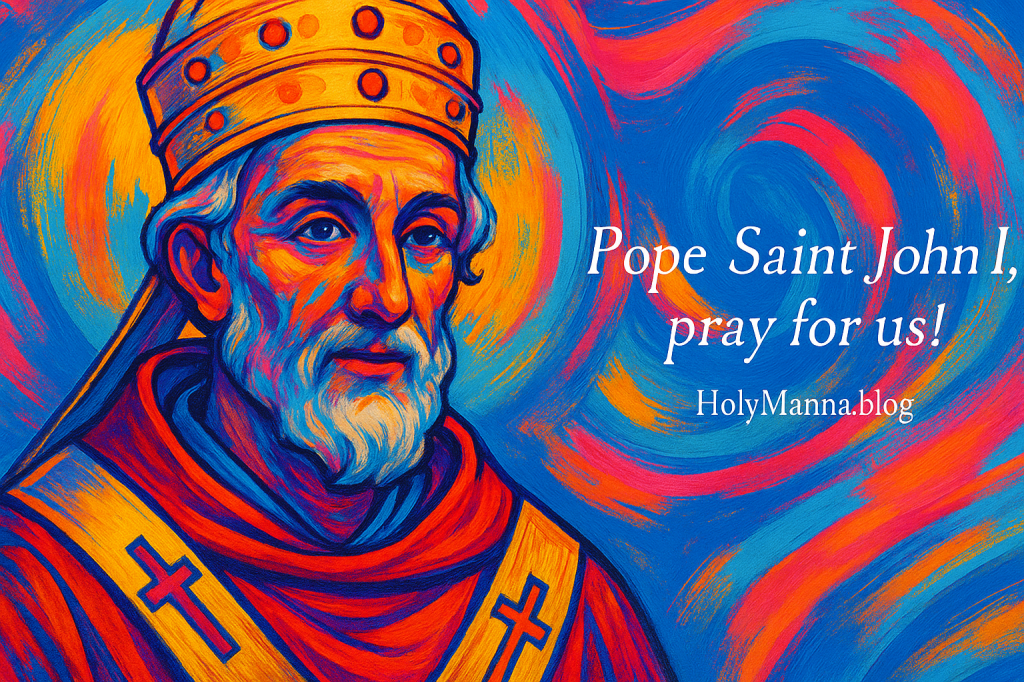
The Legacy of a Martyr Pope
Pope Saint John I stands as a remarkable figure in the early Church, a man whose quiet strength and commitment to the truth would eventually lead him to martyrdom. He served as the bishop of Rome at a time when the political and theological landscapes were fraught with division. The Western world was ruled by Theodoric the Great, an Arian Christian king who denied the divinity of Christ, while the Eastern Roman Empire was led by the Catholic Emperor Justin I, who sought to restore orthodoxy. Caught between these two powerful rulers, Pope John I emerged not only as a wise mediator but also as a faithful servant of Christ who was willing to suffer for the sake of unity and truth.
Though his pontificate lasted only about three years, his courage and diplomacy had an enduring impact on the Church. His mission to Constantinople, his unwavering commitment to Catholic doctrine, and his ultimate death in prison for remaining loyal to Christ and the Church, earned him the crown of martyrdom. He reminds us that fidelity to God may demand great personal cost—and that true greatness is often hidden in the suffering borne quietly for the sake of others.
A Life of Grace and Resolve
Pope John I was born around the year 470 AD in the region of Tuscany, Italy. Though few specific details of his early childhood survive, what is known paints the picture of a man formed in the heart of a once-mighty Roman world now fragmented by invading tribes and crumbling institutions. From his youth, John was immersed in the life of the Church and grew to be a man of profound intellect, modesty, and deep personal holiness.
Raised during the collapse of the Western Roman Empire, John would have seen firsthand the tensions between Christian orthodoxy and the rise of heresies such as Arianism. There is no dramatic story of a singular conversion in his life—no thunderous moment like Saint Paul’s. Rather, his sanctity was forged through steady devotion, theological training, and faithful clerical service. Over time, he rose through the ecclesiastical ranks and became a trusted leader among the clergy.
When he was elected pope in 523 AD, the Church needed a man of wisdom and humility, and John fit this role perfectly. Despite being elderly and frail at the time of his election, he bore the responsibility of the papacy with resolve. His tenure would be shaped by one central crisis: how to maintain the integrity of the faith under a king who did not believe that Jesus Christ was consubstantial with the Father.
His most remembered action as pope was a diplomatic journey to Constantinople—an unprecedented act for a pontiff of his time. John became the first pope to ever visit the Eastern imperial court, showing both the growing influence of the papacy and the delicate role it played between feuding empires. He was not only a bridge between East and West, but also a firm rock standing on the Gospel of truth.
A Peaceful Mission That Defied Politics
Unlike saints known for visible miracles such as healing the blind or multiplying food, Pope Saint John I’s miracles were acts of spiritual fortitude, divine wisdom, and courageous diplomacy. His journey to Constantinople in 525 AD can be viewed as one of the most miraculous feats of statesmanship in the early Church.
Sent by King Theodoric the Great to negotiate with Emperor Justin I, Pope John I was tasked with advocating for the Arian Christians who were being persecuted in the East. Theodoric hoped John could convince the emperor to ease these restrictions—not out of concern for justice, but because he feared retaliation against Arians in the West. What John achieved, however, was far more complex.
Though he did succeed in obtaining some relief for the Arians, he also took the opportunity to reinforce unity with the Catholic Church in the East. The emperor greeted him with extraordinary honors, holding a grand procession in his honor and treating him as both a religious leader and political ambassador. It was the first time a pope had ever been so publicly honored by an emperor, and it demonstrated the pope’s growing spiritual authority across Christendom.
His ability to walk this razor’s edge—upholding orthodoxy while preventing war—was itself a miracle of diplomacy. In a time when kings ruled with violence and fear, Pope Saint John I ruled with wisdom and peace.
The Final Test of a True Shepherd
Tragically, what should have been a moment of triumph became the beginning of the end. When Pope John I returned to Italy, King Theodoric—already paranoid and deteriorating in health—interpreted the pope’s warm reception in Constantinople as an act of betrayal. In a fit of suspicion and rage, Theodoric had Pope John arrested and thrown into prison in Ravenna.
There, in the cold and darkness of confinement, Pope John suffered greatly. His health, already weakened by age and travel, began to decline rapidly. He was denied proper food, warmth, and care. His physical suffering became a spiritual offering as he united himself with the Passion of Christ. He bore the weight of injustice not with resentment but with quiet surrender to God’s will.
Pope John I died in prison on May 18, 526, not by execution, but by the cruel neglect of a tyrant. The Church recognizes his death as martyrdom—not for political rebellion, but because he died for his loyalty to Christ and for protecting the Church from manipulation and heresy.
His life and death echo the words of Jesus: “Blessed are those who are persecuted for righteousness’ sake, for theirs is the kingdom of heaven”.
The Enduring Power of a Martyr’s Witness
After his death, the faithful quickly began to venerate Pope John I as a martyr and saint. His body was brought to Rome and interred with honor in the Basilica of St. Peter, a testimony to the reverence he inspired in the early Church. His tomb became a site of pilgrimage, and many found comfort and inspiration in his quiet heroism.
Though there are no detailed accounts of physical healings or public miracles immediately following his death, the Church has long recognized that the blood of the martyrs is the seed of the Church. His martyrdom served as a profound witness to the sanctity of the papal office and the independence of the Church from earthly powers.
His intercession has been sought by those in leadership, those caught in impossible situations, and those suffering persecution for their faith. He remains a beacon of courage, diplomacy, and unshakable fidelity to the truth.
Pope Saint John I reminds us that the Church is often built not by grand acts but by faithful suffering, that true strength often looks like quiet endurance, and that the Cross remains the path to the Resurrection.
Reflection: Quiet Strength in a Noisy World
In our modern world, where power often appears in loud voices and flashy platforms, Pope Saint John I offers a radically different vision of strength. His papacy teaches us that real courage lies in patience, in standing firm even when no one applauds, and in protecting the truth when it’s costly to do so.
He reminds us that God is always at work behind the scenes, even in the silence of a prison cell. Pope Saint John I did not fight his enemies with swords or anger—he answered injustice with endurance, false accusations with fidelity, and fear with faith.
We, too, are called to be witnesses in the quiet corners of our lives. Whether we face moral dilemmas at work, difficult conversations with loved ones, or struggles to live out our faith in a secular culture, the example of Pope Saint John I encourages us to remain rooted in Christ. “Be faithful unto death, and I will give you the crown of life” (Revelation 2:10).
How might God be calling you to be a quiet witness of truth today? Where is He asking you to persevere with love and courage? How can you offer up your sufferings, small and great, for the good of the Church and the glory of God?
Engage with Us! 💬
Have you ever felt caught between opposing forces and had to choose between popularity and truth? Pope Saint John I stands with you.
✨ Reflection Questions:
- When have I had to speak or act for truth, even when it was unpopular or dangerous?
- In what areas of my life is God calling me to be a bridge-builder rather than a divider?
- How can I offer my daily hardships to God in union with Christ, like Pope Saint John I did in prison?
Let us walk together, inspired by the witness of Pope Saint John I, and do all things in love, just as Jesus did.
Pope Saint John I, pray for us! 🙏
Follow us on Instagram and Facebook for more insights and reflections on living a faith-filled life.

 Holy Manna!
Leave a comment