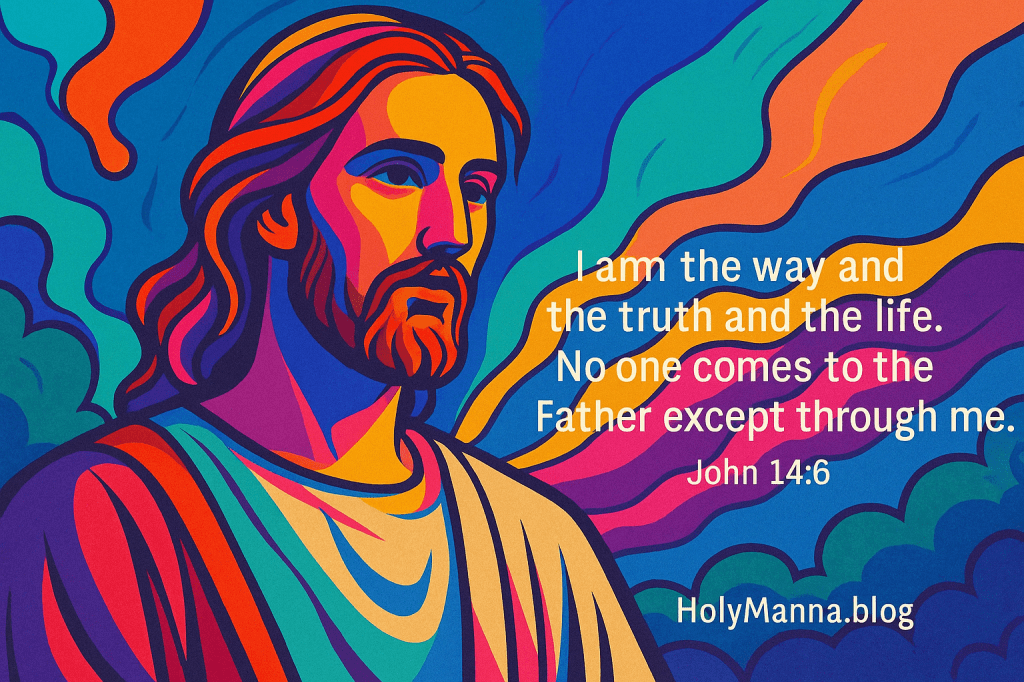
The Way That Was Promised
Have you ever followed a path unsure of where it would lead, only to discover it was exactly where you were meant to be? Today’s readings invite us to step onto such a path—one paved by promise, prophecy, and divine love. From the preaching of Saint Paul in Acts of the Apostles, to the royal declaration in Psalm 2, and culminating in the tender reassurance of Jesus in The Gospel of John, we are reminded that God has always had a plan, and that plan is fulfilled perfectly in Christ. Each passage pulses with the heartbeat of a Father who both promises and prepares, who both speaks and sends His Son to gather us home.
The early Church, especially during the apostolic age, was deeply concerned with showing how Jesus of Nazareth was not a mere teacher or prophet, but the very fulfillment of the ancient promises given to Israel. When Paul proclaims in Acts 13 that “God raised him from the dead,” he is not only preaching the Resurrection—he is connecting the dots between centuries of Jewish prophecy and the person of Jesus. This connection would have been deeply compelling to his audience: Jews and God-fearers who knew the Scriptures well but had not yet understood how they pointed to Christ. Likewise, Psalm 2, one of the royal enthronement psalms, had long been seen as messianic. When it declares, “You are my son; today I have begotten you”, it is ultimately pointing beyond Davidic kings to the eternal Son enthroned at the right hand of the Father.
But what does this mean for us today? In The Gospel of John, Jesus tenderly addresses the confusion and fear of His disciples, saying, “Do not let your hearts be troubled… I am the way and the truth and the life”. He is not merely preparing a place in heaven—He is inviting us to trust in Him as the very road that leads there. The Scriptures today are united by this theme: Jesus is not only the fulfillment of God’s promise; He is the path through which we come to dwell with the Father. Will we take refuge in Him, trust in His kingship, and walk the way He has opened for us?
First Reading – Acts 13:26–33
Proclaiming the Promise Fulfilled
The Acts of the Apostles is a treasure trove of the early Church’s missionary zeal, and today’s passage offers a powerful moment in Saint Paul’s first recorded sermon. Preaching in Pisidian Antioch, Paul addresses both Jews and “God-fearers” gathered in the synagogue. His audience would have been steeped in the Hebrew Scriptures, familiar with the covenantal promises made to Abraham and David, and awaiting a Messiah. Paul seizes this moment to reveal that these ancient hopes have been fulfilled in Jesus Christ, the crucified and risen Son of God. This reading bridges Jewish expectation and Christian revelation, showing that the promises of old were not abandoned but completed in Christ. It fits beautifully with today’s theme: Jesus is not only the way, but also the fulfillment of every divine promise.
Acts 13:26-33
New American Bible (Revised Edition)
26 “My brothers, children of the family of Abraham, and those others among you who are God-fearing, to us this word of salvation has been sent. 27 The inhabitants of Jerusalem and their leaders failed to recognize him, and by condemning him they fulfilled the oracles of the prophets that are read sabbath after sabbath. 28 For even though they found no grounds for a death sentence, they asked Pilate to have him put to death, 29 and when they had accomplished all that was written about him, they took him down from the tree and placed him in a tomb. 30 But God raised him from the dead, 31 and for many days he appeared to those who had come up with him from Galilee to Jerusalem. These are [now] his witnesses before the people. 32 We ourselves are proclaiming this good news to you that what God promised our ancestors 33 he has brought to fulfillment for us, [their] children, by raising up Jesus, as it is written in the second psalm, ‘You are my son; this day I have begotten you.’
Detailed Exegesis
Verse 26 – “My brothers, children of the family of Abraham, and those others among you who are God-fearing, to us this word of salvation has been sent.”
Paul begins by affirming his bond with the Jewish people and extends the invitation of salvation to the “God-fearing”—Gentiles who honored the God of Israel but were not full converts. This verse sets the tone for universal inclusion in the Gospel message. Salvation is no longer limited to Israel alone but is now extended to all who believe.
Verse 27 – “The inhabitants of Jerusalem and their leaders failed to recognize him, and by condemning him they fulfilled the oracles of the prophets that are read sabbath after sabbath.”
Here Paul makes a sobering claim: the very leaders entrusted with interpreting the Scriptures missed their fulfillment. Ironically, their rejection of Jesus fulfilled the very prophecies they read weekly. This verse underscores human blindness and divine providence coexisting—God’s plan is not thwarted by human failure.
Verse 28 – “For even though they found no grounds for a death sentence, they asked Pilate to have him put to death.”
The innocence of Jesus is emphasized. This mirrors the trial scenes in the Gospels where Pilate himself admits he finds no guilt in Jesus (cf. Luke 23:4). Nevertheless, political pressure leads to the miscarriage of justice. Paul wants his audience to understand that Jesus’ death was not due to guilt but was part of God’s salvific design.
Verse 29 – “And when they had accomplished all that was written about him, they took him down from the tree and placed him in a tomb.”
Paul refers to the “tree” instead of the “cross,” echoing Deuteronomy 21:23: “cursed is anyone who hangs on a tree”. This choice of wording highlights the scandal of the Crucifixion to the Jewish mind and the magnitude of God’s love in transforming a curse into the means of redemption.
Verse 30 – “But God raised him from the dead.”
This short, triumphant declaration is the heart of the Christian message. The Resurrection is God’s vindication of Jesus and the divine seal on all His teachings. Paul’s entire argument hinges on this moment—if Jesus is not raised, the promise remains unfulfilled (cf. 1 Corinthians 15:14).
Verse 31 – “And for many days he appeared to those who had come up with him from Galilee to Jerusalem. These are [now] his witnesses before the people.”
Paul points to the historical credibility of the Resurrection. The appearances of the risen Christ are not secret visions but public events witnessed by many. The witnesses have now become missionaries, testifying not only to the facts but to the truth of salvation.
Verse 32 – “We ourselves are proclaiming this good news to you that what God promised our ancestors”
Paul continues to position the Gospel as the fulfillment of God’s covenant with Israel. This “good news” is not a new religion—it is the flowering of the seed God planted in the patriarchs.
Verse 33 – “he has brought to fulfillment for us, [their] children, by raising up Jesus, as it is written in the second psalm, ‘You are my son; this day I have begotten you.’”
Paul concludes this section by quoting Psalm 2:7, showing that Jesus’ Resurrection confirms His divine sonship. This isn’t about Jesus becoming the Son at Resurrection, but about the public manifestation and inauguration of His kingship as the Risen Lord.
Teachings
The Catechism of the Catholic Church echoes this theme of fulfillment in Christ: “God’s covenants with Abraham, Moses, and David find their ultimate fulfillment in the new and eternal covenant in Jesus Christ” (CCC 1965). This continuity affirms that Christianity is not a rejection of Israel’s faith but its completion. Moreover, “By his Resurrection, he opens for us the way to a new life” (CCC 654), connecting directly to today’s Gospel where Jesus reveals Himself as the way, the truth, and the life. Saint Augustine similarly saw Christ as the unifying thread of Scripture, writing, “The New Testament lies hidden in the Old and the Old Testament is unveiled in the New” (Quaest. in Hept. 2,73).
Historically, the Church Fathers, especially Saint Irenaeus and Saint Justin Martyr, emphasized that Jesus fulfilled the prophetic writings not randomly but in exact detail. They used texts like this from Acts to demonstrate how the early Church did not fabricate the Gospel but received and interpreted the life of Christ through the lens of the Hebrew Scriptures. This gave authority and clarity to the Christian claim that Jesus is both Messiah and Lord.
This also ties into the Church’s understanding of typology—the interpretation of Old Testament events as prefiguring New Testament realities. Paul’s sermon is a brilliant example of this method. The rejection of Jesus parallels Israel’s pattern of rejecting the prophets, and the Resurrection is the climax of God’s redemptive plan. We see that what was veiled under shadows in the Old Covenant is now revealed in the radiant light of Christ.
Reflection
This reading is a powerful reminder that God always fulfills His promises—even when His ways seem hidden or delayed. Like the people in Paul’s audience, we too may struggle to see how God’s plan is unfolding in our lives. But just as the ancient prophecies were fulfilled in Jesus, so too can we trust that God is at work in every moment of our journey. Are you clinging to a promise from God that seems unfulfilled? How can you open your heart more fully to the Risen Lord who walks with you, even in moments of doubt or darkness? Paul’s courage in proclaiming Christ invites us to be bold witnesses in our own lives—confident not only in what God has done, but in what He will do. Let us live as Easter people, proclaiming with joy that Jesus is risen, and in Him every promise is Yes and Amen.
Responsorial Psalm – Psalm 2:6–11
The Begotten King Who Commands Reverence
Psalm 2 is one of the most significant messianic psalms in the Old Testament and was frequently cited by the early Church as pointing directly to Jesus Christ. Originally composed as a royal psalm, likely for the coronation of a Davidic king, it speaks with divine authority about God’s chosen ruler and His supremacy over the nations. Over time, Jewish and Christian traditions came to understand it as prophetic—a vision of the ultimate anointed one, the Messiah, whose dominion would surpass that of earthly kings. Today’s excerpt from Psalm 2 serves as both a continuation and a confirmation of the First Reading’s message: God has raised Jesus, His begotten Son, to reign over all creation. In a world prone to rejecting divine authority, this psalm reminds us of the strength, justice, and mercy that flow from Christ the King, who invites us into communion, not coercion.
Psalm 2:6-11
New American Bible (Revised Edition)
6 “I myself have installed my king
on Zion, my holy mountain.”
7 I will proclaim the decree of the Lord,
he said to me, “You are my son;
today I have begotten you.
8 Ask it of me,
and I will give you the nations as your inheritance,
and, as your possession, the ends of the earth.
9 With an iron rod you will shepherd them,
like a potter’s vessel you will shatter them.”
10 And now, kings, give heed;
take warning, judges on earth.
11 Serve the Lord with fear;
exult with trembling,
Accept correction
lest he become angry and you perish along the way
when his anger suddenly blazes up.
Blessed are all who take refuge in him!
Detailed Exegesis
Verse 6 – “I myself have installed my king on Zion, my holy mountain.”
This is God’s declaration of sovereignty. “Zion” was the spiritual and political center of ancient Israel—the site of the Temple and the heart of God’s covenant with David. To install a king on Zion was to enact God’s will, not human ambition. The early Church saw this as a reference to Jesus’ resurrection and ascension, His enthronement at the right hand of the Father.
Verse 7 – “I will proclaim the decree of the Lord, he said to me, ‘You are my son; today I have begotten you.’”
This verse was pivotal for early Christians in understanding Jesus’ divine sonship. Paul quotes it directly in the First Reading to show that the Resurrection reveals Jesus as the eternal Son. The phrase “today I have begotten you” is not about beginning to exist, but about public acknowledgment of divine identity. It also reflects God’s eternal generation of the Son, as affirmed in the Nicene Creed: “begotten, not made, consubstantial with the Father.”
Verse 8 – “Ask it of me, and I will give you the nations as your inheritance, and, as your possession, the ends of the earth.”
Here we see the global dimension of the Messiah’s reign. Jesus is not only King of Israel but of every nation. The spread of the Gospel to the Gentiles fulfills this verse in real time—through the Church’s missionary activity, Christ reigns from “sea to sea.” It underscores that salvation is meant for all, echoing today’s First Reading.
Verse 9 – “With an iron rod you will shepherd them, like a potter’s vessel you will shatter them.”
Though the image is harsh, it reflects the power of divine justice. The shepherd’s rod both protects and disciplines. For those who reject God’s authority, judgment is inevitable. This is not to inspire fear, but to highlight the strength of Christ’s reign and the seriousness of choosing Him.
Verse 10 – “And now, kings, give heed; take warning, judges on earth.”
The psalmist shifts from declaration to exhortation. Earthly rulers, who often claim autonomous power, are reminded to recognize a higher authority. This verse calls everyone—especially the powerful—to humility before the true King. It’s a call to conversion and to rightful worship.
Verse 11 – “Serve the Lord with fear; exult with trembling, accept correction lest he become angry and you perish along the way when his anger suddenly blazes up. Blessed are all who take refuge in him!”
The tone is urgent, but not hopeless. There is a path of blessing: to serve the Lord, to revere Him, and to seek refuge in His mercy. “Fear” here means reverent awe, not terror. The verse ends with hope—those who surrender to God’s kingship are not crushed but blessed.
Teachings
The Catechism of the Catholic Church affirms that Jesus is the King to whom all power and authority has been given: “Christ is Lord of the cosmos and of history. In him human history and indeed all creation are ‘set forth’ and transcendently fulfilled” (CCC 668). His kingship is not merely spiritual or symbolic—it is real, and it demands a response of faith and obedience from all peoples. This psalm articulates that divine kingship in poetic form, preparing hearts to receive Christ not only as Savior but as Sovereign.
Saint Cyril of Jerusalem saw this psalm as a beautiful summary of the mystery of Christ’s identity. In his Catechetical Lectures, he writes: “The Father said to him: ‘You are my Son; today I have begotten you’—not that He became Son then for the first time, but that He who was from eternity was revealed to the world” (Lecture 10). This teaching helps us understand that Psalm 2 is not confined to a historical moment but reveals a heavenly reality manifested in time.
Historically, this psalm was frequently used in early Christian liturgy, especially in connection with Easter and Pentecost. By tying Jesus’ resurrection to His enthronement as King, the Church proclaimed that Christ reigns now, not just in some distant future. The Gospel’s expansion beyond Jewish boundaries—the missionary work described in Acts—is the fulfillment of God’s promise to give the nations as Christ’s inheritance.
Reflection
This psalm calls us to a deep and holy reverence before the majesty of Jesus Christ. It challenges us to examine how we relate to His authority—not just in formal worship, but in the decisions we make each day. Do I serve the Lord with awe and joy? Have I accepted His kingship in my daily actions, relationships, and use of time? This world resists surrender, but those who take refuge in the Lord are promised blessing and peace. Today, let us enthrone Christ anew in our hearts, not out of fear of judgment, but out of love for the One who reigns from the cross and calls us to share in His kingdom.
Holy Gospel – John 14:1–6
The Way to the Father’s House
This Gospel passage is taken from the Farewell Discourse in The Gospel of John, a profound and intimate section in which Jesus prepares His disciples for His departure through death and His return to the Father. The context is the Last Supper—hours before the Passion—when confusion, sorrow, and anxiety filled the hearts of the disciples. Jesus offers words of deep comfort and theological clarity, speaking not in abstract doctrine but as a loving friend assuring His companions that all is unfolding according to divine purpose. In a time of impending chaos, He makes one of the most definitive and daring claims in all of Scripture: “I am the way and the truth and the life.” This passage directly ties into today’s theme of fulfillment and divine sonship. Jesus, begotten by the Father and installed as King, is not only the goal but the very road by which we reach the Father’s house.
John 14:1-6
New American Bible (Revised Edition)
Last Supper Discourses. 1 “Do not let your hearts be troubled. You have faith in God; have faith also in me. 2 In my Father’s house there are many dwelling places. If there were not, would I have told you that I am going to prepare a place for you? 3 And if I go and prepare a place for you, I will come back again and take you to myself, so that where I am you also may be. 4 Where [I] am going you know the way.” 5 Thomas said to him, “Master, we do not know where you are going; how can we know the way?” 6 Jesus said to him, “I am the way and the truth and the life. No one comes to the Father except through me.
Detailed Exegesis
Verse 1 – “Do not let your hearts be troubled. You have faith in God; have faith also in me.”
Jesus begins with reassurance. The disciples are unsettled, perhaps panicked, by the thought of His impending departure. But He invites them to transfer the faith they have in the invisible God to Himself—making a bold claim of divinity. His words echo throughout history as a balm for all who experience anxiety, reminding us that faith is the antidote to fear.
Verse 2 – “In my Father’s house there are many dwelling places. If there were not, would I have told you that I am going to prepare a place for you?”
Here, Jesus draws upon the image of a household—familiar and warm. The “Father’s house” is heaven, but also represents intimate communion with God. The term “dwelling places” (Greek: monai) suggests permanence, not transience. He assures the disciples that they have a place—not just in eternity, but in the heart of the Father.
Verse 3 – “And if I go and prepare a place for you, I will come back again and take you to myself, so that where I am you also may be.”
This verse promises reunion. Jesus is not abandoning them—He is going ahead to make room, to sanctify the way. The phrase “take you to myself” speaks of a personal, relational return. Some see this as a reference to the Second Coming; others to the individual believer’s death and reception into eternal life. Both readings are valid and beautiful.
Verse 4 – “Where I am going you know the way.”
Jesus challenges them to trust what they already know, even if it has not fully clicked yet. He implies that His very life, teachings, and presence have already laid out the path to the Father.
Verse 5 – “Thomas said to him, ‘Master, we do not know where you are going; how can we know the way?’”
Thomas, ever the honest skeptic, voices what many of us might feel: confusion and helplessness. His question provides the occasion for Jesus to make one of His most foundational declarations. It is through this sincere doubt that the truth is revealed.
Verse 6 – “Jesus said to him, ‘I am the way and the truth and the life. No one comes to the Father except through me.’”
This is one of the most exclusive and inclusive statements in Christianity. Jesus doesn’t just point to a path—He is the path. As “the way”, He is our access; as “the truth”, He is our illumination; as “the life”, He is our eternal sustenance. The statement “No one comes to the Father except through me” affirms His unique role in salvation, fulfilling all promises and prophecies of the Old Covenant.
Teachings
The Catechism of the Catholic Church teaches that “the desire for God is written in the human heart, because man is created by God and for God” (CCC 27). In Jesus, that desire finds its direction and destination. Christ is not merely a guide but the fulfillment of the longing itself. By calling Himself the way, He fulfills Israel’s deep longing for reconciliation with God and gives every human soul a roadmap written not in ink but in blood and love.
The Church fathers understood this verse as the cornerstone of Christian identity. Saint Augustine famously declared: “It is not by teaching the way that He is the way, but by being the way that He teaches the way” (Tractate on the Gospel of John, 69). This underlines that the moral and spiritual path to God is not about rule-following but about a living relationship with the Person of Jesus. To walk “the way” is to enter into friendship with Him.
In the context of today’s other readings, this Gospel culminates the story of promise and fulfillment. While Acts and Psalm 2 proclaim Jesus as the begotten Son and enthroned King, John 14 makes that truth personal: our King is not distant, but deeply concerned with bringing us home. His kingship is not imposed with force, but offered through a relationship of trust and love. The Catechism affirms: “By his Resurrection, Jesus Christ is constituted in his humanity as Lord and Christ. The Resurrection has revealed him as the ‘Son of God in power’” (CCC 648), fully aligning with the message of Psalm 2.
Reflection
This Gospel invites us to breathe deeply in the midst of life’s turbulence. Jesus’ words to His disciples are meant for us too: “Do not let your hearts be troubled.” What anxieties weigh on your heart today? Where are you struggling to trust the path God has you on? Jesus reminds us that He doesn’t just show us the way—He walks with us. Every fear, every longing, every doubt can be brought to Him, for He is the One preparing a place for us in the Father’s heart. Today, let us lean into that promise. Let us renew our trust that the risen Lord—crucified, begotten, and reigning—will never abandon us, and that in Him, the way home is always open.
Trusting the Risen King
Today’s readings carry us through the grand arc of salvation history—from promise, to fulfillment, to personal invitation. In Acts of the Apostles, Saint Paul announces the astonishing truth that everything the prophets foretold has come to pass in Jesus Christ, who was crucified, buried, and “raised from the dead”. The Responsorial Psalm lifts our gaze to the majesty of the enthroned Son, “begotten” by the Father, to whom all nations belong. And in The Gospel of John, that same divine King kneels at the table of His friends and says with tenderness: “Do not let your hearts be troubled… I am the way and the truth and the life.”
This is the wonder of our faith—that the sovereign Lord of the universe is also our Shepherd and Friend. He is the promised Son who fulfills every word of the Father. He is the King who reigns not from a golden throne, but from the wood of the Cross. And He is the Way who walks with us through every valley, every fear, every unanswered question. Will you let Him lead you today? Will you entrust your journey to the One who has already prepared your place in the Father’s house?
Let today be more than a meditation—let it be a turning point. The path has been made clear. The door has been opened. The invitation has been spoken. “You are my son; this day I have begotten you.” That eternal voice now calls out to you—not to earn your place, but to receive it in faith. Walk with the King who walks with you. Trust in the One who is not only the truth we seek, but the life we were made for.
Engage with Us!
We would love to hear how today’s Word has spoken to your heart. Share your thoughts, prayers, or personal reflections in the comments below—your journey might inspire someone else on theirs! To help you go deeper, here are some questions to guide your meditation and prayer.
Reflection Questions
First Reading – Acts 13:26–33
What promises of God have you seen fulfilled in your life? In what ways are you being called to be a bold witness to the Resurrection like Paul?
Responsorial Psalm – Psalm 2:6–11
Do you live as though Christ is truly King in every area of your life? How can you grow in holy fear and reverence before the Lord this week?
Holy Gospel – John 14:1–6
Where are you struggling to trust that Jesus is “the way” in your current circumstances? What does it mean to you personally that Jesus is preparing a place for you in the Father’s house?
Let us continue to walk together as disciples, trusting in the promises fulfilled in Jesus, honoring His kingship in our daily lives, and following Him as the only Way to eternal life. May everything we do be done with the love, humility, and mercy that Jesus has taught us. Keep going forward in faith—you are never alone on this journey!
Follow us on Instagram and Facebook for more insights and reflections on living a faith-filled life.

 Holy Manna!
Leave a comment