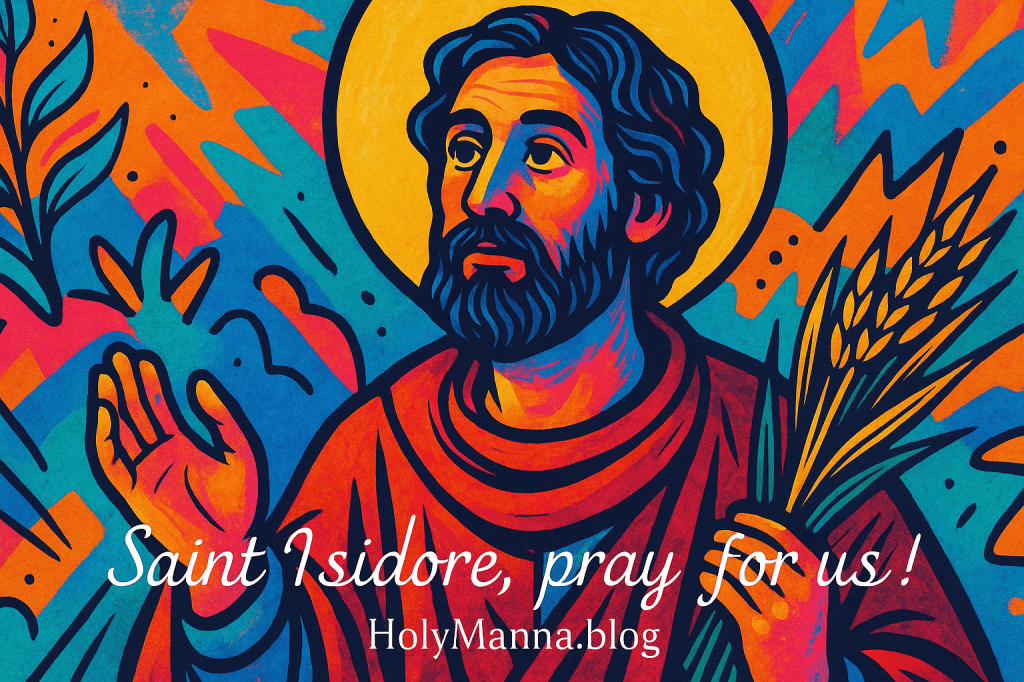
A Saint in the Soil
Among the great cloud of witnesses that the Church venerates, Saint Isidore the Farmer stands as a radiant symbol of holiness rooted in simplicity. Unlike many saints who served as bishops, martyrs, or theologians, Isidore’s sanctity blossomed in the furrows of the earth. Born into poverty in 11th-century Spain, he worked the land his entire life, showing that ordinary labor can be a pathway to extraordinary grace. He is known not only for his tireless work ethic and love for the poor but also for miraculous events that occurred both during and after his life. In 1622, Pope Gregory XV canonized him alongside spiritual titans like Saint Ignatius of Loyola and Saint Teresa of Ávila, confirming his place in the communion of saints. Today, Saint Isidore is the patron of farmers, laborers, and rural communities, and his feast day is celebrated on May 15. Through his life, we are reminded that every task—no matter how humble—can be sanctified when done with love for God.
Holy Ground
Isidore was born around 1070 in Madrid, Spain, to a poor but deeply devout family. His parents named him after the great scholar Saint Isidore of Seville, perhaps unknowingly foreshadowing his future sainthood. From an early age, Isidore learned to work the land, to rise before the sun, and to depend entirely on God’s providence. He spent much of his life as a day laborer, employed by a wealthy landowner named Juan de Vargas. Though uneducated in worldly terms, Isidore was steeped in spiritual wisdom, regularly attending Mass before beginning his day’s work.
He married a pious woman named María Torribia, who later became known as Blessed Maria de la Cabeza. Together they raised a son and lived a quiet life filled with acts of charity, prayer, and devotion. María shared her husband’s commitment to serving Christ in the poor and trusting in divine providence. They were known to open their home to those in need, never turning away a beggar. Their life together is a beautiful example of how marriage and sanctity can walk hand in hand.
Isidore is most known for his unwavering commitment to daily prayer and sacramental life. So faithful was he to attending daily Mass that his coworkers once accused him of neglecting his duties. But when his employer investigated, he saw something that stunned him—angelic beings were guiding the plow alongside Isidore. In that moment, it became clear: his prayer did not hinder his labor, but invited Heaven itself to work with him. This fusion of prayer and labor became the defining mark of Isidore’s sanctity.
Heaven in the Harvest
Saint Isidore’s life was not marked by dramatic conversions or public preaching, but by quiet miracles that testified to the presence of God in the mundane. The most well-known of these is the vision of the angels plowing the fields while Isidore prayed. This miracle was not simply an act of divine spectacle—it was a revelation that God honors those who put Him first, even in the ordinary rhythms of life.
In another remarkable episode, Isidore was once accused of stealing grain after being seen distributing food to the hungry. When the landowner opened Isidore’s sack, expecting it to be empty, it was found miraculously full. This act of divine replenishment echoed the miracles of the loaves and fishes and showed how God blesses generosity even in scarcity.
A third miracle occurred during a time of drought when Isidore, seeking water for his master, struck a dry rock with his staff. A fresh spring gushed forth from the ground—just as Moses had done in The Book of Exodus. These moments revealed that God does not wait for perfection to perform miracles; He moves through those who are faithful, humble, and compassionate.
Through these signs, Saint Isidore became a living testimony to what the Catechism of the Catholic Church teaches in paragraph 2013: “All Christians… are called to the fullness of Christian life and to the perfection of charity.”
The Furrows of Faith
Though Saint Isidore was not martyred, his life was not without difficulty. As a poor laborer, he endured the hardships of physical exhaustion, social marginalization, and the suspicion of those who misunderstood his piety. His fellow workers resented his habit of attending early morning Mass and accused him of laziness. Others mocked his generosity as foolishness. But Isidore bore all these insults with humility, never seeking revenge or defending himself harshly.
His life reminds us that suffering need not come in the form of violent persecution to be redemptive. Like Christ, who bore the weight of the cross silently, Isidore bore the burdens of his life with meekness and patience. His quiet resilience became a powerful form of witness. In this way, he reflects the wisdom of 1 Peter 2:20: “If you endure when you do right and suffer for it, you have God’s approval.”
Isidore teaches us that enduring the everyday injustices of life with a spirit of grace and prayer is, in itself, a path to holiness. He was not called to die for Christ but to live entirely for Him—and that, too, is sanctity.
Sprouting Grace
After Isidore died in 1130, his holy reputation only grew. Years later, when his body was exhumed, it was found to be incorrupt—a phenomenon that has long been seen in the Church as a sign of sanctity. Pilgrims began flocking to his grave, and many miracles were attributed to his intercession.
One of the most dramatic events took place in 1212 during the Battle of Las Navas de Tolosa. King Alfonso VIII of Castile prayed for Isidore’s help. According to accounts, the saint appeared in a vision and guided the king and his troops to a victorious strategy, altering the course of the battle and Christian history in Spain.
Isidore’s intercession also brought about numerous healings, especially among the poor and infirm. His relics became objects of veneration, and the site of his tomb—now the Cathedral of San Isidro in Madrid—remains a place of pilgrimage to this day.
In every generation since, farmers and workers have prayed for his intercession in times of drought, famine, or hardship. Many have reported unexpected rain, abundant harvests, or other favors received after invoking his name. His life continues to nourish the faithful long after his death, as foretold in John 12:24: “Unless a grain of wheat falls into the earth and dies, it remains alone; but if it dies, it bears much fruit.”
Cultivating the Spirit
Saint Isidore’s legacy is more timely than ever in a world obsessed with productivity, achievement, and recognition. His life invites us to return to the basics: prayer, humility, generosity, and faith. He proves that you don’t need a pulpit to preach or a throne to lead. Holiness is possible in every vocation, especially in the quiet labor of daily life.
We are challenged by his witness to integrate prayer into our work, to put God first, even when the world calls it impractical. We are reminded that God sees and rewards the hidden sacrifices we make—the kindness we show when no one is watching, the prayer we whisper before work, the compassion we extend even when we feel stretched thin.
Do I see my daily labor as a form of prayer?
Am I willing to give generously, even when I feel I have little to offer?
How might I invite the presence of God into the ordinary tasks of my life today?
Through Saint Isidore, we are given a roadmap for sanctity that does not require wealth, education, or status—only love, perseverance, and trust in God. In this way, he echoes the words of our Lord in Matthew 25:40: “Whatever you did for one of the least of these brothers and sisters of mine, you did for me.”
Engage with Us! 🌾
What part of Saint Isidore’s life touched your heart? How can we imitate his deep trust in divine providence today?
Reflection Questions:
- Do I begin my day with prayer, trusting that God will guide my work?
- How can I serve the poor and needy around me, even with limited resources?
- Where in my daily tasks can I invite God’s presence to sanctify my labor?
Let’s walk with one another as brothers and sisters in Christ, supporting each other in our faith journey. And in all that we do—whether plowing fields or navigating city streets—may we strive to do it with love, as our Lord Jesus did.
Saint Isidore, pray for us! 🌾
Follow us on Instagram and Facebook for more insights and reflections on living a faith-filled life.

 Holy Manna!
Leave a comment