The Faithfulness That Fulfills
Have you ever traced the thread of God’s presence across the years of your life? Today’s readings invite us to zoom out and behold the sweeping arc of salvation history—a story of divine promises patiently fulfilled, of chosen vessels anointed for mission, and of a Savior sent not only to redeem but to teach us what it means to serve. From the powerful testimony of St. Paul in Acts of the Apostles, to the covenantal poetry of Psalm 89, and finally to the intimate farewell discourse in The Gospel of John, we are drawn into the mystery of God’s faithful love made manifest in Jesus Christ.
Paul’s address in the synagogue of Antioch in Pisidia is no casual sermon. It’s a strategic proclamation rooted in Jewish memory and Scripture. He retells the story of Israel—from Egypt to the kings, with a special spotlight on David, “a man after my own heart” (Acts 13:22), whose lineage would bear the long-awaited Messiah. For Paul’s Jewish audience, the mention of David evoked the golden age of Israel and stirred hope for its restoration. That hope, Paul declares, has been fulfilled in Jesus. This context of expectation makes Psalm 89 all the more poignant, as it echoes God’s covenant with David: “My faithfulness and mercy will be with him” (Psalm 89:25). The psalm functions as both a remembrance and a prophetic lens through which we see Christ as the true anointed one.
Then comes Jesus Himself, in John’s Gospel, turning the narrative of kingship and messianic glory upside down. “No slave is greater than his master” (John 13:16), He says, preparing His disciples for betrayal, suffering, and the hard road of servanthood. This Messiah, descended from David, is also the Suffering Servant foretold by Isaiah. He is the One who washes feet, who knows the pain of betrayal, and who still chooses to love. His fidelity to the Father becomes our model and mission. How does the Lord’s unwavering love through history inspire your own trust in His plan today?
First Reading – Acts of the Apostles 13:13–25
The God Who Writes Our Story
Today’s first reading draws us into a pivotal moment in the early Church’s missionary expansion. Paul, along with Barnabas, arrives in Antioch in Pisidia—a prominent Roman colony in Asia Minor—and delivers what may be called his “synagogue sermon,” a powerful narrative that traces Israel’s salvation history and culminates in Jesus Christ. The Acts of the Apostles, traditionally attributed to St. Luke, acts as a sequel to his Gospel and highlights the spread of the Christian message from Jerusalem to the ends of the earth. This speech reveals how early Christians understood Jesus as the fulfillment of God’s promises to Israel, especially the promise made to King David. Paul’s words echo our theme today: God’s faithfulness is not abstract—it is rooted in real events, real people, and ultimately fulfilled in a real Savior.
Acts 13:13-25
New American Bible (Revised Edition)
Paul’s Arrival at Antioch in Pisidia. 13 From Paphos, Paul and his companions set sail and arrived at Perga in Pamphylia. But John left them and returned to Jerusalem. 14 They continued on from Perga and reached Antioch in Pisidia. On the sabbath they entered [into] the synagogue and took their seats. 15 After the reading of the law and the prophets, the synagogue officials sent word to them, “My brothers, if one of you has a word of exhortation for the people, please speak.”
Paul’s Address in the Synagogue. 16 So Paul got up, motioned with his hand, and said, “Fellow Israelites and you others who are God-fearing, listen. 17 The God of this people Israel chose our ancestors and exalted the people during their sojourn in the land of Egypt. With uplifted arm he led them out of it 18 and for about forty years he put up with them in the desert. 19 When he had destroyed seven nations in the land of Canaan, he gave them their land as an inheritance 20 at the end of about four hundred and fifty years. After these things he provided judges up to Samuel [the] prophet. 21 Then they asked for a king. God gave them Saul, son of Kish, a man from the tribe of Benjamin, for forty years. 22 Then he removed him and raised up David as their king; of him he testified, ‘I have found David, son of Jesse, a man after my own heart; he will carry out my every wish.’ 23 From this man’s descendants God, according to his promise, has brought to Israel a savior, Jesus. 24 John heralded his coming by proclaiming a baptism of repentance to all the people of Israel; 25 and as John was completing his course, he would say, ‘What do you suppose that I am? I am not he. Behold, one is coming after me; I am not worthy to unfasten the sandals of his feet.’
Verse-by-Verse Exegesis
Verse 13 – “From Paphos, Paul and his companions set sail and arrived at Perga in Pamphylia. But John left them and returned to Jerusalem.”
This verse sets the geographical context and introduces a subtle note of tension. John Mark’s departure from the mission field will later cause a rift between Paul and Barnabas (cf. Acts 15:38). His exit foreshadows the difficulty and cost of spreading the Gospel, even among companions.
Verse 14 – “They continued on from Perga and reached Antioch in Pisidia. On the sabbath they entered [into] the synagogue and took their seats.”
This reveals Paul’s missionary strategy: go first to the Jews. The synagogue was not only a religious space but also a community hub. By attending the sabbath gathering, Paul situates the Christian message firmly within Jewish tradition.
Verse 15 – “After the reading of the law and the prophets, the synagogue officials sent word to them, ‘My brothers, if one of you has a word of exhortation for the people, please speak.’”
This reflects a customary practice in synagogues, where visiting teachers could be invited to offer insights. Paul is given the floor, not by chance, but providentially. The “word of exhortation” echoes the Jewish tradition of derashah, or scriptural commentary.
Verse 16 – “So Paul got up, motioned with his hand, and said, ‘Fellow Israelites and you others who are God-fearing, listen.’”
Paul addresses both Jews and Gentile “God-fearers” (non-Jews who respected Jewish monotheism). His gesture and greeting indicate solemnity and inclusivity. This message is for all who revere the God of Israel.
Verse 17 – “The God of this people Israel chose our ancestors and exalted the people during their sojourn in the land of Egypt. With uplifted arm he led them out of it.”
Paul roots his message in the Exodus, the foundational act of God’s covenant love and liberation. “With uplifted arm” reflects divine power and mercy, a phrase used repeatedly in the Old Testament to describe God’s saving actions.
Verse 18 – “And for about forty years he put up with them in the desert.”
This is a raw, honest depiction of Israel’s stubbornness. The Greek can also be translated as “nourished them,” but Paul chooses to emphasize God’s patience—a central trait of divine fidelity.
Verse 19 – “When he had destroyed seven nations in the land of Canaan, he gave them their land as an inheritance.”
Paul continues the story through the conquest under Joshua, showing how God delivered on His promise of a homeland. The reference to “seven nations” aligns with Deuteronomy 7:1, emphasizing the completeness of God’s victory.
Verse 20 – “At the end of about four hundred and fifty years. After these things he provided judges up to Samuel the prophet.”
The period of judges was marked by moral chaos and spiritual wavering, but God did not abandon His people. Samuel marks the transition from judges to kings, a key turning point in Israel’s story.
Verse 21 – “Then they asked for a king. God gave them Saul, son of Kish, a man from the tribe of Benjamin, for forty years.”
Israel’s request for a king, found in 1 Samuel 8, was seen as both a rejection of God’s direct rule and a concession to their desire for earthly power. Saul’s reign is depicted as a necessary but flawed beginning.
Verse 22 – “Then he removed him and raised up David as their king; of him he testified, ‘I have found David, son of Jesse, a man after my own heart; he will carry out my every wish.’”
David, despite his faults, is God’s chosen one. This quotation alludes to 1 Samuel 13:14 and Psalm 89. David’s heart for God and willingness to repent made him a model king and a type of Christ.
Verse 23 – “From this man’s descendants God, according to his promise, has brought to Israel a savior, Jesus.”
This is the climax: Jesus is the fulfillment of the Davidic promise. The Messianic expectation centered on a descendant of David (2 Samuel 7:12–16), and Paul declares Jesus to be that promised Savior.
Verse 24 – “John heralded his coming by proclaiming a baptism of repentance to all the people of Israel.”
John the Baptist’s role was to prepare hearts through repentance. His ministry signaled a new era. He is the bridge between Old and New, the final prophet before the Messiah.
Verse 25 – “And as John was completing his course, he would say, ‘What do you suppose that I am? I am not he. Behold, one is coming after me; I am not worthy to unfasten the sandals of his feet.’”
John humbly deflects attention, echoing what Jesus will later say about true servanthood. His words anticipate Jesus’ own humility in John 13, where He washes the disciples’ feet—foreshadowed in this gesture of “unfastening sandals.”
Teachings of the Church
The Catechism of the Catholic Church teaches that “the economy of the Old Covenant was deliberately oriented toward the coming of Christ, the redeemer of all men” (CCC 122). St. Paul’s speech is a living example of how the early Church interpreted all of history as pointing to Jesus. By recounting the events from Exodus to David to John the Baptist, Paul affirms that “the Church, as early as apostolic times…has always venerated the Scriptures as she venerates the body of the Lord” (CCC 103), seeing in them the fullness of divine revelation.
St. Augustine, reflecting on the relationship between Old and New Testaments, wrote: “The New Testament lies hidden in the Old and the Old Testament is unveiled in the New” (Quaestiones in Heptateuchum). This dynamic is alive in today’s reading. Paul doesn’t dismiss the old stories—he reveres them as the sacred soil from which Jesus springs. This reading also affirms that God does not act randomly or apart from history. As St. John Henry Newman famously said, “To be deep in history is to cease to be Protestant.” The God of Israel is the God of the Church.
Historically, Paul’s sermon reflects the urgent missionary effort of the early Church. These were not academic lectures—they were matters of life and death. To proclaim Jesus as the Messiah in a synagogue could lead to joyful conversions—or violent rejections. This tension, still present in evangelization today, is rooted in fidelity to the truth: “From this man’s descendants…has brought to Israel a savior, Jesus” (Acts 13:23). It is a bold and unshakable claim.
Reflection
The first reading reminds us that our lives, too, are part of God’s story. Like the Israelites, we may wander, complain, or demand our own version of kings. Yet God, ever patient, continues to guide us back to Himself. He uses flawed people, failed starts, and unexpected paths to fulfill His purpose. Do you see your own spiritual journey within the larger story of salvation? Where has God been patient with you, and how is He calling you to trust in His promise today?
We are also called to be like Paul: storytellers of salvation. In a world that forgets its sacred roots, we must speak boldly, reverently, and personally about how Jesus fulfills the deepest desires of the human heart. Who in your life needs to hear this story today? Are you ready to trace God’s faithfulness, not just in Scripture, but in your own life—and share it with others?
Responsorial Psalm – Psalm 89:2–3, 21–22, 25, 27
Covenant Mercy That Endures Forever
Psalm 89 stands as a majestic hymn celebrating God’s covenant with King David, affirming the unshakable bond between the Lord and His anointed one. Composed during a time of reflection—possibly after the Babylonian exile—this psalm oscillates between praise for God’s promises and lament over their seeming delay or disruption. In today’s selection, we hear the confident, joyful beginning of the psalm that highlights the eternal nature of God’s mercy and His irrevocable choice of David as His servant. In the context of today’s readings, Psalm 89 reinforces the divine continuity between the Old Covenant and its fulfillment in Jesus Christ, the true Son of David. It is a poetic echo of Paul’s proclamation in Acts of the Apostles and foreshadows the humility and authority Jesus speaks of in The Gospel of John.
Psalm 89:2-3, 21-22, 25, 27
New American Bible (Revised Edition)
2 I will sing of your mercy forever, Lord
proclaim your faithfulness through all ages.
3 For I said, “My mercy is established forever;
my faithfulness will stand as long as the heavens.
21 I have chosen David, my servant;
with my holy oil I have anointed him.
22 My hand will be with him;
my arm will make him strong.
25 My faithfulness and mercy will be with him;
through my name his horn will be exalted.
27 He shall cry to me, ‘You are my father,
my God, the Rock of my salvation!’
Verse-by-Verse Exegesis
Verse 2 – “I will sing of your mercy forever, Lord / proclaim your faithfulness through all ages.”
This opening line sets the tone of enduring praise. “Mercy” (Hebrew chesed) implies covenantal love—loyal, steadfast, and undeserved. To proclaim God’s faithfulness “through all ages” is to acknowledge His actions in history and anticipate their fulfillment for future generations, including in Christ.
Verse 3 – “For I said, ‘My mercy is established forever; / my faithfulness will stand as long as the heavens.’”
Here, the psalmist reflects God’s own voice and intent. His mercy is not fleeting, and His faithfulness is as enduring as the cosmos itself. This verse affirms that divine promises, particularly to David, are not subject to human failure but grounded in divine constancy.
Verse 21 – “I have chosen David, my servant; / with my holy oil I have anointed him.”
This recalls the anointing of David by Samuel in 1 Samuel 16:13. Anointing with oil signified consecration, authority, and divine favor. In Christian interpretation, David’s anointing prefigures the anointing of Jesus, the Messiah (Christos in Greek, meaning “Anointed One”).
Verse 22 – “My hand will be with him; / my arm will make him strong.”
God’s personal involvement with David is emphasized—His “hand” and “arm” symbolize protection and empowerment. This strength is not political might alone, but divine support for carrying out the will of God. Jesus, too, is upheld by the Father’s will and Spirit in His mission.
Verse 25 – “My faithfulness and mercy will be with him; / through my name his horn will be exalted.”
“Faithfulness and mercy” again echo the covenant language of chesed and emet—love and truth. The image of the “horn” symbolizes strength and kingly dignity. Christ, the descendant of David, is the One exalted by the Father in the name above all names (cf. Philippians 2:9).
Verse 27 – “He shall cry to me, ‘You are my father, / my God, the Rock of my salvation!’”
This is a profoundly intimate verse, where the king addresses God as Father—foreshadowing Jesus’ unique Sonship. “Rock” denotes stability, refuge, and divine protection. Jesus perfectly fulfills this filial relationship, and invites us into it through Him.
Teachings of the Church
The Catechism of the Catholic Church affirms the significance of the covenant with David, stating: “The people of the ‘poor’—those who, humble and meek, wholly rely on the mysterious plans of the Lord… hope for a Messiah who will bring them salvation” (CCC 711). Psalm 89 embodies this spirit of hope, praising God’s mercy while looking forward to the realization of His promises. This longing finds its answer in Christ, the true heir of David.
St. Leo the Great powerfully writes: “What was visible in our Savior has passed over into His mysteries.” The anointing of David was a visible sign that prefigured Christ’s messianic kingship, which is now extended sacramentally to His Body, the Church. In our baptism and confirmation, we share in Christ’s anointing as priest, prophet, and king. Psalm 89, then, is not merely history—it is our inheritance and calling.
In light of this psalm, the Church recognizes that divine faithfulness is not an abstract principle but a lived reality in the communion of saints and the sacraments. As we sing of God’s mercy in the Liturgy of the Hours or in the Eucharist, we proclaim that same covenant love. The psalmist’s cry—“You are my father, my God, the Rock of my salvation!”—is fulfilled in the lips of Christ, and echoed by every baptized soul who dares to call God “Father” in the Spirit.
Reflection
Psalm 89 calls us to become people who remember. In a world addicted to novelty and forgetful of God’s mighty deeds, we are invited to proclaim His mercy “forever,” to pass it on “through all ages.” What are the moments in your life when you have felt God’s faithfulness as rock-solid as the heavens? How often do you stop to sing of His mercy—not just in song, but in the way you speak, serve, and forgive?
This psalm also challenges us to live as God’s “anointed,” not in self-glory, but in humble service. Like David, we may be flawed, but God’s hand is with us when we walk in His covenant. Are you leaning on the strength of His arm today, or striving on your own? Let us cry out, like the psalmist, from the depths of our hearts: “You are my father, my God, the Rock of my salvation!”—and trust that He will be faithful to His promises.
Holy Gospel – John 13:16–20
The Anointed Servant Who Sends
Today’s Gospel takes us into the intimate setting of the Last Supper, where Jesus, aware of His approaching Passion, imparts profound lessons to His disciples. The Gospel of John, rich in theological depth and symbolism, shifts in chapter 13 from Jesus’ public ministry to what scholars call the “Book of Glory”—a private discourse with His apostles marked by foot washing, forewarning of betrayal, and urgent teachings on love and service. In this moment, Jesus emphasizes the link between Him, the Father who sent Him, and those He sends forth. This passage resonates powerfully with our theme of God’s enduring faithfulness and His fulfillment of promises through Christ: the Messiah who serves, who suffers, and who sends.
John 13:16-20
New American Bible (Revised Edition)
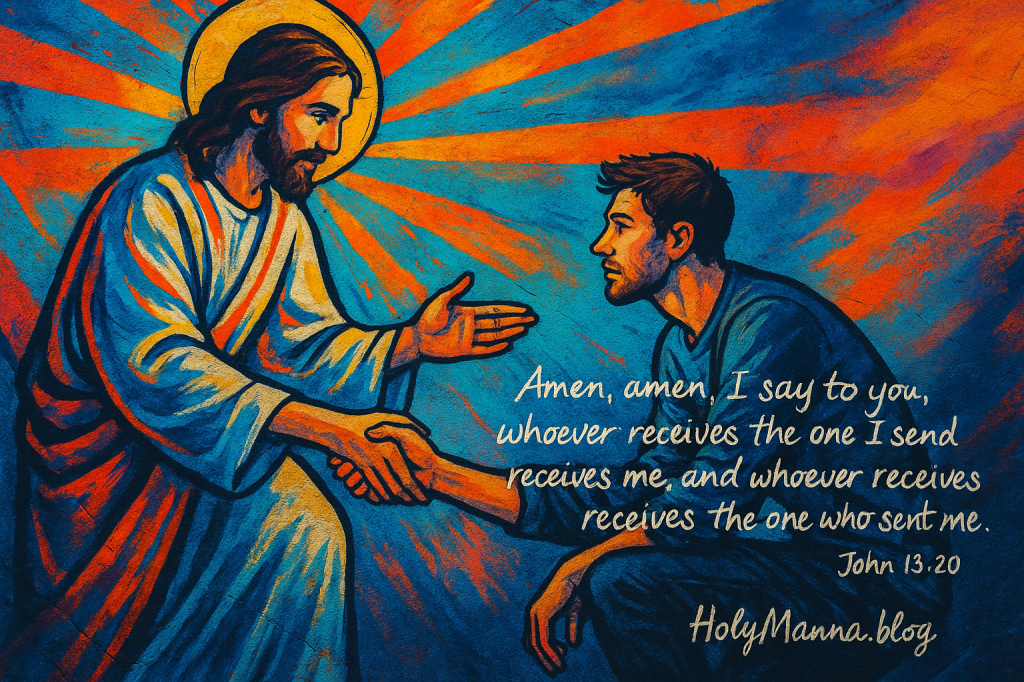
16 Amen, amen, I say to you, no slave is greater than his master nor any messenger greater than the one who sent him. 17 If you understand this, blessed are you if you do it. 18 I am not speaking of all of you. I know those whom I have chosen. But so that the scripture might be fulfilled, ‘The one who ate my food has raised his heel against me.’ 19 From now on I am telling you before it happens, so that when it happens you may believe that I AM. 20 Amen, amen, I say to you, whoever receives the one I send receives me, and whoever receives me receives the one who sent me.”
Verse-by-Verse Exegesis
Verse 16 – “Amen, amen, I say to you, no slave is greater than his master nor any messenger greater than the one who sent him.”
This double “Amen” signals solemn truth. Jesus recalls His earlier action of washing the disciples’ feet—an act of radical humility. Here, He clarifies that if the Master serves, then His servants must do the same. In the Greco-Roman world, slaves and messengers had no status. Jesus reverses worldly hierarchies: greatness lies in service, not dominion.
Verse 17 – “If you understand this, blessed are you if you do it.”
Understanding alone is not enough; blessing comes through action. Jesus is establishing a new beatitude: those who imitate Him in humble service are truly blessed. This echoes James’ teaching: “Be doers of the word and not hearers only” (James 1:22).
Verse 18 – “I am not speaking of all of you. I know those whom I have chosen. But so that the scripture might be fulfilled, ‘The one who ate my food has raised his heel against me.’”
Jesus acknowledges the coming betrayal by Judas, quoting Psalm 41:10. The betrayal is all the more painful because it comes from within—one who shared His table. Yet even this dark moment fulfills Scripture, demonstrating that nothing escapes God’s providential plan.
Verse 19 – “From now on I am telling you before it happens, so that when it happens you may believe that I AM.”
Jesus reveals His foreknowledge not to boast but to build the disciples’ faith. His self-identification as “I AM” (ego eimi) deliberately echoes the divine name revealed in Exodus 3:14. He is not merely a prophet predicting the future—He is the Lord Himself, guiding history.
Verse 20 – “Amen, amen, I say to you, whoever receives the one I send receives me, and whoever receives me receives the one who sent me.”
Here Jesus establishes the sacred chain of mission: the Father sends the Son, the Son sends the disciples. To receive a messenger of Christ is to receive Christ—and to receive Christ is to receive the Father. This verse anticipates apostolic authority and sacramental presence in the Church.
Teachings of the Church
The Catechism of the Catholic Church emphasizes Christ’s humility and service in the washing of the disciples’ feet as a model for Christian living: “Having loved those who were his own who were in the world, he loved them to the end” (Jn 13:1). By bending down to wash their feet, Jesus gives us an example of his humility and of the charity that must animate his disciples” (CCC 1235). Today’s Gospel continues this example by calling us not only to understand service but to embody it as our path to blessedness.
Additionally, the Church teaches that Christ’s mission is passed on to the apostles and their successors: “Just as the Father sent me, so I send you” (Jn 20:21). This apostolic mission is essential to the life of the Church and the faithful’s participation in it” (CCC 858). When Jesus says “whoever receives the one I send receives me”, He is laying the foundation for the Church’s authority and her ministers’ sacramental role in making Christ present in the world.
St. Thomas Aquinas wrote: “Christ is the source of all grace, and by His divine sending He gives both mission and power to those who act in His name” (Commentary on John). The profound unity between Jesus and His messengers means that the Church’s ministers are not simply representatives—they are true instruments of grace. This sacramental reality also challenges us to receive the Church’s teachings and sacraments with reverence, recognizing Christ Himself in them.
Reflection
Today’s Gospel invites us to examine the kind of service we offer. Jesus, our Lord and King, lowered Himself to wash feet and foretold betrayal not to condemn but to strengthen faith. Are we willing to serve even when it costs us something? Do we bless others not only with our thoughts and prayers, but through action, humility, and faithfulness? Jesus makes it clear: the blessing is not in knowing, but in doing.
This passage also calls us to receive others with reverence—especially those sent by Christ. Whether it’s a priest, a catechist, or a friend who shares the Gospel with us, we are challenged to see Christ in the one sent. Do we receive the people God sends into our lives with the honor due to Him? Are we ourselves open to being sent—to becoming that presence of Christ for others? Let us listen deeply to Jesus’ words today, and let them shape not only our thoughts, but our hands and hearts. “Blessed are you if you do it.”
Sent by Mercy, Rooted in Promise
Today’s liturgy paints a breathtaking picture of God’s covenantal faithfulness woven across centuries, fulfilled in Jesus, and extended through us. From Paul’s sweeping proclamation of salvation history in Acts of the Apostles, to the psalmist’s joyful exaltation of God’s steadfast love in Psalm 89, to Jesus’ intimate words at the Last Supper in The Gospel of John, we are reminded of one unshakable truth: God is faithful to His promises, and He invites us to participate in their fulfillment through humble service and courageous witness.
We see the thread of divine fidelity not only in ancient kings and prophets, but in the Word made flesh—Christ Himself—who stoops to serve, suffers betrayal, and still chooses to send us. The one anointed by God is also the one who anoints us, calling us to live as heirs of David’s line and bearers of the Gospel. In Christ, the mercy sung of by the psalmist becomes flesh. In Him, the promises remembered by Paul become personal. And through Him, the mission entrusted to the apostles becomes ours.
How is God asking you to trust His promises more deeply today? Where is He calling you to serve with humility and boldness? May you be filled with the courage to proclaim God’s mercy, the strength to live as His anointed, and the love to receive and carry Christ to others. Let us go forth joyfully, knowing that we are part of His eternal story—blessed not only when we understand it, but when we do it. “Blessed are you if you do it.”
Engage with Us!
We’d love to hear how today’s Word touched your heart. Share your thoughts, prayers, or questions in the comments below—your witness could be the encouragement someone else needs today. Let’s grow together as a community rooted in Christ’s faithfulness and sent out in His love.
Reflection Questions:
First Reading – Acts of the Apostles 13:13–25
Where do you see the hand of God writing your own salvation story?
Have you ever been called to proclaim the Gospel like Paul, even in uncomfortable or unfamiliar places?
Responsorial Psalm – Psalm 89:2–3, 21–22, 25, 27
How has God shown you His mercy and faithfulness in your life?
Do you truly see yourself as “anointed” for mission through your baptism? How does that change the way you live today?
Holy Gospel – John 13:16–20
What does it look like in your life to serve as Jesus served?
Are there people in your life whom God is sending you to? How can you receive and love them as you would receive Christ Himself?
Let’s walk forward together in faith—trusting in the promises of our loving Father, drawing strength from His Word, and offering our lives in humble service. May everything we do be done with the love and mercy Jesus has taught us, so that through us, others may come to know Him.
Follow us on Instagram and Facebook for more insights and reflections on living a faith-filled life.

 Holy Manna!
Leave a comment