The Twelfth Light
In the tapestry of the Apostles, Saint Matthias may not be the most renowned thread, but his presence is vital and divinely placed. Chosen by the early Church under the guidance of the Holy Spirit to replace Judas Iscariot, Matthias represents God’s merciful restoration and the Church’s commitment to fidelity and completeness. Though the New Testament mentions him only briefly, his selection as an Apostle affirms that no calling is accidental in the Kingdom of God. Saint Matthias is revered not for grandiose miracles or dramatic conversions, but for his enduring fidelity, his readiness to serve, and his unwavering trust in God’s providence. In him, we find a saint of second chances, quiet perseverance, and apostolic courage.
From Disciple to Apostle
Though Scripture does not offer a detailed biography of Saint Matthias, ancient tradition tells us that he was born in Judaea and was most likely a Galilean, as were many of Christ’s earliest followers. Some early sources suggest that he was among the seventy-two disciples mentioned in The Gospel of Luke—those sent out two by two by Jesus to heal, cast out demons, and preach the Kingdom of God. This detail, while not confirmed by Scripture, is consistent with the apostolic criteria laid out in Acts of the Apostles: the replacement for Judas had to be someone who had accompanied Jesus from His baptism by John until the Ascension.
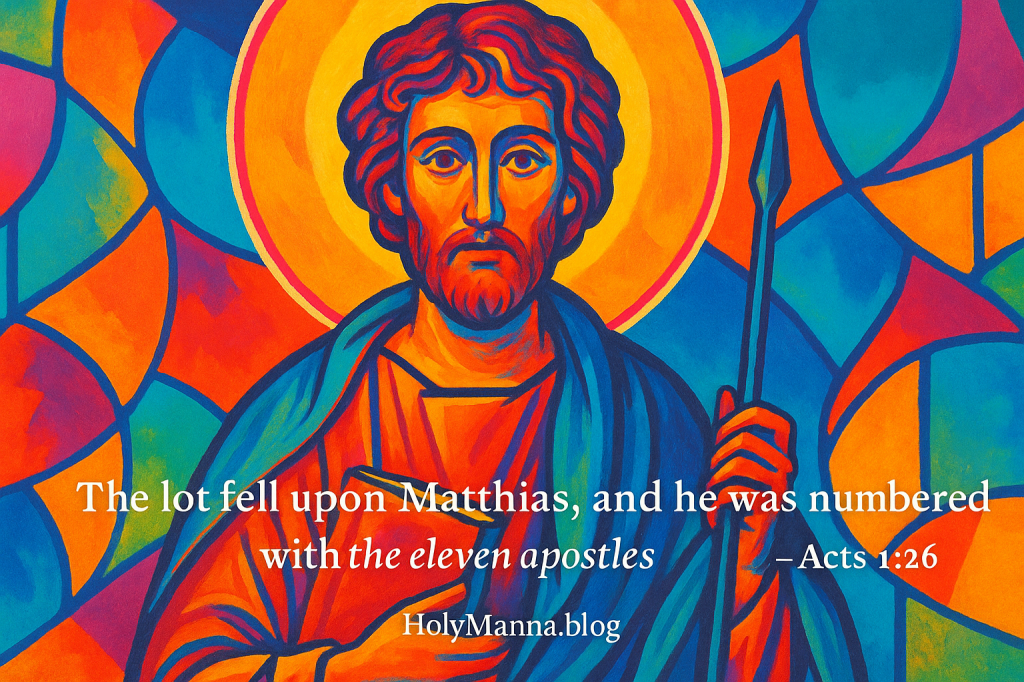
Matthias’ story truly begins after the Resurrection, when Peter, inspired by the Holy Spirit and rooted in Psalmic prophecy, declares the need to fill the vacancy left by Judas. Two men are proposed: Joseph called Barsabbas, and Matthias. After fervent prayer, the apostles cast lots—a practice common in Jewish tradition to discern God’s will. As Acts 1:24–26 recounts, “You, Lord, who know the hearts of all, show which one of these two you have chosen to take the place in this ministry and apostleship from which Judas turned aside… And the lot fell upon Matthias, and he was numbered with the eleven apostles.”
This wasn’t a game of chance—it was divine appointment. Matthias had been quietly faithful, and when the time came, God brought his hidden discipleship into the spotlight. After his commissioning, Matthias is believed to have preached the Gospel in Judea, Cappadocia, and possibly even the region of Colchis near the Caspian Sea. He is most remembered as a witness to Christ’s Resurrection and as a courageous missionary to the Gentiles, embodying the apostolic mandate to “go into all the world and preach the gospel to every creature.”
The Hidden Wonders
While no miracles are attributed to Saint Matthias in the canonical Scriptures, his name and reputation inspired several early Christian writings and legends, some of which recount his miraculous works. The Acts of Andrew and Matthias, an apocryphal text written a century or two after his death, describes his missionary journey to a land of cannibals where he was imprisoned and eventually rescued by Saint Andrew. Though this account is not part of the official canon, it reflects how early Christians revered Matthias as a vessel of divine power and perseverance.
Even if these stories remain in the realm of sacred legend, it is no small miracle that Matthias was able to bring the message of Jesus to regions untouched by the Gospel. The fruit of his missionary labors—the conversions, baptisms, and the establishment of Christian communities—are enduring testimonies to the silent miracles that often accompany the work of evangelization. In the lives of the early saints, the ordinary often becomes extraordinary through fidelity, love, and divine grace.
Martyrdom’s Crown
Like his brother apostles, Saint Matthias did not escape persecution. His witness to the risen Christ inevitably brought him into conflict with both Jewish authorities and pagan powers. According to varying traditions, Matthias suffered martyrdom in Jerusalem, where he was either stoned and then beheaded, or crucified. Another account claims he was martyred in Colchis, where he was chopped to death with an axe—a tool that later became his iconographic symbol in Christian art.
Regardless of the exact method, what all traditions agree upon is this: Matthias gave his life for the name of Jesus. His death was not in vain but sealed his apostleship with blood, making him part of that noble cloud of witnesses who imitated their Master even unto death. As the Catechism of the Catholic Church reminds us, “Martyrdom is the supreme witness given to the truth of the faith: it means bearing witness even unto death” (CCC 2473). Matthias’ martyrdom thus becomes the final confirmation of his calling, proving that he was not just chosen by lot—but by love.
After the Fire
After his death, devotion to Saint Matthias only grew. His relics were said to have been transferred to Rome by Saint Helena and eventually brought to Trier, Germany, where they rest in the Basilica of Saint Matthias—the only apostolic tomb north of the Alps. This basilica has been a site of pilgrimage for centuries, drawing the faithful seeking healing, hope, and guidance.
Numerous miracles have been attributed to the intercession of Saint Matthias, particularly among those discerning vocations or seeking clarity in making major life decisions. Because he was chosen by divine lot, many Catholics invoke him when faced with uncertainty or moments of vocational transition. Through his intercession, believers have reported miraculous healings, conversions, and deepened faith. In the communion of saints, Matthias continues to act, not with public spectacle, but in quiet fidelity—just as he did in life.
A Saint for the Overlooked
Saint Matthias offers us a powerful witness for today’s world—especially for those who feel overlooked, passed over, or hidden in the crowd. His story reassures us that God sees our quiet faithfulness and will raise it up in His perfect timing. Matthias didn’t push to be noticed. He simply followed Jesus, stayed close to the other disciples, and lived a life of trust and obedience. And when the time came, the Church and the Holy Spirit called his name.
What does that mean for us? It means that our faithfulness—whether public or hidden—matters deeply. It means that our humble “yes” to Jesus every day prepares us for whatever mission God may assign, even when we can’t see it yet. Like Matthias, we are called to be ready, to say yes, and to bear witness to Christ no matter the cost.
So let us be saints of the hidden life. Let us be willing to serve where the need is greatest, to be faithful in prayer, and to trust that God will bring our lives into the light when the moment is right. And above all, let us never forget that in God’s Kingdom, no one is forgotten.
🙏 Engage with Us!
We’d love to hear your reflections on Saint Matthias’ life and what it means for you personally. Let’s grow in faith together!
💬 Reflection Questions:
- Have you ever felt overlooked in your faith or vocation? How does Saint Matthias’ story encourage you to remain faithful in the “hidden seasons”?
- When was the last time you discerned a big decision with prayer and trust in God’s will, like the apostles did when choosing Matthias?
- What small acts of obedience can you offer to the Lord today that may bear fruit in ways you cannot yet see?
Let’s support each other on this journey. May we all be faithful witnesses, willing to serve—even when no one is watching. And let us, like Matthias, do everything with love, as our Lord Jesus did.
Saint Matthias, pray for us! 🔥
Follow us on Instagram and Facebook for more insights and reflections on living a faith-filled life.

 Holy Manna!
Leave a comment