Divine Election, Apostolic Mission, and the Call to Love
Have you ever wondered why you were born into this time, in this family, with your particular gifts, wounds, and longings? Today’s Mass readings invite us to contemplate the mystery of being chosen—not randomly or by merit, but out of God’s loving initiative. In a world obsessed with self-promotion and proving our worth, the Word today offers a powerful counter-narrative: we are chosen to be friends of Jesus, appointed to bear fruit that will last, and raised—often from lowliness—to serve as witnesses of His love. These readings speak into the deep human desire to be seen, known, and called with purpose.
Historically, this moment in The Acts of the Apostles is filled with anticipation. Jesus has ascended, and the fledgling Church is preparing for Pentecost. With only eleven apostles remaining after Judas’s betrayal and death, Peter stands up to fulfill Scripture and discern who will take Judas’s place. This was no small decision—it was a recognition that the apostolic mission must continue, that someone must be with us a witness to His resurrection. Psalm 113 then draws us into the heart of God, who not only reigns above the heavens but “raises the needy from the dust” and lifts them to share in His glory. And in The Gospel of John, Jesus Himself reminds the disciples: “It was not you who chose me, but I who chose you and appointed you to go and bear fruit”—a profound reminder that love is the root of vocation.
Together, these readings trace a holy pattern: God calls, raises, appoints, and sends. From the replacement of Judas to the lifting of the poor, from Christ’s command to love to our own discipleship today, we are caught up in a divine story of mission. But this call isn’t rooted in status—it is rooted in friendship with Christ. Are we living as those who have been chosen? Are we bearing fruit that will endure beyond our short time on earth? These are the questions that today’s Word lovingly places on our hearts.
First Reading – Acts 1:15–17, 20–26
Called to Be a Witness
The Acts of the Apostles is often referred to as the Gospel of the Holy Spirit. Written by Saint Luke, it captures the first movements of the Church after Jesus’ Ascension. Today’s passage brings us to a decisive moment: the selection of Judas’s successor. This isn’t just about organizational maintenance—it’s about divine continuity. With the Apostles gathered, Peter stands to speak amid the one hundred and twenty believers, a number echoing completeness in Jewish tradition. The Church is not yet empowered by Pentecost, but already discernment and prayer are guiding its actions. The backdrop is one of loss—Judas’s betrayal—and yet, the Apostles are not paralyzed by failure. Rather, they turn to Scripture, trust the Spirit, and prepare for mission. This reading sets the stage for the theme of divine election: “You did not choose me, but I chose you” becomes visibly embodied in the casting of lots and the choice of Matthias. From the ashes of betrayal rises the fruit of obedience and faithfulness.
Acts 1:15-17, 20-26
New American Bible (Revised Edition)
The Choice of Judas’s Successor. 15 During those days Peter stood up in the midst of the brothers (there was a group of about one hundred and twenty persons in the one place). He said, 16 “My brothers, the scripture had to be fulfilled which the holy Spirit spoke beforehand through the mouth of David, concerning Judas, who was the guide for those who arrested Jesus. 17 He was numbered among us and was allotted a share in this ministry.
20 For it is written in the Book of Psalms:
‘Let his encampment become desolate,
and may no one dwell in it.’
And:
‘May another take his office.’
21 Therefore, it is necessary that one of the men who accompanied us the whole time the Lord Jesus came and went among us, 22 beginning from the baptism of John until the day on which he was taken up from us, become with us a witness to his resurrection.” 23 So they proposed two, Joseph called Barsabbas, who was also known as Justus, and Matthias. 24 Then they prayed, “You, Lord, who know the hearts of all, show which one of these two you have chosen 25 to take the place in this apostolic ministry from which Judas turned away to go to his own place.” 26 Then they gave lots to them, and the lot fell upon Matthias, and he was counted with the eleven apostles.
Detailed Exegesis
Verse 15 – “During those days Peter stood up in the midst of the brothers (there was a group of about one hundred and twenty persons in the one place).”
Peter, taking his role as the leader among the Apostles, speaks boldly to the gathered community. The group of 120 represents a fullness—a number signifying the readiness to establish a new foundation for the Church. This number also aligns with Jewish customs where 120 men were required to form a community with its own council. The early Church is being spiritually and structurally prepared for mission.
Verse 16 – “My brothers, the scripture had to be fulfilled which the holy Spirit spoke beforehand through the mouth of David, concerning Judas, who was the guide for those who arrested Jesus.”
Peter frames Judas’s betrayal not as an accident or divine failure, but as part of a providential plan foreseen in Scripture. He appeals to divine revelation, quoting the Psalms as prophecy. This is significant: Scripture is not a dead document, but the living voice of the Holy Spirit. The betrayal serves as a painful reminder, yet it becomes a moment for fidelity to God’s plan.
Verse 17 – “He was numbered among us and was allotted a share in this ministry.”
This verse highlights the tragedy of Judas’s fall: he was one of them. He had a share—kleros, in Greek, meaning a portion or inheritance—in the ministry. His apostolic identity was real, and so his turning away is grievous. Still, the Church must move forward, acknowledging the reality of human freedom and failure within its ranks.
Verse 20 – “For it is written in the Book of Psalms: ‘Let his encampment become desolate, and may no one dwell in it.’ And: ‘May another take his office.’”
Peter quotes Psalm 69 and Psalm 109, applying them prophetically to Judas. His place—his “episkopē,” or office of oversight—is now vacant. The citation reaffirms that God’s Word speaks into the Church’s present circumstances and that leadership within the Church is not self-appointed but part of God’s design.
Verse 21 – “Therefore, it is necessary that one of the men who accompanied us the whole time the Lord Jesus came and went among us,”
Peter sets criteria for apostolic succession: the new Apostle must have witnessed Jesus’s ministry from the beginning. Apostolic authority is rooted in eyewitness testimony. The emphasis on necessity shows the early Church’s urgency to maintain the integrity of apostolic witness.
Verse 22 – “beginning from the baptism of John until the day on which he was taken up from us, become with us a witness to his resurrection.”
The scope of qualification includes Jesus’s baptism to His Ascension, and the focal mission is to be a witness to the resurrection. The Resurrection is the cornerstone of apostolic preaching and Christian faith. This verse affirms that the resurrection is not just a doctrine—it is the truth the Church is commissioned to proclaim.
Verse 23 – “So they proposed two, Joseph called Barsabbas, who was also known as Justus, and Matthias.”
Two qualified disciples are presented. We don’t know much about either man beyond this passage, yet this shows the humility of the early Church: leadership isn’t about popularity or self-promotion. Both candidates are ready to serve, but the final choice rests with God.
Verse 24 – “Then they prayed, ‘You, Lord, who know the hearts of all, show which one of these two you have chosen.’”
Prayer is central. The Apostles do not rely on human strategy—they appeal to the Lord who knows hearts. This reinforces the idea that vocation is not self-willed; it is a response to divine election. They acknowledge that only God sees the heart, just as He did when choosing David (cf. 1 Samuel 16:7).
Verse 25 – “to take the place in this apostolic ministry from which Judas turned away to go to his own place.”
The contrast between the calling of Matthias and the fall of Judas is stark. Judas turned away from his ministry, a tragic misuse of freedom. Yet, this doesn’t stop the mission—another must now take up the office he abandoned. Ministry must go on, for the sake of the Gospel.
Verse 26 – “Then they gave lots to them, and the lot fell upon Matthias, and he was counted with the eleven apostles.”
Casting lots was a traditional Jewish way of discerning God’s will, often used for dividing land or assigning roles (cf. Proverbs 16:33). This final act seals Matthias’s place in the Twelve—not by luck, but by trust in divine providence. He is now numbered among the foundation stones of the Church (cf. Revelation 21:14).
Teachings
The Catechism of the Catholic Church teaches that apostolic succession is essential to the Church’s identity: “In order that the full and living Gospel might always be preserved in the Church the apostles left bishops as their successors” (CCC 77). This reading shows the very first moment of that succession in action. The Apostles, guided by Scripture and prayer, discern God’s will and preserve the integrity of the apostolic foundation. Their actions remind us that every office of the Church is entrusted by divine election, not human ambition.
Saint John Paul II affirmed the enduring power of apostolic witness: “The witness of the Apostles, chosen and sent by Jesus himself, is a sure and faithful source of truth” (Catechesi Tradendae, 6). This is why the early Church was so intent on ensuring the continuity of this witness. The Apostles were not just teachers or leaders; they were those who had seen and known the Lord, called to pass on what they themselves had received. Their succession was not optional—it was vital.
Saint Augustine offered a profound insight into this passage, writing: “Peter, representing the Church, speaks and acts with the authority of the whole. He initiates not division, but restoration”. In other words, Peter’s leadership is not about preserving power, but about reestablishing unity and healing what was broken by betrayal. This echoes in the Church today, which continues to face crises and failings, yet returns always to Christ, to prayer, and to apostolic mission for renewal.
Reflection
What does it mean to be chosen today? This reading reminds us that the Lord still raises up witnesses in every generation. He still knows the hearts of all, still calls ordinary people to extraordinary missions. Whether we serve in the Church formally or live out our baptism in daily life, we are called to be witnesses to His resurrection. Are we living lives that point to the Risen Christ? Are we bearing fruit that will remain, as Jesus says in the Gospel?
Do we pray before making decisions as the Apostles did? Do we trust that the Lord will make His will known when we surrender ours? The Apostles did not rush ahead—they stopped, they prayed, and they trusted God with the outcome. In a culture of instant gratification and constant pressure to perform, this passage calls us back to patient discernment and holy trust.
Let us also reflect: what “office” has the Lord entrusted to me? Whether in our families, workplaces, parishes, or personal relationships, each of us has been given a share in Christ’s mission. Will we receive it with reverence? Will we live it out with love? May the example of Peter, Matthias, and the early Church stir us to renew our “yes” to the Lord’s call—wherever it may lead.
Responsorial Psalm – Psalm 113:1–8
The God Who Lifts the Lowly
Psalm 113 is part of the “Hallel” psalms (Psalms 113–118), traditionally sung by Jews during the great feasts of Passover, Pentecost, and Tabernacles. This psalm, in particular, opens the Hallel and sets the tone of exuberant praise, placing God’s name above all and emphasizing His mercy toward the lowly. It echoes across generations of worship, including the Last Supper, where Jesus and His disciples likely chanted these very verses. In today’s liturgy, Psalm 113 acts as a powerful bridge between the first reading—where Matthias, a humble follower, is raised to the apostolic office—and the Gospel, where Christ commands us to remain in His love and bear lasting fruit. God exalts the lowly, not just in word, but through action. He chooses the humble, seats them with princes, and accomplishes His divine mission through them. The psalm reveals the character of the One who calls us: a King who stoops down, who sees, and who raises.
Psalm 113:1-8
New American Bible (Revised Edition)
Praise of God’s Care for the Poor
1 Hallelujah!
Praise, you servants of the Lord,
praise the name of the Lord.
2 Blessed be the name of the Lord
both now and forever.
3 From the rising of the sun to its setting
let the name of the Lord be praised.
4 High above all nations is the Lord;
above the heavens his glory.
5 Who is like the Lord our God,
enthroned on high,
6 looking down on heaven and earth?
7 He raises the needy from the dust,
lifts the poor from the ash heap,
8 Seats them with princes,
the princes of the people,
Detailed Exegesis
Verse 1 – “Hallelujah! Praise, you servants of the Lord, praise the name of the Lord.”
The call to praise begins with an exclamation—Hallelujah, meaning “Praise the Lord!” This is a command to the servants of God—those who live in covenant with Him—to glorify His name. It reminds the faithful that worship is not optional; it is our proper response to God’s majesty and mercy. In the context of today’s readings, we see the Apostles and the early Church as these very servants, praising even in the midst of uncertainty and transition.
Verse 2 – “Blessed be the name of the Lord both now and forever.”
This verse affirms the eternal nature of God’s holiness. His name is not just to be praised in good times or in ancient memory—it is always worthy of blessing. The Church, like Israel, is a people of praise, called to bless God in every season. The name of the Lord is His identity, His presence, and His power—worthy of reverence throughout all ages.
Verse 3 – “From the rising of the sun to its setting let the name of the Lord be praised.”
Worship spans the entire earth and every moment of time. This is both a call to universal praise and an eschatological vision: the whole world, from east to west, is invited into the worship of the true God. It anticipates the global mission of the Church that began in Acts and continues today. Every Mass, every Rosary, every whispered prayer becomes a part of this unending praise.
Verse 4 – “High above all nations is the Lord; above the heavens his glory.”
Here we acknowledge God’s transcendence. He is not a tribal deity, but the Lord of all nations. His glory surpasses the highest heavens. This vastness does not diminish His care—it magnifies it. The One who is enthroned so high is the same One who stoops low to raise the poor and elect apostles from among fishermen and tax collectors.
Verse 5 – “Who is like the Lord our God, enthroned on high,”
This rhetorical question is meant to stir awe. The implied answer is: No one. There is none like God, whose kingship is unmatched and whose mercy is unsurpassed. It draws attention to God’s uniqueness in both power and compassion. This parallels today’s Gospel, where Jesus says: “As the Father loves me, so I also love you”—revealing the nature of our God as both sovereign and intimate.
Verse 6 – “looking down on heaven and earth?”
God does not remove Himself from creation. Though enthroned in glory, He sees and engages with heaven and earth. The Hebrew verb here implies gentle attention, not surveillance. God’s gaze is loving, discerning, and full of mercy—just like in Acts, where the Apostles pray: “You, Lord, who know the hearts of all”.
Verse 7 – “He raises the needy from the dust, lifts the poor from the ash heap,”
This is the heart of Psalm 113: divine elevation. God sees the poor, the forgotten, the lowly—and He raises them. In choosing Matthias, God raises a hidden disciple into apostolic glory. This verse is echoed in Mary’s Magnificat: “He has lifted up the lowly” (Luke 1:52), affirming that this is God’s pattern of action.
Verse 8 – “Seats them with princes, the princes of the people,”
God does not simply offer a handout—He offers dignity. The lifted poor are not just rescued; they are seated with princes. This imagery is both royal and Eucharistic: a foreshadowing of the heavenly banquet where the last are made first. It reminds us that to be chosen by God is to be entrusted with honor, responsibility, and communion.
Teachings
The Catechism of the Catholic Church echoes this psalmic vision of divine mercy, teaching: “God reveals his fatherly omnipotence by the way he takes care of our needs… and by his infinite mercy, for he displays his power at its height by freely forgiving sins” (CCC 270). Psalm 113 is not only about material poverty but also spiritual poverty. God exalts the contrite and lifts the humble—those who know their need for Him. This is the posture of every authentic disciple.
Saint Teresa of Ávila often reflected on the Lord’s intimate care for the lowly: “God does not look so much at the magnitude of anything we do as at the love with which we do it”. This psalm reinforces that truth. It’s not those with titles or worldly strength who are seated with princes, but those whom God chooses out of love. In the casting of lots for Matthias, we see that even unheralded followers can be raised to apostolic honor when their hearts are aligned with God’s will.
Historically, the early Christians drew strength from this psalm, especially during times of persecution and social marginalization. To belong to Christ was often to be seen as poor, weak, and rejected. Yet this psalm gave them hope: they were seen, known, and destined for glory. This assurance—of God’s preferential love for the humble—is central to the Church’s social teaching today, particularly in her defense of the poor, the unborn, and the marginalized.
Reflection
Are we living as those lifted from the dust? Psalm 113 challenges us to remember where we came from and who it is that has raised us. Whether materially or spiritually poor, each of us has experienced the mercy of God that has dignified us beyond measure. Do we praise Him from sunrise to sunset—not just with our lips, but with lives poured out in love?
This psalm calls us to examine how we treat the lowly among us. Do we honor the poor, the forgotten, the sinner, as God does? Do we believe He is still raising people from the ashes—perhaps even calling us to be the means by which He does it? Every time we serve the poor, every time we lift another through encouragement, forgiveness, or material help, we imitate the very action of God.
Finally, do we trust that God sees us in our lowliness? When we feel hidden or unimportant, Psalm 113 assures us that the Lord who is above the heavens sees us, stoops toward us, and delights to raise us. May our hearts echo today’s response: “Blessed be the name of the Lord both now and forever”—not just in word, but in every act of love.
Holy Gospel – John 15:9–17
Chosen for Love, Appointed for Fruitfulness
The Gospel of John stands apart from the Synoptic Gospels in its poetic depth and theological richness. Today’s passage falls within Jesus’ Farewell Discourse (John 13–17), spoken at the Last Supper, just before His Passion. These are not casual instructions—they are the final and most intimate words Jesus shares with His disciples before laying down His life. The context is one of profound love, divine mystery, and ultimate mission. Jesus reveals not only the nature of divine love but also the kind of relationship He desires with His followers: not servants, but friends. This gospel passage echoes the First Reading and Psalm in its central message: God is the one who calls, who chooses, and who sends. Yet here, we reach the heart of the divine motive—“As the Father loves me, so I also love you”. To be chosen by God is to be drawn into the eternal love of the Trinity and sent forth to bear lasting fruit in the world.
John 15:9-17
New American Bible (Revised Edition)
9 As the Father loves me, so I also love you. Remain in my love. 10 If you keep my commandments, you will remain in my love, just as I have kept my Father’s commandments and remain in his love.
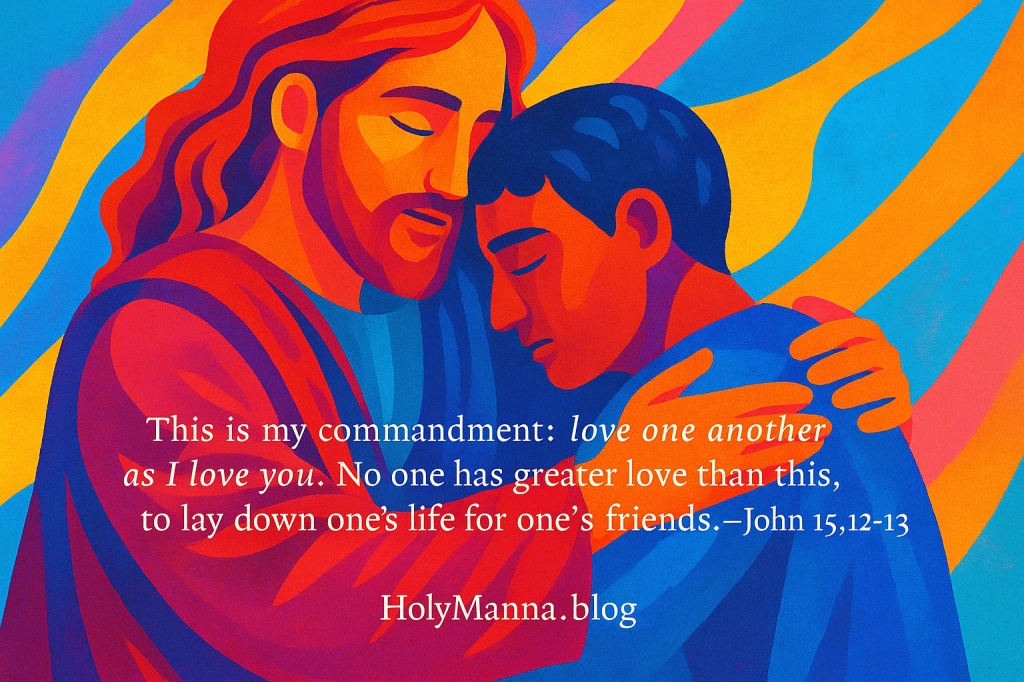
11 “I have told you this so that my joy may be in you and your joy may be complete. 12 This is my commandment: love one another as I love you. 13 No one has greater love than this, to lay down one’s life for one’s friends. 14 You are my friends if you do what I command you. 15 I no longer call you slaves, because a slave does not know what his master is doing. I have called you friends, because I have told you everything I have heard from my Father. 16 It was not you who chose me, but I who chose you and appointed you to go and bear fruit that will remain, so that whatever you ask the Father in my name he may give you. 17 This I command you: love one another.
Detailed Exegesis
Verse 9 – “As the Father loves me, so I also love you. Remain in my love.”
This staggering statement reveals that the love Jesus has for us is no less than the love He receives from the Father. This Trinitarian love is not abstract—it is deeply personal and directed toward each of us. To “remain” in His love means to dwell, abide, and root ourselves in His divine charity. It is a relationship that invites fidelity, not fleeting affection.
Verse 10 – “If you keep my commandments, you will remain in my love, just as I have kept my Father’s commandments and remain in his love.”
Love and obedience are inseparable in Jesus’ teaching. This is not obedience driven by fear, but by intimate trust. Just as the Son’s perfect love is expressed through perfect obedience to the Father, so too are we called to express our love through faithful adherence to Christ’s commands—especially the command to love one another.
Verse 11 – “I have told you this so that my joy may be in you and your joy may be complete.”
The goal of this teaching is joy—not temporary happiness, but divine joy rooted in communion with Christ. His joy is not diminished by the Cross but fulfilled through it. This joy flows from abiding love and self-giving obedience. It is the fruit of a heart in right relationship with God.
Verse 12 – “This is my commandment: love one another as I love you.”
Jesus elevates love from a suggestion to a divine mandate. The standard is no longer simply to love others as we love ourselves—but to love as Christ loves us. This is sacrificial, patient, forgiving, and boundless love. It reflects the heart of God and anticipates the Cross.
Verse 13 – “No one has greater love than this, to lay down one’s life for one’s friends.”
This verse reveals the supreme form of love: self-sacrifice. Jesus foreshadows His own Passion, but He also sets a model for all Christian discipleship. Martyrdom, spiritual or physical, becomes the highest expression of friendship with God. True love costs something—and is always life-giving.
Verse 14 – “You are my friends if you do what I command you.”
Friendship with Jesus is not passive. It requires a response—living in His will. To be called “friend” by the Son of God is to be elevated into a relationship of intimacy, trust, and shared mission. But this friendship has a form: the way of obedience and love.
Verse 15 – “I no longer call you slaves, because a slave does not know what his master is doing. I have called you friends, because I have told you everything I have heard from my Father.”
Jesus distinguishes Christian discipleship from servitude. He draws us into the inner life of the Trinity by revealing the Father’s will. Friendship with God is not blind submission; it is communion through revelation. The disciple becomes a confidant of divine mysteries.
Verse 16 – “It was not you who chose me, but I who chose you and appointed you to go and bear fruit that will remain, so that whatever you ask the Father in my name he may give you.”
This verse echoes the First Reading powerfully. Just as Matthias was chosen by God through the Apostles’ prayer, so too are we chosen—not by merit but by grace. We are not only chosen to receive, but appointed to go. The fruit we bear—faith, charity, conversion—must endure. And this mission is fueled by prayer in Jesus’ name, aligned with the Father’s will.
Verse 17 – “This I command you: love one another.”
The section ends as it began—with love. This repetition emphasizes its centrality. All Christian life, leadership, mission, and witness must be rooted in authentic love. Without it, our actions are hollow. With it, even the smallest act becomes divine.
Teachings
The Catechism of the Catholic Church teaches that the foundation of the Christian moral life is the love revealed and poured out by Jesus: “The whole law of the Gospel is contained in the ‘new commandment’ of Jesus: to love one another as he has loved us” (CCC 1970). This love is not sentimental or theoretical—it is lived out in daily, often sacrificial, choices. The Gospel calls us to abide in love through action, rooted in Christ’s own example.
Saint Thomas Aquinas, reflecting on verse 13, wrote: “To love is to will the good of the other, as other.” True love, he emphasized, seeks not possession, but the flourishing of the beloved—even at personal cost. This is the love Christ commands and models. It transforms relationships, heals communities, and builds the Kingdom of God on earth. It is also what animates all true apostolic mission.
The saints have always seen themselves as chosen and sent, just as Jesus says here. Saint Ignatius of Loyola, when meditating on divine election, urged his followers to pray: “Take, Lord, and receive… all is Yours; dispose of it wholly according to Your will. Give me only Your love and grace.” This surrender is the natural response to knowing that we are not our own—we have been chosen, and appointed to bear fruit that will last.
Reflection
Do we truly believe that we are chosen by God—not generically, but personally? Jesus did not say, “You may choose Me if you wish,” but “It was not you who chose me, but I who chose you”. This reading invites us to step into our identity as beloved and appointed friends of Christ. Are we remaining in His love, or are we striving in our own strength?
How might your life look different if every action flowed from love? What would it mean to love others as Jesus loves you—especially those who are hard to love? This is not a vague ideal but a concrete command: “Love one another as I love you.” To follow Christ is to be conformed to the Cross—to give ourselves away for others with joy and generosity.
Finally, what fruit is your life bearing? Is it fruit that will last—souls saved, hearts healed, peace planted in your family or community? Or is it fruit that fades? Christ chose you for more than survival—He appointed you to bear eternal fruit. May we say yes to this calling today, with hearts anchored in the love that first called us, formed us, and now sends us.
Chosen, Loved, and Sent
Today’s readings form a beautiful tapestry of divine initiative, human response, and eternal purpose. In The Acts of the Apostles, we see the early Church faithfully discerning the will of God, trusting in His providence to raise up Matthias as a witness to the Resurrection. In Psalm 113, we are reminded of the Lord’s tender power—“He raises the needy from the dust”—a God who stoops from the heavens to lift the humble and place them among princes. And in The Gospel of John, Jesus opens His heart to His disciples, declaring the depth of His love—“As the Father loves me, so I also love you”—and inviting them into friendship, obedience, and fruitfulness.
Each reading speaks to the same truth: God is the one who chooses. He sees not as man sees; He searches the heart. Whether it’s selecting a new Apostle, raising the forgotten, or entrusting us with His mission, God delights in calling the lowly to high and holy tasks. But this calling is not a burden—it is born in love and sustained by grace. “It was not you who chose me, but I who chose you” is not just a verse—it’s your story, your identity, and your invitation to live as a beloved disciple of Christ.
Will you live today as someone who has been chosen, lifted, and sent? Let the Word you’ve heard shape your prayer, your choices, and your relationships. Let it remind you that your worth is not in what you do, but in the One who has called you His friend. Abide in His love. Bear fruit that lasts. Love one another—not just in theory, but in deed. And when you feel small, unworthy, or unsure, remember: “Praise, you servants of the Lord… He seats them with princes”. You were made for more. You were made for Him.
Engage with Us!
We’d love to hear how the Word spoke to your heart today. What stirred you, challenged you, or moved you closer to Christ? Share your thoughts, prayers, or personal insights in the comments below. Let’s grow together as a community rooted in the Word and in love.
Reflection Questions
First Reading – Acts 1:15–17, 20–26
Have you ever felt overlooked or hidden like Matthias before his calling? How can you cultivate the habit of discerning God’s will in your decisions, as the Apostles did through prayer and Scripture? What “office” or role has God entrusted to you, and how are you being a faithful witness to His resurrection in that role?
Responsorial Psalm – Psalm 113:1–8
When was the last time you praised God for lifting you out of a low place? Do you see and honor the dignity of the poor and lowly in your community the way God does? How can you imitate the Lord by “raising others from the dust” in your words and actions this week?
Holy Gospel – John 15:9–17
What does it mean to you personally that Jesus calls you His friend? Are you abiding in His love through obedience to His commandments? What lasting fruit is your life bearing right now, and what is Christ inviting you to cultivate more deeply?
Let today’s Word inspire you to walk boldly in your calling, to love sacrificially, and to live each moment with joy, purpose, and mercy. You have been chosen, loved, and sent. Go now, and do everything with the love and mercy that Jesus has shown you.
Follow us on Instagram and Facebook for more insights and reflections on living a faith-filled life.

 Holy Manna!
Leave a comment