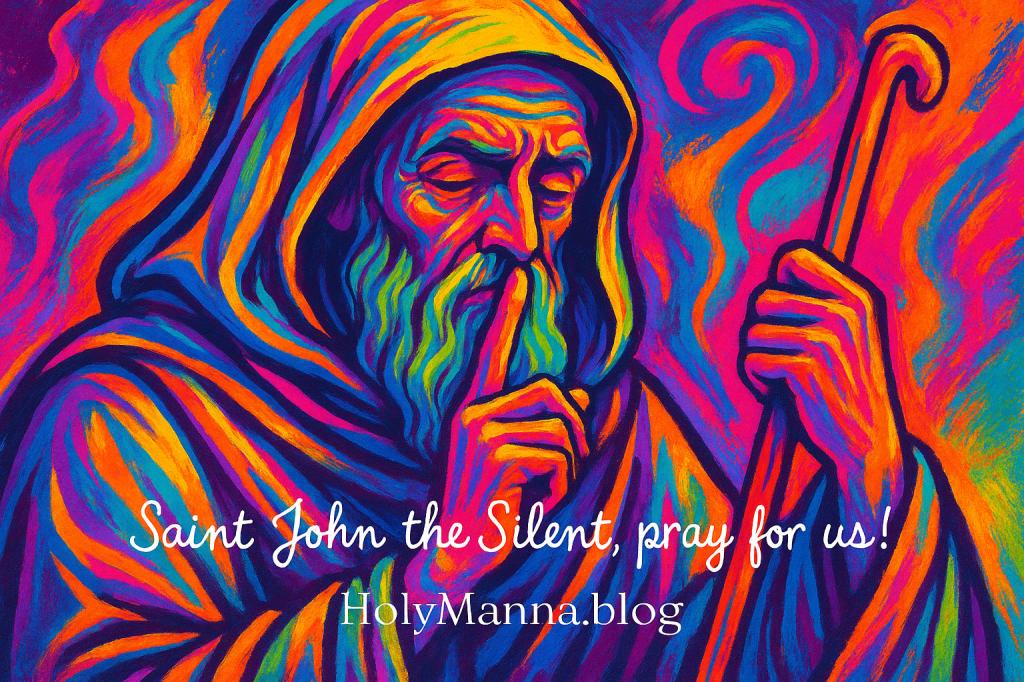
A Quiet Flame That Lit the Desert
Some saints proclaim the Gospel from rooftops, others preach from prison cells, and still others carry the Gospel in their hearts, wordless yet radiant. Saint John the Silent, also known as Saint John Hesychastes, is one of those quiet torchbearers of holiness. He is celebrated for a radical commitment to silence, hiddenness, and contemplative prayer that allowed his soul to become a vessel of divine light. Though once a bishop, John sought obscurity, preferring the desert’s solitude to the admiration of men. His life is a profound testimony to the truth found in The Catechism of the Catholic Church, which teaches that “contemplation is a gaze of faith, fixed on Jesus” (CCC 2715). John fixed his gaze on Christ for over seventy years in near-total silence, and in doing so, he became one of the desert’s brightest spiritual lights.
From Cathedral to Cave
Born around the year 454 in Nicopolis, Armenia, John entered the world into privilege, piety, and purpose. His parents, Enkratius and Euphemia, were devout Christians who nurtured him in the fear of the Lord. Orphaned while still a teenager, John demonstrated maturity beyond his years by distributing his entire inheritance to the poor—a striking echo of the rich young man of The Gospel of Matthew, but with a different ending. He turned away from wealth and toward God.
At just eighteen, he entered a hermitage where he embraced a rigorous ascetic life. His humility, wisdom, and fervent prayer life gained the admiration of many, and by the time he was twenty-eight, he was appointed bishop of Colonia in Armenia. Despite his success and spiritual impact, John’s heart was drawn not to the applause of the faithful but to the embrace of solitude. After nine years as bishop, he resigned his episcopal office following a slanderous accusation, which he bore with heroic meekness and without defense.
He journeyed to Palestine and joined the monastery of Saint Sabas near Jerusalem, hiding his past status and taking on the lowliest of tasks. When his identity was eventually discovered, Saint Sabas—himself a giant of desert holiness—granted John permission to retreat into a cave for complete solitude. For seventy-six years, John lived in the wilderness, emerging only on weekends for the Divine Liturgy. He practiced what the Eastern tradition calls hesychia—a state of deep, prayerful stillness. His vocation was not to build institutions or write tomes but to be a living sanctuary of unceasing prayer.
Miracles of the Hidden Life
Saint John the Silent’s miracles were not loud or dramatic, but they were no less real. His life was soaked in the supernatural, though cloaked in humility. He was gifted with the grace of clairvoyance and spiritual discernment, often knowing the thoughts and spiritual states of others who came to him for counsel. Abbot Saint Sabas, himself a saint and founder of the monastery, regularly sought John’s guidance for important matters.
According to the accounts preserved by early hagiographers, on several occasions during food shortages at the monastery, John’s intercession resulted in the miraculous provision of food. In one instance, when a drought had parched the desert and the cisterns were nearly dry, his prayers brought much-needed rain. These miracles were never flaunted. Instead, they were hidden in the same silence that cloaked his cave, quietly pointing to the Lord he served with such undivided love.
Even more than these signs and wonders, the true miracle of John’s life was his ability to remain in the presence of God for decades, faithfully and joyfully, with no audience but Heaven. His silence itself became a miracle—transforming his heart into a living tabernacle.
The Weight of the Cross in the Desert
Although Saint John did not suffer a martyr’s bloody death, his life was marked by what Saint Paul calls the “daily dying” (cf. 1 Corinthians 15:31). He endured slander, humiliation, isolation, and spiritual dryness with heroic fortitude. When falsely accused of misconduct as bishop, he did not argue or defend his name. Instead, he quietly stepped down, trusting that his justification would come from the Lord.
In the monastery of Saint Sabas, John was not spared further trials. Some monks misunderstood his silence, assuming he was arrogant or antisocial. He bore these misjudgments with the same composure he had shown earlier, refusing to defend himself, knowing that “blessed are those who are persecuted for righteousness’ sake, for theirs is the kingdom of heaven” (Matthew 5:10).
His cave became his cross—a place of continual self-denial, fasting, and prayer. But it also became his resurrection, for there he met the Risen Christ daily. Like Christ in the wilderness, John faced the demons of loneliness, obscurity, and spiritual warfare. And like Christ, he triumphed in silence.
After Death, the Silence Still Speaks
Saint John died around the year 558, but death did not silence the echo of his sanctity. The cave where he had prayed became a place of pilgrimage. Those who visited his tomb or relics reported miraculous healings and spiritual deliverance. His body, long venerated by monks and pilgrims in the East, became a source of intercession and divine grace.
Though not as famous in the West, Saint John’s legacy deeply influenced the Eastern monastic tradition, particularly the hesychast movement that flourished in later centuries. Saints such as Gregory Palamas and Seraphim of Sarov saw in John a forerunner of their own mystical theology: that the human person can become radiant with divine light through pure prayer and silence.
To this day, those who seek spiritual depth in silence often turn to Saint John the Silent as their patron. His memory lives on not in great cathedrals or royal honors, but in caves, chapels, and hearts that dare to be still and listen for the whisper of God.
The Desert Within
What can a fifth-century Armenian bishop turned desert hermit teach us today—especially in a world of noise, speed, and self-promotion? Everything. Saint John the Silent challenges us to look beyond appearances, to seek not status but sanctity, not likes but love, not chatter but contemplation.
His life reveals that silence is not emptiness but a womb that births intimacy with God. In a culture obsessed with visibility, his hiddenness is a reminder that “your Father who sees in secret will reward you” (Matthew 6:6). His unwavering devotion shows us that holiness is not for the stage but for the soul.
How can we imitate him? By creating moments of silence each day—turning off the noise and turning toward Christ. By embracing the trials that come without complaint, and by praying not to be admired but to be faithful. What would happen if we sought God in hiddenness, trusting Him to do great things with our small offerings?
Let us not underestimate the power of a life hidden in Christ. As The Catechism reminds us, “Contemplative prayer is the simplest expression of the mystery of prayer” (CCC 2713). In Saint John’s life, we see that simplicity flowering into glory.
💬 Engage with Us!
We’d love to hear your thoughts on Saint John the Silent’s hidden life of holiness. How does his witness speak to your own spiritual journey?
Here are some reflection questions to spark your prayer and discussion:
- What does silence mean to you — and how can you make more room for it in your life?
- Have you ever felt the call to a hidden or overlooked ministry? How did you respond?
- What practical steps can you take this week to grow in humility and deeper prayer?
Let’s support each other in our walk with Christ and never forget: Do everything in love!
Saint John, pray for us! 🙏
Follow us on Instagram and Facebook for more insights and reflections on living a faith-filled life.

 Holy Manna!
Leave a comment