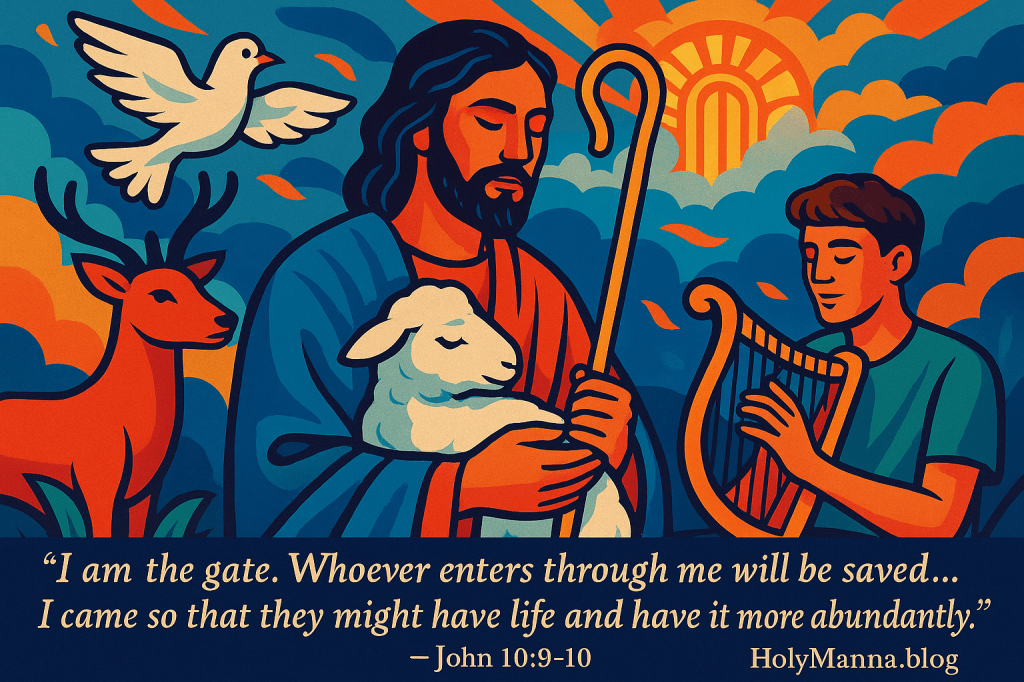
Called by Name, Welcomed by Grace
Have you ever felt like an outsider—longing to belong, but unsure if the invitation includes you? Today’s readings open the gates wide, reminding us that God’s love and salvation are not bound by human prejudice, tribal identity, or cultural limits. The same Spirit that fell upon the Jewish believers at Pentecost now falls upon the Gentiles, signaling a radical shift in the early Church’s understanding of who is “in.” Through Acts of the Apostles, we witness Saint Peter defending this divine inclusivity, insisting that he could not stand in the way of God’s work: “What God has made clean, you are not to call profane”.
This moment is not just historical—it is revolutionary. For first-century Jews, strict adherence to ritual purity laws and separation from Gentile practices shaped religious identity. But God, through a vision and the power of the Holy Spirit, challenges Peter to transcend cultural barriers and recognize the universality of the Gospel. That same longing for God, beautifully expressed in today’s Psalm—“As the deer longs for streams of water, so my soul longs for you, O God”—echoes across time, culture, and ethnicity. The thirst of the human soul knows no boundaries, and God’s answer is the same for all: come and drink deeply.
In the Gospel of John, Jesus deepens this invitation by revealing Himself as both the Shepherd and the Gate. He calls His sheep by name and promises them abundant life. “I came so that they might have life and have it more abundantly”—these words are not reserved for the elite or the religiously privileged, but for every soul that hears His voice and follows. As we move through these readings, we’re invited to reflect on the immensity of God’s mercy, the expansiveness of His call, and the personal intimacy of being known and led by the Good Shepherd. Are there places in your heart where you still feel like an outsider? Can you hear Him calling you by name today?
First Reading – Acts 11:1–18
Who Are We to Hinder God?
The Acts of the Apostles, written by Saint Luke, serves as a theological bridge between the Gospel and the birth of the Church. Today’s reading captures one of the most pivotal moments in salvation history: the moment when the early Church recognized that the Gospel is for everyone—not just the Jews, but the Gentiles too. This shift was monumental. For centuries, Israel had been set apart as God’s chosen people, marked by the covenant of circumcision and the Mosaic Law. Yet now, in this moment, we witness the fulfillment of God’s universal plan unfolding—one that had always been hinted at by the prophets and realized through Christ’s Resurrection and the outpouring of the Holy Spirit. This passage brings to light the radical hospitality of the Kingdom of God and how the Holy Spirit shatters human-made boundaries. It invites us to consider: Are we open to the surprises of the Spirit, even when they challenge our comfort or customs?
Acts 11:1-18
New American Bible (Revised Edition)
The Baptism of the Gentiles Explained. 1 Now the apostles and the brothers who were in Judea heard that the Gentiles too had accepted the word of God. 2 So when Peter went up to Jerusalem the circumcised believers confronted him, 3 saying, “You entered the house of uncircumcised people and ate with them.” 4 Peter began and explained it to them step by step, saying, 5 “I was at prayer in the city of Joppa when in a trance I had a vision, something resembling a large sheet coming down, lowered from the sky by its four corners, and it came to me. 6 Looking intently into it, I observed and saw the four-legged animals of the earth, the wild beasts, the reptiles, and the birds of the sky. 7 I also heard a voice say to me, ‘Get up, Peter. Slaughter and eat.’ 8 But I said, ‘Certainly not, sir, because nothing profane or unclean has ever entered my mouth.’ 9 But a second time a voice from heaven answered, ‘What God has made clean, you are not to call profane.’ 10 This happened three times, and then everything was drawn up again into the sky. 11 Just then three men appeared at the house where we were, who had been sent to me from Caesarea. 12 The Spirit told me to accompany them without discriminating. These six brothers also went with me, and we entered the man’s house. 13 He related to us how he had seen [the] angel standing in his house, saying, ‘Send someone to Joppa and summon Simon, who is called Peter, 14 who will speak words to you by which you and all your household will be saved.’ 15 As I began to speak, the holy Spirit fell upon them as it had upon us at the beginning, 16 and I remembered the word of the Lord, how he had said, ‘John baptized with water but you will be baptized with the holy Spirit.’ 17 If then God gave them the same gift he gave to us when we came to believe in the Lord Jesus Christ, who was I to be able to hinder God?” 18 When they heard this, they stopped objecting and glorified God, saying, “God has then granted life-giving repentance to the Gentiles too.”
Verse-by-Verse Exegesis
Verse 1 – “Now the apostles and the brothers who were in Judea heard that the Gentiles too had accepted the word of God.”
The news of the Gentile conversion spreads quickly and stirs tension. The early Jewish Christians, still rooted in their traditional worldview, are shocked to hear that non-Jews are receiving the Word of God. This verse signals the beginning of a new era where the Church must wrestle with questions of identity, inclusion, and the scope of God’s mercy.
Verse 2 – “So when Peter went up to Jerusalem the circumcised believers confronted him,”
This confrontation underscores the deep cultural and religious divide. Circumcision was not just a physical sign but a sacred identity marker. Peter’s association with the uncircumcised challenges this norm, and the faithful demand an explanation.
Verse 3 – “saying, ‘You entered the house of uncircumcised people and ate with them.’”
Eating with Gentiles was taboo, often viewed as a defilement. This accusation points to the social and religious scandal perceived by the Jewish Christians. Sharing a meal symbolized unity and acceptance—something previously thought incompatible with Gentile impurity.
Verse 4 – “Peter began and explained it to them step by step,”
Peter doesn’t respond defensively; he offers a reasoned, Spirit-led account. His methodical approach shows pastoral sensitivity and openness to communal discernment.
Verse 5 – “I was at prayer in the city of Joppa when in a trance I had a vision…”
Prayer becomes the setting for divine revelation. The vision of the sheet descending with all kinds of animals challenges Peter’s understanding of purity. God uses prayer to shake loose deeply entrenched assumptions.
Verse 6 – “Looking intently into it, I observed and saw the four-legged animals of the earth, the wild beasts, the reptiles, and the birds of the sky.”
The animals represent all of creation—especially those considered unclean in Jewish dietary law. The vision invites Peter to see through God’s eyes, where categories of clean and unclean are being transformed.
Verse 7 – “Get up, Peter. Slaughter and eat.”
God commands action, urging Peter to break a deeply held religious custom. The tension between divine command and human tradition is palpable here.
Verse 8 – “Certainly not, sir, because nothing profane or unclean has ever entered my mouth.”
Peter’s response reflects his religious obedience. He clings to the Law, even in the face of a divine command, revealing the depth of his internal struggle.
Verse 9 – “But a second time a voice from heaven answered, ‘What God has made clean, you are not to call profane.’”
This is the theological heart of the passage. God’s authority redefines what is clean, nullifying the old distinctions that once governed Jewish-Gentile relations. The Kingdom of God transcends human categories.
Verse 10 – “This happened three times, and then everything was drawn up again into the sky.”
Repetition emphasizes divine intent. Three times—like Peter’s denial and later confession of love—marks a complete transformation in his understanding.
Verse 11 – “Just then three men appeared at the house where we were, who had been sent to me from Caesarea.”
God’s providence is in motion. The vision immediately leads to a practical encounter. Caesarea, a Gentile city, is where the divine message becomes incarnate in real relationship.
Verse 12 – “The Spirit told me to accompany them without discriminating. These six brothers also went with me, and we entered the man’s house.”
Peter obeys the Spirit despite cultural discomfort. The mention of six witnesses adds credibility and communal weight to his testimony.
Verse 13 – “He related to us how he had seen [the] angel standing in his house, saying, ‘Send someone to Joppa and summon Simon, who is called Peter,”
This Gentile man, Cornelius, is shown to have received a divine message too. God is clearly at work on both ends—revealing that the Spirit precedes human evangelization.
Verse 14 – “who will speak words to you by which you and all your household will be saved.”
Salvation comes through the spoken word—through Peter, a Jew—demonstrating that the Church is the vessel of grace, now extending to all nations.
Verse 15 – “As I began to speak, the holy Spirit fell upon them as it had upon us at the beginning,”
The Pentecost experience is repeated. This affirms that the Gentiles are full recipients of the same Spirit—not second-class Christians, but equals in the Church.
Verse 16 – “and I remembered the word of the Lord, how he had said, ‘John baptized with water but you will be baptized with the holy Spirit.’”
Peter recalls Jesus’ promise, tying the event back to Christ’s mission. Baptism in the Holy Spirit marks a new covenantal reality.
Verse 17 – “If then God gave them the same gift he gave to us when we came to believe in the Lord Jesus Christ, who was I to be able to hinder God?”
This question is both rhetorical and powerful. Peter recognizes that opposing this inclusion would mean resisting God Himself.
Verse 18 – “When they heard this, they stopped objecting and glorified God, saying, ‘God has then granted life-giving repentance to the Gentiles too.’”
The community concedes and glorifies God. This moment is a breakthrough, where resistance gives way to praise, and the Church takes a decisive step toward catholicity—universal inclusion.
Teachings
The Catechism of the Catholic Church affirms this truth: “The Holy Spirit prepares men and goes out to them with his grace, in order to draw them to Christ” (CCC 2001). Today’s passage demonstrates this vividly. The Gentiles are not drawn in by human initiative but by the movement of the Spirit, confirming that the mission of the Church is always God-initiated. The Holy Spirit acts as the divine bridge between cultures, peoples, and even religious expectations.
Saint Augustine wrote, “The Church is the world reconciled” (Sermo 96), emphasizing that the Church’s very nature is to gather all into one body. This unity, rooted in Christ, is not about uniformity of culture but unity of faith. Saint John Chrysostom reflects on Peter’s discernment: “He does not say, ‘It seemed good to me,’ but tells what happened to Cornelius… and the Spirit did the convincing”. These early voices affirm that the Church was never meant to be a club for the few, but a sanctuary for all.
Historically, this encounter sets the stage for the Council of Jerusalem in Acts 15, where the Church would officially welcome Gentile converts without imposing the Mosaic Law. It is the beginning of the truly universal (“Catholic”) mission of the Church. It reminds us that we too are heirs of this radical grace—not by bloodline, but by the Spirit poured into our hearts. The Church’s mission to all nations was not a shift in plan—it was the plan all along.
Reflection
This reading invites us to step back and ask: Where in my life have I placed limits on God’s grace? Are there people, communities, or even parts of myself that I have considered “unclean” or unworthy of love? The Spirit calls us not only to welcome others but to trust that we too are welcomed—deeply, wholly, undeservedly. Like Peter, we are being asked to walk in obedience, even when it defies expectations or disrupts our sense of religious order.
God is still in the business of breaking barriers. That co-worker who doesn’t know the Lord, the family member hardened by sin, or even the parts of our own heart that seem unreachable—none are beyond His reach. Are we ready to welcome them, and ourselves, into the surprising wideness of His mercy? Can we, like Peter, say with conviction: “Who am I to hinder God?” When we do, we join the Church in glorifying the Lord who gives “life-giving repentance” to all.
Responsorial Psalm – Psalm 42:2–3; 43:3–4
The Thirst That Unites Us All
The Psalms, long considered the prayer book of the Church, express the deepest cries of the human soul. Psalm 42 and Psalm 43 are intimately linked, both traditionally attributed to the sons of Korah, a Levitical family known for temple worship. These psalms give voice to longing, exile, and a burning desire for the presence of God. Set during a time when the psalmist was far from the Temple—possibly in the north near Mount Hermon—they capture the ache of a soul deprived of worship in the holy place. In today’s context, these verses reflect not only personal spiritual thirst but the universal human hunger for communion with God. They beautifully echo the theme found in Acts and John’s Gospel—that salvation is not just about right doctrine or heritage, but about responding to a divine invitation that fulfills our deepest desire: to see God’s face and dwell in His presence.
Psalm 42:2-3; 43:3-4
New American Bible (Revised Edition)
42:2 As the deer longs for streams of water,
so my soul longs for you, O God.
3 My soul thirsts for God, the living God.
When can I enter and see the face of God?
43:3 Send your light and your fidelity,
that they may be my guide;
Let them bring me to your holy mountain,
to the place of your dwelling,
4 That I may come to the altar of God,
to God, my joy, my delight.
Then I will praise you with the harp,
O God, my God.
Verse-by-Verse Exegesis
Verse 42:2 – “As the deer longs for streams of water, so my soul longs for you, O God.”
This verse begins with one of the most iconic images in all of Scripture: a parched deer searching for flowing water. The metaphor communicates a vital, almost desperate yearning—not just a gentle desire, but an urgent thirst for survival. The soul’s need for God is likened to the body’s need for water. It reminds us that worship, prayer, and divine intimacy are not luxuries, but necessities of spiritual life.
Verse 3 – “My soul thirsts for God, the living God. When can I enter and see the face of God?”
Here, the longing deepens. It’s not enough to believe in God—there is a yearning to see Him. The term “the living God” contrasts with lifeless idols and false hopes. This is the God who acts, speaks, and draws near. The question “When?” expresses exile and distance—perhaps physical, as in the absence from the Temple, or spiritual, as in seasons of dryness. This plea resonates with anyone who has ever felt far from God, even while seeking Him.
Verse 43:3 – “Send your light and your fidelity, that they may be my guide; Let them bring me to your holy mountain, to the place of your dwelling,”
Now the psalmist asks for divine intervention. Light and fidelity—often read as symbols of God’s truth and steadfast love—are requested as guides. The “holy mountain” refers to Mount Zion, the location of the Temple. There’s a yearning not just for relief, but for reunion: to be brought home to God’s presence, led by His own attributes.
Verse 4 – “That I may come to the altar of God, to God, my joy, my delight. Then I will praise you with the harp, O God, my God.”
The longing resolves in hope. The altar symbolizes intimacy, sacrifice, and communion. The psalmist anticipates a return not just to a place, but to a Person—“God, my joy, my delight.” Worship becomes the natural response to reunion. The harp, an instrument of joy and praise, signifies that suffering and exile are not the end. The covenantal language—“O God, my God”—expresses belonging and relationship.
Teachings
The Catechism of the Catholic Church teaches that “the desire for God is written in the human heart, because man is created by God and for God” (CCC 27). These psalms embody that innate longing. They are not cries of unbelief, but the groans of a heart wounded by love. As Saint Augustine famously said, “You have made us for yourself, O Lord, and our hearts are restless until they rest in You” (Confessions, Book I). That restlessness echoes in the voice of the psalmist, who sees no other joy except in the face of the living God.
Saint Thomas Aquinas, when reflecting on the beatific vision, connects this very longing with our final destiny: “Man’s ultimate happiness consists in the contemplation of God” (Summa Theologiae, I-II, q. 3, a. 8). The psalmist’s question—“When can I see the face of God?”—prefigures the promise made by Christ in Matthew 5:8: “Blessed are the clean of heart, for they will see God.” Our liturgical life is a foretaste of this vision. When we come to the altar, we glimpse eternity.
Historically, these psalms became especially meaningful during the Babylonian exile, when the Israelites were removed from the Temple and their land. They gave voice to a displaced people, reminding them that even in exile, God’s presence could be sought and His light could still guide them. For early Christians—especially Gentile converts—these verses articulated the ache for union with a God they had only just come to know. They connect us all: whether cradle Catholic or new believer, we all thirst for the same Fountain.
Reflection
This psalm invites us to examine our thirst. What do I long for more than anything else? When I am spiritually dry, where do I turn? In a world offering countless counterfeits to joy and delight, this Scripture calls us back to the One who truly satisfies. It also encourages us not to suppress our longing, but to let it lead us—to prayer, to worship, to Eucharistic adoration, to the altar of God.
Sometimes we find ourselves far from that holy mountain—not physically, but interiorly. Doubt, sin, fatigue, or suffering can create a sense of exile. Yet this psalm assures us that God sees our thirst and responds with light and fidelity. Are we willing to follow His light, even if it leads through the wilderness? Are we praying not just for relief, but for reunion—with joy Himself?
Let today be a reminder that our longing is not a weakness, but a compass. It points us toward the Good Shepherd, who calls us by name, who opens the gate, and who leads us to still waters. Will you let your thirst lead you to the altar, to the God who is your joy and your delight?
Holy Gospel – John 10:1–10
The Gate, the Voice, and the Abundant Life
The Gospel of John is rich in symbolic language and theological depth. It was written for a community of believers facing external persecution and internal divisions. Unlike the synoptic Gospels, John uses extended discourses to reveal the identity of Jesus. Chapter 10 is part of the Good Shepherd discourse, where Jesus contrasts His care and authenticity with the false shepherds—those who seek to manipulate, dominate, or exploit the flock. The image of sheep, shepherds, gates, and voices would have resonated deeply with Jesus’ Jewish audience, who were steeped in Old Testament imagery. Psalm 23, Ezekiel 34, and other prophetic texts framed God as the shepherd of Israel, and Israel as His flock. Into this tradition, Jesus steps forward not only as the Shepherd, but as the Gate—the only legitimate way into the fold of salvation. This Gospel builds directly upon today’s theme: that the call to salvation is open, intimate, and abundant, not restricted by ethnicity, status, or past sin, but accessed through the person of Jesus Christ.
John 10:1-10
New American Bible (Revised Edition)
The Good Shepherd. 1 “Amen, amen, I say to you, whoever does not enter a sheepfold through the gate but climbs over elsewhere is a thief and a robber. 2 But whoever enters through the gate is the shepherd of the sheep. 3 The gatekeeper opens it for him, and the sheep hear his voice, as he calls his own sheep by name and leads them out. 4 When he has driven out all his own, he walks ahead of them, and the sheep follow him, because they recognize his voice. 5 But they will not follow a stranger; they will run away from him, because they do not recognize the voice of strangers.” 6 Although Jesus used this figure of speech, they did not realize what he was trying to tell them.
7 So Jesus said again, “Amen, amen, I say to you, I am the gate for the sheep. 8 All who came [before me] are thieves and robbers, but the sheep did not listen to them. 9 I am the gate. Whoever enters through me will be saved, and will come in and go out and find pasture. 10 A thief comes only to steal and slaughter and destroy; I came so that they might have life and have it more abundantly.
Verse-by-Verse Exegesis
Verse 1 – “Amen, amen, I say to you, whoever does not enter a sheepfold through the gate but climbs over elsewhere is a thief and a robber.”
Jesus opens with a strong warning. The double “Amen” underscores the importance of what follows. The sheepfold represents the people of God, and the gate signifies the legitimate entryway—God’s appointed way. Anyone bypassing this divine path is an intruder, not a shepherd. This foreshadows the false teachers, religious leaders, and ideologies that seek access to the souls of men without honoring Christ.
Verse 2 – “But whoever enters through the gate is the shepherd of the sheep.”
True shepherds don’t need to sneak in. They enter by the rightful path—through the authority and commission of God. This verse speaks to the authenticity of Christ and, by extension, His appointed ministers who lead the flock in fidelity to Him.
Verse 3 – “The gatekeeper opens it for him, and the sheep hear his voice, as he calls his own sheep by name and leads them out.”
This verse is deeply personal. The sheep are not anonymous—they are known by name. The call is not generic, but individual. The shepherd leads, not drives; he goes ahead, inviting the sheep into trust. The “gatekeeper” may be the Holy Spirit or God the Father, affirming Jesus’ divine mission.
Verse 4 – “When he has driven out all his own, he walks ahead of them, and the sheep follow him, because they recognize his voice.”
The shepherd’s leadership is not coercive. His voice is familiar, safe, and trustworthy. This reflects a relationship rooted in love, not fear. The phrase “driven out” (sometimes translated as “brought out”) suggests a shepherd who gathers and guides, not isolates or scatters.
Verse 5 – “But they will not follow a stranger; they will run away from him, because they do not recognize the voice of strangers.”
This verse sets up a contrast between Christ’s voice and that of false shepherds. Disciples who truly know Jesus will not be seduced by deception. Spiritual discernment is about recognizing the voice that leads to life.
Verse 6 – “Although Jesus used this figure of speech, they did not realize what he was trying to tell them.”
Even with vivid imagery, many do not understand. This reflects the hardness of heart and spiritual blindness that pervaded the religious elite. The metaphor is clear to those open to Christ, but veiled to those who resist Him.
Verse 7 – “So Jesus said again, ‘Amen, amen, I say to you, I am the gate for the sheep.’”
Jesus makes it explicit: He is the gate. Not just a guide or example, but the very entry point into the life of God. This “I AM” statement echoes the divine name revealed to Moses—asserting Christ’s divinity and centrality in salvation.
Verse 8 – “All who came before me are thieves and robbers, but the sheep did not listen to them.”
Jesus is not dismissing the prophets, but denouncing those who came with false motives or led others astray. He calls out corrupt leaders who abused their authority for gain. The faithful remnant, however, listened for God’s true voice.
Verse 9 – “I am the gate. Whoever enters through me will be saved, and will come in and go out and find pasture.”
This verse encapsulates the Gospel: salvation, freedom, and nourishment. To “come in and go out” signifies security and peace. The pasture represents the abundant provision of God, both in this life and the next.
Verse 10 – “A thief comes only to steal and slaughter and destroy; I came so that they might have life and have it more abundantly.”
This climactic verse exposes the enemy’s tactics and proclaims Christ’s mission. The devil seeks destruction, but Jesus offers abundance—not merely survival, but flourishing. This “abundant life” includes grace, joy, holiness, and eternal communion with God.
Teachings
The Catechism of the Catholic Church teaches that “Jesus Christ is the one, definitive Word of the Father, so there will be no further Revelation after him” (CCC 73). As the Gate and the Shepherd, Jesus is both the message and the Messenger. All true access to God flows through Him. This passage shows that entering into divine life is not a matter of ritual or lineage, but of hearing and following the voice of Christ.
Saint Gregory the Great, in his Homilies on the Gospels, reflects: “The Shepherd has become the gate. He offers Himself through Himself. Through Him, we enter and are led, and in Him we find all good things.” This profound unity—Christ as the means and the end—reveals that the path to God is not just marked by Christ, it is Christ. The Good Shepherd discourse draws us into a tender but firm invitation: come, follow, live.
Pope Benedict XVI once wrote: “Being Christian is not the result of an ethical choice or a lofty idea, but the encounter with an event, a person, which gives life a new horizon and a decisive direction” (Deus Caritas Est, 1). This Gospel speaks directly into that encounter. The sheep don’t follow an abstract idea; they follow the person who knows them, calls them, and leads them to eternal life. The voice of the Shepherd is not a theory—it is love made audible.
Reflection
This Gospel asks a simple but life-changing question: Whose voice am I following? In a world of noise—opinions, pressures, fears—Jesus speaks clearly, calling us by name. Do we recognize His voice? Do we trust it enough to follow, even when it leads through shadowed valleys or unfamiliar terrain? The promise of abundant life is not a marketing slogan; it is the reality of union with the One who laid down His life for the flock.
To follow Christ as the Gate and Shepherd means rejecting the lies of the thieves—voices that promise freedom but deliver chains. It means opening our ears through Scripture, the Sacraments, and prayer. The more we immerse ourselves in His voice, the more we will know when other voices are false. Are we spending enough time with the Shepherd to recognize when He’s speaking?
Let today be a moment of clarity. You are not nameless. You are known, called, and led. Jesus doesn’t want to give you just enough life to get by—He wants to flood your soul with abundance. Will you trust the Gate? Will you follow the Voice? Will you walk into the pasture He has prepared for you? The invitation is open. And the Shepherd is already calling.
He Calls Us All by Name
Today’s readings draw us into the beating heart of the Gospel: a God who knows us, seeks us, and opens wide the gates of His Kingdom to every soul—Jew and Gentile, strong and weak, certain and searching. In Acts, we witness a Church learning to surrender its boundaries and embrace the radical inclusivity of the Holy Spirit. Peter’s vision and the descent of the Spirit upon Cornelius’s household remind us that grace is not earned, but received. In the Psalms, we find the voice of every human heart—thirsting for the living God, yearning for His presence, and longing for reunion at His altar. And in The Gospel of John, Jesus assures us that He is the Gate, the Shepherd, the Voice we’ve been aching to hear. “I came so that they might have life and have it more abundantly.”
Each of these readings reinforces the truth that salvation is deeply personal, yet universally offered. You are not one among the crowd—you are called by name. Your thirst is seen. Your wounds are not hidden. And the Shepherd stands at the gate, calling you not only to safety, but to joy. There is no outsider in the Kingdom of God, only hearts waiting to hear His voice and follow. His pasture is wide enough for all, and His mercy is deeper than our doubts.
Will you respond today? Will you follow the voice that leads to life? Whether you feel far off or near, whether you’ve walked with Him for years or have just begun to listen, this is your moment to say yes. Let the Spirit draw you in. Let the thirst of your soul guide you home. And let Jesus, your Shepherd and your Gate, lead you into the abundance He promises. The path is open. He is calling your name.
Engage with Us!
We’d love to hear how God spoke to your heart through today’s readings. What moved you, challenged you, or gave you hope? Share your thoughts in the comments below and let’s grow together as a community rooted in Christ’s love.
Reflection Questions
First Reading – Acts 11:1–18
Where in your life might you be resisting the Spirit’s call to welcome or include others? Have you ever experienced a moment when God surprised you by working through someone you didn’t expect? How can you, like Peter, grow in obedience to God even when it stretches your understanding or comfort?
Responsorial Psalm – Psalm 42:2–3; 43:3–4
What is your soul thirsting for today? When have you felt far from God’s “holy mountain,” and how did you find your way back? What practices (adoration, Scripture, the Sacraments) help you hear and follow the “light and fidelity” of the Lord?
Holy Gospel – John 10:1–10
Whose voice do you tend to listen to most in your daily life—and how can you better tune in to the voice of the Good Shepherd? What would it look like to live with the abundance Jesus promises, even amid hardship? How can you help others recognize the Gate and enter into the joy of salvation through your words and actions?
May you go forth today with a renewed heart, open ears, and a spirit ready to welcome God’s surprises. Let the love and mercy of Jesus guide every decision, every interaction, and every moment. Live boldly, love freely, and never forget—you are known, called, and deeply loved.
Follow us on Instagram and Facebook for more insights and reflections on living a faith-filled life.

 Holy Manna!
Leave a comment