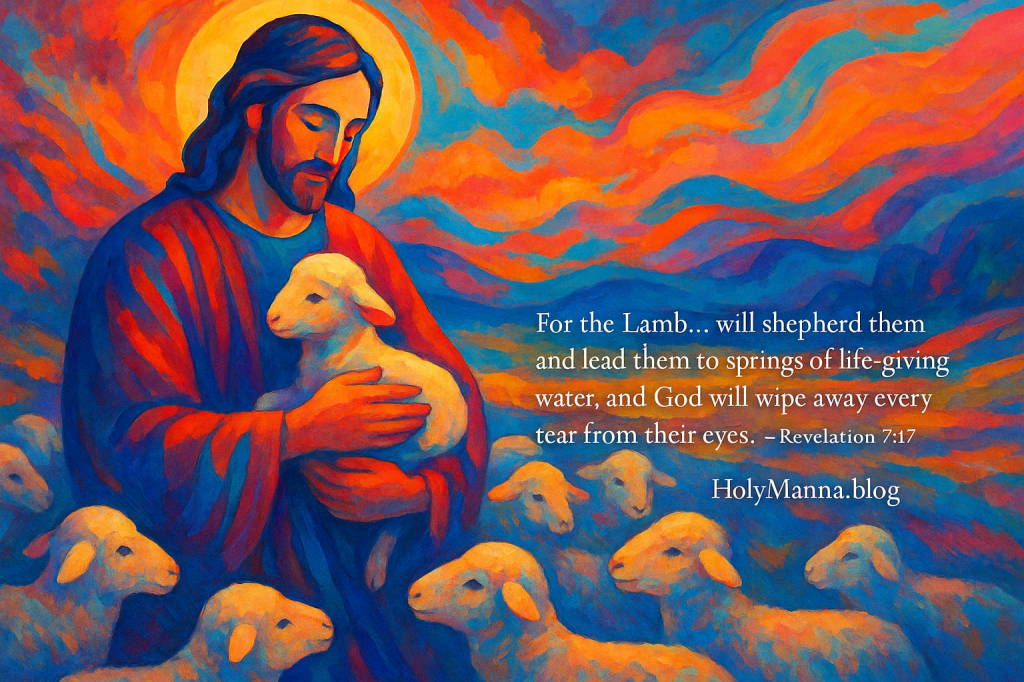
The Shepherd Who Gathers, Guides, and Guards
Have you ever felt the quiet but undeniable pull of Someone calling you by name? A voice that cuts through the noise of life, reaching your heart with a promise of safety, purpose, and love? Today’s Mass readings surround us with that voice—the voice of the Good Shepherd—reminding us that we are known, pursued, and protected by the One who laid down His life for us. In a world that often feels fractured and uncertain, we are invited to listen again and follow the One whose hand no one can pry open: Jesus Christ, the Lamb who is also our Shepherd.
The theme that unites today’s readings is clear and comforting: God faithfully shepherds His people through every trial, gathering them into His eternal embrace. In Acts of the Apostles, Paul and Barnabas boldly proclaim the Word of God in the synagogue, only to face rejection from many Jews. Yet this rejection becomes the opening for the Gentiles to rejoice, fulfilling the prophecy that salvation would reach the ends of the earth. Psalm 100 bursts forth with joy, calling all nations to serve the Lord with gladness because we are “the flock he shepherds.” In Revelation, we see the glorious vision of the elect—saints from every tribe and tongue—robed in white and sheltered by the Lamb, no longer hungering, thirsting, or weeping. And in The Gospel of John, Jesus makes a simple yet world-shaking declaration: “My sheep hear my voice; I know them, and they follow me”.
Understanding the cultural and religious context makes this theme even richer. In Jesus’ time, shepherd imagery was deeply woven into Jewish identity—King David had been a shepherd, and God Himself was praised as the Shepherd of Israel in the Psalms. When Jesus claims to be the Good Shepherd, He is not merely offering comfort; He is making a radical and divine claim that ties His mission to the deepest hopes of Israel’s story. The early Christians, especially amid persecution and exclusion, clung to this image: a Messiah who doesn’t merely lead, but carries, comforts, and gives His life for His sheep. As we reflect on these readings, can you hear the Shepherd’s voice calling you today?
First Reading – Acts 13:14, 43-52
A Shepherd’s Word for All
The Acts of the Apostles offers us an intimate glimpse into the birth of the Church, especially its early missionary journeys. Written by St. Luke, this book details how the Holy Spirit led the apostles beyond the Jewish communities into the wider Gentile world. Today’s reading drops us into Paul and Barnabas’s mission in Antioch of Pisidia, a Roman colony in the central region of modern-day Turkey. The synagogue setting is significant: Paul always began his evangelization among the Jews, sharing how Jesus fulfilled the promises of the Hebrew Scriptures. However, this passage shows a turning point—the widening of salvation’s embrace to include the Gentiles. In the face of resistance, the apostles do not retreat; instead, they rejoice in the fulfillment of God’s plan to shepherd all peoples. This moment in salvation history beautifully mirrors today’s overarching theme: God is the Shepherd who gathers His flock from every corner of the earth, even when others try to scatter it.
Acts 13:14, 43-52
New American Bible (Revised Edition)
14 They continued on from Perga and reached Antioch in Pisidia. On the sabbath they entered [into] the synagogue and took their seats.
43 After the congregation had dispersed, many Jews and worshipers who were converts to Judaism followed Paul and Barnabas, who spoke to them and urged them to remain faithful to the grace of God.
Address to the Gentiles. 44 On the following sabbath almost the whole city gathered to hear the word of the Lord. 45 When the Jews saw the crowds, they were filled with jealousy and with violent abuse contradicted what Paul said. 46 Both Paul and Barnabas spoke out boldly and said, “It was necessary that the word of God be spoken to you first, but since you reject it and condemn yourselves as unworthy of eternal life, we now turn to the Gentiles. 47 For so the Lord has commanded us, ‘I have made you a light to the Gentiles, that you may be an instrument of salvation to the ends of the earth.’”
48 The Gentiles were delighted when they heard this and glorified the word of the Lord. All who were destined for eternal life came to believe, 49 and the word of the Lord continued to spread through the whole region. 50 The Jews, however, incited the women of prominence who were worshipers and the leading men of the city, stirred up a persecution against Paul and Barnabas, and expelled them from their territory. 51 So they shook the dust from their feet in protest against them and went to Iconium. 52 The disciples were filled with joy and the holy Spirit.
Verse-by-Verse Exegesis
Verse 14 – “They continued on from Perga and reached Antioch in Pisidia. On the sabbath they entered [into] the synagogue and took their seats.”
Paul and Barnabas are on their first missionary journey, having left Perga (in Pamphylia) and traveled inland to Antioch in Pisidia. The detail that they enter the synagogue on the sabbath highlights their strategy of first preaching to the Jews, who were already familiar with the Scriptures. This approach reflects respect for God’s covenant with Israel and emphasizes that the Gospel is a continuation—not a rejection—of that sacred history.
Verse 43 – “After the congregation had dispersed, many Jews and worshipers who were converts to Judaism followed Paul and Barnabas, who spoke to them and urged them to remain faithful to the grace of God.”
Here we see the first seeds of faith taking root. Not all rejected the message—many Jews and Gentile converts were drawn in and encouraged by the Gospel. Paul’s urging to “remain faithful to the grace of God” speaks to the Christian call to perseverance. Grace is freely given, but it must be cherished and lived out.
Verse 44 – “On the following sabbath almost the whole city gathered to hear the word of the Lord.”
This verse illustrates the magnetic power of the Gospel. News had spread quickly, and the near-universal gathering of the city symbolizes the inclusive reach of Christ’s message. The image recalls the Good Shepherd who calls out and whose sheep—Jews and Gentiles alike—come to hear His voice.
Verse 45 – “When the Jews saw the crowds, they were filled with jealousy and with violent abuse contradicted what Paul said.”
Sadly, jealousy becomes a stumbling block. Rather than rejoicing in the expansion of God’s family, some Jews respond with hostility. This mirrors earlier resistance faced by the prophets, and even Jesus Himself. The tension shows how pride and fear can harden hearts against the Shepherd’s call.
Verse 46 – “Both Paul and Barnabas spoke out boldly and said, ‘It was necessary that the word of God be spoken to you first, but since you reject it and condemn yourselves as unworthy of eternal life, we now turn to the Gentiles.’”
This pivotal declaration is not a rejection of the Jews, but an acknowledgment of their free choice to refuse the Gospel. Paul’s boldness underscores that salvation cannot be monopolized—it is offered to all. Their mission, fueled by the Holy Spirit, is not stopped but redirected.
Verse 47 – “For so the Lord has commanded us, ‘I have made you a light to the Gentiles, that you may be an instrument of salvation to the ends of the earth.’”
Paul quotes Isaiah 49:6, originally a prophecy about the Servant of the Lord, which he now applies to their missionary vocation. This verse emphasizes the universal mission of the Church—a continuation of Israel’s call to be a light for all nations. The Shepherd’s flock is meant to grow beyond cultural and national boundaries.
Verse 48 – “The Gentiles were delighted when they heard this and glorified the word of the Lord. All who were destined for eternal life came to believe.”
The Gentiles receive the Word with joy and glorify God. The phrase “destined for eternal life” does not negate free will but reveals the mysterious interplay between divine providence and human response. The Shepherd knows His sheep, and they recognize His voice.
Verse 49 – “The word of the Lord continued to spread through the whole region.”
Despite resistance, the Word cannot be silenced. Like the seed scattered on fertile soil, it grows wherever it is welcomed. The Shepherd continues to gather His sheep through the proclamation of the Gospel.
Verse 50 – “The Jews, however, incited the women of prominence who were worshipers and the leading men of the city, stirred up a persecution against Paul and Barnabas, and expelled them from their territory.”
Religious and civic authorities unite in opposition, using their influence to silence the apostles. Yet this very persecution propels the mission forward, echoing what Jesus had foretold in The Gospel of Matthew 10:23: “When they persecute you in one town, flee to another.”
Verse 51 – “So they shook the dust from their feet in protest against them and went to Iconium.”
Shaking the dust was a symbolic act of judgment and detachment. Paul and Barnabas leave without bitterness, entrusting the city to God’s justice. Their journey continues—they do not abandon the mission.
Verse 52 – “The disciples were filled with joy and the holy Spirit.”
Despite rejection and persecution, the disciples are filled with joy—a joy that comes from the Holy Spirit, not circumstances. This verse reminds us that those who follow the Shepherd experience deep peace, even in trial.
Teachings from the Church
The Catechism of the Catholic Church affirms the universal call of the Gospel, echoing today’s passage. “The Church’s mission stimulates efforts towards Christian unity. Indeed, ‘divisions among Christians prevent the Church from realizing in practice the fullness of catholicity proper to her in those of her sons who, though joined to her by Baptism, are yet separated from full communion with her’” (CCC 820). Like Paul and Barnabas, we are sent to proclaim truth with both boldness and charity.
St. John Chrysostom, a Doctor of the Church, wrote, “It is not failure of success but failure of effort that makes the disciple guilty. Paul did what he could. The rest was left to the listener’s freedom.” This truth is reflected in Paul and Barnabas’s decision to move forward despite rejection. We are called to be faithful witnesses, even when the outcome is uncertain.
Historically, this moment in Acts marks the spread of Christianity into Gentile territory, paving the way for the eventual Christianization of the Roman Empire. The Shepherd’s flock grew beyond Jerusalem, beyond the synagogue, to encompass the whole world. The Church, guided by the Holy Spirit, continues this same mission today, gathering the scattered sheep into one fold under Christ.
Reflection
How often do we hesitate to share our faith for fear of rejection? Paul and Barnabas faced envy, slander, and expulsion, yet they continued joyfully, filled with the Holy Spirit. Their example invites us to be courageous in our witness, to speak the truth with love, and to trust that God’s Word will bear fruit—even if we do not see it immediately. Are we willing to be a light to others, even when it costs us comfort or approval?
This reading also reminds us that God’s grace is never wasted. Have you ever seen rejection or closed doors lead you to an unexpected blessing? Like the apostles turning to the Gentiles, sometimes our disappointments are divine redirections. Will you allow the Shepherd to lead you through those moments?
Lastly, are you one of the sheep who hears His voice today? If so, follow Him with joy, knowing that you are part of a flock that stretches across the earth and into eternity. And if you feel distant from that voice, know that the Shepherd is still calling—gently, persistently, and with the promise that “no one can take [you] out of [His] hand” (John 10:28).
Responsorial Psalm – Psalm 100:1-3, 5
The Song of the Shepherd’s Flock
Psalm 100 is one of the most beloved psalms of thanksgiving in the entire Psalter, offering a poetic and powerful invitation to worship. Traditionally attributed to King David, it served as a liturgical hymn used during temple processions and communal praise. The historical setting reflects a time when the people of Israel would come into the temple courts, offering sacrifices and celebrating the steadfast love of God. Within the context of today’s readings, this psalm stands as a jubilant response to the missionary proclamation of salvation to all nations. As Paul and Barnabas announce the Gospel to both Jews and Gentiles in Acts, this psalm echoes across generations: “We belong to Him, we are His people, the flock He shepherds”. It is a jubilant chorus proclaiming that we are not lost, not abandoned, but known, called, and cherished by the Lord who shepherds His people.
Psalm 100:1-3, 5
New American Bible (Revised Edition)
Processional Hymn
1 A psalm of thanksgiving.
Shout joyfully to the Lord, all you lands;
2 serve the Lord with gladness;
come before him with joyful song.
3 Know that the Lord is God,
he made us, we belong to him,
we are his people, the flock he shepherds.
5 good indeed is the Lord,
His mercy endures forever,
his faithfulness lasts through every generation.
Verse-by-Verse Exegesis
Verse 1 – “Shout joyfully to the Lord, all you lands”
This universal call to worship tears down all boundaries—national, ethnic, and religious. The psalmist does not merely address Israel but invites “all lands” to recognize and rejoice in the Lord. It anticipates the Gospel’s expansion beyond Jerusalem, perfectly aligning with today’s first reading. Joy is not a private feeling here; it is a public, thunderous act of exultation in the presence of the true God.
Verse 2 – “Serve the Lord with gladness; come before him with joyful song.”
Worship is more than ritual; it is relational. To “serve the Lord” means to live in covenantal fidelity—a joyful offering of one’s life. The word “gladness” reveals a heart that knows it is loved and chosen. True service is not drudgery but delight, and praise is the natural overflow of a soul who has heard the Shepherd’s voice and responded with joy.
Verse 3 – “Know that the Lord is God, he made us, we belong to him, we are his people, the flock he shepherds.”
This is the heart of the psalm and the beating heart of today’s liturgy. To “know” here is not intellectual alone—it is covenantal recognition, rooted in experience and identity. We are not self-made. We were created, claimed, and cherished by the Lord. The image of a shepherd here points directly to the Gospel: “My sheep hear my voice; I know them, and they follow me” (John 10:27). This verse is both a declaration of belonging and a call to trust.
Verse 5 – “Good indeed is the Lord, His mercy endures forever, his faithfulness lasts through every generation.”
God’s goodness is not fleeting. His mercy—hesed in Hebrew—is His steadfast, covenantal love. This verse roots our joy not in changing emotions but in the unchanging nature of God. Generational faithfulness assures us that the Shepherd who led Israel still leads us today. Even in distress, persecution, or confusion, His love endures.
Teachings from the Church
The Catechism of the Catholic Church emphasizes worship as a joyful and communal response to the God who saves: “Adoration is the first attitude of man acknowledging that he is a creature before his Creator… It exalts the greatness of the Lord who made us and the almighty power of the Savior who sets us free from evil” (CCC 2628). Psalm 100 models this attitude perfectly. We shout, serve, and sing not to earn God’s favor but to respond to His eternal love.
St. Augustine, reflecting on this psalm, wrote: “Let your life be your praise. You are the voice, you are the psalm. Let the praise of God resound in your life, not only from your lips.” This reminds us that joyful worship is not confined to church pews. It is a lifestyle—a continual offering of glad service and gratitude, especially in how we treat others as fellow members of the flock.
Throughout Church history, this psalm has been a part of the Liturgy of the Hours, prayed daily by monks, priests, and lay faithful alike. It stands as a timeless expression of Christian identity. In a world of shifting allegiances and false shepherds, Psalm 100 reminds us who we are: created, known, and loved. As Lumen Gentium affirms, “The Church is a sheepfold, the sole and necessary gateway to which is Christ” (LG 6). This psalm, then, is not just a song—it’s a declaration of the security and joy we find under the care of the Good Shepherd.
Reflection
When was the last time you worshiped the Lord with abandon—with shouts of joy and songs from the heart? Psalm 100 invites us to recover a childlike wonder before God. So often, we pray with guarded hearts, weighed down by distractions or worries. But can you enter His presence today with gladness, trusting that He is good and faithful to you personally?
This reading also challenges our identity. Do you live as someone who truly “belongs” to God? In a culture obsessed with self-definition, Psalm 100 cuts through the noise: “He made us, we belong to him.” That truth offers security in uncertain times and challenges us to trust even when we don’t understand.
Finally, how can your life become a song of praise this week? Perhaps it’s in serving your family with gladness, worshiping more freely at Mass, or being bold in sharing the Shepherd’s love with someone who feels lost. Whatever it may be, know this: “His mercy endures forever”, and you are eternally held in the hands of the Shepherd who calls you by name.
Second Reading – Revelation 7:9, 14-17
From Suffering to Springs of Life
The Book of Revelation—often misunderstood as a cryptic forecast of doom—is in fact a profoundly hopeful vision given to St. John during his exile on the island of Patmos. This apocalyptic text is saturated with liturgical imagery, heavenly worship, and promises of God’s ultimate victory over evil. Today’s passage comes from a vision within Chapter 7, portraying the “elect” who have endured the great tribulation. Written in a time when Christians faced severe persecution under the Roman Empire, this scene offered early believers the reassurance that their suffering was not in vain. They were not forsaken; they were seen, known, and destined for glory. In the context of today’s theme, this reading assures us that the Shepherd not only calls and gathers His flock but also leads them through tribulation to eternal consolation. This vision is not reserved for a distant future—it is the destiny promised to all who cling to the Lamb through suffering and remain faithful.
Revelation 7:9, 14-17
New American Bible (Revised Edition)
Triumph of the Elect. 9 After this I had a vision of a great multitude, which no one could count, from every nation, race, people, and tongue. They stood before the throne and before the Lamb, wearing white robes and holding palm branches in their hands.
14 I said to him, “My lord, you are the one who knows.” He said to me, “These are the ones who have survived the time of great distress; they have washed their robes and made them white in the blood of the Lamb.
15 “For this reason they stand before God’s throne
and worship him day and night in his temple.
The one who sits on the throne will shelter them.
16 They will not hunger or thirst anymore,
nor will the sun or any heat strike them.
17 For the Lamb who is in the center of the throne will shepherd them
and lead them to springs of life-giving water,
and God will wipe away every tear from their eyes.”
Verse-by-Verse Exegesis
Verse 9 – “After this I had a vision of a great multitude, which no one could count, from every nation, race, people, and tongue. They stood before the throne and before the Lamb, wearing white robes and holding palm branches in their hands.”
This breathtaking image shatters any notion of exclusivity in salvation. The “great multitude” reveals the universality of the Church—those who have responded to Christ’s voice from every corner of the world. Their white robes symbolize purity and victory, and the palm branches harken back to ancient celebrations of triumph, as in Jesus’ entry into Jerusalem. Here, however, it is not a fleeting earthly welcome, but eternal worship before the Lamb who reigns.
Verse 14 – “I said to him, ‘My lord, you are the one who knows.’ He said to me, ‘These are the ones who have survived the time of great distress; they have washed their robes and made them white in the blood of the Lamb.’”
The “great distress” refers to the trials endured by faithful Christians—persecution, martyrdom, and the struggle against sin. Yet what seems stained by suffering is, paradoxically, made white by the blood of Christ. This verse reveals a divine paradox: the blood that would normally stain becomes a purifying flood. The imagery is deeply Eucharistic, reminding us that our salvation comes through the Lamb’s sacrifice.
Verse 15 – “For this reason they stand before God’s throne and worship him day and night in his temple. The one who sits on the throne will shelter them.”
Their suffering is not the end—it is their entry into eternal worship. To “stand before the throne” signifies closeness and honor. The promise that God will “shelter them” evokes the tabernacle of the Old Covenant, now fulfilled in God’s intimate and everlasting presence. This verse offers a profound hope: that those who endure with Christ will be drawn into unceasing communion with Him.
Verse 16 – “They will not hunger or thirst anymore, nor will the sun or any heat strike them.”
This echoes Isaiah 49:10 and evokes the Shepherd imagery of Psalm 23. These words are especially poignant for those who have endured physical or spiritual deprivation. The Lamb Himself ensures that their needs are met in full. This verse moves beyond metaphor—it promises complete restoration and peace.
Verse 17 – “For the Lamb who is in the center of the throne will shepherd them and lead them to springs of life-giving water, and God will wipe away every tear from their eyes.”
Here is the crowning image: the Lamb is also the Shepherd. He does not dominate from the throne but leads from within the flock. The “springs of life-giving water” echo Jesus’ words in The Gospel of John 4:14: “The water I shall give will become in him a spring of water welling up to eternal life.” The final line—“God will wipe away every tear from their eyes”—offers one of the most tender and beautiful promises in all of Scripture. The Shepherd not only protects His flock but heals every sorrow they carry.
Teachings from the Church
The Catechism of the Catholic Church speaks to this heavenly reality as the ultimate goal of human life. “Those who die in God’s grace and friendship… live forever with Christ. They are like God forever, for they ‘see him as he is,’ face to face” (CCC 1023). The multitude in white robes represents those who have fully entered this beatific vision. They are not ghosts or vague spirits—they are perfected souls, forever praising the Lamb who saved them.
St. Bede the Venerable, a Doctor of the Church, commented on this passage: “The Church on earth is united to the Church in heaven. The saints already reign with Christ and await the resurrection of their bodies, and we are strengthened by their example and prayers.” The Church’s understanding of the Communion of Saints gives flesh to this vision: we are not alone in our trials. The saints who endured before us now intercede for us.
In liturgical life, this reading is often proclaimed on the Feast of All Saints, reminding us of our own call to holiness. The Second Vatican Council emphasized this in Lumen Gentium: “All the faithful, whatever their condition or state, are called by the Lord—each in his own way—to that perfect holiness whereby the Father himself is perfect” (LG 11). This passage from Revelation does not speak only of martyrs—it speaks of you and me, called to fidelity, purification, and eternal union with God.
Reflection
Do you see yourself in the multitude clothed in white? So often we focus on our failures and forget that our destiny is not destruction but glory. This reading reminds us that suffering, when united to Christ, is not meaningless. Can you bring your own trials before the Lamb today, trusting that He sees and transforms them?
How can you begin to live with eternity in mind? The saints in this vision worship constantly—not because they must, but because they are consumed by love. Each moment of prayer, each Mass, each act of mercy on earth is a foretaste of that eternal praise. What is keeping you from that joy now?
Lastly, do you believe that the Shepherd wants to wipe away your tears? He is not far from your pain. He has walked through death and opened the gate to life. Let Him lead you today to the springs of life-giving water. Let Him remind you that you belong—not in fear, but in glory—with the flock gathered forever around His throne.
Holy Gospel – John 10:27-30
The Voice of the Shepherd
In The Gospel of John, Jesus offers some of the most intimate and mystical revelations about His identity and relationship with the Father. Chapter 10 is especially rich, as it presents the image of Jesus as the Good Shepherd—a theme deeply embedded in the Old Testament and cherished by the people of Israel. In a society where shepherds were both lowly and vital, the image held powerful meaning. Israel had long understood God as their Shepherd (cf. Psalm 23), and kings, especially David, were seen as shepherds of God’s people. When Jesus declares Himself to be the Good Shepherd, He is making both a theological and a messianic claim: He is the one foretold who will gather, protect, and lead the flock of God. Today’s brief but profound Gospel passage is part of this larger discourse and brings the theme of divine intimacy and protection to a climactic affirmation. It ties perfectly into our liturgical theme: Christ is the Shepherd who not only calls us but holds us eternally secure in the unity of the Father and the Son.
John 10:27-30
New American Bible (Revised Edition)
27 My sheep hear my voice; I know them, and they follow me. 28 I give them eternal life, and they shall never perish. No one can take them out of my hand. 29 My Father, who has given them to me, is greater than all, and no one can take them out of the Father’s hand. 30 The Father and I are one.”
Verse-by-Verse Exegesis
Verse 27 – “My sheep hear my voice; I know them, and they follow me.”
This verse describes the relationship between Christ and the believer with astonishing simplicity and depth. To “hear” His voice is not merely to perceive sound but to recognize, trust, and obey. The Greek word used for “know” implies intimate, covenantal relationship—not mere awareness. Following the Shepherd is both a sign of belonging and a response to being known. This echoes Revelation 7, where those who survived the great tribulation followed the Lamb.
Verse 28 – “I give them eternal life, and they shall never perish. No one can take them out of my hand.”
Here Jesus unveils the gift that lies at the heart of the Gospel: eternal life. It is not merely a future promise but a present reality begun in grace. The phrase “they shall never perish” is emphatic—it reassures us that the Shepherd’s care is absolute. His “hand” is a symbol of divine authority and protection. Once we belong to Christ, we are held securely, even in the midst of trial.
Verse 29 – “My Father, who has given them to me, is greater than all, and no one can take them out of the Father’s hand.”
Jesus deepens the security of our salvation by anchoring it in the Father’s will. Our place in the flock is not merely by personal choice but also divine election. The unity between the Father and the Son means that being held by Jesus is being held by the Father Himself. There is no force—spiritual or human—that can separate us from their love.
Verse 30 – “The Father and I are one.”
This closing declaration is staggering. Jesus is not saying merely that He and the Father are united in purpose but that they share the same divine nature. The Greek word used, hen, signifies unity of essence. This is a direct claim to divinity and would later lead to intensified opposition from religious authorities. For believers, it is the foundation of our faith and the source of our peace: we follow a Shepherd who is God Himself.
Teachings from the Church
The Catechism of the Catholic Church affirms the inseparable unity of the Father and the Son: “Jesus revealed that God is ‘Father’ in an unheard-of sense: he is Father not only in being Creator; he is eternally Father by his relationship to his only Son… who is eternally ‘the Father’s Son’” (CCC 240). In claiming unity with the Father, Jesus unveils the inner life of the Trinity and invites us into that divine communion.
St. Cyril of Alexandria wrote, “When the Savior says that He and the Father are one, He speaks of their identity of nature. He does not say that the Father is the Son or the Son the Father, but that the Father and the Son are of the same nature”. This Christological truth was formally defined by the Council of Nicaea in 325 A.D., safeguarding our understanding of Jesus as fully God and fully man. Because of this divine nature, His promise of eternal life is not metaphorical or symbolic—it is real and efficacious.
The Fathers of the Church often linked the Shepherd discourse to the sacraments. St. Ambrose taught that we hear the Shepherd’s voice in the proclamation of the Word and are fed by Him in the Eucharist. In both Word and Sacrament, Jesus continues to call His sheep and nourish them. This liturgical presence is not an abstraction; it is the lived reality of the Church, the flock gathered at the altar around the voice and table of the Shepherd.
Reflection
Have you learned to recognize the Shepherd’s voice amidst the clamor of the world? In a culture filled with noise, ideologies, and distractions, the voice of Christ is quiet but clear. It speaks in Scripture, in the sacraments, in the silence of prayer. How can you attune your heart this week to listen more attentively to His call?
This Gospel also raises a question of trust. Do you believe that you are truly held in the hand of God—that nothing and no one can snatch you away? We often live in fear, striving for control, worried about being lost. But Jesus tells us plainly: “No one can take them out of my hand”. What would it look like to live as someone who truly believes that?
Lastly, what does it mean for you to follow? The Shepherd walks ahead—sometimes into suffering, sometimes into joy. Are you willing to follow where He leads, trusting in His care even when the path is unclear? Today, let your heart rest in this truth: “The Father and I are one”—and in their unity, you are eternally known, eternally loved, and eternally safe.
The Flock of the Eternal Shepherd
Today’s liturgy has woven together a powerful portrait of our identity as God’s beloved flock—gathered from every nation, sustained through every trial, and eternally secure in the hands of the Good Shepherd. From Acts, we witnessed the boldness of Paul and Barnabas as they carried the voice of the Shepherd beyond the synagogue to the Gentile world, inviting all to hear and follow. In Psalm 100, we joined the universal chorus of thanksgiving, joyfully declaring that “we belong to Him, we are His people, the flock He shepherds”. In Revelation, our eyes were lifted to heaven, where the saints—clothed in white and led by the Lamb—rejoice in unending worship and peace. And in The Gospel of John, we heard the tender voice of Jesus say, “My sheep hear my voice; I know them, and they follow me”, sealing our hearts with the promise that “no one can take them out of my hand”.
This is not a distant theological concept—it is a living reality. You are known. You are called. You are protected. The Shepherd walks ahead of you, through suffering and joy, through doubt and devotion. He feeds you with His Word, strengthens you in the Eucharist, and guards your soul with a love stronger than death. Will you trust Him more deeply today? Will you follow wherever He leads, even if the path is hard?
Let today be a renewal of your commitment to hear His voice, to follow with faith, and to rest in the security of His love. You are not alone. You are part of a great multitude, journeying toward springs of life-giving water. Lift your eyes to the Lamb. Open your heart to the Shepherd. And with joy, say to Him today: “I belong to You.”
Engage with Us!
We’d love to hear how the Word of God spoke to your heart today. Share your thoughts, questions, and reflections in the comments below—your journey can inspire and encourage someone else in theirs. Let’s walk together as one flock under the care of our Good Shepherd.
Reflection Questions:
First Reading – Acts 13:14, 43-52
When have you experienced rejection or resistance for sharing your faith?
How might God be redirecting you to share His love with someone new today?
Are there moments in your life when a “closed door” led to unexpected grace?
Responsorial Psalm – Psalm 100:1-3, 5
Do you approach worship with joy and gratitude, or has it become routine?
What would it look like to serve the Lord with gladness in your daily life?
How does remembering that “we belong to Him” change the way you see yourself and others?
Second Reading – Revelation 7:9, 14-17
How does the image of the multitude in white inspire your hope for heaven?
What suffering in your life might God be using to purify and draw you closer to Him?
Are you living with eternity in mind, or getting too caught up in the temporary?
Holy Gospel – John 10:27-30
How do you discern the Shepherd’s voice amid the noise of daily life?
Do you believe, deep down, that you are safe in the hands of Jesus?
Where is Jesus asking you to follow Him more boldly today?
Keep walking with the Lord this week, trusting that He knows you, loves you, and walks beside you. May everything you do be done with the love, humility, and mercy that Jesus has shown us. Let the Shepherd guide your steps—and never forget, you belong to Him.
Follow us on Instagram and Facebook for more insights and reflections on living a faith-filled life.

 Holy Manna!
Leave a comment