✨ A Lamp Set on a Hill
In the golden age of Catholic reform, amid giants like Saint Teresa of Ávila and Saint Ignatius of Loyola, one voice rose with clarity and fire—a priest whose words burned away complacency and ignited hearts for Christ. Saint John of Ávila, canonized in 1970 and declared a Doctor of the Church in 2012, is one of Spain’s greatest saints, though he remains lesser-known outside his homeland. Called the “Apostle of Andalusia,” he was a preacher, theologian, mystic, and spiritual director whose influence shaped a generation of saints and renewed the Church from within. His writings reveal a man wholly consumed by love for God and zealous for the salvation of souls. Saint John reminds us that spiritual reform always begins in the heart and that union with Christ is both our calling and our joy.
🌱 A Life Set Apart for God
Saint John of Ávila was born on January 6, 1499, in Almodóvar del Campo, in the region of Castile, Spain. He was the only child of Alfonso Ávila and Catalina Xixón, a devout and prosperous couple who ensured he received a good education. His early years were marked by a gentle disposition, intellectual brilliance, and a heart already drawn to spiritual things. Though his parents hoped he would become a lawyer, God had other plans.
At just fourteen, John began studying law at the University of Salamanca. But the pursuit of worldly success left him empty. A deep interior conversion led him to abandon legal studies and spend three years in solitude, prayer, and penance at home. This was no mere emotional shift—it was the beginning of a total reorientation of his life toward God.
He later pursued theology at the University of Alcalá under the tutelage of Dominican and Jesuit scholars. There, his zeal for souls was refined by intellectual rigor and spiritual depth. Ordained a priest in 1526, he celebrated his first Mass in his hometown and, in a gesture reminiscent of Saint Francis of Assisi, gave away his entire inheritance to the poor.
Initially intending to evangelize the Americas, he was redirected by God through the Archbishop of Seville, who asked him to stay in Spain and preach. It was a providential detour. John would spend the rest of his life as a missionary in his own country, setting hearts ablaze through homilies, letters, and personal spiritual guidance. His radiant love for the Eucharist, his powerful calls to repentance, and his clarity in doctrine earned him admiration and, in some cases, suspicion from those threatened by his holiness.
🔥 Tongues of Fire
Though not known for ostentatious supernatural phenomena, Saint John of Ávila’s entire life was permeated with the miraculous power of grace. The most striking miracles he performed were interior—hearts converted, vocations awakened, and entire cities moved to reform. His preaching was so compelling that after hearing him speak, many would rush to confession, abandon lives of sin, or even enter religious life.
There are recorded instances of instantaneous conversions following his sermons. In Granada, a town once known for its vice and disorder, his preaching brought about a visible transformation: taverns closed, restitution was made, and families were reconciled. “His words pierced like arrows,” one contemporary wrote, “not wounding to destroy, but to heal.”
Saint John also possessed the charism of spiritual discernment. He could read the soul of a penitent with uncanny clarity and speak words of counsel that revealed hidden sins or wounds. This gift made him a trusted director for future saints, including Saint Teresa of Ávila, who said that his letters helped her persevere through trials and grow in holiness. His ability to guide others toward union with God—often through written correspondence—is itself a miracle of pastoral care and divine insight.
💀 Shackled but Unshaken
Saint John of Ávila’s holiness attracted not only admiration but also persecution. His preaching on moral reform and his growing influence stirred the suspicions of local authorities, especially in an era wary of heresy. In 1531, he was arrested by the Inquisition and imprisoned in Seville on false charges related to his teachings on justification and grace.
Though he was eventually exonerated, his time in prison was a crucible of suffering. Isolated and ill, he found strength in prayer, Scripture, and surrender to God’s will. Rather than become embittered, he emerged more purified, having used even his captivity as an opportunity for union with Christ.
Saint John would later suffer from chronic illness for over a decade, particularly in his final years. His ailments, which included severe fatigue and heart complications, confined him to a cell-like room in Montilla. Yet even here, he continued to write, counsel, and offer his life as a living sacrifice. He viewed suffering not as a curse, but as a cross that could conform him more perfectly to the Crucified Savior. His enduring patience and cheerfulness in suffering were perhaps his greatest silent sermons.
🕊️ Heaven Still Speaks
Saint John of Ávila died on May 10, 1569, in Montilla, surrounded by those he had mentored and loved. Almost immediately, miracles began to be reported at his tomb. Pilgrims came seeking healing and left cured. Others reported profound conversions after invoking his intercession.
His spiritual writings, especially Audi, Filia (“Listen, O Daughter”), have been a source of guidance for both laypeople and clergy. This work, originally written for a young woman discerning religious life, covers themes such as detachment from the world, the importance of prayer, and the depth of God’s love. It became a beloved spiritual classic and has been translated into multiple languages.
In 1894, Pope Leo XIII declared him Venerable. He was beatified in 1894 and canonized in 1970 by Pope Paul VI. Most recently, in 2012, Pope Benedict XVI named him a Doctor of the Church, recognizing the theological depth and pastoral wisdom of his works. His tomb in Montilla remains a place of pilgrimage, a quiet testament to a life wholly given to Christ and now glorified in heaven.
🔥 Lessons from a Burning Heart
Saint John of Ávila’s life is a radiant testimony that true renewal—whether personal or ecclesial—comes not from innovation or rebellion, but from holiness. His witness calls us to deepen our interior life, pursue virtue, and speak the truth in love. In a culture obsessed with self-expression and instant gratification, he reminds us that the soul’s true joy is found in surrender to God’s will and in service to others.
His example especially resonates with those in ministry, catechesis, and spiritual direction. He teaches us that effective ministry flows not from strategy but from sanctity, not from programs but from prayer. He believed in the transformative power of the Word and the Eucharist, and he trusted that grace could do what no human persuasion could achieve.
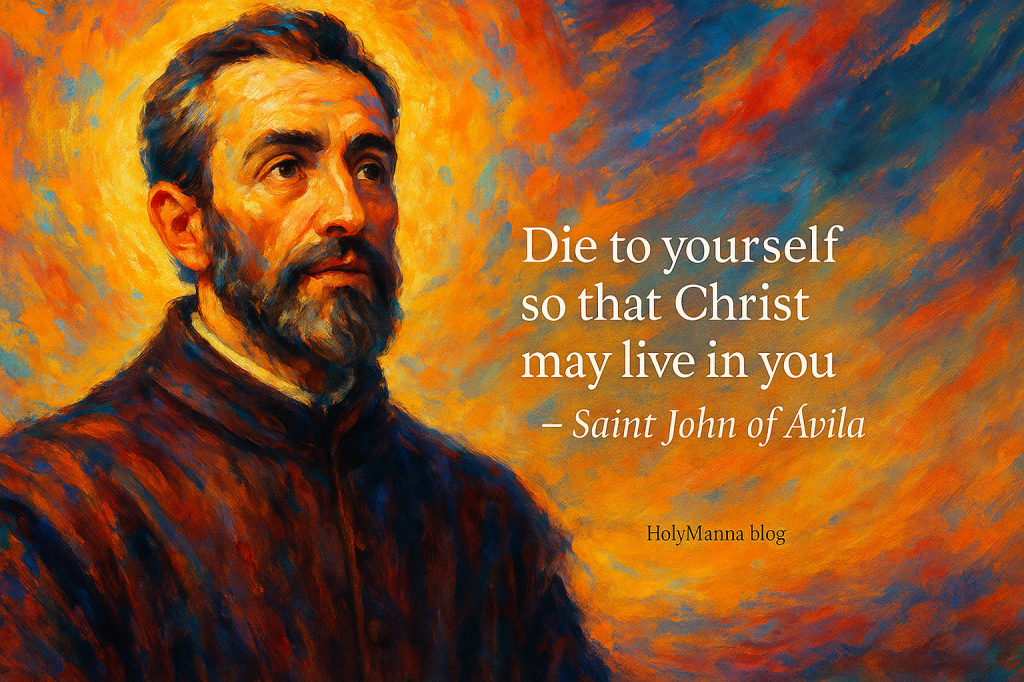
“Die to yourself so that Christ may live in you”—these words of Saint John are both a challenge and a consolation. How is God inviting you to die to your old self so that a greater love may live in you today?
Are you willing to let your heart be set on fire by Christ as John of Ávila’s was? What small acts of faithfulness today can lead you closer to the burning love of the Sacred Heart?
💬 Engage with Us!
How does Saint John of Ávila inspire you today? Have you ever experienced healing or clarity through spiritual counsel? Share your thoughts in the comments and let’s build each other up in faith!
✨ Reflection Questions:
- What area of my life needs interior reform through prayer and surrender to Christ?
- How can I be more bold and loving in sharing the truth of the Gospel like Saint John of Ávila?
- Am I allowing suffering to unite me to Christ or pushing it away out of fear or frustration?
Let us encourage one another to walk in holiness, to trust in God’s perfect timing, and to do all things with love, as our Lord Jesus Christ did.
Saint John, pray for us! 🙏
Follow us on Instagram and Facebook for more insights and reflections on living a faith-filled life.

 Holy Manna!
Leave a comment