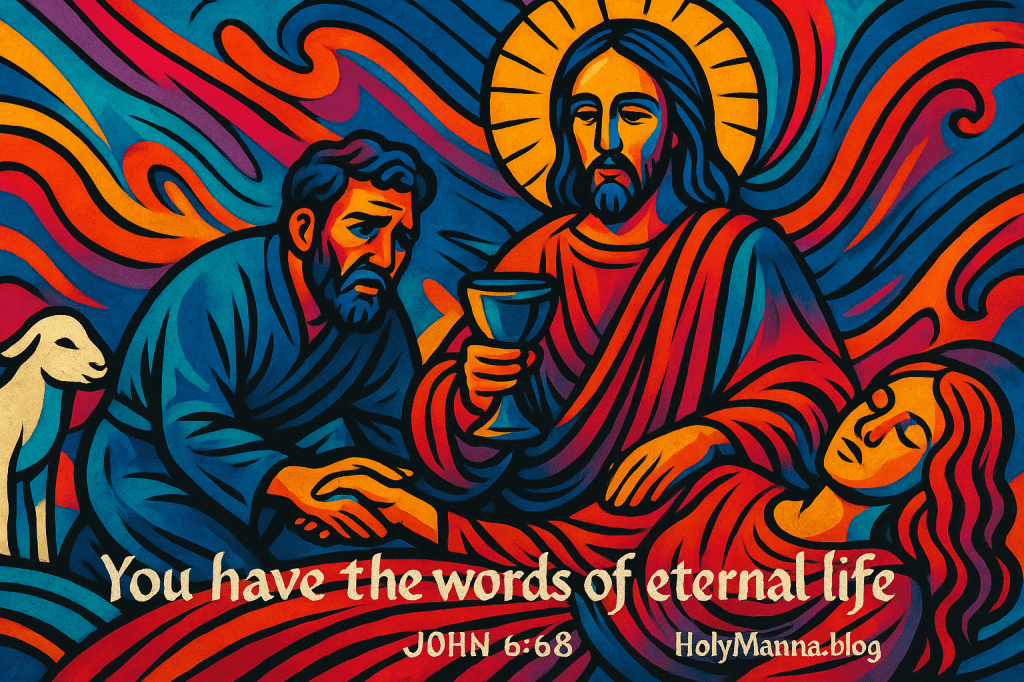
To Whom Shall We Go?
We’ve all faced those moments when faith feels like a fork in the road—one path is trust in what we cannot see, and the other is the temptation to turn back. Today’s readings draw us into one of those decisive moments, not just for the early Church, but for every disciple of Christ. How do we respond when the teachings of Jesus seem hard? When life overwhelms us? When our prayers don’t make sense—or don’t seem answered? In the tension between fear and faith, healing and hardship, doubt and decision, the Holy Spirit invites us to rediscover Jesus as the only one who holds the words of eternal life.
Historically, the Church in the Acts of the Apostles was undergoing both external persecution and internal expansion. Yet today we read that it was “at peace”—a divine peace, rooted not in comfort, but in the “consolation of the Holy Spirit.” This peace made space for Peter’s miraculous ministry: a paralyzed man walks, a devout woman is raised from the dead, and whole communities turn to the Lord. These events echo the psalmist’s awe and gratitude: “How can I repay the Lord for all the great good done for me?” Miracles, however, are not the end goal—they are signs that point us toward the fullness of life found in Christ alone.
That fullness is tested in The Gospel of John, as Jesus reveals the mystery of the Eucharist. His words are too much for many: “This saying is hard; who can accept it?” And yet, Peter—the same apostle we saw raise the dead and walk in faith—chooses to stay. Not because he fully understands, but because he fully believes: “You have the words of eternal life.” Today, we are invited into that same confession. Whether we’re witnessing signs and wonders or struggling to accept a hard teaching, the question remains: To whom shall we go?
First Reading – Acts 9:31–42
Miracles, Mercy, and the Mysterious Power of the Name
The Acts of the Apostles is more than just a historical chronicle—it is the living testimony of how the Holy Spirit animates the Church after the Resurrection and Ascension of Christ. Written by St. Luke, this book shows us the Church in its earliest form: fragile yet fervent, persecuted yet flourishing. By chapter 9, Saul has just undergone his radical conversion, and now St. Peter—already preaching boldly since Pentecost—steps onto the scene in powerful new ways. These stories are not just about healing and resurrection. They are about how the Church, walking “in the fear of the Lord and with the consolation of the Holy Spirit,” becomes the living presence of Christ on earth. Today’s passage situates Peter as a vessel of divine power, one who continues the ministry of Jesus Himself: healing the sick, raising the dead, and calling people to believe in the name above all names. These miracles echo the deeper truth of the Gospel—that Jesus not only saves souls but restores bodies, communities, and broken hearts.
Acts 9:31-42
New American Bible (Revised Edition)
The Church at Peace. 31 The church throughout all Judea, Galilee, and Samaria was at peace. It was being built up and walked in the fear of the Lord, and with the consolation of the holy Spirit it grew in numbers.
Peter Heals Aeneas at Lydda. 32 As Peter was passing through every region, he went down to the holy ones living in Lydda. 33 There he found a man named Aeneas, who had been confined to bed for eight years, for he was paralyzed. 34 Peter said to him, “Aeneas, Jesus Christ heals you. Get up and make your bed.” He got up at once. 35 And all the inhabitants of Lydda and Sharon saw him, and they turned to the Lord.
Peter Restores Tabitha to Life. 36 Now in Joppa there was a disciple named Tabitha (which translated means Dorcas). She was completely occupied with good deeds and almsgiving. 37 Now during those days she fell sick and died, so after washing her, they laid [her] out in a room upstairs. 38 Since Lydda was near Joppa, the disciples, hearing that Peter was there, sent two men to him with the request, “Please come to us without delay.” 39 So Peter got up and went with them. When he arrived, they took him to the room upstairs where all the widows came to him weeping and showing him the tunics and cloaks that Dorcas had made while she was with them. 40 Peter sent them all out and knelt down and prayed. Then he turned to her body and said, “Tabitha, rise up.” She opened her eyes, saw Peter, and sat up. 41 He gave her his hand and raised her up, and when he had called the holy ones and the widows, he presented her alive. 42 This became known all over Joppa, and many came to believe in the Lord.
Detailed Exegesis
Verse 31 – “The church throughout all Judea, Galilee, and Samaria was at peace. It was being built up and walked in the fear of the Lord, and with the consolation of the holy Spirit it grew in numbers.”
This verse marks a moment of divine pause—after intense persecution, the early Church enters a season of peace. Yet this peace is not passive; it’s fruitful. The “fear of the Lord” here denotes awe-filled reverence, not terror. The community walks in both fear and consolation—two movements of the Spirit that nurture holiness and joy.
Verse 32 – “As Peter was passing through every region, he went down to the holy ones living in Lydda.”
Peter’s missionary work mirrors Christ’s own itinerant ministry. The term “holy ones” (Greek: hagioi) refers to baptized believers who have been set apart. This shows the early development of local Christian communities.
Verse 33 – “There he found a man named Aeneas, who had been confined to bed for eight years, for he was paralyzed.”
This brief introduction highlights Aeneas’ suffering. Eight years is a long time—this wasn’t a passing affliction but a long-standing condition, rendering him dependent and immobile.
Verse 34 – “Peter said to him, ‘Aeneas, Jesus Christ heals you. Get up and make your bed.’ He got up at once.”
Notice that Peter doesn’t claim the healing for himself—it is Jesus Christ who heals. The immediacy of Aeneas’ response evokes the many “get up” moments in Jesus’ healings. It reflects the authority of the name of Jesus and the faith that moves at His word.
Verse 35 – “And all the inhabitants of Lydda and Sharon saw him, and they turned to the Lord.”
Healing leads to conversion. This verse emphasizes the communal impact of personal restoration. Aeneas’ healing becomes a signpost to the Lord, drawing entire towns into belief.
Verse 36 – “Now in Joppa there was a disciple named Tabitha (which translated means Dorcas). She was completely occupied with good deeds and almsgiving.”
Tabitha is one of the few women in Scripture explicitly called a “disciple.” Her identity is not rooted in public teaching, but in her works of mercy. Her life of service embodies the Church’s social teaching and echoes the description of the virtuous woman in Proverbs 31.
Verse 37 – “Now during those days she fell sick and died, so after washing her, they laid [her] out in a room upstairs.”
The community’s reverence for Tabitha is shown in how they prepare her body—washing, mourning, and placing her with care. Her death is deeply felt, a sign of her spiritual impact.
Verse 38 – “Since Lydda was near Joppa, the disciples, hearing that Peter was there, sent two men to him with the request, ‘Please come to us without delay.’”
This shows faith in Peter’s ability to act on behalf of the Lord. It also reflects the communal bonds of the Church—news travels, and help is summoned urgently.
Verse 39 – “So Peter got up and went with them. When he arrived, they took him to the room upstairs where all the widows came to him weeping and showing him the tunics and cloaks that Dorcas had made while she was with them.”
The widows’ grief is personal and tangible. They don’t just mourn; they show Peter her legacy. The tunics and cloaks are testimonies to her charity, each thread a silent prayer.
Verse 40 – “Peter sent them all out and knelt down and prayed. Then he turned to her body and said, ‘Tabitha, rise up.’ She opened her eyes, saw Peter, and sat up.”
Peter imitates Jesus in Mark 5, where the Lord raises Jairus’ daughter with the Aramaic words “Talitha koum.” Peter’s action is preceded by prayer—reminding us that even Apostles seek God’s power, not their own. The command “rise up” again reflects the resurrection power of Christ working through His Church.
Verse 41 – “He gave her his hand and raised her up, and when he had called the holy ones and the widows, he presented her alive.”
This is more than physical resurrection—it’s restoration to community. The same language used for Jesus’ own resurrection (“He raised her up”) is employed here.
Verse 42 – “This became known all over Joppa, and many came to believe in the Lord.”
As with Aeneas, Tabitha’s restoration becomes a catalyst for evangelization. Her life—and her death—lead others to eternal life.
Teachings
The Church teaches that the Apostles were given authority not only to teach but to heal and raise the dead through the power of Christ. The Catechism of the Catholic Church states, “In the Name of Jesus the Apostles perform many signs, which manifest that the kingdom is present in him” (CCC 549). This is seen vividly in Peter’s miracles. But these miracles serve not as ends in themselves; they are signs that draw people to believe in the risen Christ and join His Body, the Church.
St. John Chrysostom commented on this passage, saying, “It was not Peter but Jesus who raised Tabitha. Peter knelt down in prayer—he did not attempt it by command alone. The resurrection came from above.” This humility is essential. It also models how we are to approach our own ministries—whether preaching, serving, or healing—always recognizing the true source of grace.
Tabitha (Dorcas) also embodies the Church’s teaching on the works of mercy. As The Catechism reminds us: “Charity is the soul of the holiness to which all are called: it governs, shapes, and perfects all the means of sanctification” (CCC 826). Her quiet life of service wasn’t peripheral—it was essential. She stands as a model of sanctity for all laypeople, especially women, whose hidden sacrifices build up the Church in powerful, often unseen ways.
Reflection
This passage reminds us that holiness and healing are never private matters—they ripple outward. Aeneas’ healing led a region to turn to the Lord. Tabitha’s resurrection brought many to faith. What might God want to heal or resurrect in your life—not just for your sake, but so others may believe? We live in a world that often doubts miracles, yet we are surrounded by them: conversions, reconciliations, acts of mercy, lives reclaimed from sin. Do we believe that Christ still works wonders through His Church today?
It also invites us to become like Tabitha—faithful in good works, hidden in humility, and remembered for love. What legacy are you sewing into the lives of others? In a world obsessed with status, God exalts those who serve quietly. Finally, Peter’s actions challenge us to pray with boldness. When someone comes to you with pain, do you respond with faith and intercession? Whether we witness healing or carry the cross, we are called to trust that Jesus is still at work—still raising the dead, still calling His people to rise.
Responsorial Psalm – Psalm 116:12–17
The Cup of Salvation and the Cry of the Redeemed
Psalm 116 is a psalm of thanksgiving—a hymn sung by one who has been delivered from suffering and death. It belongs to the Hallel collection (Psalms 113–118), traditionally sung by Jews during Passover celebrations. This means that these were likely among the psalms sung by Jesus Himself during the Last Supper. The words today express the heart of someone who has experienced a personal miracle and now seeks to offer a fitting response to God’s overwhelming mercy. In the context of today’s readings—where Peter raises Tabitha from the dead and Jesus’ disciples struggle with the challenge of accepting His hard sayings—this psalm places us in the role of the one who has been healed, who has been saved, and who must now decide: How shall I respond to the Lord’s saving work in my life? It calls us into the interior space of gratitude, devotion, and renewal.
Psalm 116:12-17
New American Bible (Revised Edition)
12 How can I repay the Lord
for all the great good done for me?
13 I will raise the cup of salvation
and call on the name of the Lord.
14 I will pay my vows to the Lord
in the presence of all his people.
15 Dear in the eyes of the Lord
is the death of his devoted.
16 Lord, I am your servant,
your servant, the child of your maidservant;
you have loosed my bonds.
17 I will offer a sacrifice of praise
and call on the name of the Lord.
Detailed Exegesis
Verse 12 – “How can I repay the Lord for all the great good done for me?”
This rhetorical question opens the psalmist’s reflection with a tone of awe. It recognizes the complete gratuity of God’s mercy—nothing we offer could ever equal His saving love. The psalmist is not attempting a transactional exchange but entering into a covenantal relationship rooted in thanksgiving.
Verse 13 – “I will raise the cup of salvation and call on the name of the Lord.”
The “cup of salvation” likely refers to a liturgical drink offering in the Temple, but Christians also see in this a foreshadowing of the Eucharist. To “call on the name of the Lord” is to invoke God in worship, in dependence, and in joy. This verse mirrors our own reception of the Precious Blood at Mass—an act of faith and thanksgiving.
Verse 14 – “I will pay my vows to the Lord in the presence of all his people.”
This public declaration reflects the importance of communal worship. Vows made in distress are fulfilled in thanksgiving. In biblical times, this may have involved sacrifices or pilgrimages to the Temple; for us, it’s our visible commitment to live faithfully—even when no one else sees.
Verse 15 – “Dear in the eyes of the Lord is the death of his devoted.”
This poignant verse reminds us that God does not view the death of His faithful ones with indifference. The Hebrew can also be translated “precious” or “costly.” In light of Tabitha’s death and restoration in the First Reading, this verse takes on new meaning—God sees, treasures, and redeems the lives of those who serve Him.
Verse 16 – “Lord, I am your servant, your servant, the child of your maidservant; you have loosed my bonds.”
The repetition here emphasizes humility and identity. To be a servant of God is a badge of honor. The “child of your maidservant” echoes Old Testament figures like Samuel, whose mother consecrated him to the Lord. The psalmist’s freedom from bondage—be it illness, sin, or despair—is not just a private grace but a call to serve.
Verse 17 – “I will offer a sacrifice of praise and call on the name of the Lord.”
This final verse circles back to worship. Praise is offered not merely in word but as a sacrifice—something deliberate, sacred, and costly. Once again, we see the psalmist rooting gratitude not in vague emotion but in ritual, action, and devotion.
Teachings
The Catechism teaches that thanksgiving is one of the principal forms of prayer: “Thanksgiving characterizes the prayer of the Church which, in celebrating the Eucharist, reveals and becomes more fully what she is. Indeed, in the Eucharist the Church expresses her gratitude to God for all his benefits” (CCC 2637). Psalm 116 is practically a template for Eucharistic prayer—it echoes in the very heart of the Mass as we lift up the chalice of salvation in thanksgiving for Christ’s Paschal sacrifice.
St. Augustine beautifully reflects on the line, “You have loosed my bonds,” saying, “He has broken my chains, He has forgiven my sins, He has freed me from the snare of the devil. What shall I render unto Him? I will love Him who first loved me.” This loving response is the essence of the Christian life: not duty for duty’s sake, but a heart set free, giving itself back in love. It’s the same freedom that animated Tabitha’s works of mercy and Peter’s boldness in Joppa.
The Psalm’s repeated theme of calling on the name of the Lord ties directly into the early Church’s identity. As Acts 4:12 declares, “There is no other name under heaven given to the human race by which we are to be saved.” This is more than speech—it’s invocation, dependence, surrender. The saints lived by this name, died in this name, and were saved through this name. To “call on the name of the Lord” is to declare publicly and personally that Jesus is our salvation—whether in the quiet of thanksgiving or the noise of suffering.
Reflection
Psalm 116 challenges us to examine the depth of our gratitude. Have we recognized the great good the Lord has done for us? Or have we become numb to His mercies? In a world that demands constant performance, this psalm invites us to rest in the truth that God acts first—and we respond with humble thanks. When was the last time you offered a “sacrifice of praise”? Not praise that feels good, but praise that costs something—your time, your comfort, your pride?
It also reminds us that salvation is communal. The psalmist does not keep his joy to himself; he fulfills his vows “in the presence of all His people.” How might you share your testimony today? How might your praise spark someone else’s faith? Whether you’ve been healed like Aeneas, raised like Tabitha, or wrestling with hard truths like the disciples in the Gospel, one thing remains: we are called to lift high the cup of salvation and declare, “You have loosed my bonds.”
Holy Gospel – John 6:60–69
Staying When It’s Hard to Stay
This Gospel passage captures a critical turning point in The Gospel of John, often referred to as the “Bread of Life Discourse.” After Jesus declares that His flesh is true food and His blood true drink (John 6:55), many disciples recoil. Today’s verses pick up as their murmuring turns into a mass departure. This episode is deeply rooted in both Jewish and early Christian context: to a first-century Jew, the idea of drinking blood was abhorrent—Levitical law strictly forbade it (cf. Leviticus 17:10–14). Jesus’ words are not metaphorical or poetic exaggerations. He means what He says, and it shocks His listeners. The division caused by this teaching sets the stage for Peter’s beautiful declaration of faith—one that echoes through every generation of believers struggling with doubt. Within the Eucharistic mystery and the human response to it, this Gospel brings today’s theme full circle: Faith must cling to Christ even when understanding fails.
John 6:60-69
New American Bible (Revised Edition)
60 Then many of his disciples who were listening said, “This saying is hard; who can accept it?” 61 Since Jesus knew that his disciples were murmuring about this, he said to them, “Does this shock you? 62 What if you were to see the Son of Man ascending to where he was before? 63 It is the spirit that gives life, while the flesh is of no avail. The words I have spoken to you are spirit and life. 64 But there are some of you who do not believe.” Jesus knew from the beginning the ones who would not believe and the one who would betray him. 65 And he said, “For this reason I have told you that no one can come to me unless it is granted him by my Father.”
66 As a result of this, many [of] his disciples returned to their former way of life and no longer accompanied him. 67 Jesus then said to the Twelve, “Do you also want to leave?” 68 Simon Peter answered him, “Master, to whom shall we go? You have the words of eternal life. 69 We have come to believe and are convinced that you are the Holy One of God.”
Detailed Exegesis
Verse 60 – “Then many of his disciples who were listening said, ‘This saying is hard; who can accept it?’”
The Greek word for “hard” here (sklēros) implies something not just difficult, but offensive or intolerable. The challenge is not in understanding Jesus’ words, but in accepting them. This verse reveals that even those closest to Jesus can struggle with His teachings.
Verse 61 – “Since Jesus knew that his disciples were murmuring about this, he said to them, ‘Does this shock you?’”
Jesus does not soften His message to ease their discomfort. Instead, He confronts their reaction head-on. The word “shock” underscores the depth of their dismay. Jesus exposes their hearts—He sees that their struggle is with faith, not comprehension.
Verse 62 – “What if you were to see the Son of Man ascending to where he was before?”
Here, Jesus points to His divine origin and future Ascension. He is gently suggesting that if they cannot believe His words about the Eucharist now, how will they respond when they see the fullness of His glory? This statement invites them to lift their gaze beyond the material to the heavenly.
Verse 63 – “It is the spirit that gives life, while the flesh is of no avail. The words I have spoken to you are spirit and life.”
This is not a rejection of the Incarnation or the physical world, but a correction of their misunderstanding. “Flesh” here means human effort apart from the Spirit. Jesus affirms that His words carry divine, life-giving power. The true understanding of His teaching can only come through the Spirit.
Verse 64 – “But there are some of you who do not believe.” Jesus knew from the beginning the ones who would not believe and the one who would betray him.”
Jesus speaks prophetically here—not only about Judas, but about all who would reject Him. Belief is not simply intellectual assent but total surrender. He recognizes the resistance within their hearts even before their outward departure.
Verse 65 – “And he said, ‘For this reason I have told you that no one can come to me unless it is granted him by my Father.’”
Faith is a grace. Jesus reiterates that belief in Him isn’t the result of logic or persuasion, but a gift from the Father. This echoes John 6:44 and deepens the mystery of divine election and human freedom.
Verse 66 – “As a result of this, many [of] his disciples returned to their former way of life and no longer accompanied him.”
One of the most sorrowful verses in the Gospels. These were not strangers, but disciples—those who had followed Him. The phrase “returned to their former way of life” suggests more than physical departure; it implies a spiritual regression, a reversal of conversion.
Verse 67 – “Jesus then said to the Twelve, ‘Do you also want to leave?’”
Jesus gives His closest followers freedom. He doesn’t coerce loyalty. His question is piercing—inviting each to make a personal decision. It is a moment of spiritual confrontation and invitation.
Verse 68 – “Simon Peter answered him, ‘Master, to whom shall we go? You have the words of eternal life.’”
Peter doesn’t say he understands everything—only that he knows Jesus is the source of life. This is faith in its purest form: a decision to stay with the Lord even in confusion or difficulty. The use of “Master” (Greek: Kyrios) affirms Jesus’ authority.
Verse 69 – “We have come to believe and are convinced that you are the Holy One of God.”
This confession of faith anchors the entire discourse. To call Jesus “the Holy One of God” is to recognize Him as the Messiah, consecrated and sent by the Father. Peter speaks not only for the Twelve but for all who would choose faith over comfort.
Teachings
This passage is central to the Church’s teaching on the Eucharist. The Catechism of the Catholic Church teaches: “The Eucharist is the heart and the summit of the Church’s life, for in it Christ associates his Church and all her members with his sacrifice of praise and thanksgiving” (CCC 1407). The difficulty of Jesus’ words in John 6 lies in their shocking truth—He is not speaking symbolically but sacramentally. The disciples’ struggle becomes our own challenge: Will we believe even when the mystery surpasses our understanding?
St. Cyril of Jerusalem affirmed this teaching in the fourth century: “Since Christ himself has declared the bread to be his body, who shall dare to doubt it? And when He has Himself affirmed and said: ‘This is my blood,’ who shall ever hesitate and say it is not his blood?” (Catechetical Lectures, 22). Cyril echoes Peter’s posture—faith grounded not in clarity, but in trust. The saints remind us that faith often involves darkness—but a darkness illuminated by the presence of the Holy One.
The Gospel also highlights the dynamic between grace and freedom. CCC 1996 states: “Our justification comes from the grace of God. Grace is favor, the free and undeserved help that God gives us to respond to his call.” Jesus’ words, “No one can come to me unless it is granted him by my Father,” remind us that faith is not our achievement—it’s a gift. But we must choose to receive it. The Twelve could have walked away, but they remained. Their staying becomes the Church’s foundation.
Reflection
This Gospel meets us in our own moments of decision. Have you ever heard a teaching of Christ that felt “too hard” to accept? Have you ever been tempted to walk away—not because you didn’t believe, but because belief came at a cost? Jesus still turns to each of us and asks, “Do you also want to leave?” And like Peter, we are invited to respond—not with perfect understanding, but with unwavering trust: “To whom shall we go? You have the words of eternal life.”
Today’s passage calls us to deeper Eucharistic faith. Do you approach the Body and Blood of Christ with reverence, belief, and awe? Do you stay with Him even when His ways don’t make sense? In a world that often values comfort over conviction, Jesus invites us to remain—to walk the narrow road, to wrestle with mystery, and to trust that His words are indeed spirit and life. The Bread of Life discourse is not just theological—it’s personal. And its question echoes even now: Will you stay?
Stay With Him
From the hills of Judea to the Upper Room in Joppa, from the trembling heart of the psalmist to the challenging words of Jesus in The Gospel of John, today’s readings lead us along a journey of faith—a journey that passes through healing, confrontation, surrender, and renewal. We have seen Peter raise the dead and heal the paralyzed, not by his own power but through the living presence of Jesus Christ. We have echoed the psalmist’s cry of thanksgiving, lifting the cup of salvation and calling on the name of the Lord who has loosed our bonds. And we have stood with the Twelve as others walked away from Jesus, and heard Peter’s stirring profession: “You have the words of eternal life.”
At the heart of it all is a question—Will you stay with Him when it’s hard? Will you trust the One who heals, who raises, who feeds, even when His words challenge your understanding or your comfort? The Holy Spirit does not call us to a life of ease, but to a life of transformation. And this transformation often comes through mystery, through the breaking of bread and the breaking of pride, through the surrender of our own understanding and the embrace of a greater truth.
So today, let us take a step closer to Jesus. Let us call on His name with faith, offer Him a sacrifice of praise, and trust that He is still the Holy One of God. Whether you are in a season of peace like the early Church, or wrestling with a hard teaching like the murmuring disciples, hear the Lord’s voice inviting you to remain. To whom shall you go? Stay with Him. He is still speaking spirit and life into the hearts of those who believe.
Engage with Us!
We’d love to hear how the Word of God spoke to your heart today. Share your thoughts, prayers, or personal reflections in the comments below! Let’s grow together as a community rooted in Christ, encouraging one another to live with bold faith, generous love, and unwavering trust in the Lord’s promises.
Reflection Questions:
First Reading – Acts 9:31–42
Have you ever witnessed or experienced a moment of healing or restoration that deepened your faith? How can you imitate the generosity and devotion of Tabitha in your own community? What “miracle” might God be asking you to believe for—not only for yourself, but for the sake of others coming to know Him?
Responsorial Psalm – Psalm 116:12–17
What “cup of salvation” are you being called to lift today in thanksgiving? How do you express gratitude to God for what He has done in your life? What does a “sacrifice of praise” look like for you right now?
Holy Gospel – John 6:60–69
Have you ever found one of Jesus’ teachings “too hard” to accept? What helped you stay, even when others walked away? How can Peter’s words—“To whom shall we go?”—shape your prayer life in moments of doubt or spiritual dryness?
As you go about your day, remember that every step of faith, every act of mercy, and every word of praise brings you closer to the heart of Jesus. Stay close to Him. Trust in His healing. Speak His name with boldness. And do everything—with every breath, every choice, and every sacrifice—with the same love and mercy that Jesus poured out for you.
Follow us on Instagram and Facebook for more insights and reflections on living a faith-filled life.

 Holy Manna!
Leave a comment