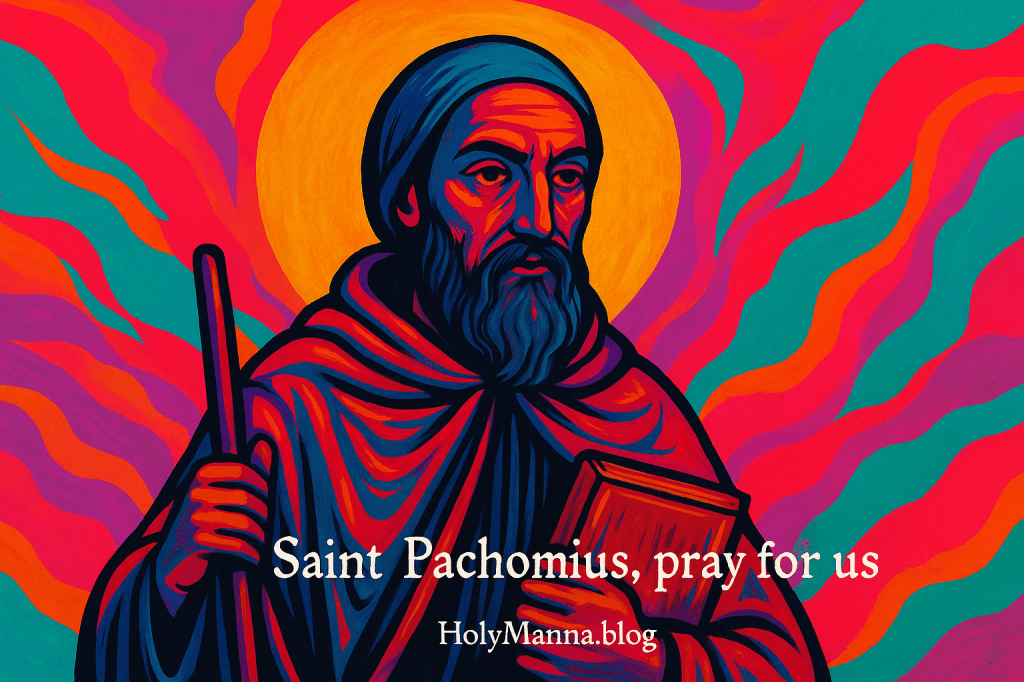
The Builder of Sacred Brotherhood
Saint Pachomius is honored in the Catholic Church as the father of cenobitic monasticism—a form of religious life lived in community rather than in solitude. Before him, Christian monasticism was largely shaped by hermits like Saint Anthony of the Desert, who pursued holiness through complete withdrawal from society. Pachomius, however, discerned a different call from God: to gather believers into communities where prayer, labor, and charity could be lived out in common purpose. This vision would go on to shape Christian religious life for centuries, influencing Saint Basil, Saint Benedict, and countless other monastic founders.
What makes Pachomius particularly significant is not only his radical faith and asceticism, but also his extraordinary gift of organization. He didn’t merely start a monastery—he created a system, a holy order of life that allowed thousands of monks to grow in holiness together. His communities emphasized obedience, humility, silence, and manual labor, all grounded in daily liturgical prayer. It was a spiritual revolution, and his flame still burns today in monastic houses around the world.
The Soldier Who Found Christ
Saint Pachomius was born around the year 292 A.D. in the region of Thebes, Egypt. Raised by pagan parents, he had no knowledge of the Christian God during his early years. As a young man, he was conscripted into the Roman army during a time of great unrest and uncertainty. This was a season of trial and loneliness, one that unknowingly prepared his heart for a dramatic encounter with divine love.
While detained in a military prison in the city of Thebes, Pachomius witnessed a moment of inexplicable charity. Local Christians came to the prison—not to visit family or friends—but simply to care for the soldiers, offering them food, water, and comfort. The soldiers were complete strangers to them, yet these Christians served them with warmth and humility. Deeply moved by this mysterious kindness, Pachomius resolved that if he were released, he would seek to know the God who inspired such love.
After his release, he followed through on his vow. He entered the catechumenate, was baptized, and began his journey in Christ. His thirst for holiness led him to the desert, where he became a disciple of the famous hermit Saint Palamon. Under Palamon’s guidance, Pachomius practiced the hard disciplines of fasting, solitude, and contemplation. But in time, he discerned a unique call: to bring together those seeking God not in isolation, but as a family of faith. This calling led him to establish the first true Christian monastery at Tabennisi, around the year 318 A.D.
Heaven in the Desert
Though Pachomius is not remembered for extravagant or public miracles, his life was filled with divine signs and spiritual gifts that bore witness to God’s presence. He was known to receive heavenly visions, including direct communication with angels and even with Christ Himself. These visions guided the formation of his monastic communities and affirmed that his work was divinely inspired.
One remarkable miracle attributed to Pachomius was his supernatural gift of languages. He was said to understand and speak various tongues without study, which enabled him to welcome and spiritually direct monks from different parts of the Roman Empire. This miraculous ability helped maintain unity in his diverse communities and allowed the Gospel to take deeper root in many hearts.
Healing also flowed through Pachomius’ ministry. When monks fell ill, he would often pray over them, anoint them with oil, or simply touch them—and they would recover. These healings were never performed for show but arose naturally out of his deep compassion and trust in the Lord. “Whatever you did for the least of these brothers of mine, you did for me” became a quiet reality in his desert monasteries, where Christ’s love was lived in simplicity and strength.
A Life Poured Out
Pachomius was not martyred by sword or fire, but he lived a martyrdom of endurance, responsibility, and love. His life as a spiritual father to thousands of monks was anything but easy. He faced resistance from within his own communities, as some monks struggled with the discipline, obedience, and humility his rule required. There were moments when the burden of leadership brought him close to despair. Yet he never abandoned the calling, turning instead to deeper prayer and fasting to regain strength.
He also battled spiritual darkness—temptations, doubts, and attacks from the devil. Like many saints of the desert, he was no stranger to the inner warfare that comes with seeking holiness. “The spirit is willing, but the flesh is weak” was not just a saying, but a battlefield he faced every day.
Toward the end of his life, Pachomius was caught in a plague that spread through his monastic communities. Rather than retreat to safety, he chose to remain with his brothers, caring for the sick and offering final prayers for the dying. In this final act of selflessness, he contracted the disease himself and died around the year 348 A.D. His passing was not marked by earthly triumph, but by the peace of a man who had spent every breath for the love of God and neighbor.
The Fruit That Endures
After Saint Pachomius’ death, the spiritual fruit of his life continued to multiply. Reports of healing at his tomb began to spread, and many pilgrims journeyed to the places he had lived and prayed. But the greater miracle was the endurance and spread of his monastic rule. Within a few decades, thousands more had embraced the Pachomian way, and his writings were translated into Greek, Latin, and Syriac. His vision traveled far beyond Egypt, shaping monasticism in the Eastern and Western Church.
One of the most remarkable aspects of his posthumous legacy is the continuity of his communal spirit. Monasteries inspired by Pachomius’ vision became places of peace, healing, and profound spiritual formation. The monks who followed his rule became missionaries, teachers, and even bishops. The very idea that ordinary people could live holy lives in community—tending fields, praying psalms, sharing meals—was revolutionary. “Where two or three are gathered in my name, I am there among them” became the cornerstone of a new Christian way of life.
Today, his name is honored not just by Roman Catholics, but also by Eastern Orthodox, Coptic, and other apostolic Christians. His feast day, celebrated on May 9 in the Roman Church and May 15 in the Coptic Church, continues to inspire new generations of believers seeking holiness in fellowship.
Reflections from the Cloister
Saint Pachomius reminds us that holiness is not an escape from the world, but a deeper engagement with it—beginning in the communities we are placed in. His life challenges us to bring Christ into our daily rhythms, to allow prayer and work to shape our souls, and to bear with one another in love.
What might happen if we began to treat our homes like small monasteries—centers of peace, order, and spiritual nourishment? Could you structure your day around prayer, service, and silence? Could your family or friend group become a place where God dwells more fully?
Saint Pachomius teaches that even the desert can become a garden when Christ is at the center. We are invited to bring that garden to life wherever we are—be it in a home, a parish, or a workplace.
Are you ready to live a more structured and holy life?
What rhythms do you need to establish to grow closer to God?
How can you be a source of peace and charity in your community today?
Engage with Us!
Let’s grow together in faith and purpose. Share your thoughts or experiences in the comments!
Reflection Questions:
- How can I bring more structure and discipline into my spiritual life?
- In what ways can I serve others in my community as those early Christians served Pachomius?
- What does it mean to live in communion with others today, and how can I foster it in my life?
Let us walk together, supporting each other in the journey of faith. And may we strive to do everything with love, just as our Lord Jesus Christ did.
Saint Pachomius, pray for us! 🙏
Follow us on Instagram and Facebook for more insights and reflections on living a faith-filled life.

 Holy Manna!
Leave a comment