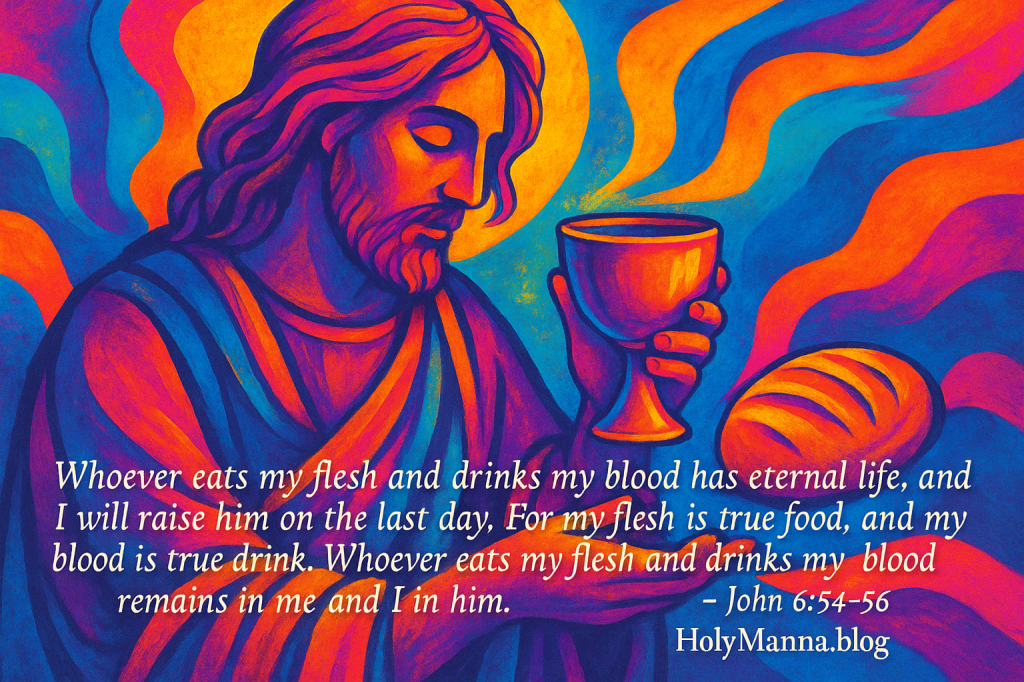
From Darkness to Communion
Have you ever wondered what it would take for your life to truly change—to see everything with new eyes, to live with a heart set ablaze by truth? Today’s readings invite us into a powerful movement: from blindness to sight, from unbelief to faith, from death to divine life. At the center of it all is the transformative encounter with Jesus Christ—not just as a historical figure or wise teacher, but as the living Lord who calls us by name and offers Himself as our very food. Whether we see ourselves in Saul’s dramatic conversion, in the hesitant obedience of Ananias, or in the crowd struggling to understand Jesus’ words about eating His flesh, the call is the same: to surrender, to receive, and to live anew.
In the Acts of the Apostles, we witness the radical mercy of God breaking into Saul’s life. Known for persecuting early Christians, Saul is stopped on the road to Damascus not by argument, but by a blinding encounter with the risen Jesus: “Saul, Saul, why are you persecuting me?” This moment is not only personal—it’s ecclesial. Jesus identifies with His Body, the Church, showing us that to harm His followers is to harm Him. The early Church, emerging in a time of fierce opposition, often grew through such conversions, where former enemies became apostles. Saul’s baptism, spiritual healing, and immediate preaching reveal that no one is beyond God’s reach when grace takes hold.
This same grace is offered to us in the most intimate way through the Eucharist. In The Gospel of John, Jesus proclaims: “Whoever eats my flesh and drinks my blood has eternal life”, revealing a mystery that scandalized many of His listeners—and still stretches our faith today. To eat the flesh of the Son of Man is not metaphor, but sacrament. Jesus gives Himself fully so that we may have true life in Him. Just as Saul’s vision was restored and his mission ignited, so too are we restored and sent out when we receive Jesus in the Eucharist. The Responsorial Psalm cries out with global joy—“Praise the Lord, all you nations!”—reminding us that this gift is for every people, every heart, and every soul willing to be changed. Are you ready to let Jesus change everything for you today?
First Reading – Acts 9:1–20
From Persecutor to Proclaimer: The Power of Encounter
The Acts of the Apostles is a book of divine disruption and missionary momentum. Written by Saint Luke as a continuation of his Gospel, Acts chronicles the birth and explosive growth of the early Church through the power of the Holy Spirit. Today’s reading, nestled in the dramatic ninth chapter, recounts the most pivotal conversion in Christian history: Saul of Tarsus, a zealous persecutor of the followers of the Way, is struck blind by the risen Christ and emerges days later as Paul, the Apostle to the Gentiles. This moment is more than biography—it is theology in action, revealing how God’s mercy chooses the most unlikely vessels and transforms them for His glory. Set against the backdrop of a persecuted yet Spirit-filled Church, Saul’s encounter fulfills today’s central theme: that meeting the living Christ changes everything.
Acts 9:1-20
New American Bible (Revised Edition)
Saul’s Conversion. 1 Now Saul, still breathing murderous threats against the disciples of the Lord, went to the high priest 2 and asked him for letters to the synagogues in Damascus, that, if he should find any men or women who belonged to the Way, he might bring them back to Jerusalem in chains. 3 On his journey, as he was nearing Damascus, a light from the sky suddenly flashed around him. 4 He fell to the ground and heard a voice saying to him, “Saul, Saul, why are you persecuting me?” 5 He said, “Who are you, sir?” The reply came, “I am Jesus, whom you are persecuting. 6 Now get up and go into the city and you will be told what you must do.” 7 The men who were traveling with him stood speechless, for they heard the voice but could see no one. 8 Saul got up from the ground, but when he opened his eyes he could see nothing; so they led him by the hand and brought him to Damascus. 9 For three days he was unable to see, and he neither ate nor drank.
Saul’s Baptism. 10 There was a disciple in Damascus named Ananias, and the Lord said to him in a vision, “Ananias.” He answered, “Here I am, Lord.” 11 The Lord said to him, “Get up and go to the street called Straight and ask at the house of Judas for a man from Tarsus named Saul. He is there praying, 12 and [in a vision] he has seen a man named Ananias come in and lay [his] hands on him, that he may regain his sight.” 13 But Ananias replied, “Lord, I have heard from many sources about this man, what evil things he has done to your holy ones in Jerusalem. 14 And here he has authority from the chief priests to imprison all who call upon your name.” 15 But the Lord said to him, “Go, for this man is a chosen instrument of mine to carry my name before Gentiles, kings, and Israelites, 16 and I will show him what he will have to suffer for my name.” 17 So Ananias went and entered the house; laying his hands on him, he said, “Saul, my brother, the Lord has sent me, Jesus who appeared to you on the way by which you came, that you may regain your sight and be filled with the holy Spirit.” 18 Immediately things like scales fell from his eyes and he regained his sight. He got up and was baptized, 19 and when he had eaten, he recovered his strength.
Saul Preaches in Damascus. He stayed some days with the disciples in Damascus, 20 and he began at once to proclaim Jesus in the synagogues, that he is the Son of God.
Detailed Exegesis
Verse 1 – “Now Saul, still breathing murderous threats against the disciples of the Lord, went to the high priest”
This opening paints Saul as a man consumed with violent zeal. His hatred for Christians is not passive; he is actively seeking out the means to destroy them, reflecting the intense hostility faced by the early Church. His “breathing” of threats suggests a life animated by rage, a soul desperate for purification.
Verse 2 – “and asked him for letters to the synagogues in Damascus, that, if he should find any men or women who belonged to the Way, he might bring them back to Jerusalem in chains.”
The term the Way refers to the earliest self-identification of the Christian community. Saul’s pursuit of both men and women shows the indiscriminate nature of his persecution. His authority from the high priest reveals that this was sanctioned religious violence—legal, yet morally bankrupt.
Verse 3 – “On his journey, as he was nearing Damascus, a light from the sky suddenly flashed around him.”
This divine interruption comes not in a temple but on a road, underscoring that God reaches into the ordinary paths of life. The light signifies God’s glory and judgment, often associated in Scripture with divine manifestation (cf. Exodus 24:17).
Verse 4 – “He fell to the ground and heard a voice saying to him, ‘Saul, Saul, why are you persecuting me?’”
Jesus identifies directly with His Church: to persecute His followers is to persecute Him. The repetition of Saul’s name recalls other pivotal callings in Scripture (e.g., “Moses, Moses” in Exodus 3:4), signaling a holy moment of transformation.
Verse 5 – “He said, ‘Who are you, sir?’ The reply came, ‘I am Jesus, whom you are persecuting.’”
Saul’s ignorance of Christ is shattered by this revelation. Jesus asserts His identity not as a distant idea but as a person, alive and reigning, forever united with His body, the Church.
Verse 6 – “Now get up and go into the city and you will be told what you must do.”
God doesn’t lay out the entire plan. Saul is commanded to obey in faith—a key aspect of conversion. The journey from blindness to sight begins with trust.
Verse 7 – “The men who were traveling with him stood speechless, for they heard the voice but could see no one.”
This encounter was deeply personal yet not private. Others witnessed something but lacked the full experience. Only Saul receives the full weight of the vision.
Verse 8 – “Saul got up from the ground, but when he opened his eyes he could see nothing; so they led him by the hand and brought him to Damascus.”
Physical blindness now mirrors his spiritual blindness. The proud persecutor must now be led by the hand—an image of divine humbling and dependence.
Verse 9 – “For three days he was unable to see, and he neither ate nor drank.”
Three days of fasting and blindness symbolize a death and burial, preparing him for resurrection in baptism. Like Christ in the tomb, Saul is in a place of transformation.
Verse 10 – “There was a disciple in Damascus named Ananias, and the Lord said to him in a vision, ‘Ananias.’ He answered, ‘Here I am, Lord.’”
Ananias’ response mirrors that of biblical prophets (cf. Isaiah 6:8), signaling his openness to God’s surprising mission. His obedience becomes the catalyst for Paul’s healing.
Verse 11 – “The Lord said to him, ‘Get up and go to the street called Straight and ask at the house of Judas for a man from Tarsus named Saul. He is there praying,”
The “Straight Street” detail adds historical texture—this road still exists in Damascus. Saul’s prayer life shows that even in darkness, he is seeking God, already being drawn into communion.
Verse 12 – “and [in a vision] he has seen a man named Ananias come in and lay [his] hands on him, that he may regain his sight.”
God orchestrates healing through human cooperation. Ananias’ role demonstrates that miracles often come through simple acts of obedience.
Verse 13 – “But Ananias replied, ‘Lord, I have heard from many sources about this man, what evil things he has done to your holy ones in Jerusalem.’”
Ananias’ hesitation is honest. It reflects our own fears when God calls us into difficult acts of mercy. Yet his dialogue with the Lord shows trust even in the face of danger.
Verse 14 – “And here he has authority from the chief priests to imprison all who call upon your name.”
Ananias acknowledges Saul’s power. The phrase “call upon your name” highlights the early Christian practice of prayer and worship centered on Jesus.
Verse 15 – “But the Lord said to him, ‘Go, for this man is a chosen instrument of mine to carry my name before Gentiles, kings, and Israelites,”
God sees what we do not. Saul’s mission is not just to Israel, but to the nations. He will become the Apostle to the Gentiles, fulfilling Isaiah’s vision that salvation would reach the ends of the earth (Isaiah 49:6).
Verse 16 – “and I will show him what he will have to suffer for my name.”
This mission is not glamorous—it will cost Saul deeply. Suffering becomes a hallmark of authentic apostleship (cf. 2 Corinthians 11:23–28).
Verse 17 – “So Ananias went and entered the house; laying his hands on him, he said, ‘Saul, my brother, the Lord has sent me, Jesus who appeared to you on the way by which you came, that you may regain your sight and be filled with the holy Spirit.’”
The laying on of hands prefigures the sacramental life of the Church. Ananias calls him “brother,” affirming his new identity in Christ before any public action is taken.
Verse 18 – “Immediately things like scales fell from his eyes and he regained his sight. He got up and was baptized,”
This image of scales evokes the removal of spiritual blindness. Baptism follows immediately—Paul enters fully into the Church through water and Spirit (cf. John 3:5).
Verse 19 – “and when he had eaten, he recovered his strength.”
His physical restoration parallels his spiritual renewal. From fasting and blindness to nourishment and strength—Saul is now a new creation.
Verse 20 – “He stayed some days with the disciples in Damascus, and he began at once to proclaim Jesus in the synagogues, that he is the Son of God.”
Transformation leads to mission. Saul doesn’t wait for perfection; filled with the Spirit, he begins proclaiming Jesus as Lord—a title that echoes divine identity.
Teachings
The Catechism of the Catholic Church teaches that conversion is a work of grace initiated by God: “Moved by grace, man turns toward God and away from sin, thus accepting forgiveness and righteousness from on high” (CCC 1989). Saul’s experience exemplifies this divine initiative. It is not Saul who finds Christ—it is Christ who finds Saul, calls him by name, and opens his heart to faith and mission. The grace of conversion, especially when dramatic, reminds us that God’s mercy is not constrained by our past.
Saint John Chrysostom reflects on Paul’s conversion with awe, writing, “What a change! He who had been a wolf now becomes a shepherd, he who had been a persecutor now becomes a proclaimer.” The Church Fathers often highlighted Paul’s transformation as proof that no sinner is beyond redemption. His conversion shows how God delights in making the weak strong and the hostile holy.
Historically, this moment marks the Church’s decisive turn toward the Gentile world. Saul—now Paul—would write nearly half the New Testament, build communities across the Roman Empire, and ultimately die a martyr’s death. But it all began with obedience, healing, and baptism. As Pope Benedict XVI noted, “The story of Paul’s conversion shows us that true conversion is always a personal encounter with Jesus Christ” (General Audience, Sept. 3, 2008). That encounter is at the heart of the Christian life.
Reflection
This reading confronts us with a challenge: What in your life needs to be blinded in order for you to truly see? Like Saul, many of us carry misguided zeal, pride, or fear that distances us from Christ and His Church. Yet Jesus doesn’t wait for us to get everything right before reaching out. He meets us where we are—on the road, in the middle of our mess, with love that disarms and transforms. What would it look like to say “yes” to that encounter today?
We are also reminded of Ananias’ courage. He wasn’t famous, but he was faithful. His obedience was the bridge between Saul’s blindness and Paul’s mission. Is there someone God is calling you to forgive, heal, or encourage—even if it scares you? The Spirit often works through our hands, our voices, and our willingness to act.
Finally, Saul’s immediate proclamation challenges us to share the Gospel boldly, not because we are perfect, but because we’ve met the Perfect One. As you reflect today, ask: How is Jesus calling me to proclaim His name in my own Damascus—my home, my workplace, my friendships? Let’s be open to divine disruption, ready to rise when Jesus calls us by name.
Responsorial Psalm – Psalm 117
The Smallest Psalm with the Loudest Praise
Nestled among the rich poetic tapestry of the Book of Psalms, Psalm 117 stands out as the shortest chapter in all of Scripture, but its brevity is no weakness. Rather, it serves as a powerful call to universal praise—a liturgical trumpet blast inviting all peoples, not just Israel, to worship the Lord. In its two concise verses, the psalm captures the heart of the Church’s missionary vision, echoing the transformation we see in Saul’s conversion and the global promise found in Jesus’ gift of the Eucharist. While Saul is called to carry Christ’s name to the Gentiles, and Jesus offers His Body for the life of the world, Psalm 117 proclaims the same message in poetic form: “Praise the Lord, all you nations!”—an invitation rooted in God’s unfailing love and fidelity.
Psalm 117
New American Bible (Revised Edition)
The Nations Called to Praise
1 Praise the Lord, all you nations!
Extol him, all you peoples!
2 His mercy for us is strong;
the faithfulness of the Lord is forever.
Hallelujah!
Detailed Exegesis
Verse 1 – “Praise the Lord, all you nations! Extol him, all you peoples!”
This verse is a bold, inclusive command. The Hebrew term for “nations” (goyim) refers to the Gentiles, while “peoples” (ummim) encompasses all ethnicities and tribes. In the Old Covenant, Israel was set apart to prepare the way for the gathering of all nations. Here, that promise reaches its crescendo: God’s mercy is not tribal or national—it is cosmic. The verb “praise” (halelu) is a joyful, loud, public declaration. “Extol” implies lifting high the name of the Lord, a gesture of reverence and recognition of His supreme glory. This verse aligns with the Church’s call to evangelization, a theme clearly embodied in Paul’s new mission to proclaim Christ beyond the borders of Judaism.
Verse 2 – “His mercy for us is strong; the faithfulness of the Lord is forever. Hallelujah!”
This verse grounds the call to worship in the unchanging character of God. The word translated “mercy” is hesed, a covenantal love that endures despite human failure. It is the same love that struck Saul blind and raised him as Paul. The term “faithfulness” (’emet) speaks of God’s truth and trustworthiness across time. Together, these attributes form the foundation of all true worship: we praise not because of what we do, but because of who God is. The final word, “Hallelujah,” is more than a liturgical refrain—it is a declaration of joy rooted in eternity.
Teachings
The universal invitation of Psalm 117 finds fulfillment in the mission of the Church, as articulated in The Catechism of the Catholic Church: “The Church is missionary by her very nature, for it is from the mission of the Son and the mission of the Holy Spirit that she draws her origin” (CCC 850). As such, when the psalmist cries out, “Praise the Lord, all you nations!”, it is not just poetic—it is prophetic. It anticipates the Church’s call to make disciples of all nations (cf. Matthew 28:19), a call first answered in the bold footsteps of apostles like Paul, whose conversion we witness today.
Saint Augustine reflects on this psalm with deep admiration for its simplicity and power: “This short Psalm… contains a great mystery. All nations are invited to praise the Lord. The cause of this joy is the truth of the Lord which abides forever.” For Augustine, the psalm captures the unity of the Church as a communion not bound by ethnicity or law, but by love and truth. This unity is embodied in the Eucharist, where all peoples are fed with the same Body and Blood of Christ—an idea expressed beautifully in today’s Gospel and rooted in this universal call to praise.
Historically, Psalm 117 was likely sung during the Passover liturgy as part of the Hallel Psalms (Psalms 113–118). These were the songs Jesus Himself would have sung at the Last Supper, just before instituting the Eucharist. Thus, this tiny psalm bridges the Old and New Covenants. It not only celebrates God’s past faithfulness to Israel but prophetically rejoices in the global salvation opened through Christ. In today’s Mass, we echo its words as a response to God’s living Word—joining our voices to generations past and to the universal Church that sings in every language and land.
Reflection
Sometimes, we underestimate the power of praise. Do we realize that praising God is a form of spiritual warfare, a weapon against despair, division, and doubt? This psalm reminds us that even the shortest prayer, when it rises from a heart of gratitude and trust, can echo into eternity. It teaches us that worship is not confined to churches or cultures—it is the birthright of all humanity, a response to the God who is both merciful and faithful.
In our busy lives, it’s easy to reduce our faith to requests and routines. But Psalm 117 calls us to stop and lift our eyes—to praise, to extol, to rejoice. What would change if you began each day not with anxiety or complaint, but with the simple words: “Hallelujah, His mercy endures forever”? When we praise God for who He is, our hearts are opened to receive what He longs to give us.
Let this psalm be your breath prayer today—short, simple, and powerful. And remember: when you raise your voice in praise, you join a symphony of nations, apostles, saints, and sinners all singing the same eternal refrain: “The faithfulness of the Lord is forever!”
Holy Gospel – John 6:52–59
True Food, True Drink: The Mystery That Divides and Unites
The Gospel of John is often called the “Spiritual Gospel” for its deeply theological focus on the identity of Jesus as the eternal Word made flesh. Chapter 6, known as the Bread of Life Discourse, stands at the heart of John’s Eucharistic theology. Today’s passage continues a conversation that has escalated into confrontation. After feeding the five thousand and walking on water, Jesus begins revealing that He is not just a miracle worker but the Bread come down from Heaven. What follows is an earth-shattering claim: His flesh is true food, His blood true drink. This scandalized many of His listeners and continues to challenge believers today. Set within a synagogue in Capernaum, this teaching draws a sharp line between mere admiration of Jesus and actual communion with Him. It is here that the theme of transformation through divine encounter reaches its pinnacle. In the Eucharist, Jesus not only meets us—He enters us.
John 6:52-59
New American Bible (Revised Edition)
52 The Jews quarreled among themselves, saying, “How can this man give us [his] flesh to eat?” 53 Jesus said to them, “Amen, amen, I say to you, unless you eat the flesh of the Son of Man and drink his blood, you do not have life within you. 54 Whoever eats my flesh and drinks my blood has eternal life, and I will raise him on the last day. 55 For my flesh is true food, and my blood is true drink. 56 Whoever eats my flesh and drinks my blood remains in me and I in him. 57 Just as the living Father sent me and I have life because of the Father, so also the one who feeds on me will have life because of me. 58 This is the bread that came down from heaven. Unlike your ancestors who ate and still died, whoever eats this bread will live forever.” 59 These things he said while teaching in the synagogue in Capernaum.
Detailed Exegesis
Verse 52 – “The Jews quarreled among themselves, saying, ‘How can this man give us [his] flesh to eat?’”
This verse reveals both confusion and scandal. The Jews, likely including scribes and Pharisees, understand Jesus literally—and rightly so. Their question is not just about cannibalism, but about divine identity. Who but God could make such an outrageous offer?
Verse 53 – “Jesus said to them, ‘Amen, amen, I say to you, unless you eat the flesh of the Son of Man and drink his blood, you do not have life within you.’”
Jesus does not correct their literal interpretation; He intensifies it. “Amen, amen” signals solemn teaching. The verbs for eating (phago) and drinking are physical, not symbolic. Life here refers to zoe, divine and eternal life, not just biological existence.
Verse 54 – “Whoever eats my flesh and drinks my blood has eternal life, and I will raise him on the last day.”
The promise is eschatological. Communion with Jesus is not just spiritually nourishing—it is the very means of resurrection. The Eucharist is not optional for eternal life; it is essential.
Verse 55 – “For my flesh is true food, and my blood is true drink.”
Jesus reinforces the reality of His offering. The word “true” (alethes) contrasts with mere appearances or symbolic acts. This verse echoes the sacramental realism the Church upholds: Christ is truly present—Body, Blood, Soul, and Divinity.
Verse 56 – “Whoever eats my flesh and drinks my blood remains in me and I in him.”
This is the language of communion and indwelling. The Greek word meno (remain) also appears in John 15’s vine and branches imagery. Eucharistic reception is not just nourishment; it is union.
Verse 57 – “Just as the living Father sent me and I have life because of the Father, so also the one who feeds on me will have life because of me.”
This verse introduces a Trinitarian dimension. Just as the Son receives life from the Father, so the believer receives life from the Son through sacramental participation. It’s a divine chain of communion.
Verse 58 – “This is the bread that came down from heaven. Unlike your ancestors who ate and still died, whoever eats this bread will live forever.”
Jesus compares the manna of the Exodus to Himself. The manna was temporary and could not prevent death. He is the true manna, offering eternal sustenance. This verse ties together Old Covenant imagery and New Covenant fulfillment.
Verse 59 – “These things he said while teaching in the synagogue in Capernaum.”
This geographical detail roots the discourse in history. It also intensifies the scandal—He is speaking these words in a sacred space, to devout Jews. The setting underscores the revolutionary nature of His claim.
Teachings
The Catechism of the Catholic Church teaches clearly: “The mode of Christ’s presence under the Eucharistic species is unique. It raises the Eucharist above all the sacraments as ‘the perfection of the spiritual life and the end to which all the sacraments tend.’ In the most blessed sacrament of the Eucharist ‘the body and blood, together with the soul and divinity, of our Lord Jesus Christ and, therefore, the whole Christ is truly, really, and substantially contained.’” (CCC 1374). This paragraph captures the heart of today’s Gospel: Jesus is not speaking metaphorically. He means what He says. His Real Presence is not poetic—it is ontological.
Saint Ignatius of Antioch, writing in the early second century, affirms this truth in his Letter to the Smyrnaeans: “Take note of those who hold heterodox opinions… they abstain from the Eucharist and from prayer, because they do not confess that the Eucharist is the flesh of our Savior Jesus Christ.” The belief in the Real Presence is not a later development—it is apostolic. It was shocking then, and it remains the cornerstone of Catholic worship today.
Historically, this teaching split the crowd. Many disciples turned away (John 6:66), unwilling to accept so hard a saying. But the Church, especially through the centuries of Eucharistic devotion—from the theology of Thomas Aquinas to the miracle of Lanciano—has continually borne witness to this mystery. As Saint Thomas writes: “Sight, touch, taste in thee are each deceived; the ear alone most safely is believed: I believe all the Son of God has spoken; than truth’s own word, there is no truer token.” (Adoro Te Devote). Faith in the Eucharist remains the defining line between casual belief and true communion.
Reflection
This Gospel invites a piercing question: Do I truly believe that Jesus is present—Body, Blood, Soul, and Divinity—in the Eucharist I receive? If we did, how would it change the way we approach the Mass, the way we live, the way we see others? Jesus offers Himself completely, yet so many of us treat the Eucharist as routine. Have we allowed familiarity to dull our reverence?
Like the crowd in Capernaum, we may struggle to understand. But faith is not rooted in comprehension—it is rooted in trust. Jesus does not soften His words to make them more palatable. He invites us to trust Him beyond logic, to consume His love in a form we cannot fully grasp. Are we willing to receive the Bread of Life on His terms, not ours?
Let us come to the altar not out of obligation, but with awe. And let today’s words echo in our hearts as a call to deeper intimacy: “Whoever eats my flesh and drinks my blood remains in me and I in him.” This is not merely about Sunday observance—it is about eternal communion. Will you let Him remain in you today? Will you live because of Him?
Open Hands, Open Heart
Today’s readings lead us on a journey from darkness into light, from confusion into communion, from death into divine life. We began with Acts 9, where Saul, once a fierce enemy of the faith, is brought low by the radiant presence of Christ. His blindness becomes the soil where humility and conversion take root. Through obedience, baptism, and the laying on of hands, he rises not only with sight restored, but with a new identity and mission—to proclaim the very name he once tried to destroy. Have you allowed Christ to interrupt your plans, to reorient your path with His truth?
In Psalm 117, we heard the resounding call: “Praise the Lord, all you nations!”. This universal summons to worship reminds us that the gift of salvation is not for a select few, but for all who open their hearts to the mercy and faithfulness of God. Saul’s mission, and ours, is to help bring that praise to every nation, every soul. In a world divided by fear and self-interest, can we be a voice of unity and hope, lifting high the name of the Lord?
And in John 6, Jesus gives us the greatest gift of all: Himself. Not in word only, but in the flesh and blood that become our food and drink. “Whoever eats my flesh and drinks my blood has eternal life”—this is not a metaphor, but a miracle. In the Eucharist, the same Jesus who appeared to Saul now enters into us, dwells within us, and strengthens us for mission. Will you receive Him with reverence? Will you let Him remain in you? Today, let us respond like Ananias: “Here I am, Lord.” And let us go forth like Paul, transformed and unashamed, with open hands and an open heart, ready to proclaim: “Jesus is the Son of God.”
Engage with Us!
We’d love to hear how today’s readings spoke to your heart. Your reflections might be just what someone else needs to read today. Share your thoughts in the comments below—let’s grow together in faith, inspired by God’s Word and each other’s journeys. Whether a verse moved you, a question challenged you, or a grace touched your heart, we welcome your voice!
Reflection Questions:
First Reading – Acts 9:1–20
What areas of your life need the kind of radical conversion Saul experienced? Have you ever resisted a call from God out of fear, like Ananias? How did you respond—or how might you respond differently now? Who might God be asking you to reach out to, even if it challenges your comfort or judgment?
Responsorial Psalm – Psalm 117
What does it mean to you that all nations are called to praise the Lord? Do you begin your day with praise and thanksgiving, or with worry and routine? How might a shift in focus transform your spiritual life? How have you experienced God’s mercy and faithfulness this week?
Holy Gospel – John 6:52–59
Do you truly believe in the Real Presence of Jesus in the Eucharist? How does that belief (or doubt) affect the way you attend Mass? How can you prepare your heart more intentionally before receiving Holy Communion? What does it mean to “remain” in Christ in your daily routine, relationships, and struggles?
May you go forth today with a heart renewed by the love and mercy of Jesus. Let every step you take be rooted in faith, every action clothed in love, and every word reflect the light of Christ. Walk boldly in your calling—He who called you is faithful, and He will never leave your side.
Follow us on Instagram and Facebook for more insights and reflections on living a faith-filled life.

 Holy Manna!
Leave a comment