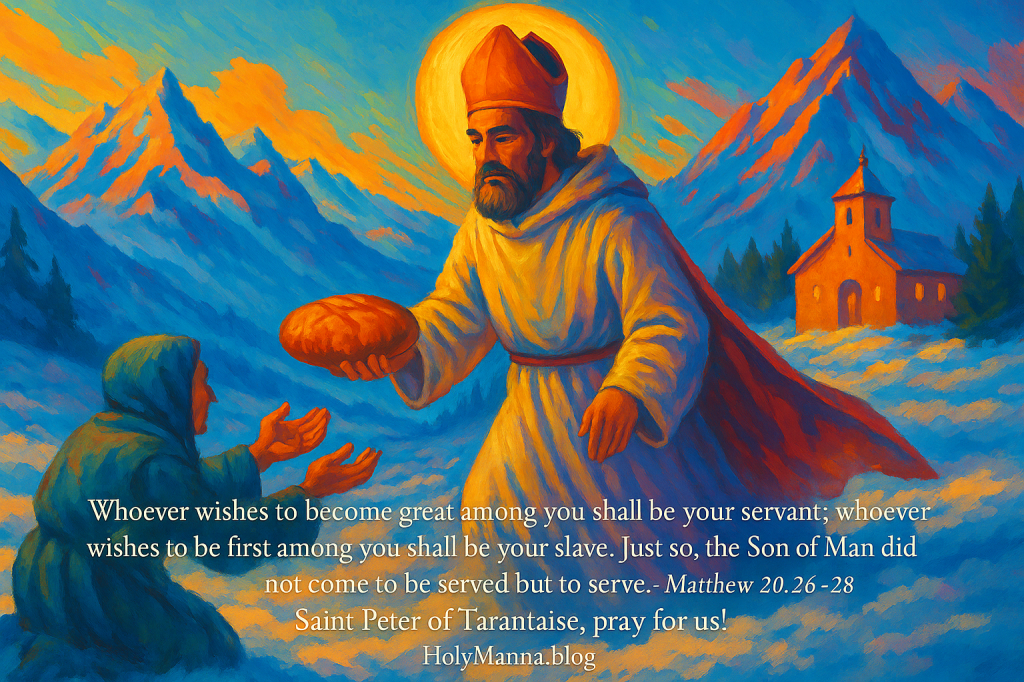
🕊️The Humble Archbishop of the Alps
Saint Peter of Tarantaise is a radiant example of what it means to be both a contemplative and a servant-leader in the Catholic Church. A 12th-century Cistercian monk who became an archbishop, Peter was never ambitious for greatness, yet holiness sought him out. He is revered for his unwavering devotion to the poor, his reform of a morally lax diocese, and his total commitment to Gospel values. Known especially for his work in the mountainous Alpine region of southeastern France, Saint Peter’s ministry was defined by self-denial, simplicity, and a profound love for those entrusted to his care. Canonized only 17 years after his death, his memory remains alive in the Church as a model of pastoral charity and quiet strength.
🪵A Life Offered in Silence
Born around the year 1102 in Saint-Maurice-de-Maurienne, nestled in the Tarentaise Valley of the French Alps, Peter came from noble stock. Yet even from a young age, he seemed uninterested in the wealth and status his lineage afforded him. Drawn instead to a life of holiness, he joined the newly established Cistercian Order at Bonnevaux Abbey. The Cistercians were known for their radical return to Benedictine simplicity—poverty, manual labor, and contemplation. Peter embraced it all, and quickly distinguished himself by his humility, discipline, and love of prayer.
Around 1132, Peter was chosen as the first abbot of Tamié Abbey, a monastery founded in a remote part of the Alps. His leadership was quiet but effective, deeply rooted in the monastic ideal of ora et labora—prayer and work. It was from this hidden life that the Church called him forth, much against his will, to become the Archbishop of Tarantaise in 1142. The diocese had fallen into spiritual ruin: clergy were corrupt, the poor neglected, and the faithful scattered. Peter did not see this new role as a promotion, but as a cross. He accepted it out of obedience, trading the silence of the cloister for the noise of the world.
As archbishop, Peter became a tireless servant. He personally visited remote mountain villages, often on foot or mule, in treacherous weather. He founded hospitals, cared for the poor, and reformed the clergy with a gentle but firm hand. He did not rule from a throne but walked among his people, feeding the hungry, clothing the naked, and offering spiritual guidance wherever he went. In all things, he remained a monk—simple in dress, humble in speech, and fervent in prayer.
✨ Bread in the Wilderness
Saint Peter’s life was marked by a series of miracles that bore witness to the holiness of his soul and the power of his faith. Perhaps the most frequent and poignant of these were his miraculous provisions for the poor. In one well-known account, Peter and his companions ran out of food while on a journey through the mountains. Rather than turn people away, Peter prayed earnestly—and soon, bread appeared in abundance, enough to feed everyone present. Time and again, those who traveled with him recounted similar stories: provisions multiplying, hunger being satisfied, and needs mysteriously met through divine intervention.
In addition to feeding the hungry, Peter was also a channel of healing. Several stories tell of the sick and the crippled being restored to health after he prayed over them or blessed them. In one notable case, a man who had been unable to walk for years was healed after Peter traced the sign of the Cross over his body. These were not showy signs, but quiet, gentle manifestations of God’s mercy—wrought through a man who always deflected attention from himself and pointed it back to Christ. As Saint John the Baptist once said, “He must increase; I must decrease” (John 3:30), so too did Peter live by that motto.
🌨️ Into the Wilderness
Despite the fruits of his ministry, Saint Peter found the burden of leadership heavy, not for its workload, but for its temptations—power, honor, public esteem. Around the year 1155, overwhelmed by the constant demands and fearing the loss of his inner peace, Peter made a dramatic decision. Without telling anyone, he disappeared. He traveled incognito to a remote Cistercian monastery in Switzerland and entered as a lay brother under a false name. There, he swept floors, prayed in silence, and returned to the life that first brought him joy: hiddenness.
His absence was deeply felt in Tarantaise, and after more than a year, he was discovered. The Church ordered him to return to his episcopal duties. Obediently, and without complaint, Peter resumed his role as archbishop. This episode, far from being scandalous, was a testament to his humility. It revealed the depth of his spiritual hunger—not for influence, but for intimacy with God. It was a rare and holy thing: a bishop who longed not for the spotlight but for the shadow of the Cross.
Peter also faced external trials: political conflicts, disputes between monarchs and popes, and local unrest. But through it all, he remained unshaken, rooted in prayer, charity, and the Eucharist. He became a peacemaker, a mediator, and a gentle force for unity during turbulent times.
🕯️ Light in the Alps
Saint Peter died on September 14, 1174, while on a journey through the region of Bellevaux in Switzerland. His death was peaceful and holy, surrounded by those who loved and revered him. But his story did not end there. Almost immediately, reports of miraculous healings and divine interventions began to pour in at his tomb. Cripples walked, fevers vanished, and desperate prayers were answered. His intercession became sought not just in the Tarentaise but throughout France and neighboring regions.
Pilgrimages to his burial site at Bellevaux became common, and his relics were treated with great veneration. Later, they were transferred to Tamié Abbey, which became a sacred destination for those seeking healing and spiritual renewal. His canonization in 1191 by Pope Celestine III confirmed what the faithful already knew: that Saint Peter of Tarantaise had lived and died as a true friend of God. His life continues to be a beacon, especially for those called to serve in hidden ways—quietly, faithfully, and with unshakable trust in divine providence.
🙏 A Path Through the Snow
Saint Peter of Tarantaise calls us to a kind of discipleship that is radically countercultural. In a world that values fame, speed, and visibility, Peter teaches us the holiness of obscurity, the power of silence, and the beauty of sacrificial love. He reminds us that true greatness lies not in being known, but in knowing God—and making Him known through love and service.
Are you a leader? Then lead like Peter—with gentleness, humility, and an unwavering commitment to the truth. Are you weary of being unnoticed in your work or in your service? Then remember Peter’s years of quiet labor, where no one saw but God. Do you feel called to something greater, but fear it? Peter felt the same—and walked forward anyway, because obedience is greater than comfort.
His life speaks especially to those who are torn between the desire for a contemplative life and the demands of public responsibility. He shows us that both are possible, and that God is found not only in the cloister, but also in the chaos, if we walk with Him.
“Whoever wishes to become great among you shall be your servant; whoever wishes to be first among you shall be your slave. Just so, the Son of Man did not come to be served but to serve” (Matthew 20:26–28). In Saint Peter of Tarantaise, we see this Gospel lived to the full.
Where might God be calling you to serve, even when it feels uncomfortable or unseen? Are you willing to step aside from recognition so that Christ may be glorified? Will you follow Christ even through the snow-covered paths of your own spiritual journey?
💬 Engage with Us!
Have you ever felt called to step into a role you didn’t seek? Has God ever used your hidden service for something greater?
Here are three reflection questions to spark your prayer and conversation:
- How do I respond when God calls me to serve outside my comfort zone?
- What areas of my life require more humility and quiet service?
- Am I willing to be forgotten by the world, if it means being faithful to Christ?
Let’s support one another in following Christ with courage, humility, and love—just like Saint Peter of Tarantaise. May his example inspire us to walk even the snowiest paths for the sake of the Gospel. Leave your thoughts below and let’s grow together in faith.
Saint Peter, pray for us! ❄️
Follow us on Instagram and Facebook for more insights and reflections on living a faith-filled life.

 Holy Manna!
Leave a comment