How God Turns Persecution into Praise
There are days when life feels like it’s falling apart—when our plans scatter, when people reject us, when we question if God is really present in the storm. Today’s readings invite us to step into that very experience and discover that even in the chaos, Christ is not only near—He is active. What if our moments of suffering were actually doorways to deeper joy? What if the breaking apart of our comfort zones is how God multiplies our impact?
In Acts of the Apostles, the early Church faces one of its darkest hours. Stephen has just been martyred, Saul is terrorizing believers, and Christians are forced to flee. Yet rather than silencing the Gospel, this persecution becomes the very means by which it spreads. Philip, one of those scattered, brings healing and conversion to Samaria—an area once despised by Jews. The result? “There was great joy in that city” (Acts 8:8). This same joy echoes in Psalm 66, as all the earth is called to praise the God who delivers, who parts seas, who sees and judges the nations. In other words, the same God who guided Israel through the Red Sea is now guiding His Church through tribulation.
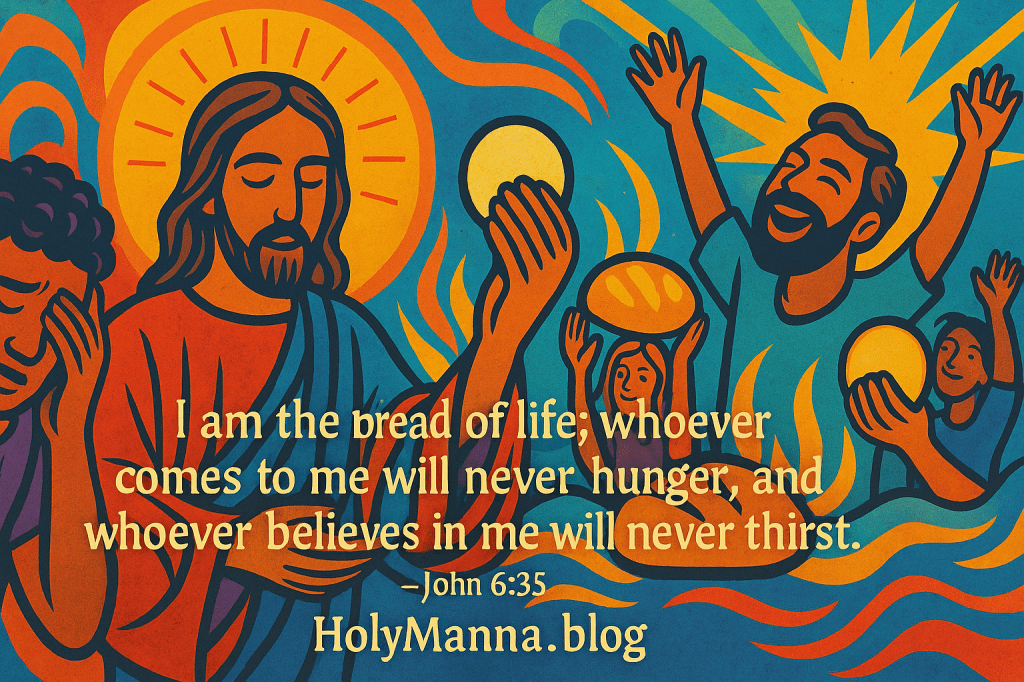
Then we arrive at the heart of it all in The Gospel of John, where Jesus declares, “I am the bread of life” (John 6:35). In a world hungry for peace and thirsty for meaning, He offers Himself—not as a temporary relief, but as eternal sustenance. Even as He faces disbelief and rejection, His mission is unwavering: “This is the will of my Father… that everyone who sees the Son and believes in him may have eternal life” (John 6:40). Today’s readings remind us that God doesn’t just work in spite of suffering—He works through it. The persecuted Church becomes a vessel of joy. The exiled believer becomes a missionary. The rejected Messiah becomes the Bread that raises us up. Where do you see God turning your trials into testimony?
First Reading – Acts 8:1-8
Scattered but Not Defeated
The Acts of the Apostles is often referred to as the Gospel of the Holy Spirit. Written by St. Luke as a sequel to his Gospel, this book charts the explosive growth of the early Church after Pentecost, especially through the witness of the Apostles and the first Christian martyrs. Today’s passage is a turning point in that narrative: the brutal martyrdom of Stephen—witnessed and approved by Saul—sparks a wave of persecution that scatters believers beyond Jerusalem. At first glance, it may seem like a story of loss and fear. But Luke reveals a deeper truth: what appears to be devastation becomes divine dispersion. The Church is not destroyed—it is deployed. What does it mean that the Good News spreads fastest when it costs the most?
Acts 8:1-8
New American Bible (Revised Edition)
1 Now Saul was consenting to his execution.
Persecution of the Church. On that day, there broke out a severe persecution of the church in Jerusalem, and all were scattered throughout the countryside of Judea and Samaria, except the apostles. 2 Devout men buried Stephen and made a loud lament over him. 3 Saul, meanwhile, was trying to destroy the church; entering house after house and dragging out men and women, he handed them over for imprisonment.
Philip in Samaria. 4 Now those who had been scattered went about preaching the word. 5 Thus Philip went down to [the] city of Samaria and proclaimed the Messiah to them. 6 With one accord, the crowds paid attention to what was said by Philip when they heard it and saw the signs he was doing. 7 For unclean spirits, crying out in a loud voice, came out of many possessed people, and many paralyzed and crippled people were cured. 8 There was great joy in that city.
Detailed Exegesis
Verse 1 – “Now Saul was consenting to his execution.”
This verse sets the tone for what follows. Saul, who will later become Paul, is here aligned with violence against the Church. His consent reflects the systemic approval of Stephen’s stoning by religious leaders. This moment illustrates how the early Church not only faced external opposition but also religious persecution from within its own heritage.
Verse 1 (continued) – “On that day, there broke out a severe persecution of the church in Jerusalem, and all were scattered throughout the countryside of Judea and Samaria, except the apostles.”
This scattering fulfills what Jesus commanded in Acts 1:8—that His followers would be witnesses “in Jerusalem, throughout Judea and Samaria, and to the ends of the earth.” Ironically, it is persecution—not peace—that drives this mission forward. Judea and Samaria were culturally mixed and religiously controversial regions, yet they become fertile ground for the Gospel.
Verse 2 – “Devout men buried Stephen and made a loud lament over him.”
Despite the danger, some faithful Jews publicly mourn Stephen, honoring him with dignity. This verse reveals the emotional and cultural upheaval following his martyrdom. Jewish burial customs emphasized communal grief, and the loud lament underscores the loss the Christian community feels—even amid rising hostility.
Verse 3 – “Saul, meanwhile, was trying to destroy the church; entering house after house and dragging out men and women, he handed them over for imprisonment.”
Here we see Saul’s zeal turned violent. He doesn’t merely oppose Christianity—he seeks to obliterate it. His actions echo the systemic oppression experienced by the Israelites in Egypt and Babylon, connecting the early Christians to the larger narrative of God’s people enduring suffering.
Verse 4 – “Now those who had been scattered went about preaching the word.”
Rather than hiding in fear, the scattered disciples become missionaries. This verse turns the tragedy of persecution into a strategy for evangelization. The seed of the Church, sown in tears, begins to bear fruit.
Verse 5 – “Thus Philip went down to [the] city of Samaria and proclaimed the Messiah to them.”
Philip, one of the seven deacons (like Stephen), goes to Samaria—a region traditionally despised by Jews for its impure worship. Yet it is to these outsiders that the message of Jesus is proclaimed. The Gospel begins to bridge divisions long entrenched in cultural and religious memory.
Verse 6 – “With one accord, the crowds paid attention to what was said by Philip when they heard it and saw the signs he was doing.”
Philip’s preaching is confirmed by miracles. The unity and attentiveness of the Samaritans signals their openness to grace. The signs and wonders recall the ministry of Christ and affirm Philip’s Spirit-filled authority.
Verse 7 – “For unclean spirits, crying out in a loud voice, came out of many possessed people, and many paralyzed and crippled people were cured.”
The Kingdom of God is manifest not only in words but in healing. This echoes Jesus’ mission in Luke 4:18 to “proclaim liberty to captives” and is a tangible sign that the Gospel brings liberation from physical, spiritual, and societal bondage.
Verse 8 – “There was great joy in that city.”
This concluding verse is deeply moving. Out of persecution and pain comes “great joy.” It is a reminder that joy is not the absence of suffering but the presence of Christ in the midst of it. Samaria, once spiritually estranged, now rejoices in the light of salvation.
Teachings
The Catechism of the Catholic Church teaches that “The blood of martyrs is the seed of Christians” (CCC 852). The Church’s missionary dynamism is born of suffering love, not conquest. The flight of the early Christians did not signal defeat, but revealed the hand of Providence, as God’s saving plan unfolded through unlikely paths. Persecution compelled believers to rely not on human strength but on the Spirit’s power.
St. John Chrysostom reflects on this dynamic in his homily on Acts: “The dispersion was more profitable than the peace which preceded it. For this was the means of their doctrine becoming universally known.” Here, the wisdom of the early Church Fathers reveals how God writes straight with crooked lines, using adversity to purify and propel His people.
Historically, the inclusion of Samaritans in the Church prefigures the radical inclusion of the Gentiles later in Acts. This marks a theological shift from a Jewish-centered faith to the universality of the Gospel. It echoes Jesus’ encounter with the Samaritan woman in John 4, showing that even the most marginalized are welcomed into the fold. As the Catechism says: “The Church is catholic because she has been sent out by Christ on a mission to the whole of the human race” (CCC 831).
Reflection
What does it look like to share the Gospel when you’re in survival mode? This reading reminds us that our most difficult seasons can become the most fruitful. When we feel scattered—by grief, failure, or fear—God is not absent. He may, in fact, be sending us to new places, new people, and new purposes. Like Philip, we are called to proclaim the Messiah where we are sent, even if we didn’t choose the destination. Who in your life needs to hear the Good News that suffering is not the end of the story? Are you willing to let your trials become someone else’s joy?
Responsorial Psalm – Psalm 66:1-7
Praise That Rises from Deliverance
Psalm 66 is a powerful hymn of communal praise, traditionally attributed to the post-Exilic period when the people of Israel had returned from Babylonian captivity. It exalts God’s saving power with cosmic scale, calling “all the earth” to recognize His glorious deeds. This psalm reminds Israel—and us—that divine deliverance is not only historical but ever-present. Today’s selection echoes the joy and expansion we saw in Acts 8, where persecution leads to proclamation, and sorrow gives way to healing. Just as Samaria rejoiced at God’s work through Philip, this psalm invites every nation to shout for joy at the wonders of the Lord. How often do we pause to praise God not just for what He’s done for us individually, but for what He has done throughout all of salvation history?
Psalm 66:1-7
New American Bible (Revised Edition)
Praise of God, Israel’s Deliverer
1 For the leader. A song; a psalm.
2 Shout joyfully to God, all the earth;
sing of his glorious name;
give him glorious praise.
3 Say to God: “How awesome your deeds!
Before your great strength your enemies cringe.
4 All the earth falls in worship before you;
they sing of you, sing of your name!”
Selah
5 Come and see the works of God,
awesome in deeds before the children of Adam.
6 He changed the sea to dry land;
through the river they passed on foot.
There we rejoiced in him,
7 who rules by his might forever,
His eyes are fixed upon the nations.
Let no rebel rise to challenge!
Selah
Detailed Exegesis
Verse 1 – “Shout joyfully to God, all the earth;
This opening verse sets the tone with a universal invitation. Praise is not reserved for Israel alone but is extended to the whole earth. It foreshadows the missionary expansion seen in the New Testament—an echo of the joy Samaria experienced when it received the Gospel.
Verse 2 – “Sing of his glorious name; give him glorious praise.”
Here, the psalmist calls for worship that matches the majesty of God’s name. In Scripture, God’s name reveals His essence—His glory, mercy, and power. To praise His name is to acknowledge His identity as deliverer, sustainer, and ruler.
Verse 3 – “Say to God: ‘How awesome your deeds! Before your great strength your enemies cringe.’”
This verse contrasts divine might with human resistance. God’s deeds inspire awe, not merely admiration. The word “awesome” reminds us that fear of the Lord is the beginning of wisdom (Proverbs 9:10). His enemies cringe—not because God is cruel, but because His justice is inescapable.
Verse 4 – “All the earth falls in worship before you; they sing of you, sing of your name!”
Repetition emphasizes intensity. This verse envisions a world in unified worship. It connects with Acts 8 by affirming that the Gospel’s spread is not accidental but part of God’s global plan. Even former enemies—like the Samaritans—can become joyful worshippers.
Verse 5 – “Come and see the works of God, awesome in deeds before the children of Adam.”
This invitation echoes Jesus’ call in John 1:39—“Come and see.” God’s works are not abstract ideas but visible realities that invite reflection. The “children of Adam” broadens the scope again to all humanity, not just Israel.
Verse 6 – “He changed the sea to dry land; through the river they passed on foot. There we rejoiced in him,”
This line recalls two key events: the crossing of the Red Sea (Exodus 14) and the Jordan River (Joshua 3). Both were miraculous moments of liberation and covenant fulfillment. These acts are signs of God’s control over nature and His commitment to His people. There—in those very acts of deliverance—the people rejoiced. The joy in Samaria is a New Testament echo of this same divine rescue.
Verse 7 – “Who rules by his might forever, his eyes are fixed upon the nations. Let no rebel rise to challenge!”
God is not a distant deity; He sees and judges the nations. His rule is eternal. The psalmist warns rebels not to rise, not because God is insecure, but because resistance to divine love only leads to ruin. This ties into Acts 8, where Saul’s opposition will ultimately be overcome by grace.
Teachings
The Catechism of the Catholic Church teaches that praise is the form of prayer that “lauds God for his own sake and gives him glory quite beyond what he does, but simply because HE IS” (CCC 2639). Psalm 66 exemplifies this—praising God not only for past miracles but for His eternal rule and presence. It draws our eyes beyond the immediate to the cosmic and eternal plan of God, inviting us to join in a chorus that spans heaven and earth.
St. Augustine, in his Exposition on the Psalms, comments on this passage: “If you want to praise Him worthily, live what you sing. You are praising God? Live in such a way that you do not blaspheme Him by your life.” His point is simple: praise must be more than words—it must be embodied. This challenges modern believers to let their entire lives be a song of thanksgiving.
The Church Fathers often linked Old Testament deliverance with New Testament salvation. The crossing of the Red Sea is seen as a foreshadowing of Baptism, where believers pass from death to life. As the Israelites rejoiced there, we rejoice in the waters of rebirth. The psalm thus becomes a bridge, connecting ancient Israel’s history with the Church’s mission and sacramental life. As CCC 1221 teaches: “But above all, the crossing of the Red Sea, literally the liberation of Israel from the slavery of Egypt, announces the liberation wrought by Baptism.”
Reflection
Are you living a life of praise, or merely a life of requests? Psalm 66 challenges us to celebrate God’s deeds both in Scripture and in our own lives. It reminds us to step back and look at the big picture—to recognize that God is at work in our deliverance, in history, and even in our trials. Like the early Christians in Acts, we can praise God not just when things are calm, but especially when they are hard, because we trust that He sees, He saves, and He reigns. What moment of deliverance in your life do you need to remember and rejoice in today? How can your praise be more than a song—how can it become a lifestyle?
Holy Gospel – John 6:35-40
Bread That Endures
The Gospel of John stands apart from the synoptic Gospels with its rich theological depth and mystical tone. Written near the end of the first century, it was crafted for a community grappling with persecution, disbelief, and the challenge of maintaining faith in the risen Christ. Chapter 6 is one of the most profound sections of this Gospel. It begins with the miraculous feeding of the five thousand and unfolds into Jesus’ “Bread of Life Discourse,” a moment where physical hunger becomes the doorway to eternal truth. Today’s passage is the climax of that discourse. In it, Jesus makes a radical claim: “I am the bread of life” (John 6:35). He identifies Himself not merely as a teacher or prophet, but as the very sustenance that satisfies the deepest hunger of the human soul. In the context of today’s theme, where the early Church suffers and scatters, and the world is called to worship in awe, Jesus offers something permanent in a world full of loss—eternal life in Him. What are we really feeding on each day—fear or faith, fleeting pleasures or the presence of Christ?
John 6:35-40
New American Bible (Revised Edition)
35 Jesus said to them, “I am the bread of life; whoever comes to me will never hunger, and whoever believes in me will never thirst. 36 But I told you that although you have seen [me], you do not believe. 37 Everything that the Father gives me will come to me, and I will not reject anyone who comes to me, 38 because I came down from heaven not to do my own will but the will of the one who sent me. 39 And this is the will of the one who sent me, that I should not lose anything of what he gave me, but that I should raise it [on] the last day. 40 For this is the will of my Father, that everyone who sees the Son and believes in him may have eternal life, and I shall raise him [on] the last day.”
Detailed Exegesis
Verse 35 – “Jesus said to them, ‘I am the bread of life; whoever comes to me will never hunger, and whoever believes in me will never thirst.’”
Jesus uses the divine name “I am,” echoing God’s self-revelation in Exodus 3:14. He does not merely offer bread—He is the bread. This evokes the manna in the desert, which sustained Israel physically, but here Jesus promises spiritual and eternal nourishment. Hunger and thirst represent the deep longing of the human heart—for truth, love, and eternal purpose.
Verse 36 – “But I told you that although you have seen me, you do not believe.”
This verse speaks to the tension between sight and faith. Many witnessed Jesus’ miracles but still refused to believe. Faith is not simply about evidence—it’s about trust. Even today, many “see” Jesus through Church teaching and sacrament, yet resist true belief. This verse invites examination of the barriers in our own hearts.
Verse 37 – “Everything that the Father gives me will come to me, and I will not reject anyone who comes to me.”
This is a powerful promise of divine welcome. No one is too far, too broken, or too late to be received by Christ. The initiative begins with the Father’s gift and is fulfilled in the Son’s embrace. In a world that casts people aside, Jesus guarantees belonging to all who come to Him.
Verse 38 – “Because I came down from heaven not to do my own will but the will of the one who sent me.”
Jesus’ obedience is central to His mission. This line affirms His divinity (“came down from heaven”) and His humility. He is the new Moses, but greater—because He not only brings the law, He fulfills the Father’s will perfectly, even unto death. This verse roots Jesus’ authority in divine love, not self-interest.
Verse 39 – “And this is the will of the one who sent me, that I should not lose anything of what he gave me, but that I should raise it on the last day.”
God’s will is not for condemnation but salvation. Jesus promises resurrection—not just survival. In a time of persecution, this would have comforted John’s community deeply. It comforts us today too: nothing entrusted to Jesus is lost. Every pain, every sacrifice, every believer will be raised.
Verse 40 – “For this is the will of my Father, that everyone who sees the Son and believes in him may have eternal life, and I shall raise him on the last day.”
Here the Gospel culminates. The purpose of everything—incarnation, teaching, suffering, death—is this: that we may believe in Jesus and be raised to eternal life. This verse confirms that salvation is available to everyone who sees and believes—not by merit, but by grace. Jesus repeats the resurrection promise to underscore its certainty.
Teachings
The Catechism of the Catholic Church teaches: “The Eucharist is ‘the source and summit of the Christian life’” (CCC 1324). Jesus as the Bread of Life is not metaphorical—it is sacramental. The Eucharist makes this passage real at every Mass. The Bread of Life is not a symbol—it is a Person. As the Church Fathers proclaimed: “What you see is the bread and the chalice; that is what your eyes report to you. But what your faith obliges you to accept is that the bread is the Body of Christ and the chalice is the Blood of Christ” (St. Augustine, Sermons 272).
St. Cyril of Jerusalem, speaking to catechumens in the early Church, taught: “Since Christ himself has declared the bread to be his body, who can have any further doubt? Since he himself has said quite categorically, ‘This is my blood,’ who would dare to question it and say that it is not his blood?” This faith in the real presence is the heartbeat of Catholic worship. The hunger Jesus speaks of in John 6 is not figurative—it is the ache for communion with God.
In Church history, the Bread of Life Discourse has been a rallying point for Eucharistic devotion, especially in times of persecution. During the Cristero War in Mexico, priests celebrated clandestine Masses, risking death so the faithful could receive the Body of Christ. Why? Because they knew this was the bread that satisfies not just hunger, but the human cry for eternity. As CCC 1391 states: “Holy Communion augments our union with Christ. The principal fruit of receiving the Eucharist in Holy Communion is an intimate union with Christ Jesus.”
Reflection
What are you hungry for today? Many of us are chasing things that will never satisfy—approval, pleasure, success, control. Jesus invites us to feast on something eternal. In the noise of a world full of options, He gives one clear answer: “I am the bread of life.” This reading challenges us to reexamine our appetites and make space for the only food that leads to life. It also assures us: no matter how far we’ve wandered, Jesus will not reject us if we come to Him. Where do you need to let go of what perishes, so you can cling to what endures? And are you receiving the Eucharist with the hunger and reverence it deserves? Let us draw near to the Bread that was broken so that we may be made whole—and raised on the last day.
From Scattered to Sustained
Today’s readings lead us on a journey—from persecution to proclamation, from fear to joy, from earthly hunger to eternal satisfaction. In Acts 8, the Church is violently scattered, yet instead of retreating, it goes forth preaching the Messiah. God transforms suffering into mission. Psalm 66 invites all the earth to shout with joy to the God who delivers, reminding us that even in chaos, God’s mighty hand guides His people with purpose and power. And in The Gospel of John, Jesus opens the depths of divine love with these words: “I am the bread of life”, assuring us that those who believe in Him will never hunger or thirst again and will be raised up on the last day.
Each reading shows us that suffering, far from being the end, is often the doorway through which God pours out joy, healing, and salvation. The persecuted Church becomes the missionary Church. The mourning becomes praise. The hunger of the human soul is met by the Bread from Heaven. Jesus doesn’t promise ease—He promises eternal life. And He promises that no one who comes to Him will be turned away. Do we trust Him enough to come, even when the path leads through hardship?
So today, let us step forward with courage. Let us praise Him not only in the sanctuary but in the scattering. Let us receive the Bread of Life with awe and live as those who have been raised already in hope. Wherever God has placed you—be it a place of sorrow, transition, or uncertainty—know this: He is not only present. He is working. He is sending. And He is sustaining. Let your life, like Philip’s, like the psalmist’s, like the disciples’, be a living testimony that in Jesus Christ, even the broken are made whole, even the scattered are gathered, and even the dead are raised.
Engage with Us!
We would love to hear how God is speaking to you through today’s readings. Your reflections may inspire, console, or challenge someone else in their walk of faith. Share your thoughts in the comments—whether it’s a moment of insight, a personal story, or a question you’re still pondering. Let’s grow together as a community of believers rooted in Christ and sustained by His Word.
Reflection Questions:
First Reading – Acts 8:1-8
Have you ever experienced a “scattering” moment in your life that led to unexpected growth or mission?
How can you, like Philip, bring the joy of the Gospel to someone who feels like an outsider today?
Responsorial Psalm – Psalm 66:1-7
What is one concrete act of God’s deliverance in your life that you can praise Him for today?
How can you let your life become a song of praise—not just in words, but in action?
Holy Gospel – John 6:35-40
What are you hungering for in this season of your life? Are you seeking fulfillment in Christ or in the things that perish?
How can you deepen your reverence and love for the Eucharist as the true Bread of Life?
As you go forward today, remember that God meets us in our weakness, feeds us with His very self, and turns our trials into testimonies. Live each moment with faith, walk each step in hope, and do everything with the love and mercy Jesus taught us. You are never alone. You are part of His great story.
Follow us on Instagram and Facebook for more insights and reflections on living a faith-filled life.

 Holy Manna!
Leave a comment