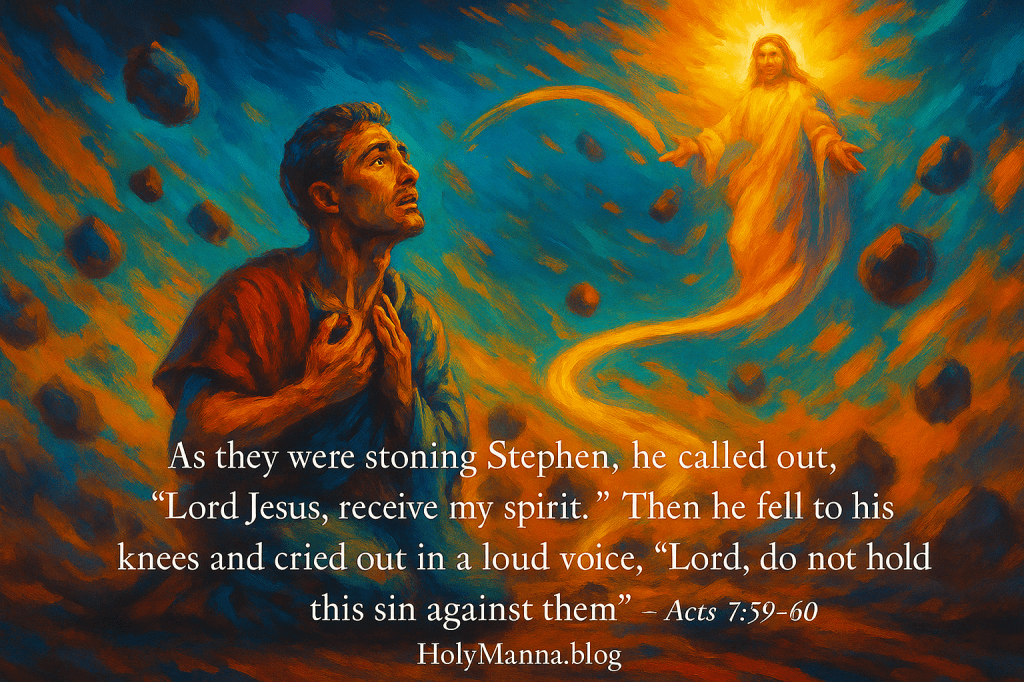
Into Your Hands
Have you ever been rejected for standing up for what’s right—mocked, excluded, or even attacked for speaking the truth with love? Today’s readings draw us deep into the heart of this struggle, not to shame or frighten us, but to show us what radical faithfulness looks like in the face of opposition. From Stephen’s martyrdom to Christ’s Eucharistic promise, Scripture today invites us to contemplate the cost of discipleship and the nourishment that sustains it. We are reminded that persecution is not the end of the story—God’s mercy and glory break through even the darkest trials.
In the Acts of the Apostles, Stephen becomes the first Christian martyr, boldly proclaiming the truth to a crowd unwilling to hear it. His Spirit-filled vision of the glorified Christ and his Christ-like words—“Lord, do not hold this sin against them”—mirror the passion of Jesus. His death marks a pivotal moment in salvation history: Saul, the future Apostle Paul, is present and approving. This event sparks widespread persecution, scattering the early Church and sowing the seeds of future evangelization. Meanwhile, the Responsorial Psalm gives voice to the persecuted soul: “Into your hands I commend my spirit”—a prayer of surrender uttered by both Stephen and Jesus, echoing from the heart of one who trusts in God’s justice despite the world’s cruelty.
Then, in The Gospel of John, Jesus speaks to the crowds about the true bread from heaven—not the manna their ancestors ate in the desert, but Himself, the Bread of Life. This discourse foreshadows the Eucharist and offers an antidote to the soul’s deepest hunger. But notice how even here, in the presence of the divine, people demand signs. There is resistance, misunderstanding, even skepticism. Yet Jesus doesn’t retract His claim; He deepens it. The same Spirit that filled Stephen now offers us divine sustenance for the journey of faith—a journey that often includes rejection but is crowned with eternal life. Are we ready to receive this Bread and walk boldly in the truth, even when it costs us everything?
First Reading – Acts 7:51–8:1
Faith That Provokes: The Courage to Speak Truth to Power
The Acts of the Apostles is the Church’s first great missionary document—a Spirit-driven chronicle of how the Gospel spread from Jerusalem to the ends of the earth. Today’s passage places us at a crucial turning point: the martyrdom of St. Stephen, the first to shed his blood for Christ. This reading concludes Stephen’s long and courageous speech before the Sanhedrin, in which he retraces Israel’s history and accuses the religious elite of resisting the Holy Spirit. His words ignite a violent reaction that culminates in his execution by stoning. This moment is not only a tragedy but a spark—Stephen’s death triggers a wave of persecution that scatters believers and, paradoxically, accelerates the Gospel’s spread. We are also introduced to a man named Saul, who consents to the killing but will soon undergo a transformation that reshapes Christian history. In the heart of opposition, divine grace is already at work.
Acts 7:51-8:1
New American Bible (Revised Edition)
Conclusion. 7:51 “You stiff-necked people, uncircumcised in heart and ears, you always oppose the holy Spirit; you are just like your ancestors. 52 Which of the prophets did your ancestors not persecute? They put to death those who foretold the coming of the righteous one, whose betrayers and murderers you have now become. 53 You received the law as transmitted by angels, but you did not observe it.”
Stephen’s Martyrdom. 54 When they heard this, they were infuriated, and they ground their teeth at him. 55 But he, filled with the holy Spirit, looked up intently to heaven and saw the glory of God and Jesus standing at the right hand of God, 56 and he said, “Behold, I see the heavens opened and the Son of Man standing at the right hand of God.” 57 But they cried out in a loud voice, covered their ears, and rushed upon him together. 58 They threw him out of the city, and began to stone him. The witnesses laid down their cloaks at the feet of a young man named Saul. 59 As they were stoning Stephen, he called out, “Lord Jesus, receive my spirit.” 60 Then he fell to his knees and cried out in a loud voice, “Lord, do not hold this sin against them”; and when he said this, he fell asleep.
8:1 Now Saul was consenting to his execution.
Detailed Exegesis
Verse 51 – “You stiff-necked people, uncircumcised in heart and ears, you always oppose the holy Spirit; you are just like your ancestors.”
Stephen boldly denounces the leaders for their stubborn resistance to God, echoing the prophets’ language of rebuke. The phrase “uncircumcised in heart and ears” recalls Jeremiah 6:10 and Deuteronomy 10:16, calling out their lack of inner conversion. Circumcision, a physical sign of covenant, means nothing without a heart attuned to God’s will. Stephen accuses them of the gravest offense: resisting the Holy Spirit, the very One sent to guide Israel into truth.
Verse 52 – “Which of the prophets did your ancestors not persecute? They put to death those who foretold the coming of the righteous one, whose betrayers and murderers you have now become.”
Stephen continues the prophetic indictment by drawing a historical line from Israel’s rejection of the prophets to the crucifixion of Christ—the “Righteous One”, a messianic title drawn from Isaiah 53. By calling them the betrayers and murderers of the Messiah, he is not only accusing them of past sins but placing them at the center of salvation history’s climactic act.
Verse 53 – “You received the law as transmitted by angels, but you did not observe it.”
This verse emphasizes the sacredness of the Law, traditionally believed to have been mediated through angels (see Galatians 3:19). Yet Stephen’s charge is that revering the Law is meaningless if one fails to obey it. It is not possession of the Law that sanctifies, but its fulfillment through faith and love.
Verse 54 – “When they heard this, they were infuriated, and they ground their teeth at him.”
Their response reveals hardened hearts incapable of repentance. The gnashing of teeth—a biblical symbol of rage and spiritual torment—foreshadows their violent intent. Instead of examining their conscience, they lash out.
Verse 55 – “But he, filled with the holy Spirit, looked up intently to heaven and saw the glory of God and Jesus standing at the right hand of God.”
Stephen, full of the Spirit, is granted a vision of heaven opened—a divine consolation in the moment of persecution. Jesus is not seated (as usually described) but standing, as if to welcome His martyr home or to testify on his behalf. It is a moment of breathtaking intimacy and assurance.
Verse 56 – “And he said, ‘Behold, I see the heavens opened and the Son of Man standing at the right hand of God.’”
Stephen voices what he sees, invoking “the Son of Man”, a title Jesus used at His trial (see Matthew 26:64), which also led to accusations of blasphemy. Stephen is now sharing in Christ’s passion, proclaiming the same truth and receiving the same rejection.
Verse 57 – “But they cried out in a loud voice, covered their ears, and rushed upon him together.”
Their physical reaction—covering their ears—symbolizes spiritual deafness. They do not want to hear the truth. Their rage drives them to collective violence, a chilling portrayal of how far sin can blind the human heart.
Verse 58 – “They threw him out of the city, and began to stone him. The witnesses laid down their cloaks at the feet of a young man named Saul.”
Execution outside the city was required under Jewish law (see Leviticus 24:14), but the detail of Saul’s presence introduces a dark irony: the future Apostle Paul is now an accomplice to murder. Yet even here, the grace of God is quietly at work.
Verse 59 – “As they were stoning Stephen, he called out, ‘Lord Jesus, receive my spirit.’”
Stephen’s dying words mirror Jesus’ on the Cross (see Luke 23:46). This is no mere imitation; it is union with Christ in His death. To entrust one’s spirit is to surrender fully to divine mercy.
Verse 60 – “Then he fell to his knees and cried out in a loud voice, ‘Lord, do not hold this sin against them’; and when he said this, he fell asleep.”
Stephen’s final words echo Christ’s plea—“Father, forgive them”—demonstrating that true martyrdom is not just about dying for the truth, but loving in the midst of hatred. The phrase “fell asleep” evokes peace and hope in the resurrection.
Chapter 8, Verse 1 – “Now Saul was consenting to his execution.”
The chapter transition marks a shift: persecution is unleashed, but so is the Gospel. Saul’s consent is not the end of his story—it’s the beginning of God’s pursuit of him. Out of this darkness, a light will shine.
Teachings
The Catechism of the Catholic Church teaches: “Martyrdom is the supreme witness given to the truth of the faith: it means bearing witness even unto death” (CCC 2473). Stephen, the first to embody this teaching, stands as a model for all Christians who face hostility for their beliefs. His death reflects not only courage but the fullness of charity. As CCC 852 reminds us, “The Holy Spirit is the protagonist of the whole mission of the Church.” Stephen, acting entirely under the power of the Spirit, becomes a seed of evangelization. Like Christ, his suffering is not sterile; it gives life. St. Augustine, reflecting on this mystery, famously said: “The Church owes Paul to the prayer of Stephen.”
We also see a profound fulfillment of Jesus’ own prophecy in Matthew 10:18-20: “You will be brought before governors and kings for my sake… But when they hand you over, do not worry about how you are to speak… For it will not be you who speak but the Spirit of your Father speaking through you.” Stephen becomes the embodiment of this promise, showing us that true discipleship is not about self-defense, but Spirit-led witness. The early Church Fathers saw his death as the first fruit of the Gospel, one that would water the earth with grace and mercy. His fearless proclamation mirrors what the Church herself is called to in every age: to proclaim Christ crucified and risen, even when the world refuses to listen.
Stephen’s martyrdom also reveals a hidden pattern: persecution often precedes renewal. The scattering of believers after his death mirrors what will happen in every age when the Church is purified through suffering. Pope Benedict XVI once said: “The blood of martyrs is the seed of the Church—not only in the first centuries but in every age.” Through Stephen, we see the profound mystery that God’s glory shines brightest in human weakness when that weakness is surrendered to divine love.
Reflection
This reading calls us to a serious and beautiful question: What are we willing to endure for the truth? Most of us won’t be asked to die for the faith, but we are asked to live it boldly, especially when it’s uncomfortable. Are there moments when I stay silent out of fear? Do I pray for my enemies with the love Stephen had? Daily acts of faithfulness, small sacrifices, and courageous truth-telling prepare us for whatever God may ask of us. Let us not cover our ears to the Spirit’s call. Let us look to heaven, see the Son of Man standing, and have the courage to say, “Into your hands I commend my spirit.”
Responsorial Psalm – Psalm 31:3-4, 6-8, 17, 21
Into Your Hands: The Prayer of the Persecuted Soul
Psalm 31 is a profound cry of trust from a soul under siege. Written by David during a time of immense distress, this psalm has long served as a liturgical expression of surrender and hope, especially for the suffering righteous. It is deeply personal and messianic, echoing most poignantly in the final words of Jesus on the Cross: “Into your hands I commend my spirit” (Luke 23:46). In today’s liturgy, this psalm perfectly complements the First Reading from Acts of the Apostles. St. Stephen, as he is being stoned, echoes this very line, showing that this psalm is more than poetry—it is a spiritual lifeline. The psalm’s language of refuge, mercy, and deliverance invites all of us into the heart of a faith that holds fast even when the world falls apart.
Psalm 31:3-4, 6-8, 17, 21
New American Bible (Revised Edition)
3 incline your ear to me;
make haste to rescue me!
Be my rock of refuge,
a stronghold to save me.
4 For you are my rock and my fortress;
for your name’s sake lead me and guide me.
6 Into your hands I commend my spirit;
you will redeem me, Lord, God of truth.
7 You hate those who serve worthless idols,
but I trust in the Lord.
8 I will rejoice and be glad in your mercy,
once you have seen my misery,
[and] gotten to know the distress of my soul.
17 Let your face shine on your servant;
save me in your mercy.
21 You hide them in the shelter of your presence,
safe from scheming enemies.
You conceal them in your tent,
away from the strife of tongues.
Detailed Exegesis
Verse 3 – “Incline your ear to me; make haste to rescue me! Be my rock of refuge, a stronghold to save me.”
This plea begins with urgency. The psalmist cries for God to “incline” His ear—to listen closely and respond. The imagery of a “rock” and “stronghold” calls to mind physical security, but it also signals spiritual grounding. In ancient Israel, God as a “rock” was a central theme of covenant trust. Here, the psalmist affirms that God alone is his source of strength and protection, not armies, wealth, or political alliances.
Verse 4 – “For you are my rock and my fortress; for your name’s sake lead me and guide me.”
This verse reinforces divine stability and direction. To invoke God’s name is to call upon His covenantal faithfulness. The phrase “for your name’s sake” reflects a confidence that God acts out of His own goodness and glory. It also acknowledges that the psalmist’s deliverance would testify to God’s faithfulness before others.
Verse 6 – “Into your hands I commend my spirit; you will redeem me, Lord, God of truth.”
This is the heart of the psalm—and of today’s liturgical theme. These words were spoken by Jesus on the Cross and by Stephen as he was martyred. They represent total abandonment to the will of the Father. To commend one’s spirit is to surrender one’s very life, trusting that God will redeem even death itself.
Verse 7 – “You hate those who serve worthless idols, but I trust in the Lord.”
Here, the psalmist makes a sharp contrast between false gods and the one true God. The term “worthless idols” could refer to literal pagan deities or anything we place above God—power, prestige, comfort. Trust in the Lord sets the psalmist apart from the world, grounding him in truth even when surrounded by deceit.
Verse 8 – “I will rejoice and be glad in your mercy, once you have seen my misery, and gotten to know the distress of my soul.”
This verse brings emotional depth to the prayer. The psalmist finds joy not in a change of circumstances, but in being seen by God. God’s mercy is not abstract—it is intimate and attentive. This line affirms that divine compassion is personal: God sees and knows the depths of our suffering.
Verse 17 – “Let your face shine on your servant; save me in your mercy.”
To ask God to “shine His face” is to ask for favor, reminiscent of the priestly blessing in Numbers 6:24-26. The plea for salvation in mercy (hesed) connects once more to the covenantal nature of God’s love—faithful, enduring, and protective.
Verse 21 – “You hide them in the shelter of your presence, safe from scheming enemies. You conceal them in your tent, away from the strife of tongues.”
This final verse offers an image of divine sanctuary. The “tent” likely refers to the tabernacle—God’s dwelling with His people. It’s a powerful promise: that God not only protects His servants physically but spiritually, shielding them from gossip, slander, and inner torment. His presence becomes their fortress.
Teachings
The Catechism of the Catholic Church reminds us that prayer in the Psalms is not merely individual lament but also Christ’s own voice: “In the Psalms, the Word of God becomes man’s prayer. In the Holy Spirit, Christ himself prays in us and with us” (CCC 2587). Psalm 31, then, is not just a cry from David’s heart, but from the very heart of Christ in His Passion, and from every Christian who suffers with Him. When Stephen prays these words as he dies, the Church sees them as fulfilled in the communion of saints—those conformed to Christ even in death.
Saint Teresa of Avila, known for her interior trials, often meditated on this psalm. She wrote: “To place ourselves in God’s hands is the surest way to find peace in persecution. For He is our rock, and He cannot fail.” The spiritual tradition of the Church affirms that surrender—especially in suffering—is a form of deep intimacy with God. The saints teach us that trust does not mean we are spared from suffering, but that suffering is transformed by the presence of the One who suffers with us.
The early Church also understood this psalm as a catechesis in martyrdom. The act of entrusting one’s spirit to God, especially when facing death, became a hallmark of Christian witness. As Tertullian once wrote, “The blood of the martyrs is the seed of the Church”—a truth evident in how Stephen’s psalm-prayer continues to inspire believers in every generation. By taking up this psalm in the Liturgy of the Hours and in our daily prayer, we join in the same trust that sustained saints, mystics, and martyrs.
Reflection
What would it look like to pray this psalm in your own hour of distress? Each verse is an invitation to radical trust—not in the absence of pain, but in the midst of it. Are you willing to place your spirit in God’s hands when life feels out of control? Can you rejoice in His mercy even before your circumstances change? Psalm 31 teaches us to anchor our hearts not in outcomes, but in the unshakable refuge of God’s love. This week, when you feel overwhelmed or misunderstood, pray these verses aloud. Let them become your heartbeat. Let them remind you that you are seen, known, and hidden in the shelter of His presence.
Holy Gospel – John 6:30–35
The True Bread: Hungering for What Only Heaven Can Give
This passage from The Gospel of John is part of the Bread of Life Discourse—one of the most profound Eucharistic teachings in all of Scripture. Set after the miraculous feeding of the five thousand, the crowd presses Jesus for another sign, invoking the manna their ancestors received in the desert. Their request reveals both a longing and a misunderstanding. They crave physical sustenance and signs, but Jesus reveals a deeper hunger: the desire for eternal life and communion with God. In response, He makes an astonishing claim: “I am the bread of life.” This declaration, radical and divine, anchors today’s theme of radical faith and surrender. As Stephen gives his life for Christ and the psalmist entrusts his spirit to God, Jesus offers Himself fully as the food that sustains such faithfulness—even unto death.
John 6:30-35
New American Bible (Revised Edition)
30 So they said to him, “What sign can you do, that we may see and believe in you? What can you do? 31 Our ancestors ate manna in the desert, as it is written:
‘He gave them bread from heaven to eat.’”
32 So Jesus said to them, “Amen, amen, I say to you, it was not Moses who gave the bread from heaven; my Father gives you the true bread from heaven. 33 For the bread of God is that which comes down from heaven and gives life to the world.”
34 So they said to him, “Sir, give us this bread always.” 35 Jesus said to them, “I am the bread of life; whoever comes to me will never hunger, and whoever believes in me will never thirst.
Detailed Exegesis
Verse 30 – “So they said to him, ‘What sign can you do, that we may see and believe in you? What can you do?’”
Despite having just witnessed the multiplication of the loaves, the crowd demands more. Their request exposes a shallow form of faith—one dependent on spectacle rather than spiritual insight. They seek external validation instead of interior transformation. This verse sets up a tension between belief based on signs and belief rooted in personal relationship with Christ.
Verse 31 – “Our ancestors ate manna in the desert, as it is written: ‘He gave them bread from heaven to eat.’”
Here the crowd references Exodus 16, where God provided manna during the Israelites’ journey through the wilderness. Their quote—“He gave them bread from heaven to eat”—was widely interpreted in Jewish tradition as a sign of divine favor. But they miss the point: the manna, while miraculous, was temporary and pointed to a greater fulfillment. Jesus will correct this misunderstanding.
Verse 32 – “So Jesus said to them, ‘Amen, amen, I say to you, it was not Moses who gave the bread from heaven; my Father gives you the true bread from heaven.’”
Jesus shifts their focus from Moses to God the Father. The true giver of manna—and now of Christ Himself—is God. The use of “Amen, amen” signals a solemn and authoritative teaching. Jesus contrasts the past tense “gave” with the present “gives,” indicating that the Father’s gift is ongoing and culminating in the Eucharist.
Verse 33 – “For the bread of God is that which comes down from heaven and gives life to the world.”
This verse deepens the mystery. The bread Jesus offers is not merely provision—it is life-giving. The phrase “gives life to the world” anticipates His sacrifice and universal mission. This bread is not exclusive to Israel but offered for all. It nourishes not just bodies, but souls unto eternal life.
Verse 34 – “So they said to him, ‘Sir, give us this bread always.’”
The crowd responds with enthusiasm, though they still misunderstand. Their desire, while sincere, is still rooted in physical expectation. This echoes the Samaritan woman at the well, who says, “Sir, give me this water” (John 4:15). Their plea, however, reveals a deep longing that Jesus is ready to fulfill.
Verse 35 – “Jesus said to them, ‘I am the bread of life; whoever comes to me will never hunger, and whoever believes in me will never thirst.’”
This is the first of the seven “I AM” statements in The Gospel of John, linking Jesus directly to the divine name revealed to Moses in Exodus 3:14. His claim is total and transformative: He doesn’t just provide bread—He is the Bread. To come to Him and believe in Him is to find lasting satisfaction for every hunger and thirst of the heart.
Teachings
The Catechism of the Catholic Church explains: “In the most blessed sacrament of the Eucharist ‘the body and blood, together with the soul and divinity, of our Lord Jesus Christ and, therefore, the whole Christ is truly, really, and substantially contained’” (CCC 1374). This passage from The Gospel of John lays the theological groundwork for that truth. Jesus’ identification as the Bread of Life points directly to the Eucharist—not just as symbol, but as real presence. In receiving Him, we are nourished for the journey of discipleship, even when it leads through suffering, persecution, or martyrdom.
St. Ignatius of Antioch, writing in the first century, referred to the Eucharist as “the medicine of immortality, and the antidote to prevent us from dying, but that we should live forever in Jesus Christ.” His words resonate with today’s Gospel: this Bread gives life to the world. For early Christians like Stephen, the Eucharist was the strength by which they could offer their lives. The Liturgy, the breaking of bread, was not a ritual of comfort—it was a commissioning into a life poured out in love.
Pope Benedict XVI reflected on this passage by saying: “The Eucharist draws us into Jesus’ act of self-oblation… we enter into the very dynamic of His self-giving.” This is not merely private devotion; it’s a radical participation in Christ’s sacrifice. To receive the Bread of Life is to accept the call to live as Christ lived—emptying ourselves, enduring hardship, and bearing witness to divine love. The Bread sustains not only our faith but our mission.
Reflection
What am I truly hungering for? In a world obsessed with instant gratification and endless consumption, Jesus offers something deeper—Himself. Do I approach the Eucharist with awe and longing, or do I take it for granted? Each time we receive Communion, we proclaim our trust that Jesus alone satisfies the deepest needs of our soul. And just like the crowd, we too cry out, “Lord, give us this bread always.” Let this Gospel challenge us to examine our appetites. Are we feeding our souls with truth, beauty, and holiness—or with distractions and empty comforts? Today, ask the Lord to awaken your hunger for the eternal and to give you the grace to believe that in Him, you will never thirst again.
Fed by Fire, Formed by Faith
Today’s readings take us into the heart of Christian discipleship—a path marked by truth, trust, and total surrender. In Acts, Stephen models radical boldness, proclaiming Christ with unwavering conviction even as stones rain down. Yet in his final breath, he mirrors Jesus: “Lord, do not hold this sin against them.” His martyrdom is not an end, but a beginning—the seed of Saul’s conversion and the scattering that spreads the Gospel. The Responsorial Psalm gives voice to the soul that suffers with hope: “Into your hands I commend my spirit” becomes not just a prayer of the dying, but a daily act of faith. And in The Gospel of John, we hear Christ’s offer of divine sustenance: “I am the bread of life”—a promise that those who come to Him will never hunger or thirst again.
Together, these readings reveal the pattern of Christian life: suffering, surrender, and supernatural strength. Stephen shows us the cost of truth; the psalmist teaches us the language of trust; Jesus Himself gives us the food to endure. This is the rhythm of the saints, the martyrs, and all who dare to follow Christ not only in glory, but in rejection and sacrifice. This is not a call to despair, but an invitation to joy—a joy rooted in eternity, nourished by the Bread of Life.
Will you receive this Bread with reverence today? Will you entrust your spirit to the Father when trials come? Will you, like Stephen, lift your eyes to heaven and see the Son of Man standing at the right hand of God? Brothers and sisters, do not be afraid. Christ has gone before us. He is with us now in the Eucharist. He is our strength, our shelter, our satisfaction. Let us live like those who have been fed by fire and formed by faith.
Engage with Us!
We would love to hear how today’s readings spoke to your heart. The Word of God is alive and personal, and your insights could be the encouragement someone else needs. Share your reflections in the comments—whether it’s a verse that stirred your soul, a challenge you’re facing, or a grace you’ve received. Let’s grow together as a community rooted in faith, truth, and love.
First Reading – Acts 7:51–8:1
What fears or obstacles keep you from boldly proclaiming the truth like Stephen did? Can you think of a time when your witness caused discomfort or rejection? How did you respond? Have you ever prayed for someone who hurt you, as Stephen did? What happened in your heart when you did?
Responsorial Psalm – Psalm 31:3-4, 6-8, 17, 21
What does it mean for you to “commend your spirit” into God’s hands today? Where do you go for refuge in moments of fear or trial—and is the Lord truly your rock? Have you experienced the peace of being “seen” by God in your suffering?
Holy Gospel – John 6:30–35
What do you hunger for most in life—and is it leading you closer to Christ or farther from Him? How has the Eucharist changed the way you face difficulties, temptations, or sufferings? What steps can you take this week to deepen your belief that Jesus is truly the Bread of Life?
Let us live today as people who are nourished by the Bread of Heaven, courageous like Stephen, and anchored in trust like the psalmist. May everything we do be done with the love and mercy that Jesus taught us—unafraid, faithful, and full of grace.
Follow us on Instagram and Facebook for more insights and reflections on living a faith-filled life.

 Holy Manna!
Leave a comment