From the Shore to the Sanhedrin to the Throne
Have you ever felt love so compelling that you simply couldn’t keep it to yourself—even when it might cost you? Today’s Scriptures invite us into that very experience. In Acts of the Apostles, Peter and the Eleven accept flogging with joy because their hearts burn for the Name; in The Gospel of John, the risen Jesus draws the same Peter from an empty night of fishing to overflowing nets, then asks three piercing questions of love; and in Revelation, heaven resounds as every creature proclaims the worthiness of the Lamb. Across these pages, one melody rises: when we truly love the risen Christ, courageous obedience and exuberant praise become our native tongue, no matter the resistance.
Historically, each text echoes the early Church’s dawn. The Sanhedrin episode occurs mere weeks after Pentecost, when fledgling believers risked everything in a city still raw from the Crucifixion. Psalm-singing Israelites once used Psalm 30 in liturgies celebrating Temple dedication—yet its promise of dawn’s rejoicing now finds fullest meaning in Easter light. Meanwhile, John’s shoreline scene likely unfolded at the very spot where some disciples first met Jesus, layering memory upon mission; and John of Patmos, writing for communities under Roman persecution, lifts their eyes to the cosmic liturgy that already crowns the Lamb. The Catechism reminds us that Christ’s Resurrection “transcends and surpasses history while being at the heart of it” (CCC 648), so persecution, breakfast, and celestial worship all belong to the same paschal tapestry.
Peter’s threefold “Do you love me?” echoes our own call: love births witness. Empowered by the Spirit, believers shift from fear to fearless proclamation—“We must obey God rather than men”—and discover, like the psalmist, that mourning turns to dancing. Suffering is no obstacle; it is the very stage on which God clothes His friends with gladness. Will we allow our love for the risen Lord to propel us from the quiet shoreline of comfort into the deep waters of mission, joining every creature in the hymn of heaven today?
First Reading — Acts 5:27-32, 40-41
Obedience That Dances Through Chains
Jerusalem is still ringing with rumors of an empty tomb when Peter and his companions are dragged once more before the Sanhedrin. Acts of the Apostles—Luke’s Spirit-charged chronicle of the Church’s earliest days—has already described Pentecost’s fire; now it shows the inevitable backlash. The very council that condemned Jesus tries to silence His witnesses, yet those witnesses rejoice in a suffering that links them to their risen Lord. Luke writes for a community facing hostility from both synagogue leaders and Roman authorities, reminding them—and us—that love for Christ cannot be muzzled. This episode flows seamlessly into today’s central theme: courageous, joyful witness springs from hearts set ablaze by the sacrificial Lamb who was slain and now reigns.
Acts 5:27-32, 40-41
New American Bible (Revised Edition)
27 When they had brought them in and made them stand before the Sanhedrin, the high priest questioned them, 28 “We gave you strict orders [did we not?] to stop teaching in that name. Yet you have filled Jerusalem with your teaching and want to bring this man’s blood upon us.” 29 But Peter and the apostles said in reply, “We must obey God rather than men. 30 The God of our ancestors raised Jesus, though you had him killed by hanging him on a tree. 31 God exalted him at his right hand as leader and savior to grant Israel repentance and forgiveness of sins. 32 We are witnesses of these things, as is the holy Spirit that God has given to those who obey him.”
40 After recalling the apostles, they had them flogged, ordered them to stop speaking in the name of Jesus, and dismissed them. 41 So they left the presence of the Sanhedrin, rejoicing that they had been found worthy to suffer dishonor for the sake of the name.
Detailed Exegesis
Verse 27 – “When they had brought them in and made them stand before the Sanhedrin, the high priest questioned them,”
The apostles stand where Jesus once stood, showing that discipleship often retraces the Master’s steps. The Sanhedrin, Israel’s supreme religious court, exerts immense social pressure; Luke underscores the public nature of Christian witness.
Verse 28 – “We gave you strict orders… to stop teaching in that name. Yet you have filled Jerusalem with your teaching and want to bring this man’s blood upon us.”
The council’s irony is palpable: they fear accountability more than truth. “That name” (Greek : to onoma) hints at the divine authority of Jesus, which Judaism revered as ineffable—now proclaimed openly by fishermen.
Verse 29 – “But Peter and the apostles said in reply, ‘We must obey God rather than men.’”
Peter cites a principle echoing Daniel before Nebuchadnezzar: divine law outstrips human decrees. The verb “must” (dei) signals a divine necessity, the same dei used of Jesus’ Passion.
Verse 30 – “The God of our ancestors raised Jesus, though you had him killed by hanging him on a tree.”
Peter weaves kerygma and accusation: God’s vindication nullifies human verdicts. “Tree” recalls Deuteronomy 21:23—cursed is one hung on a tree—showing that Christ bore the curse to reverse it.
Verse 31 – “God exalted him at his right hand as leader and savior to grant Israel repentance and forgiveness of sins.”
“Leader” (archēgos) denotes pioneer; the exalted Jesus inaugurates a new exodus. Forgiveness remains offered even to His killers, revealing divine mercy’s breadth.
Verse 32 – “We are witnesses of these things, as is the Holy Spirit that God has given to those who obey him.”
Witness (martyrēs) hints at future martyrdom. The Spirit authenticates their testimony, fulfilling Jesus’ promise in Acts 1:8.
Verse 40 – “After recalling the apostles, they had them flogged, ordered them to stop speaking in the name of Jesus, and dismissed them.”
Flogging (thirty-nine lashes) was brutal yet short of the death penalty—an intimidation tactic that fails.
Verse 41 – “So they left the presence of the Sanhedrin, rejoicing that they had been found worthy to suffer dishonor for the sake of the name.”
Joy and dishonor collide. To be “worthy” (kataxioō) of shame upends worldly values: disgrace becomes a badge of honor when borne for Jesus.
Teachings
The Church teaches that Christian witness is inseparable from the Holy Spirit. “The mission of Christ and the Holy Spirit is brought to completion in the Church… the Spirit equips her and directs her through various hierarchic and charismatic gifts” (Catechism § 759). Here, the Spirit’s presence empowers ill-educated Galileans to confound a learned council, proving that divine initiative precedes human ability.
Bold proclamation is a baptismal duty. “The duty of Christians to take part in the life of the Church impels them to act as witnesses of the Gospel and of the obligations that flow from it” (Catechism § 2472). Saint John Chrysostom marvels: “Behold how the scourging leads them not to silence but to louder cries; the more they are hindered, the more they advance” (Homily on Acts 12). Such commentary affirms that external pressures cannot quench interior fire.
Historically, these verses preview waves of persecution under Herod Agrippa I (c. AD 44) and later emperors. Yet as Tertullian would write, “The blood of martyrs is seed” (Apologeticus, 50), explaining how a marginalized sect became a worldwide communion. The pattern of suffering-filled joy continues in every age—from Ignatius of Antioch singing on his way to the lions to modern believers who risk careers for confessing Christ.
Reflection
Christ still asks each of us to obey God rather than the lesser voices of convenience, reputation, or fear. Where does His call challenge your comfort zone today? Might there be conversations you avoid, acts of justice you postpone, prayers you silence because of human respect? Joy grows where obedience meets the Spirit; dishonor for His Name becomes hidden glory. Begin by invoking the Holy Spirit each morning, asking for courage to witness in word and deed. Entrust anxieties to Jesus crucified—who turns “mourning into dancing.” How will you rejoice the next time your faith costs you something? May the apostles’ example propel you to fill your corner of the world with the teaching that once flooded Jerusalem.
Responsorial Psalm — Psalm 30:2, 4-6, 11-13
From Mourning to Dancing
Psalm 30 is a hymn of thanksgiving traditionally linked to King David and later associated with the dedication of the Jerusalem Temple. Sung in liturgies of restoration, it celebrates the Lord who turns deadly peril into overflowing joy—a perfect resonance with Easter’s victory and with Peter’s jubilant endurance before the Sanhedrin. As today’s theme highlights, love for the risen Christ erupts in courageous obedience and exuberant praise; this psalm supplies the language of that praise, teaching us how redeemed hearts respond when God raises them from every “pit.”
Psalm 30:2, 4-6, 11-13
New American Bible (Revised Edition)
2 I praise you, Lord, for you raised me up
and did not let my enemies rejoice over me.
4 Lord, you brought my soul up from Sheol;
you let me live, from going down to the pit.
5 Sing praise to the Lord, you faithful;
give thanks to his holy memory.
6 For his anger lasts but a moment;
his favor a lifetime.
At dusk weeping comes for the night;
but at dawn there is rejoicing.
11 Hear, O Lord, have mercy on me;
Lord, be my helper.”
12 You changed my mourning into dancing;
you took off my sackcloth
and clothed me with gladness.
13 So that my glory may praise you
and not be silent.
O Lord, my God,
forever will I give you thanks.
Detailed Exegesis
Verse 2 – “I praise you, Lord, for you raised me up and did not let my enemies rejoice over me.”
The psalmist begins with personal gratitude. “Raised me up” foreshadows Resurrection: the Hebrew root (dalah) suggests drawing water from a well, an image of being hauled from depths we could not escape alone.
Verse 4 – “Lord, you brought my soul up from Sheol; you let me live, from going down to the pit.”
“Sheol” evokes the realm of the dead. God’s saving act is not cosmetic but life-from-death. Early Christians sang this verse as a prophecy fulfilled in Christ, whose Paschal Mystery liberates souls “imprisoned in darkness” (cf. 1 Pt 3:19).
Verse 5 – “Sing praise to the Lord, you faithful; give thanks to his holy memory.”
The solitary sufferer turns exhorter, inviting all the “faithful” (ḥasidim—covenant lovers) into communal doxology. “Holy memory” recalls God’s saving deeds; liturgy is remembrance that renews.
Verse 6 – “For his anger lasts but a moment; his favor a lifetime. At dusk weeping comes for the night; but at dawn there is rejoicing.”
Temporal contrasts reveal divine pedagogy: discipline is brief, mercy enduring. The verse anticipates Easter Vigil’s transition from night to radiant dawn, mirroring the apostles’ passage from fear to fearless proclamation.
Verse 11 – “Hear, O Lord, have mercy on me; Lord, be my helper.”
A renewed cry shows that prayer cycles between plea and praise. The psalmist models humble dependence even after deliverance—spiritual maturity knows gratitude does not cancel need.
Verse 12 – “You changed my mourning into dancing; you took off my sackcloth and clothed me with gladness.”
God is portrayed as a divine dancer-tailor, replacing garments of grief with festive robes. The image anticipates Baptismal white, sign of the “new self” (Eph 4:24) granted through Christ.
Verse 13 – “So that my glory may praise you and not be silent. O Lord, my God, forever will I give you thanks.”
The purpose of rescue is perpetual praise. “My glory” (Hebrew kavod) indicates the whole person—voice, body, story—now consecrated to thanksgiving.
Teachings
The Catechism affirms that Christian prayer of praise “shares in the blessed happiness of the pure of heart who love God in faith before seeing him in glory” (CCC 2639). Psalm 30 exemplifies this purity; the psalmist’s experience of deliverance flowers into self-forgetful adoration, anticipating the heavenly liturgy where every creature cries, “To the one who sits on the throne and to the Lamb be blessing and honor” (Rev 5:13).
Saint Augustine comments, “He who was sad in himself rejoices in Christ; for your tears would have remained yours unless He had come who says, ‘I will be your joy’” (Exposition on Psalm 30). Augustine reads the psalm through the lens of baptismal rebirth, urging the newly illumined to discard “sackcloth” of sin. Likewise, the Byzantine Church chants this psalm in the Easter Matins canon, underscoring its paschal dimension.
Historically, the Temple-dedication setting underscores communal restoration after exile; yet in Christ the dedication becomes universal. Saint John Paul II taught, “The Resurrection is the definitive ‘dedication feast’ of the new and eternal temple which is Christ’s body, and through Him, the body of the Church” (General Audience, 14 May 1997). Thus every Christian who echoes Psalm 30 joins a cosmic chorus spanning David’s harp, Apostolic courage, and the heavenly elders.
Reflection
Gratitude is courageous: it risks proclaiming God’s goodness before problems vanish. Begin each day by naming one “dusk” the Lord has already turned into “dawn.” When setbacks loom, pray verse 6 aloud, trusting that divine favor outruns fleeting sorrow. Replace interior “sackcloth” by a concrete act of charity—perhaps an encouraging call or hidden service—and notice how joy follows obedience. What pit has the Lord lifted you from, and how will you let your glory praise Him without silence today? Let Psalm 30 teach your heart the rhythm of Easter: from mourning to dancing, from whispered plea to fearless song.
Second Reading — Revelation 5:11-14
Thunder over the Throne
Exiled on Patmos around A.D. 90, the Apostle John receives a vision meant to hearten persecuted believers in Asia Minor. His Book of Revelation lifts the curtain between earth’s anguish and heaven’s liturgy, showing that every trial is already enveloped by cosmic praise. Chapter 5 is the dramatic turning point: the scroll of salvation can be opened only by the “Lamb that was slain.” Today’s verses erupt just after that revelation, forming the crescendo that crowns our theme—love for the risen Christ becomes unstoppable worship, whether in a Jerusalem courtyard, on Galilee’s shore, or before the sapphire throne.
Revelation 5:11-14
New American Bible (Revised Edition)
11 I looked again and heard the voices of many angels who surrounded the throne and the living creatures and the elders. They were countless in number, 12 and they cried out in a loud voice:
“Worthy is the Lamb that was slain
to receive power and riches, wisdom and strength,
honor and glory and blessing.”
13 Then I heard every creature in heaven and on earth and under the earth and in the sea, everything in the universe, cry out:
“To the one who sits on the throne and to the Lamb
be blessing and honor, glory and might,
forever and ever.”
14 The four living creatures answered, “Amen,” and the elders fell down and worshiped.
Detailed Exegesis
Verse 11 – “I looked again and heard the voices of many angels who surrounded the throne and the living creatures and the elders. They were countless in number,”
John’s sight shifts from vision to audition: hearing solidifies seeing. The “angels… living creatures… elders” recall the prophet Ezekiel’s cherubim and Isaiah’s seraphim, situating the Church’s worship within Israel’s prophetic tradition. “Countless” (myriades myriadon) conveys inexhaustible praise.
Verse 12 – “and they cried out in a loud voice: ‘Worthy is the Lamb that was slain to receive power and riches, wisdom and strength, honor and glory and blessing.’”
Seven gifts—symbol of fullness—answer Rome’s sevenfold imperial titles, declaring that true sovereignty belongs to the crucified. The passive participle “slain” underscores perpetual sacrifice; the Lamb’s wounds remain credentials of authority.
Verse 13 – “Then I heard every creature in heaven and on earth and under the earth and in the sea, everything in the universe, cry out: ‘To the one who sits on the throne and to the Lamb be blessing and honor, glory and might, forever and ever.’”
The chorus widens to cosmic scale: heaven, earth, underworld, seas. Creation finds its voice when humanity leads it; worship is ecological as well as ecclesial, restoring harmony fractured by sin.
Verse 14 – “The four living creatures answered, ‘Amen,’ and the elders fell down and worshiped.”
“Amen” seals the hymn like liturgical applause. Prostration (epesan) shows that knowledge of God matures into adoration; theology must kneel.
Teachings
The Catechism locates Christian liturgy within this very scene: “In the liturgy of the Church, the heavenly liturgy is revealed and made present… We participate in a foretaste of that eternal liturgy which the heavenly Jerusalem celebrates” (Catechism § 1090-1091). Earthly Masses are not mere symbols but real communion with the elders and the Lamb, which means Sunday worship is the most revolutionary act a Christian can offer in a hostile culture.
Saint Irenaeus hears in the sevenfold doxology the reversal of Adam’s fall: “Through a tree we were made debtors to God; through the tree of the Cross our debt is forgiven. The Son of Man recapitulated all things in Himself that He might be Lord both of the things in heaven and on earth” (Against Heresies V, 17). The Lamb unites heaven and earth, healing their rupture, so praise becomes the proof of new creation.
Historically, persecuted assemblies clung to this passage. Catacomb frescoes depict the Lamb enthroned, assuring martyrs that Caesar’s violence is eclipsed by Christ’s victory. In the fourth century, the Syrian Anaphora of St. James inserts verse 12 verbatim into the Eucharistic Prayer, teaching that every altar is Patmos renewed. Thus the Church’s memory and liturgy keep alive the thunderous Amen that rang out before history’s clocks began.
Reflection
Heaven erupts whenever the Eucharist is celebrated on earth. Approach Mass conscious that angels outnumber pews and that your “Amen” joins myriads. Practice daily doxology: conclude each hour with the short refrain “Worthy is the Lamb!” Let praise re-frame irritation, turning commutes and chores into preludes of worship. Do your words and habits this week echo the throne room, or the marketplace of complaint? Finally, contemplate creation as choir—listen to birdsong or ocean roar and add your human voice, completing the harmony Christ came to restore. How will you let the Lamb’s worthiness resound through your life today?
Holy Gospel — John 21:1-19
Breakfast of Rekindled Love
At the heart of John’s Gospel stands this poignant epilogue, unfolding by the shores of the Sea of Tiberias, where Peter and his companions once left their nets to follow Christ. Historically and culturally, fishing was both livelihood and metaphor—representing ordinary life transformed by Christ’s call. Authored around A.D. 90-100, the Gospel seeks to reassure persecuted early Christian communities, reminding them that even after apparent failure, despair, or denial, Christ returns faithfully to invite, feed, heal, and recommission His followers. Thus, the apostles’ encounter with the risen Jesus seamlessly links with today’s central theme—transformative love compelling courageous obedience, joyful witness, and total self-gift.
After the resurrection, uncertainty lingers among disciples grappling with their failures, especially Peter’s triple denial. This backdrop intensifies the symbolic elements: the empty nets illustrate the fruitlessness of labor apart from Christ; the abundant catch signifies evangelization’s fruitfulness when grounded in obedience; and the charcoal fire evokes Peter’s earlier denial, highlighting Christ’s intent to heal rather than condemn. This passage reveals love’s restorative power and sets the stage for mission born from repentance and grace.
John 21:1-19
New American Bible (Revised Edition)
The Appearance to the Seven Disciples. 1 After this, Jesus revealed himself again to his disciples at the Sea of Tiberias. He revealed himself in this way. 2 Together were Simon Peter, Thomas called Didymus, Nathanael from Cana in Galilee, Zebedee’s sons, and two others of his disciples. 3 Simon Peter said to them, “I am going fishing.” They said to him, “We also will come with you.” So they went out and got into the boat, but that night they caught nothing. 4 When it was already dawn, Jesus was standing on the shore; but the disciples did not realize that it was Jesus. 5 Jesus said to them, “Children, have you caught anything to eat?” They answered him, “No.” 6 So he said to them, “Cast the net over the right side of the boat and you will find something.” So they cast it, and were not able to pull it in because of the number of fish. 7 So the disciple whom Jesus loved said to Peter, “It is the Lord.” When Simon Peter heard that it was the Lord, he tucked in his garment, for he was lightly clad, and jumped into the sea. 8 The other disciples came in the boat, for they were not far from shore, only about a hundred yards, dragging the net with the fish. 9 When they climbed out on shore, they saw a charcoal fire with fish on it and bread. 10 Jesus said to them, “Bring some of the fish you just caught.” 11 So Simon Peter went over and dragged the net ashore full of one hundred fifty-three large fish. Even though there were so many, the net was not torn. 12 Jesus said to them, “Come, have breakfast.” And none of the disciples dared to ask him, “Who are you?” because they realized it was the Lord. 13 Jesus came over and took the bread and gave it to them, and in like manner the fish. 14 This was now the third time Jesus was revealed to his disciples after being raised from the dead.
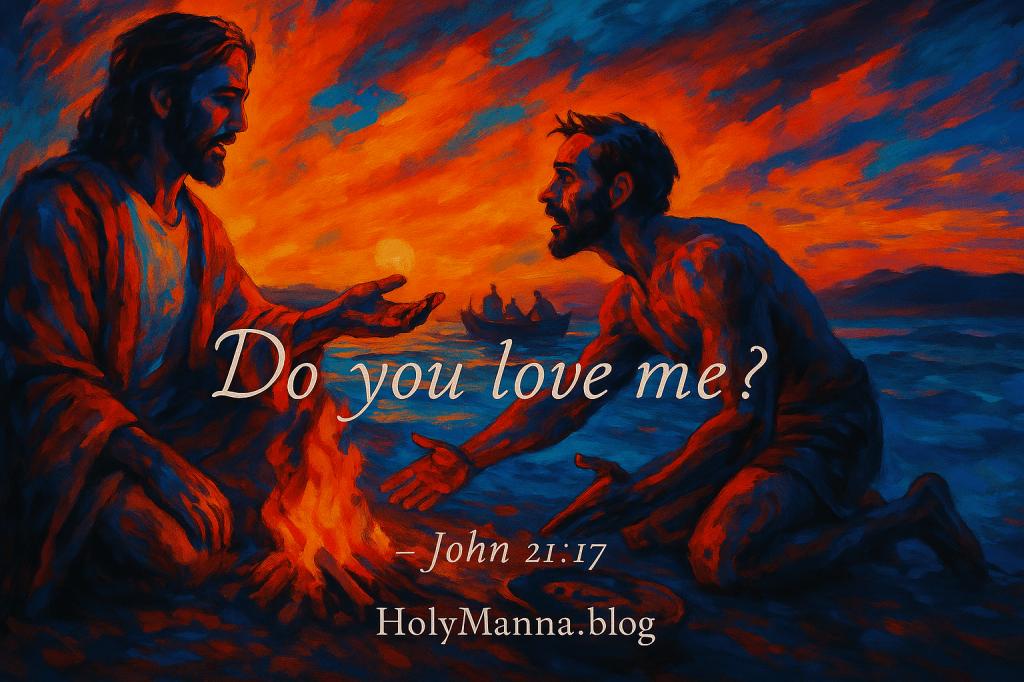
Jesus and Peter. 15 When they had finished breakfast, Jesus said to Simon Peter, “Simon, son of John, do you love me more than these?” He said to him, “Yes, Lord, you know that I love you.” He said to him, “Feed my lambs.” 16 He then said to him a second time, “Simon, son of John, do you love me?” He said to him, “Yes, Lord, you know that I love you.” He said to him, “Tend my sheep.” 17 He said to him the third time, “Simon, son of John, do you love me?” Peter was distressed that he had said to him a third time, “Do you love me?” and he said to him, “Lord, you know everything; you know that I love you.” [Jesus] said to him, “Feed my sheep. 18 Amen, amen, I say to you, when you were younger, you used to dress yourself and go where you wanted; but when you grow old, you will stretch out your hands, and someone else will dress you and lead you where you do not want to go.” 19 He said this signifying by what kind of death he would glorify God. And when he had said this, he said to him, “Follow me.”
Detailed Exegesis
Verse 1 – “After this, Jesus revealed himself again to his disciples at the Sea of Tiberias. He revealed himself in this way.”
John emphasizes divine initiative—Jesus intentionally chooses familiar surroundings to reconnect deeply with His disciples. The “Sea of Tiberias” (also known as Sea of Galilee) symbolizes returning to the beginning, highlighting Christ’s consistent invitation.
Verse 2 – “Together were Simon Peter, Thomas called Didymus, Nathanael from Cana in Galilee, Zebedee’s sons, and two others of his disciples.”
This diverse group illustrates the universality of the Church, uniting varied backgrounds in a single mission. The presence of Thomas (recently doubting) and Nathanael (once skeptical) emphasizes inclusion despite past doubts.
Verse 3 – “Simon Peter said to them, ‘I am going fishing.’ They said to him, ‘We also will come with you.’ So they went out and got into the boat, but that night they caught nothing.”
Peter’s return to fishing symbolizes uncertainty after the Resurrection. Their fruitless night illustrates human futility apart from Christ, echoing His earlier teaching: “without me you can do nothing” (John 15:5).
Verse 4 – “When it was already dawn, Jesus was standing on the shore; but the disciples did not realize that it was Jesus.”
The dawning signifies a new beginning. Their inability to recognize Jesus at first suggests the mystery of Christ’s presence, initially hidden yet faithfully near.
Verse 5 – “Jesus said to them, ‘Children, have you caught anything to eat?’ They answered him, ‘No.’”
Christ’s affectionate term “Children” (paidia) signals loving authority. By admitting their emptiness, the disciples demonstrate humility, preparing for divine assistance.
Verse 6 – “So he said to them, ‘Cast the net over the right side of the boat and you will find something.’ So they cast it, and were not able to pull it in because of the number of fish.”
Obedience to Jesus’ word immediately produces abundance. The “right side” symbolizes righteousness and correct relationship with God.
Verse 7 – “So the disciple whom Jesus loved said to Peter, ‘It is the Lord.’ When Simon Peter heard that it was the Lord, he tucked in his garment, for he was lightly clad, and jumped into the sea.”
John’s intuitive recognition comes from deep love; Peter’s eager plunge demonstrates impulsive devotion, eager for reconciliation after his denial.
Verse 8 – “The other disciples came in the boat, for they were not far from shore, only about a hundred yards, dragging the net with the fish.”
Their collaborative effort symbolizes the communal dimension of Church life, balancing active labor with contemplative insight.
Verse 9 – “When they climbed out on shore, they saw a charcoal fire with fish on it and bread.”
The “charcoal fire” specifically recalls the fire at Peter’s denial (John 18:18), intentionally setting a scene for healing past wounds through encounter and forgiveness.
Verse 10 – “Jesus said to them, ‘Bring some of the fish you just caught.’”
This highlights that Christ values human cooperation and effort, blending divine provision with human agency in mission.
Verse 11 – “So Simon Peter went over and dragged the net ashore full of one hundred fifty-three large fish. Even though there were so many, the net was not torn.”
Symbolically, “153” was seen by Church Fathers (like Jerome and Augustine) to represent all known nations, signifying the universal mission. The unbroken net points to the unity and indestructibility of the Church.
Verse 12 – “Jesus said to them, ‘Come, have breakfast.’ And none of the disciples dared to ask him, ‘Who are you?’ because they realized it was the Lord.”
The simple invitation to breakfast echoes the Eucharistic banquet. Christ continually feeds and renews His disciples through simple, everyday experiences.
Verse 13 – “Jesus came over and took the bread and gave it to them, and in like manner the fish.”
The language parallels the multiplication of loaves and the Last Supper, emphasizing Eucharistic fellowship and continuity of Christ’s presence.
Verse 14 – “This was now the third time Jesus was revealed to his disciples after being raised from the dead.”
The “third time” underscores completeness, paralleling Peter’s upcoming threefold restoration.
Verses 15-17 – “When they had finished breakfast, Jesus said to Simon Peter, “Simon, son of John, do you love me more than these?” He said to him, “Yes, Lord, you know that I love you.” He said to him, “Feed my lambs.” He then said to him a second time, “Simon, son of John, do you love me?” He said to him, “Yes, Lord, you know that I love you.” He said to him, “Tend my sheep.” He said to him the third time, “Simon, son of John, do you love me?” Peter was distressed that he had said to him a third time, “Do you love me?” and he said to him, “Lord, you know everything; you know that I love you.” [Jesus] said to him, “Feed my sheep.“
Christ’s repeated question, “Do you love me?” deliberately corresponds to Peter’s threefold denial. The progression from “Feed my lambs” to “Tend my sheep” indicates growing responsibility in pastoral care. Peter’s distress reveals genuine humility, a necessary virtue for authentic leadership.
Verse 18 – “Amen, amen, I say to you, when you were younger, you used to dress yourself and go where you wanted; but when you grow old, you will stretch out your hands, and someone else will dress you and lead you where you do not want to go.”
Jesus prophetically indicates Peter’s martyrdom. True discipleship involves surrendering personal autonomy for the sake of Christ.
Verse 19 – “He said this signifying by what kind of death he would glorify God. And when he had said this, he said to him, ‘Follow me.’”
The call to “Follow me” now includes deeper understanding of sacrifice. Peter’s vocation is renewed through repentance, reconciliation, and readiness for martyrdom.
Teachings & References
The Catechism emphasizes Peter’s leadership, founded upon love for Christ:
“The Lord made Simon alone… the ‘rock’ of his Church. He gave him the keys… and instituted him shepherd of the whole flock… But this power binds and looses only because of the love of Christ” (CCC 881).
Saint Augustine profoundly reflects on this dialogue, writing:
“Christ asks Peter about love, for love alone can feed His sheep. The extent of our love for Christ will always be proven by how we care for those entrusted to us” (Tractates on John, 123.5).
Historically, Peter’s martyrdom in Rome under Nero (c. A.D. 64-67) validated this prediction. Vatican II reaffirmed Peter’s primacy rooted in pastoral charity, teaching that authentic authority serves unity and love:
“The Roman Pontiff… is the perpetual and visible source and foundation of unity both of the bishops and of the whole company of the faithful” (Lumen Gentium, 23).
Reflection
Christ stands on our shores, quietly preparing breakfast amidst our routines and failures. Each morning is an invitation: Christ meets us precisely where we are—not to condemn, but to heal, nourish, and send us forth anew. Allow yourself a moment daily to encounter His gaze of tender mercy: what failures does Christ desire to transform into renewed purpose today?
The questions Jesus posed to Peter are ours as well: Do you truly love Me? Reflect on how genuine love manifests itself concretely in your relationships, responsibilities, and encounters today. Commit to a small but deliberate act of love or forgiveness, an expression of the tenderness Christ showed Peter.
Consider especially areas where Christ’s call might lead you “where you do not want to go”—perhaps confronting personal shortcomings, accepting difficult truths, or sacrificially serving others. Will you trust Him to guide you there?
Like Peter, our lives ultimately become testimony when love for Christ surpasses fear, doubt, or comfort. May your heart say joyfully today: “Lord, you know everything; you know that I love you.” How will you concretely respond to Christ’s call, embracing it as Peter did, even when it means following Him toward the cross?
Worthy Is the Lamb—Follow Him
Today’s readings form a radiant mosaic of love ignited by the Resurrection. In Acts of the Apostles, we see that love for Jesus does not shrink in the face of suffering—it rejoices. Peter and the apostles, once afraid, now walk into danger with joy because they know “we must obey God rather than men.” In Psalm 30, the psalmist’s voice rises from the pit to praise: “You changed my mourning into dancing”—a cry that only makes sense in the light of Christ’s triumph over death. In Revelation, the heavens erupt with adoration, declaring “Worthy is the Lamb that was slain” as every creature, from the depths of the sea to the highest heavens, joins in cosmic worship. And in The Gospel of John, love meets failure by a charcoal fire, heals it with a triple affirmation, and turns it into vocation: “Feed my sheep… Follow me.”
Together, these passages proclaim a single truth: love for the risen Christ transforms everything. It turns weakness into strength, denial into mission, fear into praise, and suffering into glory. It compels us to speak even when silenced, to worship even when weary, and to serve even when it costs us everything. This is not mere sentiment—it is divine invitation. Jesus doesn’t just want your admiration; He desires your heart, your courage, your hands, your voice.
Will you let His love restore you like Peter, embolden you like the apostles, and lift you like the psalmist from mourning to dancing? Let today be the moment you answer His call again—not with half-hearted words, but with your life. Follow Him, not only when it’s easy, but especially when it’s hard. For worthy is the Lamb—and His love is worth everything.
Engage with Us!
We’d love to hear how today’s readings are stirring your heart! Share your reflections in the comments below—your insights could inspire someone else on their journey of faith. Whether you’re moved by Peter’s redemption, the apostles’ bold witness, the heavenly worship in Revelation, or the psalmist’s joy, your voice matters in this community of believers.
Reflection Questions
First Reading – Acts 5:27-32, 40-41
Have you ever been afraid to speak about your faith? What would it look like to rejoice in suffering for the sake of Jesus’ name?
Responsorial Psalm – Psalm 30:2, 4-6, 11-13
What “pit” has the Lord lifted you from in the past? How can you let your “glory praise Him and not be silent” this week?
Second Reading – Revelation 5:11-14
How does the image of heavenly worship shape your understanding of the Mass? What can you do to make your prayer and praise more wholehearted?
Holy Gospel – John 21:1-19
In what area of your life is Jesus asking, “Do you love me?” How is He inviting you to follow Him more deeply—even in discomfort or sacrifice?
As you go forth into your day, remember: every moment is a chance to follow Christ anew. Let your love be bold, your witness joyful, and your service tender with the mercy He taught us. Whatever you do, do it with the love of the Lamb who calls you by name and says, “Follow me.”
Follow us on Instagram and Facebook for more insights and reflections on living a faith-filled life.

 Holy Manna!
Leave a comment