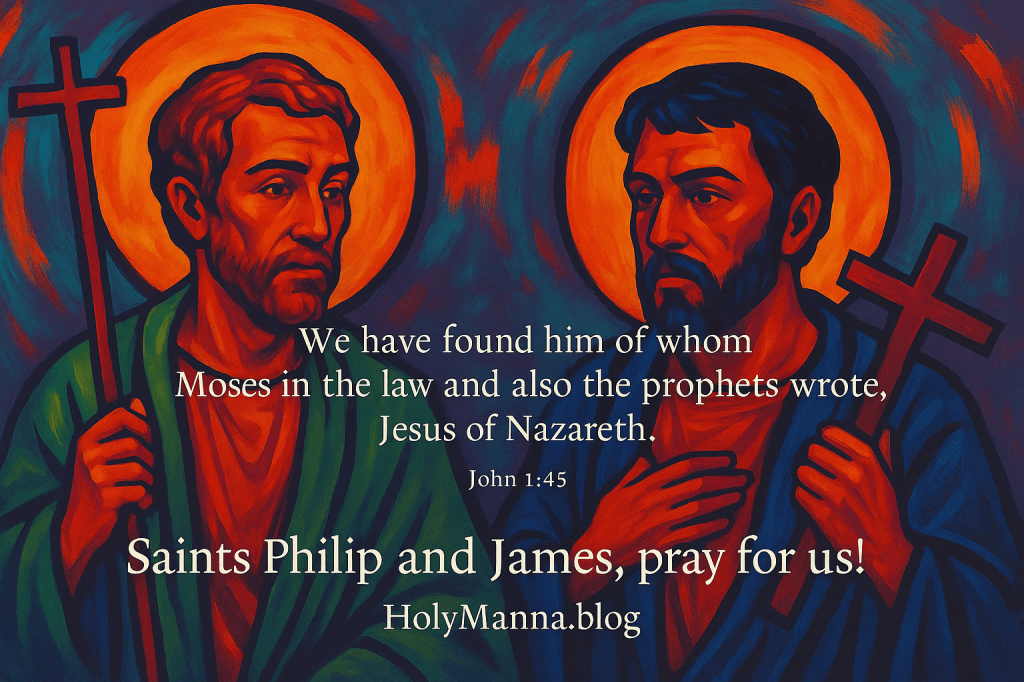
The Quiet Thunder of the Apostles
Every May 3rd, the Church celebrates Saints Philip and James the Less, two of the Twelve Apostles whose impact continues to echo through the ages. Though they may not have spoken as loudly or written as much as other apostles like Peter or Paul, their lives were a quiet thunder—steady, faithful, and resonant in their witness to Christ. These two men were chosen by Jesus Himself to lay the foundations of His Church. And while they are often celebrated together in liturgical memory, each carried a unique flame of discipleship that burned with unwavering intensity. They remind us that not every saint needs to be a spotlight figure; some build the kingdom brick by brick, word by word, and—ultimately—by the sacrifice of their very lives.
Fishers of Men
Saint Philip hailed from Bethsaida, a fishing village on the Sea of Galilee, also the hometown of Peter and Andrew. He is introduced in The Gospel of John as one of the very first to be called by Jesus: “Follow me” (John 1:43). Without hesitation, Philip responded, his heart already inclined to recognize the Messiah. What’s beautiful about Philip’s character is his immediate impulse to evangelize. After encountering Jesus, he runs to tell Nathanael, saying: “We have found him of whom Moses in the law and also the prophets wrote, Jesus of Nazareth” (John 1:45). This simple act of inviting others to meet Jesus reveals a man of deep conviction and missionary zeal.
Saint James the Less is sometimes shrouded in mystery. Called “the Less” not because he was less important, but likely to distinguish him from James the Greater, he is described as the son of Alphaeus and often referred to as a relative—or “brother”—of Jesus. Church tradition holds that he grew up near Jesus and came to embrace Him fully as Lord after the Resurrection. James played a pivotal leadership role in the early Church, becoming the first bishop of Jerusalem. His epistle, found in the New Testament, reveals a man deeply rooted in moral courage and pastoral wisdom. He emphasized that faith without works is dead and championed the unity of action and belief.
These two apostles, one a preacher from Galilee and the other a just man guiding the early Church, both became powerful instruments in God’s plan of salvation. They helped shape the heart and structure of Christianity through humble, unwavering service.
Echoes of Glory
While the Gospels do not record grand public miracles performed by Saints Philip or James during their lifetimes, early Christian writings and tradition attest to their miraculous intercession and spiritual power. Saint Philip, as he preached in the region of Phrygia, was known to have performed several miraculous acts. In one well-preserved tradition, he exorcised a serpent from a pagan temple, liberating a woman possessed by a demon. This miracle caused a wave of conversions, compelling the locals to abandon their idol worship and embrace the faith of Christ. His presence was often accompanied by divine power, especially in regions resistant to the Gospel.
James the Less was not associated with flashy miracles but rather with the miracle of holy living. Known as “James the Just,” he earned this title due to his exemplary righteousness, austere life, and unyielding adherence to God’s law. His leadership of the Jerusalem Church during the tumultuous first decades of Christianity was, in itself, miraculous. Amid persecution, theological disputes, and rapid Church expansion, James served as a calm and holy anchor. His guidance at the Council of Jerusalem (Acts 15) helped bridge the Jewish and Gentile wings of the Church—a true miracle of ecclesial unity.
These miracles may not involve thunderbolts or parted seas, but they reveal a subtler, perhaps more challenging kind of sanctity: one that transforms hearts, reconciles communities, and builds the Church from within.
Crowned in Blood
Martyrdom is the ultimate testimony of love. Saints Philip and James bore that testimony in profoundly moving ways. According to ancient sources, Saint Philip met his martyrdom in the city of Hierapolis. There, after years of preaching, healing, and challenging idol worship, he was arrested. Refusing to renounce Christ, he was sentenced to death—some accounts say crucified upside down, others say he was bound and stoned. Regardless of the method, what endures is the report that he continued preaching from the cross, proclaiming the Gospel to the very ones executing him. His last breath was a prayer and a proclamation.
Saint James the Less died in Jerusalem. His martyrdom was as dramatic as it was heartbreaking. He was taken to the pinnacle of the Temple—the very place where Jesus had once stood—and thrown down. Miraculously, he survived the fall, and in his brokenness, he began to pray for his attackers: “Father, forgive them”—words that echo the Savior’s cry from Calvary. Enraged by his refusal to die, a mob beat him with a fuller’s club, ending his earthly life. Yet, what ended in blood gave birth to glory. His death became a rallying cry for early Christians, a testament to truth lived to the end.
Their sufferings were not in vain. Through their blood, the Church was nourished. Through their deaths, faith was strengthened in communities that would otherwise have fallen into fear.
A Legacy That Keeps Healing
Death could not silence these apostles. In fact, it magnified their voices. The relics of Saints Philip and James were transferred to Rome and now rest in the Basilica of the Twelve Apostles, where countless faithful have come over the centuries to seek their intercession. While specific posthumous miracles are not extensively catalogued, the sheer devotion to these saints across generations is itself a miracle of continuity and faith.
Pilgrims report physical and spiritual healings, moments of deep peace, and conversions at their tomb. Their relics are treated with immense reverence, and numerous churches across Europe are dedicated in their names. Their memory continues to draw the faithful, not just in stone and inscription, but in lived inspiration. These saints, once quiet voices among louder ones, now resound across time with a spiritual echo that calls us to holiness.
Living the Legacy: A Call to Daily Apostleship
What can we learn from Saints Philip and James the Less? We live in a world that often prizes visibility and grandeur. Yet, these saints remind us that holiness is often forged in silence, in consistency, in the small “yeses” of everyday life. Philip shows us the importance of evangelization: sharing Jesus simply, directly, and with joy. James teaches us that faith is not a set of words but a way of life—one that must be embodied in justice, mercy, and perseverance.
Are we willing to speak of Christ to those who might scoff or turn away, like Philip did with Nathanael?
Do we anchor our lives in virtue, even when no one is watching, like James the Just?
Are we ready to suffer for what we believe, to be misunderstood, mocked, or excluded, if it means standing with Christ?
We are all called to be apostles—not necessarily in title, but certainly in mission. The world needs quiet witnesses, humble saints, and steadfast souls. The Church needs you to be that today.
Engage with Us!
Have the lives of Saints Philip and James touched your heart? Share your thoughts, stories, or favorite prayers in the comments below. Let’s build each other up in faith!
Here are a few questions to reflect on:
- What small but faithful action can I take today to live out my faith more fully?
- How can I deepen my personal knowledge of Christ, as Philip desired?
- What areas of my life need more consistency between my beliefs and my actions, as James taught?
Let us support one another in our journeys of faith. May we, like Saints Philip and James, strive to do all things with love, anchored in Christ Jesus our Lord.
Saints Philip and James, pray for us! 🌟
Follow us on Instagram and Facebook for more insights and reflections on living a faith-filled life.

 Holy Manna!
Leave a comment