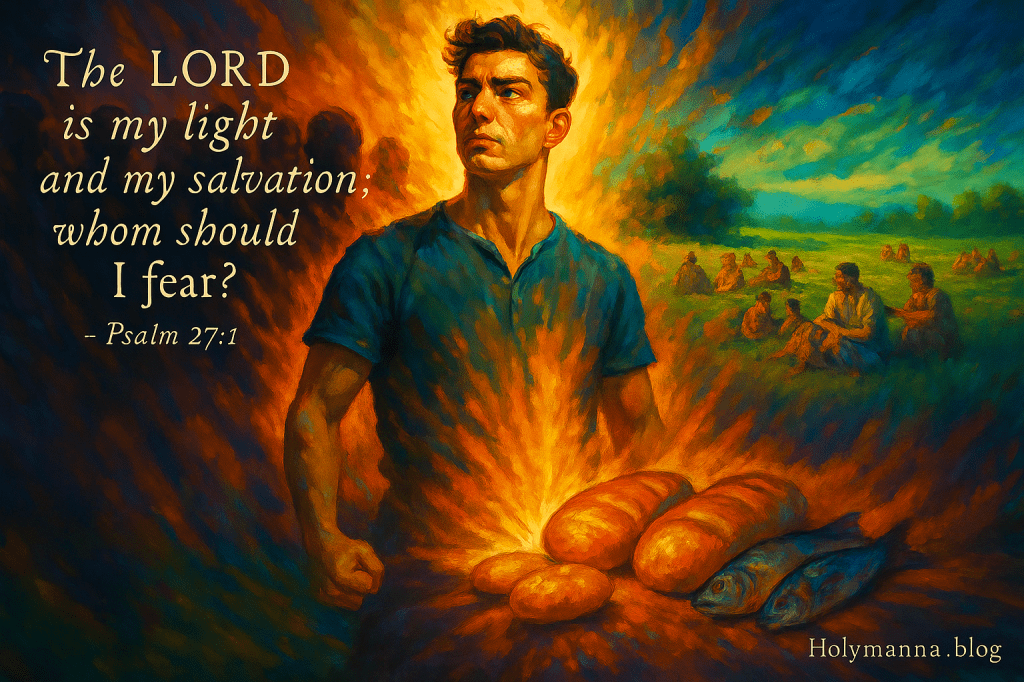
Of Whom Should I Be Afraid?
Have you ever faced a moment where fear or uncertainty pressed in, tempting you to give up or shrink back? Today’s readings speak powerfully into those moments when we’re called to trust that God is truly in control—when what little we have seems inadequate, when opposition threatens our peace, or when His plan feels hidden in mystery. They challenge us to look beyond what we see and feel, and to anchor our courage in the quiet assurance that God’s hand is at work—unshakable, unstoppable, and overflowing with love.
The readings for today center on a profound and comforting truth: God’s mission cannot be stopped, and His providence never fails. From Acts of the Apostles, we witness the bold witness of the early Church. The apostles rejoice after being flogged for preaching in Jesus’ name, recognizing their suffering as a sign of divine favor. Gamaliel’s advice reveals a key principle: if their work is truly from God, no human power can destroy it. This same spirit echoes in Psalm 27, where David proclaims, “The Lord is my light and my salvation; whom should I fear?” His words remind us that courage doesn’t come from our strength, but from a deep trust in the One who fights for us.
In The Gospel of John, Jesus performs the miraculous multiplication of loaves and fish, offering more than just physical nourishment. He reveals the abundant, attentive love of God, who sees our needs and answers them—often in unexpected, overwhelming ways. The boy’s small offering becomes a feast, just as our humble faith, when placed in God’s hands, becomes the soil of miracles. Are we willing to trust God with what little we have? Are we stouthearted enough to wait for Him when answers aren’t clear? Today, we’re invited to believe not only in God’s power, but in His personal involvement in our story—no matter how uncertain the road ahead may seem.
First Reading – Acts 5:34–42
Joy in Suffering for the Name
Have you ever wondered what sets apart a mission that is merely human from one that is divinely inspired? This passage from the Acts of the Apostles takes us into the heart of that question, during a moment of great tension in the early Church. The apostles are on trial before the Sanhedrin—the same religious court that condemned Jesus. Acts, traditionally authored by St. Luke, documents how the Holy Spirit propels the Church forward in the face of persecution. The setting is post-Pentecost Jerusalem, where miracles and bold preaching are converting many. The Sanhedrin, anxious about losing influence, seeks to crush the movement. Yet Gamaliel, a respected Pharisee and rabbi (and mentor to Saul of Tarsus), offers a measured response that becomes one of the most prophetic moments in the New Testament. His speech invites us to trust in divine providence: “If it comes from God, you will not be able to destroy them”. Today’s theme—trusting in God’s unstoppable mission—unfolds here with profound clarity.
Acts 5:34-42
New American Bible (Revised Edition)
34 But a Pharisee in the Sanhedrin named Gamaliel, a teacher of the law, respected by all the people, stood up, ordered the men to be put outside for a short time, 35 and said to them, “Fellow Israelites, be careful what you are about to do to these men. 36 Some time ago, Theudas appeared, claiming to be someone important, and about four hundred men joined him, but he was killed, and all those who were loyal to him were disbanded and came to nothing. 37 After him came Judas the Galilean at the time of the census. He also drew people after him, but he too perished and all who were loyal to him were scattered. 38 So now I tell you, have nothing to do with these men, and let them go. For if this endeavor or this activity is of human origin, it will destroy itself. 39 But if it comes from God, you will not be able to destroy them; you may even find yourselves fighting against God.” They were persuaded by him. 40 After recalling the apostles, they had them flogged, ordered them to stop speaking in the name of Jesus, and dismissed them. 41 So they left the presence of the Sanhedrin, rejoicing that they had been found worthy to suffer dishonor for the sake of the name. 42 And all day long, both at the temple and in their homes, they did not stop teaching and proclaiming the Messiah, Jesus.
Detailed Exegesis
Verse 34 – “But a Pharisee in the Sanhedrin named Gamaliel, a teacher of the law, respected by all the people, stood up, ordered the men to be put outside for a short time.”
This verse introduces Gamaliel as a voice of wisdom and restraint. His reputation as a learned and respected teacher gives weight to his words. His removal of the apostles is both strategic and respectful, allowing the council to deliberate without emotional interference.
Verse 35 – “Fellow Israelites, be careful what you are about to do to these men.”
Gamaliel’s caution underscores the gravity of judging spiritual matters too hastily. His tone is fatherly, inviting reflection rather than reaction, and sets the stage for a deeper theological insight.
Verse 36 – “Some time ago, Theudas appeared, claiming to be someone important, and about four hundred men joined him, but he was killed, and all those who were loyal to him were disbanded and came to nothing.”
Theudas’s failed rebellion illustrates Gamaliel’s principle: human-led movements often die with their leaders. This reference gives historical grounding to his upcoming conclusion.
Verse 37 – “After him came Judas the Galilean at the time of the census. He also drew people after him, but he too perished and all who were loyal to him were scattered.”
Here, Judas is another example of a nationalist revolutionary whose movement ultimately collapsed. Gamaliel draws parallels between these figures and Jesus—but with a caveat.
Verse 38 – “So now I tell you, have nothing to do with these men, and let them go. For if this endeavor or this activity is of human origin, it will destroy itself.”
This is Gamaliel’s wisdom in action: not every threat must be met with suppression. If the apostles’ work is merely human, it will wither away like the others.
Verse 39 – “But if it comes from God, you will not be able to destroy them; you may even find yourselves fighting against God.”
This is the theological climax. Gamaliel cautions against resisting what may be the work of God Himself. His statement foreshadows the Church’s explosive growth and the futility of opposing it.
Verse 40 – “After recalling the apostles, they had them flogged, ordered them to stop speaking in the name of Jesus, and dismissed them.”
Despite Gamaliel’s words, the Sanhedrin still punishes the apostles. Flogging was brutal and public, yet their inner freedom remains untouched.
Verse 41 – “So they left the presence of the Sanhedrin, rejoicing that they had been found worthy to suffer dishonor for the sake of the name.”
This verse reveals the radical joy of Christian discipleship. The apostles interpret suffering not as failure, but as participation in Christ’s passion.
Verse 42 – “And all day long, both at the temple and in their homes, they did not stop teaching and proclaiming the Messiah, Jesus.”
Their zeal is undeterred. Whether in public or private, the message of Jesus continues to spread. Their faith is not performative—it is persistent and intimate.
Teachings
This passage beautifully illustrates what the Catechism of the Catholic Church teaches about the Church’s mission: “The mission of the Church… continues the mission of Christ: ‘As the Father has sent me, even so I send you’” (CCC 849). The apostles embody this divine mandate, filled with the Holy Spirit and fortified by grace. Their willingness to suffer rather than be silent speaks to a supernatural source of courage.
St. John Chrysostom once said, “No one was so bold as these men, for nothing was able to deter them: not threats, not danger, not death itself… For grace made them strong” (Homilies on Acts). Their reaction to persecution—rejoicing in suffering—is not natural; it is Spirit-driven. They are not masochists but men transformed by the resurrection. As The Catechism further affirms: “The blood of martyrs is the seed of Christians” (CCC 852, quoting Tertullian). Their endurance confirms the authenticity of their witness.
Historically, Gamaliel’s prophetic caution echoes forward through centuries of Church history. From Rome to the ends of the earth, efforts to suppress the Gospel have always failed. The early martyrs—like St. Stephen, who comes just a chapter later—mirror the apostles’ faith and courage. The Church’s endurance amid persecution proves what Gamaliel said: “If it is from God, you will not be able to destroy them.”
Reflection
The apostles’ response to suffering—joy, not resentment—poses a challenge to all of us. How do I respond when I am mocked or misunderstood for my faith? Do I trust that God can use even hardship to confirm my mission? Like the apostles, we are called to perseverance and boldness. There is no need to fear human opposition when the One who sends us is faithful.
Where are you being called to proclaim Christ—at home, at work, or among friends? Are you open to rejoicing in discomfort, if it brings honor to the Name of Jesus? Let this reading stir up courage in your heart. God does not call the comfortable—He comforts the called. And His mission, alive in you, cannot be stopped.
Responsorial Psalm – Psalm 27:1, 4, 13–14
Courage in the Presence of God
Psalm 27 is a profound expression of trust in the Lord, traditionally attributed to King David. Set in the midst of conflict and danger, the psalm conveys unwavering confidence in God’s protection and a deep yearning for His presence. This blend of battle imagery and devotional intimacy makes it a favorite among believers facing trials. Its placement in today’s liturgy serves as a powerful echo of the first reading from Acts of the Apostles, where the early Church rejoices in persecution, trusting entirely in God’s providence. Just as the apostles remained unshaken before the Sanhedrin, David proclaims his fearlessness in the face of enemies because his strength lies not in armies or weapons but in the Lord Himself. This psalm resonates deeply with our theme: trusting God’s mission and providence even in the face of uncertainty or opposition.
Psalm 27:1, 4, 13-14
New American Bible (Revised Edition)
Trust in God
1 Of David.
The Lord is my light and my salvation;
whom should I fear?
The Lord is my life’s refuge;
of whom should I be afraid?
4 One thing I ask of the Lord;
this I seek:
To dwell in the Lord’s house
all the days of my life,
To gaze on the Lord’s beauty,
to visit his temple.
13 I believe I shall see the Lord’s goodness
in the land of the living.
14 Wait for the Lord, take courage;
be stouthearted, wait for the Lord!
Detailed Exegesis
Verse 1 – “The Lord is my light and my salvation; whom should I fear? The Lord is my life’s refuge; of whom should I be afraid?”
This opening verse is both a declaration and a challenge to the soul. In ancient Israel, light symbolized God’s guidance and holiness, while “salvation” pointed to deliverance from real enemies. The repetition—“whom should I fear?”—signals a heart that has chosen to rest in God’s presence. The Catechism reminds us: “Faith in God brings light into the hearts of believers” (CCC 162), and here we see that light casting out fear.
Verse 4 – “One thing I ask of the Lord; this I seek: To dwell in the Lord’s house all the days of my life, to gaze on the Lord’s beauty, to visit his temple.”
David’s one desire is not revenge or safety but communion with God. To dwell in the Lord’s house reflects a longing to live in God’s presence, especially in the sanctuary of the temple. “To gaze on the Lord’s beauty” reveals a contemplative heart that knows true strength is found in worship. This verse reminds us that fear fades when our gaze is fixed on eternal realities.
Verse 13 – “I believe I shall see the Lord’s goodness in the land of the living.”
Here, David expresses hope not only for the afterlife but for God’s presence in the midst of earthly struggles. This is a crucial insight: God’s goodness is not confined to heaven—it breaks into our lives here and now. The “land of the living” refers to this world, transformed by divine grace.
Verse 14 – “Wait for the Lord, take courage; be stouthearted, wait for the Lord!”
This final verse is a command to the reader’s soul. “Wait” in the biblical sense means trusting patiently in God’s timing. “Take courage” and “be stouthearted” are military terms urging spiritual bravery. The repetition of “wait for the Lord” calls us to endurance rooted in faith. In times of persecution, like those faced by the apostles, or in our personal struggles, this verse becomes a rallying cry.
Teachings
Psalm 27 is a foundational text for the Church’s understanding of confidence in divine providence. The Catechism of the Catholic Church teaches that “Hope is the confident expectation of divine blessing and the beatific vision of God; it is also the fear of offending God’s love and of incurring punishment” (CCC 2090). David’s hope is not vague optimism—it is anchored in God’s revealed character. His fearless trust models the kind of hope the Church encourages every Christian to cultivate.
St. Augustine, reflecting on this psalm, wrote, “Let your hope be in the Lord; let it not rest in yourself. If you trust in yourself, you will fall; if you trust in God, you shall stand firm” (Expositions on the Psalms, Ps. 27). Augustine sees in David’s cry a lesson in humility and surrender. The strength to persevere in trials does not come from within, but from our willingness to dwell in God’s presence and let Him fight our battles.
Historically, this psalm has offered comfort to Christians throughout centuries of persecution and war. During the early Church’s oppression under Roman emperors, many martyrs prayed or sang Psalm 27 before facing execution. Its language of spiritual bravery became a shield against despair. The Church continues this tradition today, using this psalm in liturgical prayers, such as in Compline (Night Prayer), where the soul seeks peace and refuge in God before sleep. It is a song of trust sung in the dark.
Reflection
What do you fear today? What voices in your life cause you to doubt God’s protection or plan? Psalm 27 invites you to bring those fears into the light of God’s presence. Like David, like the apostles, you are not asked to be fearless on your own—but to trust in the One who is your light, your salvation, your refuge. Can you shift your gaze from what threatens you to the beauty of the Lord?
This psalm also calls for a daily discipline of waiting and worship. In a fast-paced world of instant answers and anxious hearts, are you willing to wait for the Lord? Can you be “stouthearted” not just once, but persistently—believing you will see God’s goodness in this life? If your heart longs to dwell with Him, He will meet you. Take courage, and wait.
Holy Gospel – John 6:1–15
Little Becomes Abundant in the Hands of Jesus
Today’s Gospel reading presents one of the most beloved miracles in the life of Christ: the multiplication of loaves and fish. Found in The Gospel of John, this miracle stands at the beginning of what scholars call the Bread of Life discourse (John 6), a chapter that profoundly prefigures the Eucharist. The setting is a large, expectant crowd following Jesus in Galilee during the time of Passover—an important religious festival that commemorated God’s deliverance of Israel from Egypt. Against this backdrop of liberation and divine provision, Jesus reveals Himself not only as a miracle worker but as the true source of spiritual nourishment. The crowd comes with physical hunger, but Jesus intends to awaken in them a deeper thirst for eternal bread. This miracle connects beautifully to today’s overarching theme: trusting in God’s providence, even when what we have seems laughably insufficient. Like the apostles before the Sanhedrin and David in his psalm, the people will come to realize that God provides—and multiplies—when we place everything in His hands.
John 6:1-15
New American Bible (Revised Edition)
Multiplication of the Loaves. 1 After this, Jesus went across the Sea of Galilee [of Tiberias]. 2 A large crowd followed him, because they saw the signs he was performing on the sick. 3 Jesus went up on the mountain, and there he sat down with his disciples. 4 The Jewish feast of Passover was near. 5 When Jesus raised his eyes and saw that a large crowd was coming to him, he said to Philip, “Where can we buy enough food for them to eat?” 6 He said this to test him, because he himself knew what he was going to do. 7 Philip answered him, “Two hundred days’ wages worth of food would not be enough for each of them to have a little [bit].” 8 One of his disciples, Andrew, the brother of Simon Peter, said to him, 9 “There is a boy here who has five barley loaves and two fish; but what good are these for so many?” 10 Jesus said, “Have the people recline.” Now there was a great deal of grass in that place. So the men reclined, about five thousand in number. 11 Then Jesus took the loaves, gave thanks, and distributed them to those who were reclining, and also as much of the fish as they wanted. 12 When they had had their fill, he said to his disciples, “Gather the fragments left over, so that nothing will be wasted.” 13 So they collected them, and filled twelve wicker baskets with fragments from the five barley loaves that had been more than they could eat. 14 When the people saw the sign he had done, they said, “This is truly the Prophet, the one who is to come into the world.” 15 Since Jesus knew that they were going to come and carry him off to make him king, he withdrew again to the mountain alone.
Detailed Exegesis
Verse 1 – “After this, Jesus went across the Sea of Galilee [of Tiberias].”
This movement across the sea marks a transition in Jesus’ public ministry. The mention of Tiberias—named after the Roman emperor—reminds us of the political landscape in which Jesus operates. His Kingdom is not of this world, yet it breaks into it.
Verse 2 – “A large crowd followed him, because they saw the signs he was performing on the sick.”
The crowd is drawn not by His teaching but by His miracles. They are curious, perhaps desperate. This sets the stage for Jesus to shift their focus from signs to substance—from healing to spiritual sustenance.
Verse 3 – “Jesus went up on the mountain, and there he sat down with his disciples.”
Mountains in Scripture often symbolize encounters with God—think of Moses on Sinai or the Transfiguration. Jesus positions Himself as a teacher, ready to reveal divine truths. Sitting down reflects rabbinic authority.
Verse 4 – “The Jewish feast of Passover was near.”
This temporal marker is not incidental. Passover was a time of remembering how God fed His people with manna in the desert. The miracle to follow will mirror that provision—and foreshadow the Eucharist.
Verse 5 – “When Jesus raised his eyes and saw that a large crowd was coming to him, he said to Philip, ‘Where can we buy enough food for them to eat?’”
Jesus initiates the problem-solving. His question to Philip is a test of faith. He knows what He will do, but He invites His disciples into the process of discovery and trust.
Verse 6 – “He said this to test him, because he himself knew what he was going to do.”
Christ’s tests are never cruel—they are invitations to deeper trust. He draws Philip out, not to shame him, but to prepare him for a revelation of divine abundance.
Verse 7 – “Philip answered him, ‘Two hundred days’ wages worth of food would not be enough for each of them to have a little [bit].’”
Philip’s answer reflects a human, economic calculation. He sees scarcity, not possibility. His response is reasonable but limited—focused on what man can do, not what God can.
Verse 8 – “One of his disciples, Andrew, the brother of Simon Peter, said to him,”
Andrew speaks next. Like Philip, he sees the size of the problem, but he takes a small step of faith by mentioning the boy’s offering. Andrew is often portrayed as one who introduces people to Jesus.
Verse 9 – “There is a boy here who has five barley loaves and two fish; but what good are these for so many?”
This verse is poignant. The boy’s offering is insignificant by human standards, yet it is precisely what Jesus will use. Barley loaves were the food of the poor. The miracle begins with humility and generosity.
Verse 10 – “Jesus said, ‘Have the people recline.’ Now there was a great deal of grass in that place. So the men reclined, about five thousand in number.”
Reclining was the posture for formal meals in antiquity, particularly during Passover. Jesus is preparing not just a snack, but a banquet. The lush grass suggests God’s provision—like the Shepherd in Psalm 23.
Verse 11 – “Then Jesus took the loaves, gave thanks, and distributed them to those who were reclining, and also as much of the fish as they wanted.”
This action mirrors the structure of the Eucharist: taking, blessing, breaking, and giving. The miracle is not in flashy spectacle but in quiet abundance. Everyone receives not just a taste—but as much as they want.
Verse 12 – “When they had had their fill, he said to his disciples, ‘Gather the fragments left over, so that nothing will be wasted.’”
This verse shows Jesus’ care and reverence for what has been provided. Nothing is wasted in the economy of grace. Even the leftovers are sacred.
Verse 13 – “So they collected them, and filled twelve wicker baskets with fragments from the five barley loaves that had been more than they could eat.”
The number twelve likely symbolizes the twelve tribes of Israel, pointing to the universal abundance of God’s Kingdom. There is more than enough for all. What began as “not enough” becomes overflowing.
Verse 14 – “When the people saw the sign he had done, they said, ‘This is truly the Prophet, the one who is to come into the world.’”
Their reaction reflects Deuteronomy 18:15, where Moses foretells a prophet like himself. They recognize something divine—but their understanding is still incomplete.
Verse 15 – “Since Jesus knew that they were going to come and carry him off to make him king, he withdrew again to the mountain alone.”
Jesus refuses earthly kingship. His mission is not to be a political savior, but the Bread of Life. He retreats—not from the people, but from their misunderstanding of who He truly is.
Teachings
This Gospel is rich in Eucharistic symbolism. The Catechism of the Catholic Church teaches: “The miracles of the multiplication of the loaves… announce the superabundance of this unique bread of his Eucharist” (CCC 1335). The feeding of the five thousand is not merely an act of compassion—it is a sign that anticipates the Eucharist, where Christ gives not just bread, but His very self for the life of the world.
St. Irenaeus, writing in the second century, reflected: “Just as the bread from the earth, receiving the invocation of God, is no longer common bread but Eucharist… so too our bodies, receiving the Eucharist, are no longer corruptible but have the hope of resurrection” (Against Heresies, 4.18.5). The miracle, then, points beyond physical hunger to the transformation and sanctification of the faithful.
The Church Fathers often emphasized that the boy’s small gift was the key to the miracle. St. Bede the Venerable wrote: “The Lord took what was offered, multiplied it, and fed the people… showing that whatever we offer Him, even if small, becomes great by His power”. This is a deep comfort to those of us who feel we have little to give. God doesn’t ask us to be impressive—only faithful.
Reflection
What do you have to offer Jesus today? Is it just a little time, a little patience, a struggling prayer life, or a hesitant heart? Whatever it is—even if it feels too small—He can multiply it. This Gospel is a call to place all we are into the hands of Christ, trusting that He will do more than we could ask or imagine. Are you willing to hand Him your “five loaves and two fish”?
We also see that true discipleship means following not for signs, but for the Bread that lasts. Do you come to Jesus for comfort, or for communion? For miracles, or for mission? Let Him reorder your hunger. Let Him teach you to trust not in your own sufficiency, but in His abundance. And when He gives you more than enough, gather the fragments—and share them.
Living in the Light of Divine Providence
Today’s readings weave a luminous tapestry of trust, courage, and divine abundance. In Acts of the Apostles, we saw the apostles’ fearless witness, rejoicing even in suffering because they knew their mission was authored by God Himself. In Psalm 27, David’s confident prayer reminded us that when the Lord is our light and salvation, fear has no lasting claim over us. And in The Gospel of John, Jesus revealed that our small offerings, placed trustingly in His hands, can feed multitudes and overflow into grace upon grace. Each passage speaks with one voice: God is faithful, His plans are unstoppable, and His provision is more than enough.
When we face opposition, trials, or feelings of insufficiency, today’s Word calls us to look up with bold trust. Are you willing to wait for the Lord with stouthearted faith? Are you ready to place your humble offerings in the hands of Jesus, trusting Him to do the impossible? Just as the apostles kept proclaiming Christ despite suffering, and just as the boy with five loaves gave everything he had, so too are we invited to live lives of generous, unshakable trust.
Let us rejoice that we are part of a mission that no earthly force can destroy. Let us offer our daily lives—our work, our struggles, our gifts—as loaves and fishes for the Kingdom. And let us wait with courage, trusting that we will indeed see “the Lord’s goodness in the land of the living”. May our hearts sing today and always: “The Lord is my light and my salvation; whom should I fear?”
Engage with Us!
We would love to hear how today’s readings are touching your heart! Share your thoughts, prayers, or favorite verses in the comments below. Let’s build a community where we encourage one another to live boldly in God’s providence and love. Here are some reflection questions to help you dive deeper into today’s Word:
First Reading – Acts 5:34–42
How do you respond when you face resistance for your faith? In what ways is God inviting you to rejoice even in the midst of trials, as the apostles did?
Responsorial Psalm – Psalm 27:1, 4, 13–14
What fear do you need to surrender to God today? How can you intentionally “wait for the Lord” with courage and trust this week?
Holy Gospel – John 6:1–15
What are your “five loaves and two fish”—the gifts or resources you can offer to Jesus? Where is Jesus calling you to trust Him to multiply your offering beyond what you can imagine?
We are all pilgrims on this journey of faith together. May you walk today with courage, joy, and deep trust in the God who provides, saves, and transforms everything with His love. Whatever you do, do it with the love and mercy that Jesus taught us—trusting that even the smallest act, given with a faithful heart, can change the world.
Follow us on Instagram and Facebook for more insights and reflections on living a faith-filled life.

 Holy Manna!
Leave a comment