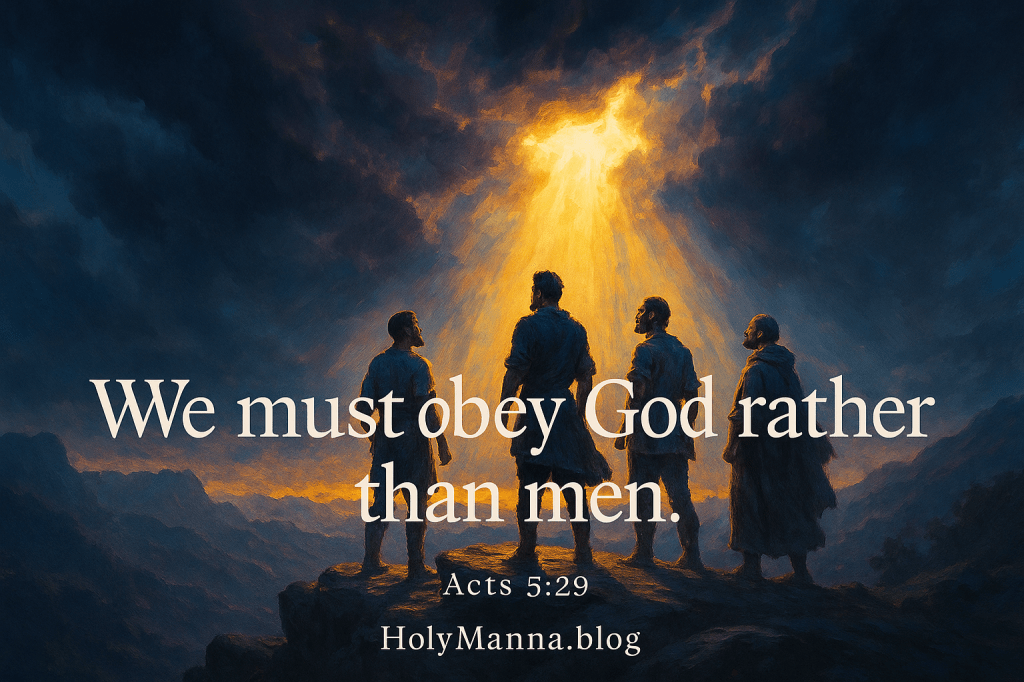
We Must Obey God Rather Than Men
Have you ever felt the tension between what the world expects of you and what God is asking of you? That quiet yet persistent pull deep within, inviting you to stand firm in truth even when it costs you something? Today’s readings confront this tension head-on, inviting us into the unshakable conviction that obedience to God is not only higher than obedience to human authority—it is the very path to eternal life.
In Acts of the Apostles, Peter and the others defy the Sanhedrin not out of rebellion, but from a divine calling: “We must obey God rather than men”. This wasn’t just civil disobedience—it was a supernatural witness, fueled by the Holy Spirit, to the risen and exalted Christ. Their boldness takes place in the early days of the Church, a time of persecution when proclaiming Jesus as the Messiah could mean imprisonment or death. Yet, their message remains clear: repentance and forgiveness come only through Jesus, whom God has raised and glorified. Their courage echoes through the ages to us today, especially in a world that often resists truth.
The Gospel according to John deepens this theme by reminding us that Jesus is not just a prophet or teacher, but the One who comes from above, speaking the very words of God. “Whoever believes in the Son has eternal life”—a truth as radiant now as it was then. Paired with Psalm 34, which assures us that “The Lord is close to the brokenhearted… and delivers them from all their afflictions”, we are reminded that obedience to God may lead us through suffering, but never without His presence and promise. These readings challenge us: Are we living as if Jesus truly is above all? Are we obeying His voice, even when it costs us comfort or reputation? Let today’s Word call us to deeper courage, steadfast belief, and joy in knowing that God’s Spirit is poured out upon those who obey.
First Reading – Acts 5:27–33
Bold Obedience in the Face of Power
In the heart of the Easter season, we journey with the early Church as it begins to radiate the light of Christ into a dark and resistant world. Today’s reading from The Acts of the Apostles places us in a dramatic confrontation between human authority and divine commission. Acts, written by St. Luke, is not merely a historical account—it is a theological masterpiece that traces the birth of the Church through the power of the Holy Spirit. This passage, set in the context of Peter and the apostles standing before the Sanhedrin, reveals a core principle of Christian witness: we obey God, not men. Amidst persecution, these apostles are not discouraged; they are emboldened, proclaiming the truth of the Resurrection with fearless clarity. Their courage, rooted in divine authority, embodies the very theme that runs through today’s readings—eternal life belongs to those who believe and obey Christ, no matter the cost.
Acts 5:27-33
New American Bible (Revised Edition)
27 When they had brought them in and made them stand before the Sanhedrin, the high priest questioned them, 28 “We gave you strict orders [did we not?] to stop teaching in that name. Yet you have filled Jerusalem with your teaching and want to bring this man’s blood upon us.” 29 But Peter and the apostles said in reply, “We must obey God rather than men. 30 The God of our ancestors raised Jesus, though you had him killed by hanging him on a tree. 31 God exalted him at his right hand as leader and savior to grant Israel repentance and forgiveness of sins. 32 We are witnesses of these things, as is the holy Spirit that God has given to those who obey him.”
33 When they heard this, they became infuriated and wanted to put them to death.
Detailed Exegesis
Verse 27 – “When they had brought them in and made them stand before the Sanhedrin, the high priest questioned them,”
This verse sets the scene: the apostles are once again arrested and brought before the religious council of the Jews—the Sanhedrin. It is the same body that condemned Jesus. The Sanhedrin held great religious and social authority, and for the apostles to be summoned here a second time signals the threat of severe punishment. Yet, they do not cower.
Verse 28 – “We gave you strict orders [did we not?] to stop teaching in that name. Yet you have filled Jerusalem with your teaching and want to bring this man’s blood upon us.”
The high priest accuses them not only of disobedience but of implicating the Sanhedrin in Jesus’ death—a truth they are unwilling to accept. “That name” is Jesus, whose very mention they try to avoid. The apostles’ evangelization has been so effective that all Jerusalem is stirred. Truth, even when uncomfortable, cannot be silenced.
Verse 29 – “But Peter and the apostles said in reply, ‘We must obey God rather than men.’”
Here is the spiritual climax: Peter affirms a higher allegiance. This echoes Jesus’ words in The Gospel of Matthew: “Do not be afraid of those who kill the body but cannot kill the soul” (Matthew 10:28). Obedience to God transcends legal or social norms when those norms contradict divine will.
Verse 30 – “The God of our ancestors raised Jesus, though you had him killed by hanging him on a tree.”
Peter confronts them with the Paschal truth: Jesus, the crucified one, is risen. Referring to the cross as a “tree” connects to Deuteronomy 21:23, where being hanged on a tree was considered cursed. Peter boldly turns this around—what they saw as shame, God has turned into glory.
Verse 31 – “God exalted him at his right hand as leader and savior to grant Israel repentance and forgiveness of sins.”
Jesus is not just risen—He is exalted, seated at the right hand of the Father, a position of divine authority. His mission is redemptive: “to grant Israel repentance and forgiveness”, showing that even those who crucified Him are offered mercy.
Verse 32 – “We are witnesses of these things, as is the holy Spirit that God has given to those who obey him.”
Peter affirms that their proclamation is not self-motivated but divinely inspired. The Holy Spirit, a recurring character in Acts, is God’s own seal upon those who choose obedience. This statement challenges the Sanhedrin: if they do not recognize the Spirit, they may not be truly obedient to God.
Verse 33 – “When they heard this, they became infuriated and wanted to put them to death.”
The truth pierces their hearts, but rather than repenting, they respond with rage. Their power is threatened, and so they resort to violence. This reaction mirrors that of the crowds before Pilate—those who resist truth often attack its messengers.
Teachings from the Church
The Catechism of the Catholic Church teaches us that Christian obedience must be rooted in God’s law, especially when civil authority contradicts divine truth. “The citizen is obliged in conscience not to follow the directives of civil authorities when they are contrary to the demands of the moral order, to the fundamental rights of persons or the teachings of the Gospel” (CCC 2242). This principle was lived out by the apostles who, filled with the Spirit, accepted persecution rather than deny the Risen Christ.
St. John Chrysostom reflects on this courage in his homilies, noting: “The boldness of the apostles was born not of pride but of the fire of the Spirit, and the clarity of conscience that knows it is obeying God.” For the early Church, martyrdom was not sought, but it was embraced when fidelity to Christ demanded it. The same fire that empowered Peter at Pentecost now propels him before the Sanhedrin.
Historically, this passage has inspired countless saints and martyrs—from St. Stephen, the first martyr, to St. Thomas More, who famously declared before his execution, “I die the king’s faithful servant, but God’s first.” The Church recognizes that persecution will come to those who follow Christ (see 2 Timothy 3:12), and yet promises that through the cross, glory follows.
Reflection for Today
This reading compels us to ask: Am I willing to stand for Christ when it’s inconvenient, uncomfortable, or even dangerous? In our culture, standing up for the Gospel may not always mean prison or death, but it can cost us popularity, career advancement, or relationships. Yet like the apostles, we are called to be witnesses—not of our own courage, but of Christ crucified and risen. What areas of my life still fear human approval more than divine truth? Obedience to God sometimes begins in the quiet, hidden moments—choosing integrity at work, speaking gently when provoked, sharing the faith even when it might be awkward.
Ask the Holy Spirit to give you the same boldness He gave Peter. Are you listening to the Spirit’s promptings? Do you trust that God’s will, even in suffering, is always for your good and His glory? Let this reading awaken in you a heart that longs to please God more than men, confident that even in trials, “The Lord delivers him from them all” (Psalm 34:20).
Responsorial Psalm – Psalm 34:2, 9, 17–20
Praise in the Midst of Persecution
Psalm 34 is a hymn of thanksgiving attributed to King David, composed after he narrowly escaped danger from Abimelech by feigning madness (1 Samuel 21:10–15). Historically, it is a song birthed from trial—a cry of gratitude to the God who rescues the righteous. It belongs to a category of psalms known as “individual thanksgiving” and reflects the lived experience of those who, like the apostles in today’s First Reading, choose to trust God in adversity. In the context of today’s theme—obedience to God over man—Psalm 34 reminds us that divine favor is not about comfort but about faithfulness. Those who remain steadfast in affliction are never abandoned by the Lord. This psalm serves as a spiritual and emotional anchor, assuring the believer that God not only sees their suffering but is near to them in it. It aligns beautifully with the courage shown in Acts 5 and the divine testimony proclaimed in John 3, pointing us to a God who rescues, defends, and exalts those who place their trust in Him.
Psalm 34:2, 9, 17-20
New American Bible (Revised Edition)
2 I will bless the Lord at all times;
his praise shall be always in my mouth.
9 Taste and see that the Lord is good;
blessed is the stalwart one who takes refuge in him.
17 The Lord’s face is against evildoers
to wipe out their memory from the earth.
18 The righteous cry out, the Lord hears
and he rescues them from all their afflictions.
19 The Lord is close to the brokenhearted,
saves those whose spirit is crushed.
20 Many are the troubles of the righteous,
but the Lord delivers him from them all.
Detailed Exegesis
Verse 2 – “I will bless the Lord at all times; his praise shall be always in my mouth.”
David opens with a resolution to praise God unceasingly, regardless of circumstances. This declaration of continual praise is a spiritual posture, not an emotional reaction. It teaches us that praise is not based on how we feel, but on who God is. For the persecuted believer, praise becomes an act of spiritual defiance against despair.
Verse 9 – “Taste and see that the Lord is good; blessed is the stalwart one who takes refuge in him.”
This verse is both an invitation and a testimony. To “taste” is to experience—David invites the listener to engage with the Lord personally, not just intellectually. The word “stalwart” evokes courage and resilience, traits we see in Peter and the apostles. Trusting in God is not passive; it is an act of strength rooted in relationship.
Verse 17 – “The Lord’s face is against evildoers to wipe out their memory from the earth.”
Here, the psalmist contrasts the fate of the wicked with the protection given to the righteous. The “face” of God, in Hebrew thought, symbolizes presence and favor. To have God’s face against someone is to be opposed by His very being. The wicked may seem powerful, but their legacy is fleeting in the light of divine justice.
Verse 18 – “The righteous cry out, the Lord hears and he rescues them from all their afflictions.”
This is a beautiful assurance of divine attentiveness. God is not deaf to the cries of His faithful. “Afflictions” may still come, but they do not have the final word. This verse aligns with the apostles’ experience in Acts 5, where obedience led to danger, but ultimately, God’s deliverance was assured.
Verse 19 – “The Lord is close to the brokenhearted, saves those whose spirit is crushed.”
God’s nearness is most tangible in moments of sorrow. This verse reveals His tenderness and compassion. When worldly hope fades, divine comfort draws near. The apostles likely knew this kind of brokenness—yet their spirits were lifted by divine intimacy.
Verse 20 – “Many are the troubles of the righteous, but the Lord delivers him from them all.”
This closing verse sums up the mystery of Christian suffering. Righteousness does not exempt us from trials—it often invites them. Yet, every trial comes with a promise: “the Lord delivers him from them all”. This assurance echoes through every martyrdom and act of faithful endurance in Church history.
Teachings from the Church
The Catechism of the Catholic Church affirms the comforting truth of Psalm 34 in its teaching on divine providence. “God cares for all, from the least things to the great events of the world and its history. The sacred books powerfully affirm God’s absolute sovereignty over the course of events” (CCC 302). Even in suffering, the believer is never outside of God’s gaze or plan. When affliction comes, it is not a sign of abandonment but a participation in Christ’s own sufferings.
St. Augustine, reflecting on this psalm, writes: “When we are in tribulation, let us not faint; when we are in abundance, let us not be proud. Let us bless the Lord at all times.” This echoes the apostles’ witness—they rejoiced not only in victory but in persecution, recognizing that God’s deliverance often comes through the fire, not around it. The saints consistently teach that suffering endured in faith becomes redemptive, both personally and for the body of Christ.
The Church has long used Psalm 34 in liturgical settings to instill trust in God’s mercy. It is especially poignant in the Liturgy of the Hours and in the rites of Anointing of the Sick, where those facing physical and spiritual affliction are reminded that God is near. The Psalm becomes a healing balm—a sacred reminder that no pain escapes the loving notice of the Lord.
Reflection for Today
This Psalm meets us where we are: in the mess, in the fear, in the ache of obedience. Do I praise God at all times, or only when things are going well? Am I willing to “taste and see” His goodness even when the world feels bitter? Our faith is not proven in ease, but in endurance. Today, we are invited to rest in the assurance that the Lord is close to us when we are broken, that He hears every whispered prayer, and that deliverance is never far from the faithful heart.
We can take practical steps in our day to live out this Psalm. Begin and end the day with words of blessing, even if your circumstances don’t feel praiseworthy. Lean into the sacraments—especially the Eucharist—as a way to “taste and see” the Lord’s goodness. Are you taking refuge in God, or in the fleeting comforts of the world? Let this Psalm renew your courage and deepen your intimacy with the One who delivers you from all your fears.
Holy Gospel – John 3:31–36
The Eternal Weight of Belief and Disobedience
Today’s Gospel reading brings us to the third chapter of The Gospel of John, a chapter saturated with theological depth and eternal consequence. This portion follows Jesus’ conversation with Nicodemus, a Pharisee who seeks understanding but approaches in the secrecy of night. Jesus speaks of heavenly realities—rebirth in the Spirit, the love of the Father in sending the Son, and the light of truth that exposes the darkness. The passage we meditate on today is part of John the Baptist’s final testimony, affirming Jesus’ divine origin and the authority of His words. The Gospel of John was written not simply as a record of events, but as a theological invitation to faith, composed for a community facing persecution and division. In it, John continually elevates Jesus as the eternal Word made flesh, whose mission is to give life to those who believe. In the context of today’s theme, this passage reveals that true obedience to God hinges on believing in the One He has sent—and that disobedience is not neutral, but carries eternal consequence.
John 3:31-36
New American Bible (Revised Edition)
31 The one who comes from above is above all. The one who is of the earth is earthly and speaks of earthly things. But the one who comes from heaven [is above all]. 32 He testifies to what he has seen and heard, but no one accepts his testimony. 33 Whoever does accept his testimony certifies that God is trustworthy. 34 For the one whom God sent speaks the words of God. He does not ration his gift of the Spirit. 35 The Father loves the Son and has given everything over to him. 36 Whoever believes in the Son has eternal life, but whoever disobeys the Son will not see life, but the wrath of God remains upon him.
Detailed Exegesis
Verse 31 – “The one who comes from above is above all. The one who is of the earth is earthly and speaks of earthly things. But the one who comes from heaven is above all.”
This verse emphasizes the divine origin and authority of Jesus. “From above” refers not just to location, but to nature—Jesus is not merely a prophet; He is divine. In contrast, those “of the earth” are bound by limited understanding. This elevates Jesus’ testimony beyond any human opinion or authority, reinforcing why the apostles in Acts chose to obey Him over the Sanhedrin.
Verse 32 – “He testifies to what he has seen and heard, but no one accepts his testimony.”
Jesus speaks of heavenly realities because He comes from heaven. His words are not theories, but direct revelations. Yet, this verse carries the sorrow of rejection. “No one accepts” is not absolute but emphasizes how widespread disbelief was, even in the face of divine truth. The same disbelief that led to His crucifixion now threatens the soul of every hearer.
Verse 33 – “Whoever does accept his testimony certifies that God is trustworthy.”
To accept Jesus’ testimony is to affirm the trustworthiness of God Himself. Belief is not simply intellectual assent—it is a declaration of confidence in the character and truth of God. Faith in Jesus becomes the ultimate act of obedience, and in doing so, we declare: “God is true” (John 3:33, RSVCE).
Verse 34 – “For the one whom God sent speaks the words of God. He does not ration his gift of the Spirit.”
Jesus, the Sent One, speaks with divine authority. There is no limitation in His outpouring of the Holy Spirit—He gives fully and abundantly. This abundance connects us back to the first reading: the apostles are filled with the Spirit because they obey the one who gives without measure. In Jesus, heaven touches earth without reserve.
Verse 35 – “The Father loves the Son and has given everything over to him.”
This verse reveals the intimacy within the Trinity. The Father entrusts everything—creation, judgment, redemption—to the Son. This divine entrustment confirms that Jesus is not just a messenger but Lord of all. To disobey Him is to reject the very authority of God.
Verse 36 – “Whoever believes in the Son has eternal life, but whoever disobeys the Son will not see life, but the wrath of God remains upon him.”
This closing verse is stark in its clarity. Belief in Jesus opens the door to eternal life—present and future. But disobedience (linked directly with disbelief) results in separation from God. The “wrath of God” is not emotional rage, but the just consequence of rejecting the life offered in Christ. Obedience and belief are inseparable; to reject one is to lose both.
Teachings from the Church
The Catechism of the Catholic Church clearly teaches that faith in Jesus Christ is the foundation of salvation. “Believing in Jesus Christ and in the One who sent him for our salvation is necessary for obtaining that salvation” (CCC 161). This is not optional or symbolic—faith is the door to grace, and that grace enables us to live in obedience to the truth. Jesus is not one voice among many; He is “above all”, as today’s Gospel reminds us.
St. Thomas Aquinas, in his Commentary on the Gospel of John, reflects on verse 34 by saying, “The measure of the gift corresponds to the capacity of the receiver. But Christ, possessing the fullness of grace, receives the Spirit without measure.” Therefore, all who are in Christ share in this limitless Spirit. This is why disobedience is not merely a failure to follow commands—it is a rejection of divine communion.
Historically, the Johannine community faced significant opposition from both Jewish authorities and emerging Gnostic heresies. John’s Gospel combats both by asserting that Jesus is the full revelation of God and that eternal life is not a distant hope but a present reality for those who believe. This context illuminates the urgency of John’s message: belief and obedience are not private devotions—they are cosmic decisions with eternal ramifications.
Reflection for Today
This Gospel demands a personal response. Do I truly believe that Jesus is above all? Do I live as though eternal life is already mine through Him? We may not openly reject Jesus, but we disobey in subtle ways—compromising truth, remaining silent when we should speak, choosing comfort over sacrifice. Today, we are invited to renew our belief, not just with our words but with our lives.
To believe in Jesus is to entrust Him with everything: our time, our future, our relationships, even our suffering. Let us begin by submitting our will to His—through prayer, repentance, and a desire to hear and do the Word. What area of your life is Jesus asking you to surrender today? Are you resisting His voice, or are you making space to obey with joy? Let His Spirit move freely in you, for He gives without measure. And in that obedience, may we proclaim with our lives that “God is trustworthy”.
Living the Call: Obedience, Trust, and Eternal Life
Today’s readings form a beautiful tapestry of courageous obedience, steadfast trust, and the glorious promise of eternal life. In Acts of the Apostles, we witnessed Peter and the apostles standing boldly before human authority, proclaiming with conviction, “We must obey God rather than men”. Their unwavering testimony reminds us that true faith demands action—even when it invites persecution. Through Psalm 34, we found a song for the suffering heart, a reminder that the Lord is near to the brokenhearted and saves those crushed in spirit. God’s rescue is not theoretical; it is real, personal, and promised to the faithful who cry out to Him. Finally, The Gospel of John laid the eternal choice before us with piercing clarity: to believe in the Son is to enter into life; to reject Him is to remain in death. There is no middle ground.
Each reading calls us deeper—to trust when it would be easier to fear, to obey when it would be safer to conform, and to believe when doubt is loudest. In every trial, in every temptation, the Spirit is given without measure to those who ask. Will you live today as one who has tasted and seen that the Lord is good? Will you choose to trust His testimony over the shifting opinions of the world? God invites you not into a life of comfort, but into a life of divine purpose and unshakable joy. May we, like the apostles, stand before the world with hearts on fire, declaring not our strength, but His sovereignty. May our lives become a living song of praise, testifying that “whoever believes in the Son has eternal life”.
Engage with Us!
We would love to hear how today’s Word has touched your heart! How is God calling you to deeper obedience, trust, and belief? Share your thoughts, prayers, or personal reflections in the comments below. Together, we can strengthen one another on this journey of faith, courage, and love.
Reflection Questions:
First Reading – Acts 5:27–33
When have you been called to choose between pleasing God and pleasing others? How can you prepare your heart to say, like Peter, “We must obey God rather than men”?
Responsorial Psalm – Psalm 34:2, 9, 17–20
In what moments of suffering or fear have you experienced the nearness of God? How can you cultivate a habit of praising God at all times, especially during trials?
Holy Gospel – John 3:31–36
Do you truly believe that Jesus is “above all” in your life? What areas are you being invited to surrender more fully to His authority and trust?
May you go forth today inspired to live with the boldness of the apostles, the trust of the psalmist, and the faith proclaimed by John the Baptist. Whatever you do, do it with the love, mercy, and truth that Jesus has taught us. Trust that the Lord is near to you always, and that every act of obedience draws you deeper into His eternal life!
Follow us on Instagram and Facebook for more insights and reflections on living a faith-filled life.

 Holy Manna!
Leave a comment