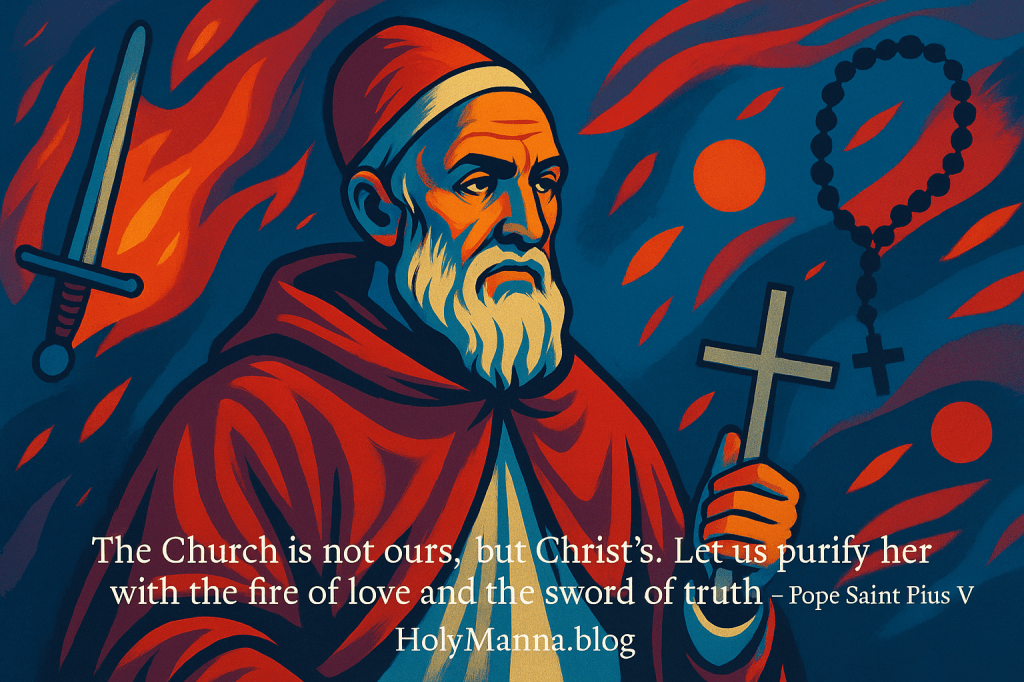
Defender of Christendom and Reformer of the Church
Few saints shine as brightly in the stormy centuries of Church history as Pope Saint Pius V. He lived during one of the most turbulent periods in Christendom—the age of the Protestant Reformation, internal Church corruption, and the encroachment of the Ottoman Empire. Yet in this chaos, God raised up a Dominican friar who would become not only a shepherd of souls but a bulwark of truth. Elected pope in 1566, Pius V is most remembered for his rigorous enforcement of the reforms of the Council of Trent, his moral integrity, and his pivotal role in organizing the Holy League, which won the miraculous victory at the Battle of Lepanto in 1571. This victory preserved Christian Europe and was attributed by the pope himself to the intercession of the Blessed Virgin Mary. In fact, he instituted the feast of Our Lady of Victory, later renamed Our Lady of the Rosary, to commemorate that triumph.
Wearing the simple white habit of his Dominican order, Pius V brought a radical return to holiness, austerity, and fidelity to Rome. The white cassock, a sign of purity and simplicity, became the traditional papal garb in his honor. More than a reformer, he was a spiritual father who called the Church to deeper holiness in word and deed. “The Church is not ours, but Christ’s. Let us purify her with the fire of love and the sword of truth”, he once said. That was the mission he fulfilled with courage and conviction.
From Shepherd Boy to Shepherd of the Church
Antonio Ghislieri was born into a poor but devout family on January 17, 1504, in the small town of Bosco in the Duchy of Milan. As a boy, he tended sheep—learning silence, simplicity, and watchfulness in the countryside. These early years formed a soul accustomed to solitude, prayer, and manual labor. At age fourteen, he entered the Dominican Order and took the religious name Michele. The Dominicans, also known as the Order of Preachers, shaped his intellectual rigor and burning love for truth.
What set young Michele apart was not ambition or eloquence, but holiness. He lived with strict discipline and deep devotion to the Eucharist and Our Lady. He studied theology and philosophy and was ordained a priest known for his preaching and his austere life. Eventually, he rose to become inquisitor general, bishop, and then cardinal under Pope Paul IV. Known for his incorruptibility and deep prayer life, he was often sent to dioceses in need of reform.
When elected pope in 1566, Michele Ghislieri reluctantly accepted, taking the name Pius V. He saw his role not as a throne of power, but as a cross to carry for the good of souls. As pope, he implemented the Tridentine Reforms, publishing the Roman Catechism, the Roman Breviary, and the Roman Missal, standardizing the liturgy for centuries. “All must conform to the truth of Christ, not the whims of the age”, he declared in his papal writings.
He was also known for his pastoral care. He walked barefoot on Ash Wednesday, personally visited the sick, and reallocated Church funds to care for the poor. His papacy was marked by both spiritual authority and human compassion, rooted in his unshakable trust in God.
Heaven’s Warrior
Though not a saint known for working numerous personal miracles, the most awe-inspiring sign of divine favor during Pope Saint Pius V’s lifetime came during one of the most significant naval battles in Christian history. On October 7, 1571, the Christian Holy League faced the vastly superior Ottoman fleet in the Battle of Lepanto. The odds were bleak. Europe held its breath. But Pius V called for all of Christendom to pray the Rosary for victory. Churches were filled with faithful, and rosaries clutched tightly in hand.
At the exact hour of the battle, Pope Pius V was in a meeting when he suddenly stood, walked to a window, and with radiant joy announced, “The Christian fleet is victorious!” Though no messenger could have reached Rome in time, the pope had seen the victory in a vision.
It was only days later that official word arrived: the Ottoman fleet had been decisively defeated. The pope immediately attributed the victory to the Blessed Virgin Mary’s intercession, and instituted the feast day of Our Lady of Victory. This was later renamed Our Lady of the Rosary, a feast we still celebrate every October 7th.
That moment at Lepanto was not only a military win but a spiritual triumph. It was a sign that God was with His Church and that the humble prayers of the faithful—especially the Rosary—could bring down empires. This miracle affirmed Pius V’s deep devotion to Mary and his conviction that true power comes from heaven, not armies.
Fire of Reform
Though not a martyr by blood, Pope Saint Pius V endured a white martyrdom marked by suffering, resistance, and deep personal sacrifice. Reform is never welcomed easily. His rigorous enforcement of the Council of Trent’s decrees earned him enemies within the Church, particularly among lax clergy and bishops who resisted accountability. He was mocked, plotted against, and politically opposed by powerful figures across Europe.
One of his most controversial acts was excommunicating Queen Elizabeth I of England in 1570 through the papal bull Regnans in Excelsis, declaring her a heretic and releasing her subjects from allegiance to her. While the decision had political ramifications, Pius V believed it necessary to protect the souls of Catholics persecuted under her reign.
He also faced enormous pressure in defending Catholic territories from Islamic incursion and Protestant heresies, which were rapidly gaining ground. Every reform he enacted—from purifying monastic life to standardizing the Mass—came with resistance, yet he bore it all with patience, penance, and prayer.
He fasted often, wore a hairshirt beneath his papal robes, and lived in a modest room without luxury. His life was truly one of penance for the sins of the Church and the world. He never stopped calling the Church to holiness, even at great personal cost. “Christ crucified is my only glory”, he would repeat during moments of trial.
Even in Death, His Light Shone
Pius V died on May 1, 1572, after six years as pope, worn out by labor and fasting, but radiant in faith. Yet his work and witness did not end with his earthly life. Healings and answered prayers were reported at his tomb in the Basilica of Santa Maria Maggiore in Rome. Pilgrims flocked to the site seeking his intercession. One notable case involved a child gravely ill, who recovered after his parents prayed through Pius V’s intercession.
Over the centuries, devotion to him spread. He became a symbol of spiritual renewal and moral integrity. Canonized by Pope Clement XI in 1712, Pope Saint Pius V stands as a saint not only for his era but for all time. He reminds us that reform begins in the soul, victory is born from prayer, and holiness is the Church’s true power.
His relics remain in Santa Maria Maggiore, where they are venerated by thousands. The impact of his reforms continues through the Tridentine Mass, the legacy of the Rosary, and the feast of Our Lady of the Rosary—proof that this holy pope’s mission endures through the ages.
A Call to Bold Faith in Our Own Time
In our age of confusion, moral compromise, and spiritual fatigue, Pope Saint Pius V calls us to something higher—holiness that costs something. He shows us that the Church is not called to conform to the world, but to call the world to Christ. His life is a challenge to live with greater clarity, courage, and conviction.
What areas of my life are in need of reform? Where am I tolerating lukewarmness? These are the questions Pope Saint Pius V provokes. He reminds us that saints are forged not in comfort, but in the fire of prayer, sacrifice, and truth.
We can imitate him by embracing the Rosary, living simply, standing for truth with love, and enduring trials with joy. The Catechism tells us, “The saints contemplate God, praise him and constantly care for those whom they have left on earth. Their intercession is their most exalted service to God’s plan. We can and should ask them to intercede for us and for the whole world” (CCC 2683). So let us ask Pope Saint Pius V to pray for us—that we may be lights in the darkness and witnesses to Christ, no matter the cost.
Engage with Us!
We would love to hear from you!
How has Pope Saint Pius V inspired you? Which aspect of his life resonates most deeply with your journey?
Here are some reflection questions for you:
- How can I be more courageous in defending my faith in today’s world?
- In what areas of my life do I need reform and greater alignment with God’s will?
- What practical steps can I take to foster a deeper devotion to prayer, like Pope Saint Pius V?
Share your thoughts in the comments below! Let’s support one another as we strive to follow the path of Christ, doing everything with love, just as Pope Saint Pius V did.
Saint Pius V, pray for us! 📿
Follow us on Instagram and Facebook for more insights and reflections on living a faith-filled life.

 Holy Manna!
Leave a comment