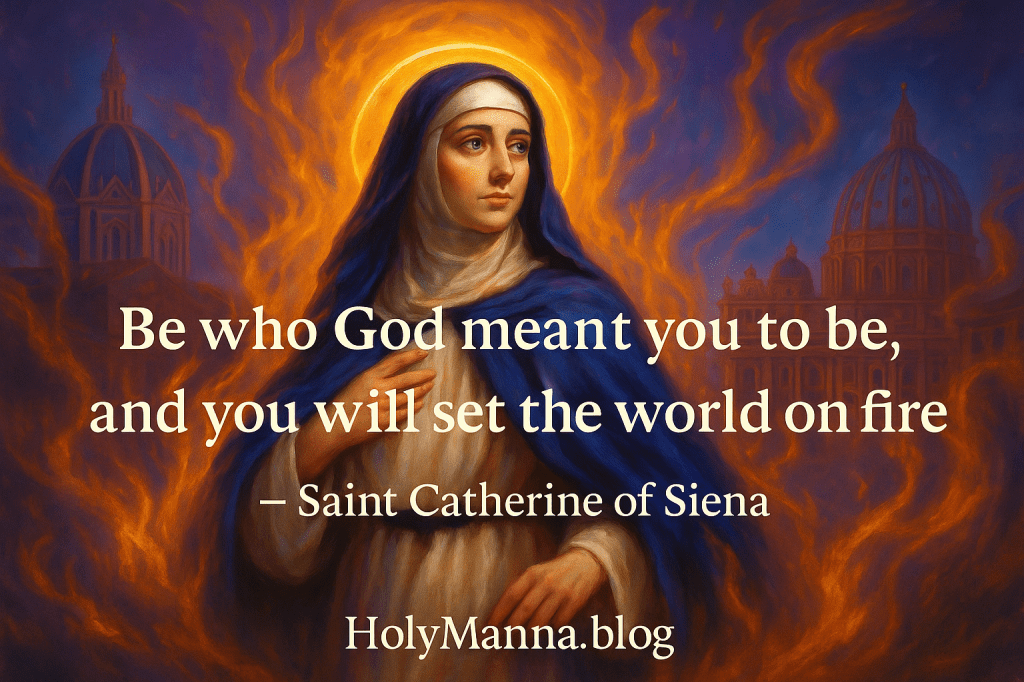
The Mystic Flame
Saint Catherine of Siena stands as one of the brightest flames of sanctity in Church history—a laywoman, mystic, and reformer whose soul was set ablaze with divine love. Born into a tumultuous 14th-century Italy riddled with plague, war, and a fractured Church, she emerged not as a cloistered nun but as a spiritual warrior, peacemaker, and theological powerhouse. Despite never receiving a formal education, she dictated some of the most profound spiritual writings in Christian tradition, including her masterpiece, The Dialogue. Her letters, infused with bold love for Christ and unwavering fidelity to the Church, moved popes and princes. Named a Doctor of the Church in 1970 and co-patron of Europe in 1999, her legacy continues to ignite hearts with her timeless call to holiness: “Be who God meant you to be, and you will set the world on fire.”
A Soul Set Apart
Catherine Benincasa was born on March 25, 1347, in Siena, Italy, during a time of great suffering as the Black Death ravaged Europe. She was the 25th of 25 children—though only half of them survived infancy. Her father, Giacomo, was a wool dyer, and her mother, Lapa, a strong-willed woman, initially hoped Catherine would marry well. But from a young age, Catherine’s heart was already claimed by heaven. At just six years old, she experienced a vision of Christ seated in glory with Saints Peter, Paul, and John. This vision forever changed her and planted within her a burning desire to belong to Jesus alone.
When her parents pressured her to marry, Catherine refused. In an act of radical defiance and faith, she cut off her hair and fasted for days, embracing solitude and prayer. Eventually, they relented, and she joined the Mantellate, the Third Order of Saint Dominic. This allowed her to live in the world but devote herself entirely to God. Catherine’s inner life soon blossomed into extraordinary mystical experiences, including what she described as a “mystical marriage” with Jesus Christ. He appeared to her, accompanied by the Blessed Virgin and saints, and placed a ring on her finger—a ring only she could see.
Yet Catherine did not stay hidden in her cell. Fueled by divine love, she emerged as a voice of truth and reconciliation, writing letters to popes, cardinals, queens, and rulers. She urged repentance, reform, and unity within the Church, even persuading Pope Gregory XI to return the papacy to Rome from Avignon. She also cared for the sick and dying, especially during outbreaks of the plague, and comforted condemned prisoners, urging them to turn to Christ in their final hours. Her entire life became a witness to the transformative power of divine intimacy: it calls us inward to be with God and outward to be His voice in the world.
Signs of the Beloved
Throughout her life, Saint Catherine was surrounded by extraordinary graces that pointed to her unique union with God. One of the most powerful signs was her mystical marriage to Christ. This event was no mere metaphor; she described it as a real, spiritual experience in which Jesus gave her an invisible wedding ring, binding her soul to His in eternal covenant. She also received the stigmata—the wounds of Christ—but prayed they would remain hidden during her life so as not to draw attention to herself. After her death, they became visible, confirming the authenticity of her suffering and sanctity.
Her ability to survive for long periods on the Eucharist alone is another testimony to her deep Eucharistic devotion. She often fasted from all food and drink except Holy Communion, stating that it was Christ Himself who sustained her. Numerous healing miracles were attributed to her as well. She prayed over the sick and witnessed their recovery, sometimes with just the sign of the Cross or a word of encouragement. People from all walks of life sought her counsel—not just for wisdom but for miracles of healing, reconciliation, and peace.
Catherine was also known for instances of bilocation, appearing in two places at once, often while she was physically caring for the sick yet spiritually present in mystical dialogue with the Lord. These wonders were not spectacles, but affirmations of her complete surrender to God’s will and the supernatural life flowing through her.
Thorns and Glory
Saint Catherine’s sanctity was not without great cost. She was misunderstood by her family, rejected by many in the clergy, and even accused of heresy. Some mocked her letters to popes and questioned how a young, uneducated woman dared speak on theological and ecclesial matters. Yet she never acted out of pride, but from obedience to God, often reminding others that she was only a “vessel,” a “nothingness” filled by Christ.
Her physical sufferings were intense. She practiced extreme asceticism, surviving for months at a time only on the Eucharist, often to the detriment of her body. Toward the end of her life, her health collapsed. Still, she offered every pain as a sacrifice for the Church, which she famously called “Christ’s Bride.” She bore in her heart the agony of Christ crucified, praying continually for unity and reform.
Though not martyred by the sword, she lived what many have called a white martyrdom, dying to herself daily for the sake of the Gospel. She died on April 29, 1380, in Rome, at the age of 33—the same age as Christ. In her final moments, she cried out, “Father, into Your hands I commend my spirit.”
Glory Beyond the Grave
The miracles didn’t end with her death. Pilgrims flocked to her tomb at the Church of Santa Maria sopra Minerva in Rome, where healings were soon reported. Her body was found incorrupt, and though her remains are in Rome, her head is preserved in Siena in the Basilica of San Domenico, surrounded by reverent devotion. Both sites remain popular pilgrimage destinations, testifying to the deep love and veneration the faithful have for her.
She was canonized in 1461 by Pope Pius II and declared a Doctor of the Church by Pope Paul VI in 1970, recognizing her extraordinary contributions to Catholic theology and spirituality. In 1999, Pope John Paul II proclaimed her a Co-Patroness of Europe, alongside Saints Bridget of Sweden and Edith Stein. Through her intercession, countless souls have found healing, inspiration, and the courage to love Christ and His Church with the same radical trust that consumed her heart.
Living Like Fire
Saint Catherine’s life is a challenge and an invitation. She shows us that holiness is not limited by age, gender, or education. It is the fruit of love—deep, fierce, uncompromising love for Christ and His Church. She reminds us that we are called not only to pray for the Church but to suffer and serve for her good.
What does it mean to be a voice of truth today? In a world torn by division, Saint Catherine teaches us the importance of speaking boldly yet lovingly, rooted in prayer and humility. How do we respond to suffering—our own and that of the Church? She shows us how to offer it as a gift, trusting that God uses every cross for a greater resurrection. How can we deepen our intimacy with Christ? Catherine points us to the Eucharist, to silent prayer, and to total surrender.
Her words still burn with relevance:
“If you are what you should be, you will set the whole world ablaze!”
Let us, then, be emboldened to live with hearts on fire—hearts formed in the furnace of divine love, fueled by prayer, and poured out for the world. Through Saint Catherine’s intercession, may we become who God made us to be.
💬 Engage with Us!
Have you ever felt called to do something bold for your faith, but were afraid to act? What can Saint Catherine teach us about trusting God even when we feel inadequate?
Reflection Questions:
- How can I cultivate a deeper relationship with Jesus through prayer, as Saint Catherine did?
- What fears or insecurities hold me back from speaking the truth or living my faith publicly?
- In what ways can I offer my daily sufferings for the healing and unity of the Church?
Let us support one another on this journey toward sanctity. May we, like Saint Catherine, do everything with love—for God, His Church, and each soul we encounter.
Saint Catherine of Siena, pray for us! 🕊️

 Holy Manna!
Leave a comment