Born of the Spirit, Bound by Love
There’s a mysterious beauty in the way the Holy Spirit moves—unpredictable, powerful, and utterly transforming. Today’s readings invite us into that sacred mystery, revealing how life in the Spirit radically reorients our hearts, our communities, and our understanding of eternal life. The early Church, clothed in this Spirit, shared all things in common; Jesus speaks of a birth “from above” that leads us into the Kingdom; and the psalmist anchors it all in the eternal majesty and holiness of God. These aren’t just spiritual ideas—they’re a call to live differently, starting from the inside out.
In the days following the Resurrection, the fledgling Christian community was still figuring out what it meant to follow the risen Christ in a hostile world. The Acts of the Apostles describes a Church marked by unity and sacrificial generosity, where no one was in need because everyone was family. This was not merely social charity—it was the visible fruit of hearts reborn by the Spirit. Meanwhile, Jesus’ late-night conversation with Nicodemus in The Gospel of John draws us into a deeper understanding of salvation: it’s not just about knowing religious laws or earthly success, but being lifted up with Christ through faith in His crucifixion and Resurrection. Psalm 93 completes the picture by grounding us in the sovereignty of God—His decrees are unshakable, and His house is clothed in holiness forever.
What unites these readings is the theme of life in the Spirit: a new birth that brings about unity, generosity, and hope in the eternal. We are not meant to be lone pilgrims wandering toward heaven—we are meant to be born again into a family, a Church, where our lives witness to the Resurrection through the way we love and live together. What would it look like if our communities today mirrored that same Spirit-filled unity and sacrificial love?
First Reading – Acts 4:32–37
The Spirit of One Heart and Mind
In the earliest days of Christianity, following the outpouring of the Holy Spirit at Pentecost, the infant Church blossomed into a vibrant, Spirit-filled community. The Acts of the Apostles, written by St. Luke, serves as both a historical narrative and theological reflection on the birth of the Church and the mission of the Apostles. This passage places us squarely in Jerusalem, where thousands have come to believe in Jesus as the Messiah. What we witness here is not a utopian ideal, but the real-life fruit of men and women reborn by the Holy Spirit—living out the radical love of Christ. The emphasis on communal living, sacrificial giving, and apostolic authority demonstrates how the Spirit draws individuals into deep unity, fulfilling Christ’s prayer that His followers may be “one as we are one” (cf. John 17:22). This unity, rooted in the Resurrection, is a living testimony to the world—a witness that something divine has happened.
Acts 4:32-37
New American Bible (Revised Edition)
32 The community of believers was of one heart and mind, and no one claimed that any of his possessions was his own, but they had everything in common. 33 With great power the apostles bore witness to the resurrection of the Lord Jesus, and great favor was accorded them all. 34 There was no needy person among them, for those who owned property or houses would sell them, bring the proceeds of the sale, 35 and put them at the feet of the apostles, and they were distributed to each according to need.
36 Thus Joseph, also named by the apostles Barnabas (which is translated “son of encouragement”), a Levite, a Cypriot by birth, 37 sold a piece of property that he owned, then brought the money and put it at the feet of the apostles.
Detailed Exegesis
Verse 32 – “The community of believers was of one heart and mind, and no one claimed that any of his possessions was his own, but they had everything in common.”
This verse sets the tone: unity. The phrase “one heart and mind” echoes Old Testament language for covenant fidelity (cf. Jeremiah 32:39). The community’s total sharing reflects a supernatural charity—far beyond mere socialism. It was voluntary, Spirit-led, and centered on love of neighbor.
Verse 33 – “With great power the apostles bore witness to the resurrection of the Lord Jesus, and great favor was accorded them all.”
The Apostles’ preaching of the Resurrection was not mere words—it was infused with “great power,” a reference to the Holy Spirit’s ongoing action. Their credibility was confirmed by miracles and the authentic life of the community. The “favor” mentioned is both divine grace and the esteem of the people, drawn to the light of Christ in them.
Verse 34 – “There was no needy person among them, for those who owned property or houses would sell them, bring the proceeds of the sale,”
The fulfillment of Deuteronomy 15:4—“There shall be no poor among you”—comes alive in the Church. Possessions were not hoarded but seen as tools for love and mercy. This economic generosity was a fruit of interior conversion, not obligation.
Verse 35 – “and put them at the feet of the apostles, and they were distributed to each according to need.”
The Apostles acted as spiritual shepherds and administrative stewards. Laying gifts at their feet symbolizes trust in their discernment and the apostolic structure Christ established. Distribution “according to need” reflects divine justice, not human favoritism.
Verse 36 – “Thus Joseph, also named by the apostles Barnabas (which is translated ‘son of encouragement’), a Levite, a Cypriot by birth,”
Barnabas is introduced as a model of this Spirit-filled generosity. A Levite—traditionally not landowners—he is already stepping outside old constraints. His name, “son of encouragement,” signals his role as a bridge-builder and missionary to come.
Verse 37 – “sold a piece of property that he owned, then brought the money and put it at the feet of the apostles.”
Barnabas doesn’t just give out of surplus—he sells property. His act is concrete, sacrificial, and public. It reveals a heart fully entrusted to Christ and the Church. His example would later contrast sharply with Ananias and Sapphira’s deception in Acts 5.
Teachings
The unity and generosity of the early Church were not simply human efforts but the fruit of life in the Spirit. The Catechism of the Catholic Church teaches: “The Holy Spirit… builds, animates, and sanctifies the Church. The Church is the sacrament of the Holy Trinity’s communion with men” (CCC 747). What we see in Acts 4 is the visible manifestation of this divine communion—men and women responding to grace by forming a radically loving community. Their unity is not uniformity, but a supernatural harmony rooted in their shared identity in Christ.
St. John Chrysostom praises this communal life, saying: “They had not yet heard of almsgiving, but they did alms; they had not yet heard of fasting, but they fasted. The Holy Spirit had established everything in them” (Homilies on Acts). The spontaneity of their charity reveals the Spirit as their teacher. Unlike later monastic or institutional structures, this was a grassroots holiness that foreshadowed the Church’s vocation in every age—to become a sign of unity and a beacon of mercy.
Historically, this passage inspired movements of reform and renewal. From the Desert Fathers to Francis of Assisi to modern Catholic social teaching, the model of radical sharing in Acts 4 has repeatedly called the Church back to simplicity and solidarity with the poor. Pope Benedict XVI wrote: “The Church’s social teaching is based on the truth of what the human person is… it is a proclamation of Christ” (Caritas in Veritate, 1). That proclamation resounds through every generous act rooted in the Spirit.
Reflection
What would it look like if we truly saw our possessions as gifts entrusted to us for the good of others? The early Christians challenge us to reconsider our attachment to material comfort and reflect on what “being of one heart and mind” might mean in our families, parishes, and workplaces. While few of us are called to sell everything, all of us are called to live generously—with our time, our attention, and our resources.
Are we willing to lay what we have “at the feet” of the Church—not just financially, but in service, prayer, and love? Do we let the Holy Spirit guide our daily choices, or do we cling to control? Like Barnabas, we’re invited to become sons and daughters of encouragement—to lift others up through concrete acts of mercy. Today’s reading reminds us that a Spirit-led life is always a life poured out for others, because where the Spirit is, there is love.
Responsorial Psalm – Psalm 93:1–2, 5
The Throne That Cannot Be Moved
In a world that often feels unstable and chaotic, Psalm 93 proclaims a truth that anchors the soul: God reigns. This royal psalm belongs to a group of enthronement psalms (Psalms 93–99) that celebrate the Lord as the eternal King who rules over creation with majesty, might, and holiness. Written during a time when Israel’s monarchy had either collapsed or was under threat, this psalm reminded the faithful that God’s sovereignty is unshaken by earthly events. In the context of today’s readings, Psalm 93 reveals the unchanging foundation upon which the unity and transformation of the early Church was built. The Apostles’ bold witness and the community’s radical generosity flowed from a deep trust in the Lord’s eternal reign, and Jesus’ teaching to Nicodemus about being “born from above” finds its grounding in the majesty of the One who ordains such rebirth.
Psalm 93:1-2, 5
New American Bible (Revised Edition)
God Is a Mighty King
1 The Lord is king, robed with majesty;
the Lord is robed, girded with might.
The world will surely stand in place,
never to be moved.
2 Your throne stands firm from of old;
you are from everlasting.
5 Your decrees are firmly established;
holiness befits your house, Lord,
for all the length of days.
Verse-by-Verse Exegesis
Verse 1 – “The Lord is king, robed with majesty; the Lord is robed, girded with might. The world will surely stand in place, never to be moved.”
This verse declares God’s kingship not merely as a title, but as a visible, powerful reality. The imagery of being “robed with majesty” and “girded with might” evokes a warrior-king prepared for battle, ruling in splendor and strength. His dominion is not passive—He actively sustains the world. This is echoed in The Catechism: “God is the sovereign master of his plan. But to carry it out he also makes use of his creatures… God is the first cause who operates in and through secondary causes” (CCC 306).
Verse 2 – “Your throne stands firm from of old; you are from everlasting.”
Here, the psalmist proclaims God’s eternal nature. His throne—symbol of divine authority—is not subject to time or change. Unlike earthly rulers, His governance has no beginning or end. This verse reminds us of the constancy of God, a theme echoed in Hebrews 13:8: “Jesus Christ is the same yesterday, today, and forever.”
Verse 5 – “Your decrees are firmly established; holiness befits your house, Lord, for all the length of days.”
This closing verse ties divine kingship with moral order and sacred space. God’s laws are not arbitrary; they are firm, true, and enduring. “Holiness befits your house” points to the Temple, but also to the Church, the new dwelling of God in the Spirit. The permanence of God’s Word and the sanctity of His dwelling provide a foundation for the holy life of believers.
Teachings
The eternal kingship of God is a cornerstone of Christian faith. The Catechism affirms: “The kingdom of God lies ahead of us. It is brought near in the Word incarnate, it is proclaimed throughout the whole Gospel, and it has come in Christ’s death and Resurrection” (CCC 2816). What Psalm 93 anticipates, Christ fulfills. The Church, born from the side of Christ, now stands as His living Temple—His house of holiness for all generations.
St. Augustine, in his Exposition on the Psalms, reflects on this passage: “He is clothed with majesty—because He put on the flesh of man… girded with strength—because He has conquered the world.” This blending of kingship and incarnation underscores that God’s majesty is not distant or aloof. He enters our story, takes on our humanity, and reigns from a cross. This is the throne that stands firm—the wood of Calvary that cannot be moved.
Historically, the Church has turned to Psalm 93 in moments of crisis, especially when external powers seemed to threaten the faith. During times of persecution, schism, or cultural upheaval, the psalm reminded Christians that the Lord reigns—even when His crown is hidden. In the Liturgy of the Hours, this psalm is often prayed on Fridays, pointing us to Christ’s Passion as the paradoxical moment of His enthronement.
Reflection
Do I live as though God is truly King over every part of my life? Psalm 93 challenges us to reflect on where we place our trust. In a culture that celebrates self-rule and temporary trends, this psalm reorients our hearts to eternal truths. God’s throne is not threatened by our confusion or our crises. His decrees are still firm, His Church still holy, and His reign still eternal.
We’re invited to bring our fears and uncertainties before this eternal King. When the world feels unstable, do we anchor ourselves in God’s Word? When we feel shaken, do we remember that we are temples of the Holy Spirit, called to reflect the holiness of God’s house? Today, let us echo the trust of the psalmist and renew our confidence in the One whose rule cannot be moved.
Holy Gospel – John 3:7–15
Lifted Up to New Life
In this nighttime dialogue with Nicodemus, Jesus unveils one of the most profound mysteries of the Christian life: the necessity of being born from above. This passage from The Gospel of John forms part of Jesus’ early ministry and comes in the context of His encounter with a prominent Pharisee—Nicodemus, a “teacher of Israel” who approaches Jesus with sincere curiosity but limited understanding. Set against the backdrop of Israel’s longing for the Messiah and the Jewish expectations of national restoration, Jesus shifts the conversation to a deeper spiritual reality: eternal life begins with rebirth in the Spirit. This section of John’s Gospel is filled with theological richness and symbolic language, drawing heavily on Old Testament imagery. Within the theme of today’s readings, this Gospel reveals the hidden foundation of the early Church’s unity and spiritual power: it is not human effort, but the new life of the Spirit made possible by the Passion and Resurrection of Christ.
John 3:7-15
New American Bible (Revised Edition)
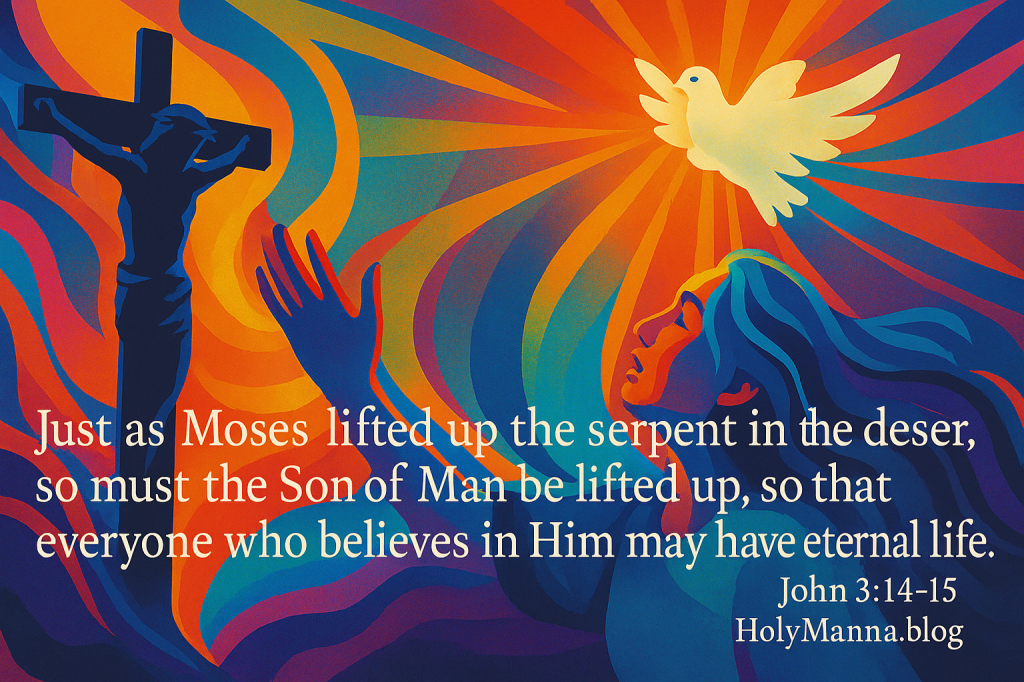
7 Do not be amazed that I told you, ‘You must be born from above.’ 8 The wind blows where it wills, and you can hear the sound it makes, but you do not know where it comes from or where it goes; so it is with everyone who is born of the Spirit.” 9 Nicodemus answered and said to him, “How can this happen?” 10 Jesus answered and said to him, “You are the teacher of Israel and you do not understand this? 11 Amen, amen, I say to you, we speak of what we know and we testify to what we have seen, but you people do not accept our testimony. 12 If I tell you about earthly things and you do not believe, how will you believe if I tell you about heavenly things? 13 No one has gone up to heaven except the one who has come down from heaven, the Son of Man. 14 And just as Moses lifted up the serpent in the desert, so must the Son of Man be lifted up, 15 so that everyone who believes in him may have eternal life.”
Detailed Exegesis
Verse 7 – “Do not be amazed that I told you, ‘You must be born from above.’”
Jesus corrects Nicodemus’ shock at the idea of rebirth. The phrase “born from above” (often translated “born again”) refers to a spiritual birth through water and the Spirit—pointing ahead to Baptism. This rebirth is not a metaphor, but a divine necessity for entrance into the Kingdom of God.
Verse 8 – “The wind blows where it wills, and you can hear the sound it makes, but you do not know where it comes from or where it goes; so it is with everyone who is born of the Spirit.”
Here Jesus uses the image of wind (pneuma in Greek, also meaning spirit) to describe the mysterious, sovereign action of the Holy Spirit. Just as the wind is invisible yet powerful, the Spirit transforms lives in ways beyond human comprehension. This reminds us that being born of the Spirit involves surrender and trust in God’s movement.
Verse 9 – “Nicodemus answered and said to him, ‘How can this happen?’”
Nicodemus, despite his status and learning, is puzzled. His question reflects the limits of human reasoning when it comes to divine mysteries. He represents many who encounter the Gospel but cannot grasp it without the enlightenment of grace.
Verse 10 – “Jesus answered and said to him, ‘You are the teacher of Israel and you do not understand this?’”
Jesus gently rebukes Nicodemus. As a scholar of Scripture, Nicodemus should have recognized the prophetic promises of a new heart and spirit (cf. Ezekiel 36:26–27). The critique highlights how religious knowledge alone is insufficient without openness to the Spirit.
Verse 11 – “Amen, amen, I say to you, we speak of what we know and we testify to what we have seen, but you people do not accept our testimony.”
Jesus speaks with divine authority—“Amen, amen” introduces solemn declarations. His testimony is not theoretical but experiential. Yet, despite this truth, many reject it. “You people” refers broadly to those resistant to divine revelation, especially among the religious elite.
Verse 12 – “If I tell you about earthly things and you do not believe, how will you believe if I tell you about heavenly things?”
Jesus laments Nicodemus’ unbelief even in basic spiritual truths. If one cannot accept the visible signs (like Baptism), how can they receive deeper revelations about eternal life and the mysteries of heaven? This reveals the progressive nature of faith formation.
Verse 13 – “No one has gone up to heaven except the one who has come down from heaven, the Son of Man.”
Jesus asserts His unique authority as the one who descends from and ascends to heaven. “Son of Man” links to Daniel 7:13–14, where the divine figure receives eternal dominion. Only He can reveal heavenly realities because only He has come from the Father.
Verse 14 – “And just as Moses lifted up the serpent in the desert, so must the Son of Man be lifted up,”
Jesus references Numbers 21:4–9, where Moses lifted a bronze serpent to heal the Israelites from deadly snakebites. This typology prefigures the Crucifixion: Jesus, lifted up on the cross, becomes the source of healing and salvation for all who look upon Him with faith.
Verse 15 – “so that everyone who believes in him may have eternal life.”
This climactic verse affirms that faith in the crucified Christ is the gateway to eternal life. “Everyone” includes all people—Jew and Gentile alike. Eternal life is not merely endless existence but a share in the divine life, beginning now and culminating in heaven.
Teachings
The necessity of being born of the Spirit is foundational to Christian doctrine. The Catechism of the Catholic Church states: “Holy Baptism is the basis of the whole Christian life, the gateway to life in the Spirit… Through Baptism we are freed from sin and reborn as sons of God; we become members of Christ” (CCC 1213). Jesus’ words to Nicodemus are thus not abstract; they are the very structure of sacramental life in the Church. Rebirth is not optional—it is the means by which we are incorporated into Christ’s Body and made heirs of heaven.
St. Gregory of Nazianzus writes beautifully: “Baptism is God’s most beautiful and magnificent gift… a sharing in the burial and resurrection of Christ, a cleansing flood, the seal of eternal life” (Oratio 40). To be born from above is to pass from death to life through the paschal mystery. The lifting up of the Son of Man, which began on the cross and culminated in His exaltation, is the source of this new birth. This is why the Church so vigilantly guards the sacraments and proclaims the Crucified—because only through Him can we be reborn.
Historically, John 3:14–15 shaped the Church’s understanding of redemptive suffering and the saving power of the cross. The Fathers saw Christ as the new bronze serpent—though appearing as sin (cf. 2 Corinthians 5:21), He brings healing to those who behold Him in faith. The Church’s tradition of venerating the cross and celebrating the Exaltation of the Holy Cross finds its roots in this Gospel passage. As Pope St. Leo the Great declared: “The cross of Christ is the true ground of Christian hope and the true ladder to heaven” (Sermon 59).
Reflection
Have I truly been born from above, or am I still clinging to an earthly mindset? Jesus’ invitation to Nicodemus is for each of us. We may be knowledgeable about faith, but without the Spirit’s renewal, we risk missing the Kingdom entirely. To be reborn means surrendering our pride, our plans, and our preferences to the mysterious movement of God’s grace.
This Gospel calls us to gaze again upon the cross—not as a tragic defeat, but as the place where life begins anew. Where do I need to let Jesus lift me out of my sin, shame, or doubt? The cross, once a sign of death, is now the very means of life. Let us look upon the Crucified with faith and ask the Holy Spirit to renew us. Today is a new opportunity to be born again—not in the flesh, but in the Spirit who gives life.
Living the Spirit-Filled Life
Today’s readings reveal a radiant truth: to be born from above is to enter into a new kind of life—a life marked by unity, charity, holiness, and faith in the One who was lifted up for our salvation. In The Acts of the Apostles, we saw how the early Christians, transformed by the Spirit, lived as one heart and soul, sharing all things in common and witnessing powerfully to the Resurrection. In Psalm 93, we were reminded that the Lord reigns with majesty and strength, and His decrees and house are clothed in holiness forever. And in The Gospel of John, Jesus invites Nicodemus—and each of us—into the mystery of rebirth through the Spirit, offering eternal life to all who believe in Him.
Together, these readings offer us a blueprint for the Christian journey. They call us to trust in God’s unshakable rule, to receive the Spirit’s gift of new life, and to live that life out in a tangible way—through love, generosity, and radical community. We are not meant to go through life alone or according to worldly standards. We are meant to live from above, rooted in faith, moved by the Spirit, and drawn always toward the Cross where love was poured out.
What part of my heart still needs to be lifted up to Christ? Where is the Spirit calling me to deeper unity, generosity, or surrender? Let us allow the wind of the Holy Spirit to move freely in our lives, renewing our minds, softening our hearts, and anchoring us in the eternal reign of our King. The invitation is not just to believe—but to be transformed. Today, let us say yes to that divine invitation. Let us live the Resurrection—not just in word, but in the Spirit.
Engage with Us!
We’d love to hear how today’s Scriptures spoke to your heart. Share your reflections in the comments below—your insights might be the encouragement someone else needs today! As you sit with these readings, take a few quiet moments to ponder the questions below. Let the Holy Spirit guide your thoughts, and don’t be afraid to let Him stir something new within you.
Reflection Questions
First Reading – Acts 4:32–37
What does being “of one heart and mind” mean in your current relationships and community? Is there anything in your life that God may be calling you to share more freely for the good of others?
Responsorial Psalm – Psalm 93:1–2, 5
Where in your life do you need to be reminded that God is firmly in control? How can you make your heart and home a place where “holiness befits the house of the Lord”?
Holy Gospel – John 3:7–15
Have you experienced the power of being “born from above” in your spiritual journey? What might it look like for you to gaze upon Christ crucified and believe more deeply in His healing love?
Let today’s Word take root in your heart. May it draw you deeper into the love of the Father, the truth of the Son, and the renewing power of the Holy Spirit. And as you go forth, remember: live boldly, love deeply, and do everything with the mercy and strength that Jesus taught us from the cross.
Follow us on Instagram and Facebook for more insights and reflections on living a faith-filled life.

 Holy Manna!
Leave a comment