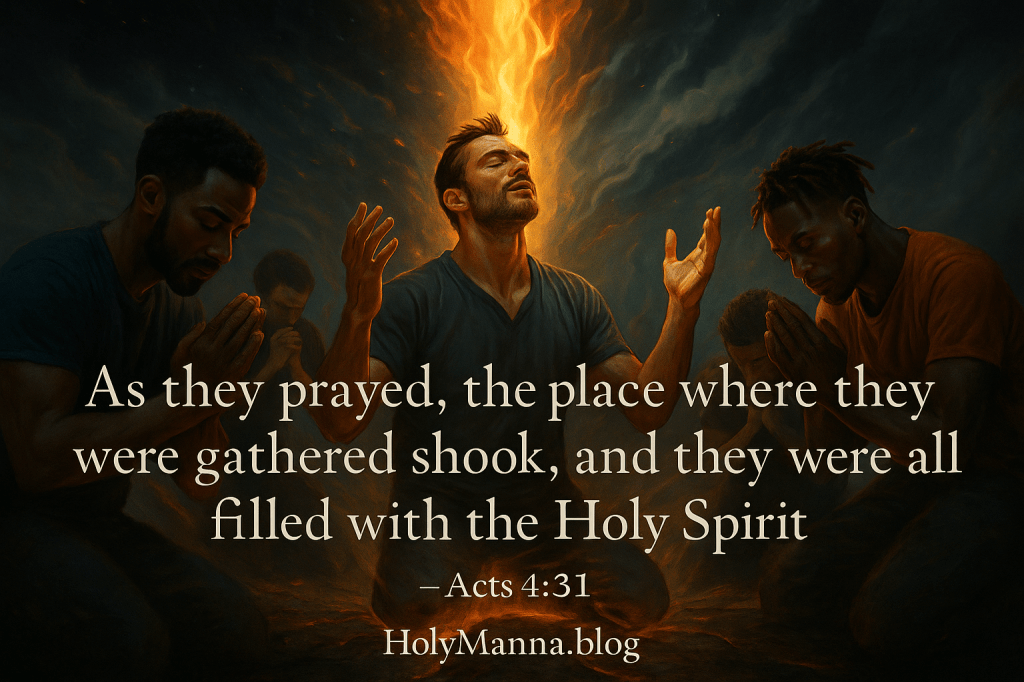
The Bold Rebirth of the Spirit
Have you ever felt the ground shift beneath you—not physically, but spiritually—as if God were awakening something deep within you? Today’s readings invite us into that very kind of holy trembling, where the power of the Holy Spirit doesn’t just comfort but compels, doesn’t merely whisper but roars with courage, clarity, and rebirth. From the early Church to the quiet encounter of Nicodemus in the night, we’re drawn into a divine movement that shakes rooms, melts fear, and demands a new kind of life.
In the Acts of the Apostles, we see the first Christians praying not for escape but for boldness amid persecution. Their prayer is met with a literal shaking of the ground and the outpouring of the Holy Spirit—just as it had been at Pentecost. This courage isn’t self-generated; it’s a gift from above. The Responsorial Psalm, echoed from Psalm 2, reminds us that while nations rage and kings conspire, God’s plan is unshakable. Christ reigns as the anointed King, installed by the Father, and His inheritance is the very nations who mock Him. This royal decree points back to the Messiah and forward to the Church’s mission—fearless and Spirit-filled.
Then, in The Gospel of John, we’re taken into a quiet, almost secretive conversation between Jesus and Nicodemus. This moment is no less revolutionary. Jesus speaks of being “born from above”—not a second physical birth, but a birth in the Spirit, invisible yet unmistakable. The same Spirit that emboldened Peter and John now moves like wind—mysterious and unstoppable—changing hearts from within. Are we open to being shaken? To letting the Spirit remake us with courage and divine clarity? These readings aren’t just stories—they’re an invitation to a life of fearless witness, reborn in the Spirit and set ablaze with purpose.
First Reading – Acts 4:23–31
When the Earth Shakes with the Spirit
The Acts of the Apostles is often referred to as the Gospel of the Holy Spirit. Written by St. Luke, it serves as a continuation of The Gospel of Luke, documenting the birth and explosive growth of the early Church after the Ascension of Christ. In today’s reading, we are placed in the aftermath of Peter and John’s bold defense before the Sanhedrin, the ruling religious council. This moment occurs just after the healing of a crippled man at the temple gate, which sparked both awe among the people and anger from the authorities. The apostles return to the Christian community, and what follows is not despair, but an eruption of Spirit-led courage. This passage echoes both the persecution of Christ and the fulfillment of Psalm 2, revealing the continuity between the Old Covenant and the New. Here, we see the infant Church leaning entirely on God in prayer, drawing strength from Him rather than fear from the world. It is a stunning example of what it means to be born from above—to act not from the flesh but from the Spirit.
Acts 4:23-31
New American Bible (Revised Edition)
Prayer of the Community. 23 After their release they went back to their own people and reported what the chief priests and elders had told them. 24 And when they heard it, they raised their voices to God with one accord and said, “Sovereign Lord, maker of heaven and earth and the sea and all that is in them, 25 you said by the holy Spirit through the mouth of our father David, your servant:
‘Why did the Gentiles rage
and the peoples entertain folly?
26 The kings of the earth took their stand
and the princes gathered together
against the Lord and against his anointed.’
27 Indeed they gathered in this city against your holy servant Jesus whom you anointed, Herod and Pontius Pilate, together with the Gentiles and the peoples of Israel, 28 to do what your hand and [your] will had long ago planned to take place. 29 And now, Lord, take note of their threats, and enable your servants to speak your word with all boldness, 30 as you stretch forth [your] hand to heal, and signs and wonders are done through the name of your holy servant Jesus.” 31 As they prayed, the place where they were gathered shook, and they were all filled with the holy Spirit and continued to speak the word of God with boldness.
Detailed Exegesis
Verse 23 – “After their release they went back to their own people and reported what the chief priests and elders had told them.”
This verse reflects the deep communal nature of the early Church. Peter and John don’t isolate or strategize alone; they return to the body of believers, highlighting the unity and shared mission that marks the Christian life.
Verse 24 – “And when they heard it, they raised their voices to God with one accord and said, ‘Sovereign Lord, maker of heaven and earth and the sea and all that is in them,’”
In the face of threat, the community’s first instinct is not to plot revenge or flee—it’s to pray. Their prayer begins with praise, acknowledging God’s absolute authority as Creator. This sets the tone: their trust is in divine sovereignty, not human power.
Verse 25 – “you said by the holy Spirit through the mouth of our father David, your servant: ‘Why did the Gentiles rage and the peoples entertain folly?’”
The community quotes Psalm 2, recognizing that what is happening is not new. This has always been the pattern: the nations rage, but God’s plan endures. The prayer draws directly from Scripture, revealing a Church rooted in the Word.
Verse 26 – “‘The kings of the earth took their stand and the princes gathered together against the Lord and against his anointed.’”
The reference to opposition against the Anointed (Messiah) reminds the believers that just as Jesus was resisted, so too will His followers be. But the underlying message is one of hope—God is not surprised by resistance; He has already overcome it.
Verse 27 – “Indeed they gathered in this city against your holy servant Jesus whom you anointed, Herod and Pontius Pilate, together with the Gentiles and the peoples of Israel,”
This verse underscores the collaboration of both Jewish and Gentile leaders in Christ’s crucifixion, a key moment of universal rebellion. Yet, this was not outside of God’s plan—it was the very means of redemption.
Verse 28 – “to do what your hand and [your] will had long ago planned to take place.”
Here, the Church acknowledges divine providence. Even the evil intentions of men were mysteriously used by God to accomplish salvation. This is a declaration of trust in the hidden yet perfect wisdom of God.
Verse 29 – “And now, Lord, take note of their threats, and enable your servants to speak your word with all boldness,”
Rather than asking for protection or ease, they ask for boldness. The Greek word here, parrhesia, means fearless confidence in proclaiming the truth. This is the true mark of being born of the Spirit.
Verse 30 – “as you stretch forth [your] hand to heal, and signs and wonders are done through the name of your holy servant Jesus.”
Their mission is not only to speak but to heal. They ask God to accompany their words with visible acts of mercy and divine power, validating the truth they proclaim.
Verse 31 – “As they prayed, the place where they were gathered shook, and they were all filled with the holy Spirit and continued to speak the word of God with boldness.”
God responds dramatically—the very earth trembles as a sign of divine presence. They are filled anew with the Holy Spirit, and the prayer is instantly fulfilled. This is the early Church in full supernatural motion.
Teachings
The Catechism of the Catholic Church emphasizes the importance of the Holy Spirit in the life of the Church and in the life of every believer: “The Holy Spirit, whom Christ the head pours out on his members, builds, animates, and sanctifies the Church” (CCC 747). In this reading, we see the Spirit animating the Church with boldness and unity. The Spirit is not a passive comforter but an active fire, inspiring courage in the face of persecution.
St. John Chrysostom, in his homilies on Acts, notes: “Observe how their confidence increases as they are filled with the Spirit: they are now more fervent, more ready to suffer, more powerful in their preaching. Grace does not make us timid—it makes us lions.” The shaking of the room is not symbolic only; it is the manifestation of heaven responding to faith-filled prayer.
Historically, this passage has often been revisited during times of Christian persecution. From the Roman Empire to modern totalitarian regimes, the Church has drawn strength from this text. It reminds us that our mission is not to survive but to witness—boldly, joyfully, and with full trust that God is with us.
Reflection
This reading challenges us to examine the foundation of our faith. Do we pray for boldness or only for safety? Do we respond to pressure with fear, or with a Spirit-led fire? The early Christians knew the cost of discipleship, but they also knew the power of prayer and the reality of the Holy Spirit.
In our daily lives, speaking the truth with love—at work, in our families, or on social media—can feel risky. But this passage shows us that God honors bold, faith-filled witness. We don’t have to be perfect orators. We simply need to ask, as the early Church did, for the grace to speak His Word with courage.
Today, take a moment to pray like the apostles. Ask the Holy Spirit to shake your soul, to fill you with confidence, and to open your lips to proclaim Christ with love and boldness. What would your life look like if fear no longer had a say? Let the ground of your heart be moved today.
Responsorial Psalm – Psalm 2:1–9
The Anointed King in a World That Rebels
Psalm 2 is one of the most important messianic psalms in the Old Testament, often read through a prophetic lens by the early Church. Attributed to King David, it was originally composed as a royal coronation hymn, declaring God’s sovereign installation of the king in Zion. However, early Christians, guided by the Holy Spirit, came to see this Psalm as fulfilled not in David or Solomon, but in Jesus Christ—the true Anointed One (Messiah). Culturally, Israelite kings were seen as sons of God by adoption, but Christ alone is the eternally begotten Son. Today’s selection of Psalm 2 fits seamlessly with the theme of Spirit-empowered boldness in the face of worldly opposition. It was directly quoted in the first reading from Acts 4, linking the early Church’s suffering to the ancient pattern of resistance to God’s reign. The psalm reminds us that human rebellion cannot overthrow divine authority. Christ reigns as King, and we, by baptism and Spirit, share in His royal mission.
Psalm 2:1-9
New American Bible (Revised Edition)
A Psalm for a Royal Coronation
1 Why do the nations protest
and the peoples conspire in vain?
2 Kings on earth rise up
and princes plot together
against the Lord and against his anointed one:
3 “Let us break their shackles
and cast off their chains from us!”
4 The one enthroned in heaven laughs;
the Lord derides them,
5 Then he speaks to them in his anger,
in his wrath he terrifies them:
6 “I myself have installed my king
on Zion, my holy mountain.”
7 I will proclaim the decree of the Lord,
he said to me, “You are my son;
today I have begotten you.
8 Ask it of me,
and I will give you the nations as your inheritance,
and, as your possession, the ends of the earth.
9 With an iron rod you will shepherd them,
like a potter’s vessel you will shatter them.”
Detailed Exegesis
Verse 1 – “Why do the nations protest and the peoples conspire in vain?”
This opening line is rhetorical and charged with divine irony. The word “vain” implies futility. Despite appearances, resistance to God’s plan is ultimately ineffective. This aligns with Acts 4, where threats from religious authorities are real but ultimately powerless against the Spirit.
Verse 2 – “Kings on earth rise up and princes plot together against the Lord and against his anointed one:”
Here we see political and earthly powers uniting in rebellion. Historically, this may have referenced Gentile nations around Israel, but in a messianic light, it refers to Jesus’ trial under Herod and Pilate. The early Church saw this as a timeless truth—those in power often resist God’s authority.
Verse 3 – “Let us break their shackles and cast off their chains from us!”
This is the voice of the rebels. What God calls covenant and freedom, the world sees as bondage. It echoes the modern mindset that views divine law as restrictive. But as St. Augustine taught, “You have made us for yourself, O Lord, and our heart is restless until it rests in you.” True freedom comes in submission to God’s will.
Verse 4 – “The one enthroned in heaven laughs; the Lord derides them,”
God’s response is not anxious or reactionary. His laughter is not mockery, but a statement of sovereignty. He is not shaken by rebellion. This is an assurance to the faithful: the victory is already secured in heaven.
Verse 5 – “Then he speaks to them in his anger, in his wrath he terrifies them:”
This verse reveals that God’s justice is not indifferent. While He is patient, He is not passive. Those who persist in rebellion will encounter divine judgment. Yet His anger is always rooted in love and justice, never cruelty.
Verse 6 – “I myself have installed my king on Zion, my holy mountain.”
This is the central declaration: God chooses and installs His King. In Jewish thought, Zion is the symbol of God’s dwelling and rule. For Christians, this King is Christ, enthroned not on a palace chair but on the Cross and Resurrection.
Verse 7 – “I will proclaim the decree of the Lord, he said to me, ‘You are my son; today I have begotten you.’”
This verse is echoed in Hebrews 1:5 and Acts 13:33 as referring to Jesus. It marks Him as the eternal Son, not by adoption but by divine nature. This affirms His identity and authority as King over all creation.
Verse 8 – “Ask it of me, and I will give you the nations as your inheritance, and, as your possession, the ends of the earth.”
The Messiah’s dominion is universal. No nation is outside His reach. This gives the Church her missionary mandate—to proclaim Christ to every people and culture as their true King and Savior.
Verse 9 – “With an iron rod you will shepherd them, like a potter’s vessel you will shatter them.”
The shepherd’s rod here is not only for guidance but for discipline. Christ’s reign includes justice. Yet the rod is wielded by a Good Shepherd who lays down His life for the sheep. The shattering of pottery speaks to the fragility of human pride before divine truth.
Teachings
The Catechism of the Catholic Church teaches that Christ is the Lord of history and the King of the universe: “Christ is Lord of the cosmos and of history, in him human history and indeed all creation are ‘set forth’ and transcendently fulfilled” (CCC 668). This Psalm points to that lordship and invites us to submit not out of fear, but out of reverence and joy. The King installed on Zion is not a tyrant but the Redeemer who invites all to share in His victory.
St. Cyril of Jerusalem taught, “He is called the Anointed because He is not king by nature, but by anointing with the Spirit of God.” The Church believes this anointing is not just historical but ongoing in the lives of the baptized. Every Christian is anointed with the Spirit and shares in Christ’s threefold office as priest, prophet, and king. Thus, we are not spectators to Psalm 2—we are participants in its fulfillment.
Historically, Psalm 2 was sung during coronations, but the early Church sang it with new understanding. When persecution rose, this Psalm was often a source of comfort and resolve. Even today, in places where Christians suffer under oppression, these words are whispered in hope: “I myself have installed my king on Zion”. Christ reigns, even when it seems the world is winning.
Reflection
This Psalm confronts us with a powerful question: Who reigns in my heart—Christ or my own will? The world offers many false kings—power, pleasure, prestige—but only one true King brings peace and eternal inheritance. When we resist God’s reign, we place ourselves in the company of those who rage in vain. But when we submit to Christ’s gentle authority, we find our true identity and mission.
We’re also invited to pray with boldness, just like the early Church did. Do we believe that Christ has authority over our fears, our relationships, our future? Are we willing to proclaim Him in a world that often laughs at His name? Ask today for the Spirit to give you courage to live as a son or daughter of the King.
Let this Psalm shake your complacency and stir your soul. What would it look like to live with the certainty that Christ reigns—not just in heaven, but here, now, through you? Submit, proclaim, rejoice: the King is on His throne.
Holy Gospel – John 3:1–8
Born from Above
In this passage from The Gospel of John, we are brought into a deeply personal and mysterious exchange between Jesus and a Pharisee named Nicodemus. John’s Gospel, known for its theological richness and symbolic depth, is markedly different from the synoptic Gospels. Written later, likely in the 90s A.D., John focuses on revealing Jesus’ divine identity and invites readers into intimate moments that unveil profound truths. This scene unfolds at night—a detail that carries symbolic weight. Night represents secrecy, uncertainty, and the condition of Nicodemus’ heart: curious but still in the dark. As a Pharisee and member of the Sanhedrin, Nicodemus holds a position of religious authority, yet he approaches Jesus with humility, recognizing the signs that point to God’s presence. What follows is one of the most theologically loaded dialogues in the New Testament. It brings to the surface the central theme of today’s liturgy: the necessity of spiritual rebirth through the Holy Spirit, a birth that enables fearless witness and new life in Christ.
John 3:1-8
New American Bible (Revised Edition)
Nicodemus. 1 Now there was a Pharisee named Nicodemus, a ruler of the Jews. 2 He came to Jesus at night and said to him, “Rabbi, we know that you are a teacher who has come from God, for no one can do these signs that you are doing unless God is with him.” 3 Jesus answered and said to him, “Amen, amen, I say to you, no one can see the kingdom of God without being born from above.” 4 Nicodemus said to him, “How can a person once grown old be born again? Surely he cannot reenter his mother’s womb and be born again, can he?” 5 Jesus answered, “Amen, amen, I say to you, no one can enter the kingdom of God without being born of water and Spirit. 6 What is born of flesh is flesh and what is born of spirit is spirit. 7 Do not be amazed that I told you, ‘You must be born from above.’ 8 The wind blows where it wills, and you can hear the sound it makes, but you do not know where it comes from or where it goes; so it is with everyone who is born of the Spirit.”
Detailed Exegesis
Verse 1 – “Now there was a Pharisee named Nicodemus, a ruler of the Jews.”
Nicodemus is introduced with two identifiers: Pharisee and ruler. This tells us he was well-versed in the Law and held a position of power. His coming to Jesus is surprising, as Pharisees were generally skeptical of Christ. His openness is notable—he seeks truth beyond institutional boundaries.
Verse 2 – “He came to Jesus at night and said to him, ‘Rabbi, we know that you are a teacher who has come from God, for no one can do these signs that you are doing unless God is with him.’”
Night indicates fear or caution, but also a desire to encounter light. Nicodemus respectfully calls Jesus Rabbi and acknowledges His divine origin based on His miracles—signs. This is an intellectual beginning, but Jesus calls him deeper.
Verse 3 – “Jesus answered and said to him, ‘Amen, amen, I say to you, no one can see the kingdom of God without being born from above.’”
Jesus uses Amen, amen to signify the gravity of His statement. The phrase “born from above” (Greek: anōthen) can mean both “again” and “from above.” Jesus isn’t calling for physical repetition, but a spiritual rebirth initiated by God.
Verse 4 – “Nicodemus said to him, ‘How can a person once grown old be born again? Surely he cannot reenter his mother’s womb and be born again, can he?’”
Nicodemus misunderstands Jesus literally, which is typical of Johannine dialogues. His question reveals the limitations of human logic when faced with divine mystery. Rebirth isn’t physical—it’s spiritual, and it’s transformative.
Verse 5 – “Jesus answered, ‘Amen, amen, I say to you, no one can enter the kingdom of God without being born of water and Spirit.’”
This verse points to Baptism—the sacrament that brings new life through water and the Holy Spirit. Entry into the Kingdom is not by heritage or law-keeping, but by sacramental rebirth. The early Church saw this as a clear reference to Christian initiation.
Verse 6 – “What is born of flesh is flesh and what is born of spirit is spirit.”
Here Jesus contrasts natural birth with spiritual birth. Flesh here refers to fallen human nature, incapable of reaching God on its own. Only the Spirit can give rise to spiritual life.
Verse 7 – “Do not be amazed that I told you, ‘You must be born from above.’”
Jesus challenges Nicodemus not to be astonished. This rebirth is not optional—it’s essential. Wonder is appropriate, but not resistance. Christ is inviting him into a new way of seeing, living, and believing.
Verse 8 – “The wind blows where it wills, and you can hear the sound it makes, but you do not know where it comes from or where it goes; so it is with everyone who is born of the Spirit.”
This poetic image reveals the mysterious freedom of the Holy Spirit. Like the wind (pneuma in Greek, which also means spirit), the Spirit moves invisibly but powerfully. Those born of the Spirit are unpredictable to the world, yet deeply rooted in God’s movement.
Teachings
The Catechism of the Catholic Church affirms the necessity of Baptism for salvation and introduces it as a gateway to life in the Spirit: “Holy Baptism is the basis of the whole Christian life, the gateway to life in the Spirit… through Baptism we are freed from sin and reborn as sons of God; we become members of Christ, are incorporated into the Church and made sharers in her mission” (CCC 1213). Jesus’ words to Nicodemus are foundational for this teaching. Rebirth through “water and Spirit” is not a metaphor—it is the very essence of Christian initiation.
St. Gregory of Nazianzus, speaking of Baptism, said: “Baptism is God’s most beautiful and magnificent gift… a delight to the soul, the remission of sins, the beginning of spiritual progress.” Nicodemus’ journey is our own—moving from curiosity to conviction, from shadow to sacrament. Jesus doesn’t shame his ignorance but invites him into divine intimacy.
Historically, the early Church read this Gospel on the eve of Easter, especially during the baptism of catechumens. It remains part of the lectionary for the Easter season because it speaks directly to the new life we receive in Christ. To be “born from above” is to become a new creation—a citizen of the Kingdom, empowered by the same Spirit who emboldened the apostles in Acts.
Reflection
Nicodemus came to Jesus in darkness, but he left marked by the light. How often do we approach Christ with questions but resist His answers because they demand a change in us? Jesus’ call to be born of water and Spirit challenges every comfort zone, every worldly identity, and invites us to receive a new heart, new mind, new purpose.
This Gospel teaches that spiritual life is not self-made. We cannot reform ourselves into saints; we must be reborn by the Spirit. The wind of the Spirit does not wait for our permission. Are we open to where He may lead us—even if it’s into unknown places of mission, healing, or forgiveness?
Today, take time to reflect on your own Baptism. Do you live as someone reborn from above? Are you yielding to the Spirit’s movement in your life, or clinging to the flesh? Let the mystery of Nicodemus awaken in you a desire to surrender fully, to let the wind blow freely—and to live boldly as one born again in the Spirit.
Let the Wind Shake You
Today’s readings form a beautiful and challenging invitation to step out of fear, step into the Spirit, and let God remake us from the inside out. In Acts 4, we witnessed a Church that doesn’t cower in the face of threats but prays for boldness—and receives it through a shaking, fiery outpouring of the Holy Spirit. Psalm 2 reminded us that while the world may rage and plot in vain, Christ reigns as the Anointed King, and His dominion will not be overthrown. Finally, in The Gospel of John, we were led by night into a quiet, life-changing conversation where Jesus reveals that only by being born from above, through water and Spirit, can we see and enter the Kingdom of God.
Each reading highlights a movement from the human to the divine—from confusion to clarity, from fear to fortitude, from flesh to Spirit. They call us to recognize that we are not meant to merely survive this life—we are meant to live boldly, reborn, and empowered by the Holy Spirit. The Kingdom of God is not just a future hope—it is breaking into the present through people who let the Spirit breathe through them.
Are you letting the Spirit shape your words, your courage, your desires? What would your life look like if you truly lived as one who is born from above? Today, let your prayer echo the apostles’: “Enable your servants to speak your word with all boldness”. Ask the Lord to shake the ground of your heart, to break your chains of fear, and to send you out—newborn in Spirit, fearless in love, and confident in your King.
Engage with Us!
We’d love to hear how today’s Scriptures stirred your heart. Did a verse speak directly to your situation? Did the Spirit nudge you toward something new or bold? Share your thoughts, questions, or prayer intentions in the comments below—we journey better together.
Reflection Questions:
First Reading – Acts 4:23–31
When faced with opposition or fear, do you turn to prayer first like the early Church? Have you ever asked the Holy Spirit for boldness? What happened when you did? What might it look like for your home, workplace, or church to be “shaken” by God’s presence?
Responsorial Psalm – Psalm 2:1–9
Where in your life have you witnessed resistance to God’s reign—either internally or around you? Do you trust that Christ is truly King over your circumstances? What false “kings” compete with Jesus in your heart today?
Holy Gospel – John 3:1–8
What does being “born from above” mean in your current spiritual journey? Are you open to the mysterious movements of the Holy Spirit, even if they disrupt your plans? Like Nicodemus, are you willing to seek Jesus—even in the dark—trusting He will lead you into light?
As you carry these questions into your day, remember: you are not alone, and you are not powerless. You are called to live with holy boldness, guided by the Spirit and rooted in the love of Christ. Let every word, every act, every breath be infused with the mercy, courage, and truth that Jesus Himself taught us. Go forth, Spirit-filled—and let the world see the light that lives in you.
Follow us on Instagram and Facebook for more insights and reflections on living a faith-filled life.

 Holy Manna!
Leave a comment