✨ The Quiet Flame
In the grand procession of popes and saints who have shaped the Church throughout the centuries, there are those who shine like brilliant stars and others who burn with a quieter, steadier flame. Saint Cletus, the third Bishop of Rome, belongs to this latter category. Though often overshadowed by the towering figures of Saint Peter and Saint Paul, Cletus played an indispensable role in anchoring the Church during its infancy. He served during a time when to be a Christian—let alone a leader of Christians—was to live under constant threat. Yet his commitment to the flock, his pastoral leadership, and his ultimate martyrdom reveal a soul deeply conformed to Christ. The Church honors him on April 26, remembering him as both a pope and a martyr—one who nurtured the fragile seed of faith with his very life.
🕊️ From the Streets of Rome
Little is recorded about the early life of Saint Cletus, but what we do know places him squarely in the foundational years of the Church. Born in Rome sometime in the first century, his name, derived from the Greek Anacletus, means “blameless” or “invoked,” a fitting title for a man who would one day guide the Church in a time of danger and growth. Tradition suggests that he may have been converted by the apostles themselves, possibly even by Saint Peter, whose teachings would have deeply shaped Cletus’ understanding of his mission.
After the death of Saint Linus, the second pope, Cletus took on the mantle of leadership in the Church of Rome, most likely around the year AD 76. His papacy, though not extensively documented, was a time of critical structural formation for the Church. He is credited with dividing the city of Rome into twenty-five parishes, a wise move that made pastoral care more effective for a rapidly growing community. Moreover, he ordained priests for these new parishes, ensuring that the sacraments and apostolic teaching were accessible across the city. In this way, Cletus sowed seeds that would blossom into a global Church. He is most known, then, not for dramatic gestures or theological treatises, but for his steady hand in building up the Church’s foundational structures—proof that in God’s plan, even quiet faithfulness echoes through eternity.
🌟 A Hidden Light
Unlike later saints whose lives are adorned with pages of miraculous events, Saint Cletus stands as a more hidden light. There are no individual, dramatic miracles recorded during his lifetime, no healings or visions that have been passed down through the ages. Yet perhaps this is precisely what makes his holiness so accessible to us. His miracle was the miracle of perseverance—the miracle of hope in a time of fear, of stability in a time of chaos.
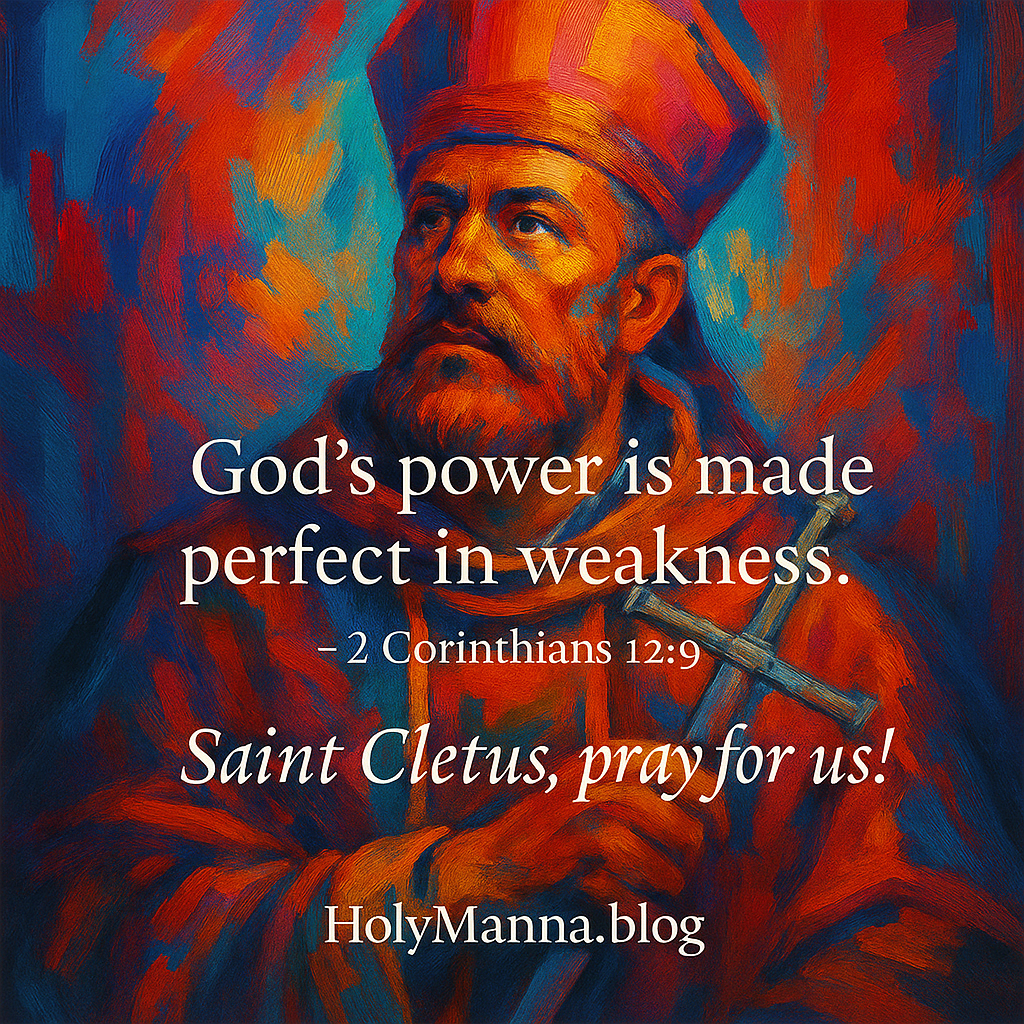
In guiding the Church during one of its most vulnerable periods, Cletus showed us that “God’s power is made perfect in weakness” (cf. 2 Corinthians 12:9). His leadership was itself a work of divine grace. Without fanfare or spectacle, he enacted what the Catechism calls the munus regendi—the pastoral office of guiding the People of God (CCC 894). This is a quiet sanctity that the world often misses, but one that Heaven treasures.
⚔️ The Crown of Witness
The reign of Emperor Domitian was one of increasing hostility toward Christians. Suspicious of any allegiance that rivaled loyalty to the empire, Domitian’s regime viewed the early Church as a dangerous sect. It was in this climate that Pope Cletus shepherded his flock, constantly aware that each Mass could be his last, that each act of pastoral care might bring about arrest or death.
Eventually, the crown of martyrdom found him. Tradition holds that Cletus was seized and beheaded around the year AD 92—a grim but glorious end to a life poured out for Christ. His martyrdom is not merely a biographical detail; it is a theological truth. The Catechism reminds us that “Martyrdom is the supreme witness given to the truth of the faith” (CCC 2473). In choosing death over denial, Cletus became a living homily of hope. His blood joined that of countless early Christians whose sacrifices became the seed of the Church.
His burial near Saint Peter on Vatican Hill reflects both his intimate connection to the apostles and the deep respect with which the early Church regarded his witness. His life and death teach us that holiness is not always loud—but it is always courageous.
🌹 The Silent Legacy
Following his martyrdom, Saint Cletus became a figure of devotion among the early faithful. Although no specific miracles are recorded after his death, the very act of preserving and venerating his tomb near Saint Peter tells us everything we need to know about his enduring influence. For early Christians, to pray near the relics of a martyr was to draw close to Heaven.
Vatican Hill—what is now the spiritual heart of Catholicism—was once a place of tears, prayer, and whispered invocations. Pilgrims came to the tomb of Cletus asking for his intercession, seeking courage, healing, and faith. His presence there, beside the Prince of the Apostles, was a sign of continuity, a reassurance that even in the darkest times, the Church stood firm.
The fact that his name appears in the Roman Canon—the most ancient Eucharistic prayer of the Mass—is a sign of the Church’s deep reverence for his legacy. His inclusion among the saints called upon during the liturgy speaks to the belief that he continues to pray for the Church he once led.
✨ Stone Upon Stone
The life of Saint Cletus invites us to rediscover the beauty of hidden holiness. In a world that prizes visibility, applause, and measurable success, Cletus stands as a quiet reminder that faithfulness is the true mark of greatness. He didn’t perform astonishing public miracles, nor did he write theological masterpieces. Instead, he built, he organized, he ordained, he loved—and he died for Christ.
How many of us are called to this kind of sanctity? The kind that builds the Church stone by stone, visit by visit, prayer by prayer. Are we willing to be faithful even if no one sees? Do we trust that our daily sacrifices, our acts of love and service, matter in the eyes of Heaven?
Saint Cletus challenges us to embrace the small roles we play in God’s plan. Whether we are parents, priests, teachers, or workers, each of us has a parish to care for. And like Cletus, we are called to love it to the end.
💬 Engage with Us!
We’d love to hear from you! Share your thoughts and inspirations in the comments.
Reflection Questions:
- In what ways can you be a “pillar” in your parish or Christian community, like Saint Cletus was for Rome?
- How do you respond to challenges against your faith—silently, boldly, prayerfully?
- What structures or habits can you build in your life that will help others grow in faith, even long after you’re gone?
Let us support one another in this journey, encouraging each other to live our faith boldly, yet humbly. And may we do everything with love—as our Lord Jesus Christ did.
Saint Cletus, pray for us! 🔥
Follow us on Instagram and Facebook for more insights and reflections on living a faith-filled life.

 Holy Manna!
Leave a comment