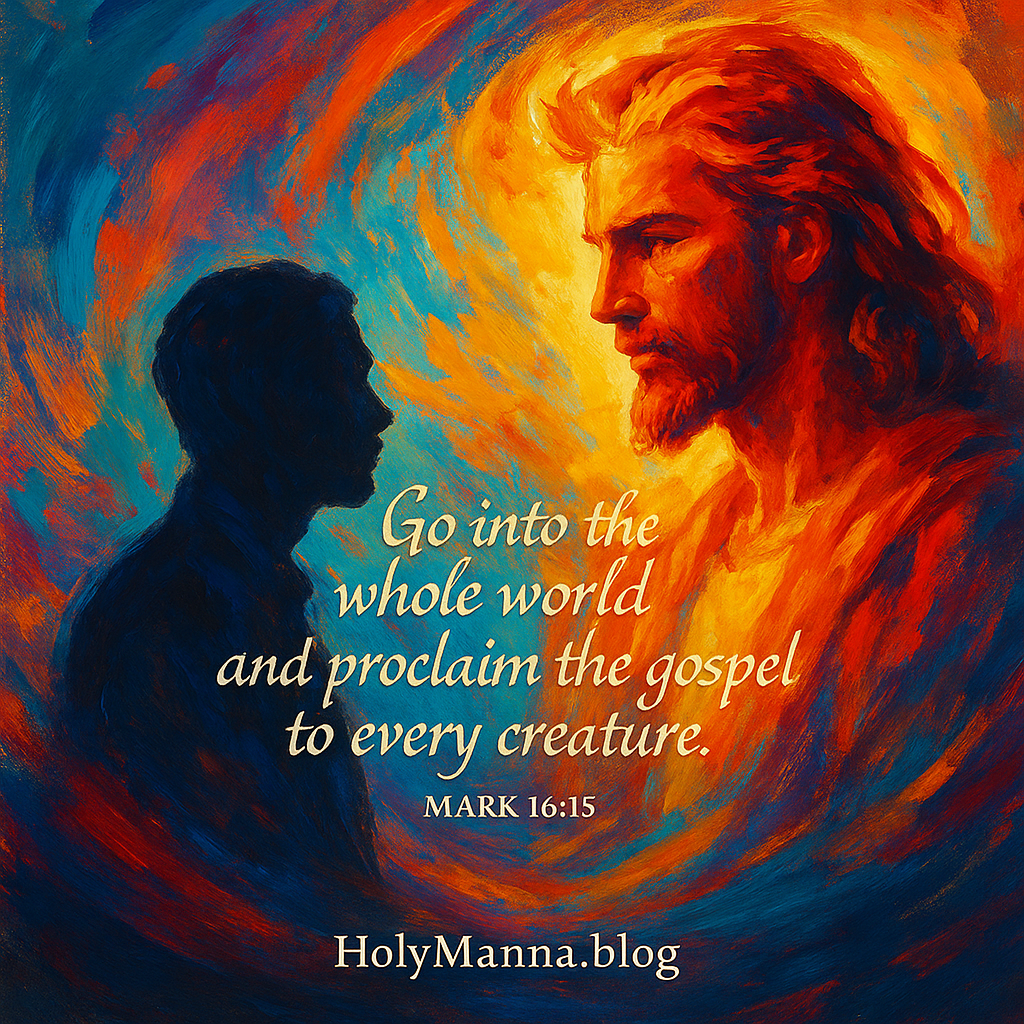
Speaking the Name of Jesus
Have you ever felt the fire of truth burning in your heart, so deeply that remaining silent seemed impossible? Today’s readings call us into that same holy fire—a bold, undeniable encounter with the risen Christ that demands to be proclaimed, even when the world tells us to hush. Through the courage of Peter and John, the victory cry of the Psalmist, and the commissioning of the disciples in The Gospel of Mark, the Church invites us to consider this truth: those who have met the Risen Lord cannot keep quiet about Him.
In Acts of the Apostles, we find ourselves in the charged atmosphere of early Christian persecution. Peter and John, simple fishermen turned fearless preachers, stand before the same Sanhedrin that condemned Jesus. Their testimony is not intellectual argument but Spirit-fueled witness—“It is impossible for us not to speak about what we have seen and heard”. This boldness shocks the religious elite, who recognize the power of Christ still moving through these “ordinary men.” Meanwhile, Psalm 118—a liturgical hymn sung during Jewish feasts like Passover—offers a jubilant echo: “I shall not die but live, and declare the deeds of the Lord”. It’s a psalm of deliverance, reminding us that the God who saves is also the God who sends.
The Gospel of Mark closes the loop with the post-Resurrection appearances of Jesus. Mary Magdalene, the first witness to the empty tomb, is not believed. Nor are the disciples on the road. Jesus rebukes the Eleven for their stubbornness—yet in divine mercy, He still commissions them: “Go into the whole world and proclaim the gospel to every creature”. Despite fear, disbelief, and resistance, the message of Easter breaks forth. These readings challenge us: Have you allowed the truth of the Resurrection to set your heart ablaze? Are you willing to speak of what you have seen and heard, even when the world refuses to believe?
First Reading – Acts 4:13–21
Fearless Fire: When Obedience to God Defies the World
The Acts of the Apostles offers a powerful glimpse into the birth of the Church, filled with the energy of Pentecost and the fire of the Holy Spirit. Set in Jerusalem, this passage occurs shortly after Peter and John heal a man lame from birth at the Temple gate—a public miracle that cannot be denied. Now standing before the Sanhedrin, the same governing religious body that condemned Jesus, the Apostles face intense pressure to silence the message of the Resurrection. This scene captures the tension between divine commission and earthly authority, and it exemplifies what it means to witness Christ with courage. Written by St. Luke, Acts not only documents the spread of the Gospel but also shows how the Holy Spirit empowers the unlikeliest of men to become vessels of divine truth. This passage resonates perfectly with today’s theme: bold proclamation in the face of resistance.
Acts 4:13-21
New American Bible (Revised Edition)
13 Observing the boldness of Peter and John and perceiving them to be uneducated, ordinary men, they were amazed, and they recognized them as the companions of Jesus. 14 Then when they saw the man who had been cured standing there with them, they could say nothing in reply. 15 So they ordered them to leave the Sanhedrin, and conferred with one another, saying, 16 “What are we to do with these men? Everyone living in Jerusalem knows that a remarkable sign was done through them, and we cannot deny it. 17 But so that it may not be spread any further among the people, let us give them a stern warning never again to speak to anyone in this name.”
18 So they called them back and ordered them not to speak or teach at all in the name of Jesus. 19 Peter and John, however, said to them in reply, “Whether it is right in the sight of God for us to obey you rather than God, you be the judges. 20 It is impossible for us not to speak about what we have seen and heard.” 21 After threatening them further, they released them, finding no way to punish them, on account of the people who were all praising God for what had happened.
Detailed Exegesis
Verse 13 – “Observing the boldness of Peter and John and perceiving them to be uneducated, ordinary men, they were amazed, and they recognized them as the companions of Jesus.”
The Sanhedrin is taken aback not by academic prowess but by the Apostles’ courage. Their boldness is evidence of the Holy Spirit, not human wisdom. In Jewish society, rabbis and scholars held authority, so the confident witness of “uneducated” men is both threatening and mystifying. Their identification as companions of Jesus becomes the key to understanding their transformation.
Verse 14 – “Then when they saw the man who had been cured standing there with them, they could say nothing in reply.”
The healed man is living proof of divine intervention. His presence silences opposition because it’s hard to argue against a miracle that everyone in Jerusalem has witnessed. The Gospel always bears fruit that demands a response—either belief or hardened rejection.
Verse 15 – “So they ordered them to leave the Sanhedrin, and conferred with one another,”
This verse reveals the political anxiety within the ruling council. The authorities do not deny the miracle, but they are more concerned with maintaining control than seeking truth. Their deliberation reflects fear—not of God, but of losing influence.
Verse 16 – “What are we to do with these men? Everyone living in Jerusalem knows that a remarkable sign was done through them, and we cannot deny it.”
Even the enemies of the Gospel recognize the power at work. This confession underscores the irony: they know the truth but resist it. The miracle becomes an inconvenience rather than a call to repentance.
Verse 17 – “But so that it may not be spread any further among the people, let us give them a stern warning never again to speak to anyone in this name.”
The name of Jesus is seen as dangerous—too powerful to allow into public discourse. Suppression of truth becomes the method of control. Yet, the Apostles have already tasted the Resurrection; silence is no longer an option.
Verse 18 – “So they called them back and ordered them not to speak or teach at all in the name of Jesus.”
This command reveals the spiritual battle beneath the surface. To ban the name of Jesus is to attempt to extinguish the light of salvation. But obedience to such a command would mean betraying the very One who conquered death.
Verse 19 – “Peter and John, however, said to them in reply, ‘Whether it is right in the sight of God for us to obey you rather than God, you be the judges.’”
Here, Peter and John appeal to a higher court: the divine authority of God. Their rhetorical challenge exposes the absurdity of the Sanhedrin’s command. This echoes The Catechism: “A human being must always obey the certain judgment of his conscience” (CCC 1790).
Verse 20 – “It is impossible for us not to speak about what we have seen and heard.”
This verse is the heart of apostolic mission. To encounter the Risen Lord is to be forever changed. The Apostles are not just telling stories—they are bearing witness to salvation history made flesh. Silence would be betrayal.
Verse 21 – “After threatening them further, they released them, finding no way to punish them, on account of the people who were all praising God for what had happened.”
Public praise for God thwarts the Sanhedrin’s desire to suppress the message. The people’s rejoicing becomes a protective shield for the Apostles. The Gospel has already begun to take root in the hearts of the faithful.
Teachings
The Church has always taught that the proclamation of the Gospel must be grounded in fidelity to Christ and empowered by the Holy Spirit. The Catechism of the Catholic Church states: “It is the Holy Spirit who…enables [the Church] to grow in communion and to serve in mission” (CCC 767). St. John Chrysostom said of the Apostles: “The more they were beaten, the more they rejoiced… For they had been deemed worthy to suffer for the name of Christ.” This fearless proclamation would lay the foundation for the martyrdom of nearly every Apostle, anchoring the Church not in comfort, but in sacrifice. Historically, these early confrontations with Jewish authorities foreshadow centuries of persecution, yet the Church not only survives—it thrives. The blood of the martyrs indeed becomes the seed of the Church.
This passage also illuminates the virtue of fortitude, one of the four cardinal virtues and a gift of the Holy Spirit. Fortitude enables believers to remain firm in the face of difficulty and to stand up for what is right. According to The Catechism, “Fortitude ensures firmness in difficulties and constancy in the pursuit of the good” (CCC 1808). Peter and John exemplify this virtue by prioritizing divine obedience over societal pressure. Their boldness was not rooted in rebellion, but in radical faithfulness to God’s command.
St. Catherine of Siena once wrote: “Be who God meant you to be and you will set the world on fire.” This reading shows two men doing exactly that. They did not wait to be accepted or understood—they simply allowed the Spirit to speak through them. Their courage reminds us that the power of the Gospel is not in clever words, but in lives transformed by the Resurrection. Every baptized Christian is invited into this mission. As Lumen Gentium teaches, “The laity…are called by God to contribute to the sanctification of the world” (LG 31). That sanctification often begins with the willingness to speak the name of Jesus aloud.
Reflection
What in your life is keeping you from proclaiming Christ boldly? Is it fear of rejection? A desire to be liked? A sense of inadequacy? Today’s reading urges us to break free from these chains. Like Peter and John, we may feel “ordinary,” but the Spirit makes us extraordinary. Let us step into each day ready to witness—not with perfection, but with authenticity. When was the last time you spoke the name of Jesus with joy and conviction? What might happen if you allowed the truth of your faith to overflow into your conversations, your workplace, your relationships? This reading dares us to stop hiding and start proclaiming: “It is impossible for us not to speak about what we have seen and heard.”
Responsorial Psalm – Psalm 118:1, 14–21
The Cry of the Redeemed: Living to Declare His Works
Psalm 118 is a hymn of thanksgiving traditionally sung during Jewish liturgical feasts such as Passover. Rooted deeply in Israel’s history, it recounts God’s deliverance from enemies and affliction, and celebrates divine fidelity and triumph. Believed to have been chanted by pilgrims ascending to the Temple, the Psalm’s refrain—“His mercy endures forever”—became an anthem of hope for the oppressed. In the early Church, Psalm 118 was often seen as a prophetic foreshadowing of Christ’s Resurrection, particularly verse 17: “I shall not die but live”. It fits seamlessly with today’s theme of bold proclamation, for it is the song of one who has been saved and now cannot help but declare God’s wonders. Peter and John, standing before the Sanhedrin, are living this Psalm—they proclaim not themselves, but the God who raises up and saves. Psalm 118 gives voice to the heart of every believer who, though chastised, has not been destroyed, and now lives to glorify the Lord.
Psalm 118:1,14-21
New American Bible (Revised Edition)
Hymn of Thanksgiving
1 Give thanks to the Lord, for he is good,
his mercy endures forever.
14 The Lord, my strength and might,
has become my savior.
15 The joyful shout of deliverance
is heard in the tents of the righteous:
“The Lord’s right hand works valiantly;
16 the Lord’s right hand is raised;
the Lord’s right hand works valiantly.”
17 I shall not die but live
and declare the deeds of the Lord.
18 The Lord chastised me harshly,
but did not hand me over to death.
19 Open the gates of righteousness;
I will enter and thank the Lord.
20 This is the Lord’s own gate,
through it the righteous enter.
21 I thank you for you answered me;
you have been my savior.
Detailed Exegesis
Verse 1 – “Give thanks to the Lord, for he is good, his mercy endures forever.”
This opening sets the tone of joyful gratitude. It affirms the foundational truth of God’s nature—His goodness and enduring mercy. In Hebrew, the word for mercy (hesed) implies a steadfast, covenantal love. The psalmist invites the community to enter a posture of thanksgiving, acknowledging God’s unchanging faithfulness.
Verse 14 – “The Lord, my strength and might, has become my savior.”
This verse echoes the Song of Moses in Exodus 15:2, linking God’s deliverance of Israel from Egypt to every moment of personal or communal salvation. The Psalmist is not relying on human power but declares that God Himself is both the source of strength and the means of rescue. For the Christian, this finds its fulfillment in Christ, who becomes our Savior not only by deliverance from enemies but by conquering sin and death.
Verse 15 – “The joyful shout of deliverance is heard in the tents of the righteous: ‘The Lord’s right hand works valiantly;’”
The imagery here shifts to a military or celebratory encampment. The “tents of the righteous” suggests the dwelling places of those who live in covenant with God. Their joy is public and contagious. The “right hand” of the Lord is a biblical symbol of power and authority, indicating divine intervention on behalf of the just.
Verse 16 – “The Lord’s right hand is raised; the Lord’s right hand works valiantly.”
This repetition emphasizes both the act and attitude of divine strength. The “raising” of the Lord’s hand suggests victory, justice, and blessing. It calls the listener to recognize not just what God has done, but who He is—active, present, and powerful in the lives of His people.
Verse 17 – “I shall not die but live, and declare the deeds of the Lord.”
This verse is a profound proclamation of hope. It resonates strongly with the Resurrection and the Apostles’ refusal to be silenced. Life is not merely preserved; it is given so that the works of the Lord may be declared. It shifts the focus from survival to mission: to live is to testify.
Verse 18 – “The Lord chastised me harshly, but did not hand me over to death.”
Here we find a mature theology of suffering. Chastisement is acknowledged as real and even painful, but it is not destructive. The psalmist affirms God’s fatherly correction without losing trust in His mercy. It mirrors Hebrews 12:6: “For whom the Lord loves, he disciplines.”
Verse 19 – “Open the gates of righteousness; I will enter and thank the Lord.”
This plea to enter the gates could reflect the Temple’s literal entrance, or symbolically the way into God’s presence. Righteousness is the entry point—not self-righteousness, but right relationship with God. Thanksgiving becomes the response of the heart that knows it has been received.
Verse 20 – “This is the Lord’s own gate, through it the righteous enter.”
The psalmist clarifies that the path to God’s presence belongs to Him and is opened by Him. Jesus later refers to Himself as the gate in John 10:9: “I am the gate. Whoever enters through me will be saved.” The righteous enter not through their works but by God’s mercy and invitation.
Verse 21 – “I thank you for you answered me; you have been my savior.”
The final verse is deeply personal. Salvation is not an abstract concept but a lived experience. God’s deliverance evokes not only gratitude but renewed trust. This is the heart of worship: to thank God for hearing, saving, and restoring.
Teachings
The Church views the Psalms as the “prayerbook of the Church,” and Psalm 118 in particular is often associated with the Resurrection. The Catechism of the Catholic Church teaches: “The Psalms both nourish and express the prayer of the People of God… Their prayer is inseparably personal and communal; it concerns both those who are praying and all men” (CCC 2587). This Psalm becomes a communal cry of victory after suffering, echoing in the hearts of the Apostles who have witnessed the power of the risen Christ.
The theme of suffering leading to life is central to both the Psalm and the Christian life. St. Augustine wrote: “God had one son on earth without sin, but never one without suffering.” Psalm 118:18 reminds us that chastisement, though difficult, is not punishment—it is purification. In CCC 1431, we read: “Interior repentance is a radical reorientation of our whole life… accompanied by a salutary pain and sadness.” Such transformation leads to deeper union with God, as modeled in this Psalm.
Finally, the repeated references to God’s hand and the imagery of gates draw our attention to divine initiative. It is God who opens the gate, raises His hand, and saves His people. The Church teaches that salvation is a gift of grace: “The initiative belongs to God in the order of grace” (CCC 2027). Like the Apostles, we are invited to step into that grace boldly and joyfully, proclaiming with the psalmist that we live to declare His deeds.
Reflection
How often do you thank God not just for blessings but for deliverance? Have you allowed your own suffering to become a gateway to deeper praise? Psalm 118 challenges us to see beyond the pain of the moment and to recognize the saving hand of God at work. In a world obsessed with comfort and self-preservation, this psalm teaches us to live for something greater—to declare, to testify, to praise. What would it look like if your life became a hymn of thanksgiving? Are there places in your heart that need to echo the psalmist’s cry: “I shall not die but live”? Let us not waste our breath on fear or self-pity. Instead, may we use it to shout for joy in the tents of the righteous, proclaiming: “The Lord’s right hand works valiantly!”
Holy Gospel – Mark 16:9–15
From Fear to Fire: The Mission of the Risen Christ
The closing verses of The Gospel of Mark draw us into the aftermath of the Resurrection, a moment of both awe and confusion for Jesus’ closest followers. These verses are part of what scholars refer to as the “Longer Ending of Mark,” a later addition recognized by the Church and preserved in the canonical text for its powerful summation of the mission given to the Apostles. In these passages, the Risen Christ appears to Mary Magdalene and others, only to find that His followers are struggling to believe the astonishing news. Still, in His mercy, Jesus commissions them to evangelize the world. This Gospel segment fits perfectly into today’s overarching theme: the unstoppable call to proclaim the Resurrection in the face of doubt, fear, and resistance. As with the boldness of Peter and John in Acts, and the victorious tone of Psalm 118, the Gospel of Mark shows us that the risen Jesus calls each of us to speak, to go, and to believe.
Mark 16:9-15
New American Bible (Revised Edition)
The Appearance to Mary Magdalene. 9 When he had risen, early on the first day of the week, he appeared first to Mary Magdalene, out of whom he had driven seven demons. 10 She went and told his companions who were mourning and weeping. 11 When they heard that he was alive and had been seen by her, they did not believe.
The Appearance to Two Disciples. 12 After this he appeared in another form to two of them walking along on their way to the country. 13 They returned and told the others; but they did not believe them either.
The Commissioning of the Eleven. 14 [But] later, as the eleven were at table, he appeared to them and rebuked them for their unbelief and hardness of heart because they had not believed those who saw him after he had been raised. 15 He said to them, “Go into the whole world and proclaim the gospel to every creature.
Detailed Exegesis
Verse 9 – “When he had risen, early on the first day of the week, he appeared first to Mary Magdalene, out of whom he had driven seven demons.”
Mary Magdalene becomes the first witness of the Resurrection—a woman once bound by demonic oppression, now entrusted with proclaiming the greatest news in salvation history. Her encounter affirms the dignity and mission of women in the Church. Jesus chooses her not despite her past, but because of her faithful love and radical transformation.
Verse 10 – “She went and told his companions who were mourning and weeping.”
Mary’s reaction is immediate—she goes to share the news. Yet the disciples are still trapped in grief and disbelief. This verse captures the tension between the Resurrection as a lived reality and the human tendency to cling to sorrow.
Verse 11 – “When they heard that he was alive and had been seen by her, they did not believe.”
The disciples’ disbelief reflects the hardness of heart even among those closest to Jesus. This lack of faith heightens the miracle of their eventual transformation—from frightened men to fearless missionaries. Their journey mirrors our own struggles to believe what seems too good to be true.
Verse 12 – “After this he appeared in another form to two of them walking along on their way to the country.”
This reference connects to the Emmaus story found in Luke 24. Jesus appears “in another form,” suggesting that the Risen Body transcends natural categories. His self-revelation often requires an interior openness that goes beyond physical recognition.
Verse 13 – “They returned and told the others; but they did not believe them either.”
The pattern continues—eyewitnesses share their encounter, yet are met with disbelief. The Gospel subtly critiques a community of faith that is slow to accept the testimony of others. It’s a caution to all of us: Are we truly open to the ways Christ manifests Himself in our lives today?
Verse 14 – “[But] later, as the eleven were at table, he appeared to them and rebuked them for their unbelief and hardness of heart because they had not believed those who saw him after he had been raised.”
Jesus’ rebuke is not condemnation but correction. His disappointment flows from love—He desires faith that trusts in others’ witness. The setting “at table” is significant; Jesus often reveals Himself in shared meals, linking this moment to the Eucharistic reality where faith is renewed.
Verse 15 – “He said to them, ‘Go into the whole world and proclaim the gospel to every creature.’”
Despite their unbelief, Jesus sends them on mission. This is mercy in action. They are commissioned not because of their perfection but because of grace. The Gospel is for every creature—a universal call to proclaim hope to all of creation.
Teachings
The Church teaches that faith is both a gift from God and a human response. The Catechism of the Catholic Church states: “Faith is a personal act—the free response of the human person to the initiative of God who reveals Himself” (CCC 166). In this Gospel, we see faith struggling to take root in the Apostles, yet Jesus does not abandon them. He meets them in their weakness, corrects them, and then entrusts them with the mission of the Church. This affirms the truth that our call to evangelize does not depend on our worthiness, but on God’s faithfulness.
The role of Mary Magdalene as the first witness to the Resurrection also highlights the Church’s recognition of the essential role of women in salvation history. St. Thomas Aquinas called her the “Apostle to the Apostles.” Her transformation from demoniac to disciple reveals the radical mercy of Christ and the dignity He restores. As CCC 641 notes: “Mary Magdalene and the holy women…were the first to encounter the Risen One and thus the first messengers of Christ’s Resurrection for the apostles themselves.”
Jesus’ final commission—“Go into the whole world and proclaim the gospel to every creature”—becomes the foundation for missionary discipleship. The Church has always understood evangelization as essential to its identity. Evangelii Nuntiandi, a key document on evangelization, declares: “The Church exists in order to evangelize” (EN 14). Even today, every baptized person is charged with continuing the mission begun in this Gospel scene—to proclaim with conviction that Christ is risen.
Reflection
Where are you struggling to believe that Christ is truly alive? Are there testimonies you’ve dismissed because they didn’t come in the form you expected? This Gospel challenges us to see that even the first disciples had to overcome doubt before they could proclaim with boldness. Yet the beauty lies in this: Christ met them where they were, and He meets us too. He does not wait for perfect faith—He offers Himself and calls us to respond. Have you heard His voice today? What stops you from sharing your faith, from proclaiming with joy the victories God has worked in your life? The call of the Risen Jesus still rings out: “Go into the whole world and proclaim the gospel to every creature.” Will you answer?
Set on Fire to Speak
Today’s readings come together as a chorus of courageous proclamation, defiant faith, and unshakable joy in the face of fear and disbelief. From the bold defiance of Peter and John before the Sanhedrin in Acts, to the victorious thanksgiving of Psalm 118, and finally the mission given to the doubting disciples in The Gospel of Mark, we are reminded that encountering the Risen Christ changes everything. “It is impossible for us not to speak about what we have seen and heard”, said Peter and John. And so it is for us—we who have been delivered from death into life are called to become living witnesses of God’s mercy and might.
The Lord’s right hand has worked valiantly in our lives, even if we do not always see it. He has chastised us gently, led us through our deserts, and opened the gates of righteousness so that we might enter and give thanks. His mercy endures forever, and His love transforms ordinary men and women into fearless proclaimers of the Gospel. Jesus appeared to the unbelieving and broken, not to shame them, but to empower them. And now, He sends us into the world—to every workplace, every street, every conversation—with the same words: “Go into the whole world and proclaim the gospel to every creature.”
What is holding you back from proclaiming the name of Jesus? Where might the Lord be asking you to open your mouth and speak life into someone’s despair? Let today be the day you stop hiding and start proclaiming. You don’t need to be perfect. You just need to be willing. The tomb is empty. The gates are open. The Spirit is ready. Let your life declare it: “I shall not die but live, and declare the deeds of the Lord.”
Engage with Us!
We’d love to hear how today’s Word has stirred your heart. What stood out to you most from the readings? How is the Holy Spirit inviting you to respond in your daily life? Share your thoughts, prayers, or testimonies in the comments below—we’re walking this journey of faith together, and your voice might be exactly what someone else needs today.
Reflection Questions
First Reading – Acts 4:13–21
Have you ever felt pressured to stay silent about your faith? What gave Peter and John the courage to speak boldly? How can you practice the same obedience to God over human opinion in your own life?
Responsorial Psalm – Psalm 118:1, 14–21
What are the “gates of righteousness” in your life that God is calling you to walk through? In what areas have you experienced the Lord’s deliverance? How can you turn that gratitude into a daily practice of praise and witness?
Holy Gospel – Mark 16:9–15
What prevents you from believing the testimonies of others or your own experiences of God’s presence? Where is Jesus calling you to “go” today to proclaim His love? How can you grow in trust, even in moments of doubt?
May your heart be set on fire by the living Christ, and may your lips never tire of speaking His name. Let your life be a psalm of thanksgiving, your courage a reflection of the Apostles, and your witness a light in a world that hungers for truth. Go forth today with faith, and do all things with the love and mercy Jesus has so generously poured into your soul.
Follow us on Instagram and Facebook for more insights and reflections on living a faith-filled life.

 Holy Manna!
Leave a comment