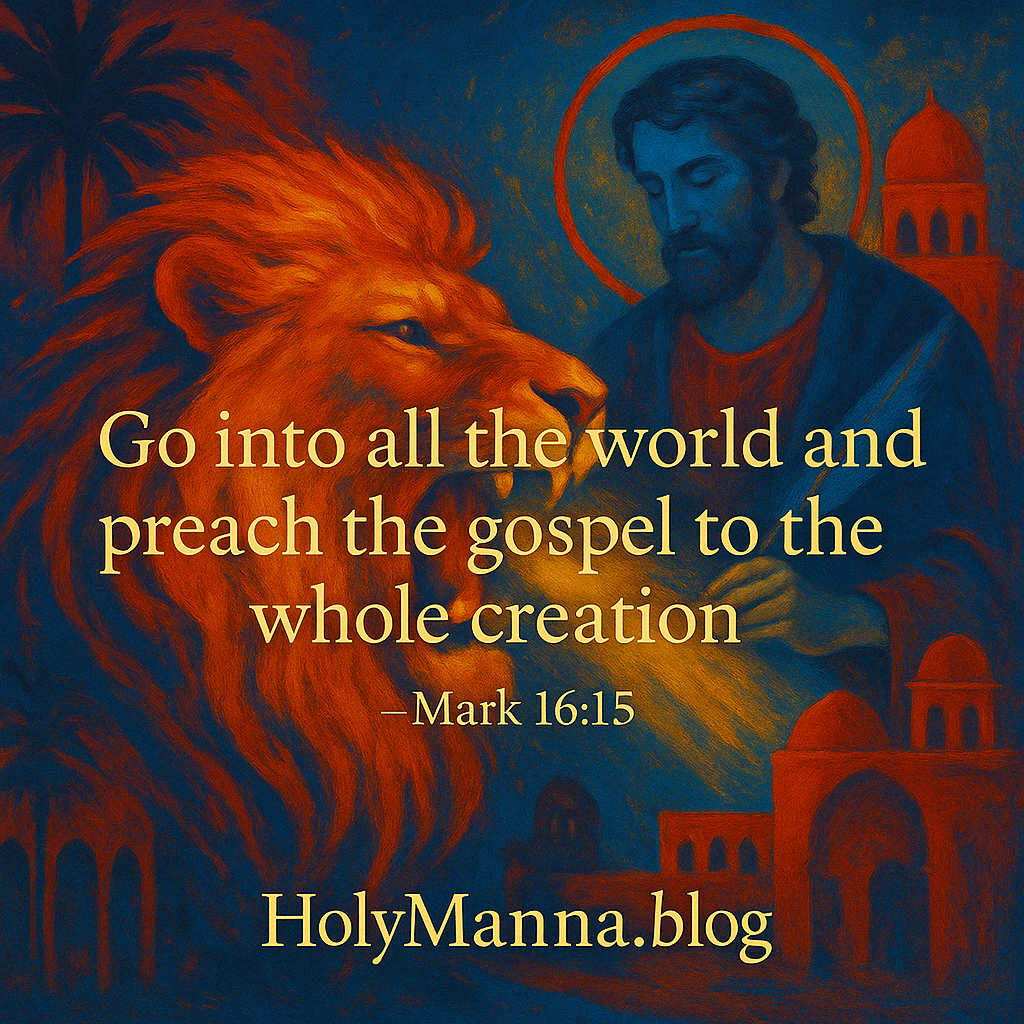
✒️ The Lion Who Roared the Gospel
Among the many pillars of the early Church, few roared with the urgency and power of the Gospel like Saint Mark the Evangelist. Known as the author of The Gospel of Mark, his voice echoes through time, capturing the raw and immediate life of Jesus Christ with unmatched clarity and vigor. His symbol—the lion—reflects not only the boldness of his writing but also the fearless heart he cultivated through grace. Saint Mark is more than a Gospel writer; he is the founder of the Church in Alexandria, a missionary to Africa, a spiritual son of Saint Peter, and a martyr whose blood planted seeds of faith in hostile soil. His witness continues to roar, not with the pride of beasts, but with the humble power of one who bore the Word to the world.
👶 From the Upper Room to the Ends of the Earth
Born as John Mark in Jerusalem, Saint Mark was raised in a devout Jewish household that would soon become a sacred place for the early Church. His mother, Mary, opened her home to the Apostles; it is believed this very home was where the Last Supper was held and where the Holy Spirit descended at Pentecost. From these beginnings, Mark witnessed the birthing pains of Christianity from a front-row seat. His early involvement with Saint Paul and his cousin Barnabas during their first missionary journey seemed promising, but he left the mission prematurely, an action that caused a split between Paul and Barnabas. Yet this moment of human frailty didn’t define him.
What transformed Mark from a timid companion into a Gospel-proclaiming bishop was his deep relationship with Saint Peter, who refers to him affectionately as “my son” in 1 Peter 5:13. Through Peter’s preaching and example, Mark learned not only the teachings of Christ but how to live and die for them. Tradition tells us that Mark took this newfound zeal to Alexandria, Egypt, where he fearlessly preached Christ crucified and risen, converting many and establishing one of the most influential churches in Christian history. His Gospel, the earliest written, is thought to reflect Peter’s own testimony. It is fast-paced, vivid, and focused on the divine action of Jesus—offering us a clear window into the Messiah’s mission.
🌟 Healing Hands, Burning Heart
While the New Testament gives us limited information on the miracles Saint Mark performed during his life, tradition, particularly within the Coptic Orthodox Church, fills in the sacred silence with stories of divine power at work. One of the most cherished is the healing of Anianus, a humble shoemaker in Alexandria. After cutting his hand while working, Anianus encountered Mark, who miraculously healed him in the name of Jesus Christ. This encounter not only restored the shoemaker’s hand but ignited a conversion so complete that Anianus would become Mark’s closest disciple and his successor as bishop.
Saint Mark’s missionary journey in Egypt was marked by signs and wonders. He cast out demons and cured the sick, echoing the very miracles his Gospel so vividly records. His miracles were not grand spectacles but acts of deep compassion that revealed the heart of Christ to a people shrouded in pagan worship. His very presence in Egypt was a miracle—a Jewish Christian boldly preaching monotheism and the crucified Christ in a city dominated by Greco-Roman and Egyptian deities. The courage to work wonders in such a setting came not from personal charisma but from a burning heart consumed by the love of God.
🩸 Dragged but Not Defeated
Saint Mark’s life was not marked by comfort or applause, but by resistance, pain, and ultimate triumph through suffering. His mission in Alexandria stirred both admiration and fury. Pagan priests and Roman authorities viewed his growing influence as a threat. The Gospel he preached challenged not only religious norms but social and political structures. Yet Mark remained unmoved. He preached the truth of Jesus Christ crucified and risen, and this unshakable faith would cost him everything.
According to tradition, around the year 68 AD, during the celebration of the Easter liturgy, a mob seized him. Tying a rope around his neck, they dragged him mercilessly through the city’s cobbled streets. Bloodied and broken, he was thrown into prison where, that night, he received a vision of Christ comforting him and welcoming him home. The next day, the mob resumed their brutality, dragging him again until he gave up his spirit.
His martyrdom was not in vain. Like the grain of wheat that dies to bear much fruit, Mark’s sacrifice became the foundation of the See of Alexandria, one of the five great patriarchates of early Christianity. His example proved that “those who lose their life for My sake will find it” (The Gospel of Matthew 10:39).
✨ The Miraculous Echo of His Witness
Saint Mark’s death did not silence him. Rather, his voice and intercession grew stronger. Devotion to him flourished rapidly, particularly in Alexandria, where the faithful began to report healings and answered prayers through his intercession. The veneration of his relics began early. In the 9th century, in an extraordinary turn of events, two Venetian merchants retrieved his relics from Egypt and smuggled them to Venice by hiding them under pork—a clever move, since Muslim officials inspecting the cargo would not touch the unclean meat.
The relics were placed in the magnificent Basilica di San Marco, which still stands as one of Christendom’s architectural treasures and spiritual centers. Pilgrims from all over the world have traveled to pray before his tomb, many reporting miracles of healing, peace, and spiritual renewal. The city of Venice adopted Saint Mark as its patron saint, his lion symbol becoming the emblem of the Venetian Republic. To this day, he is invoked by Christians seeking courage, clarity in writing or speaking, and a bold faith that can endure persecution.
🪞 Let the Lion Within You Roar
Saint Mark’s life is a testament to second chances, holy courage, and the transformative power of mentorship and mission. He shows us that even when we falter or flee—as he once did—God can redeem our story. Mark’s closeness to Peter is especially encouraging; it was through this wounded but forgiven Apostle that Mark found his voice and mission. Are we not, like Mark, called to listen, learn, and then go forth to proclaim what we have seen and heard?
His Gospel reminds us that Jesus is not distant. He is the Christ who acts, heals, and suffers for us. As Saint Mark once roared the Gospel across Egypt and beyond, so too are we called to lift up our voices—to proclaim Christ crucified with love and conviction in a noisy, distracted world. How can you be a voice for the Gospel in your workplace, your family, your community?
Perhaps it’s time to pray more boldly, speak more gently, and live more authentically. Perhaps it’s time to become, like Mark, a witness of mercy and truth, willing to suffer for the sake of the Kingdom. May Saint Mark pray for us and help us write our own Gospel with the ink of faith and the pen of love.
💬 Engage with Us!
Have you ever felt like Saint Mark—zealous but uncertain?
Has his Gospel changed your understanding of Jesus’ mission?
We’d love to hear your thoughts! Comment below and join the conversation.
Here are three reflection questions to consider:
- When was the last time I boldly shared my faith, like Saint Mark?
- What part of Saint Mark’s story resonates with my current spiritual journey?
- How can I allow the Holy Spirit to speak through me in ordinary situations?
Let us support each other on this journey of faith, encouraging one another to do everything with love, as Christ our Lord did.
Saint Mark, pray for us! 🦁
Follow us on Instagram and Facebook for more insights and reflections on living a faith-filled life.

 Holy Manna!
Leave a comment