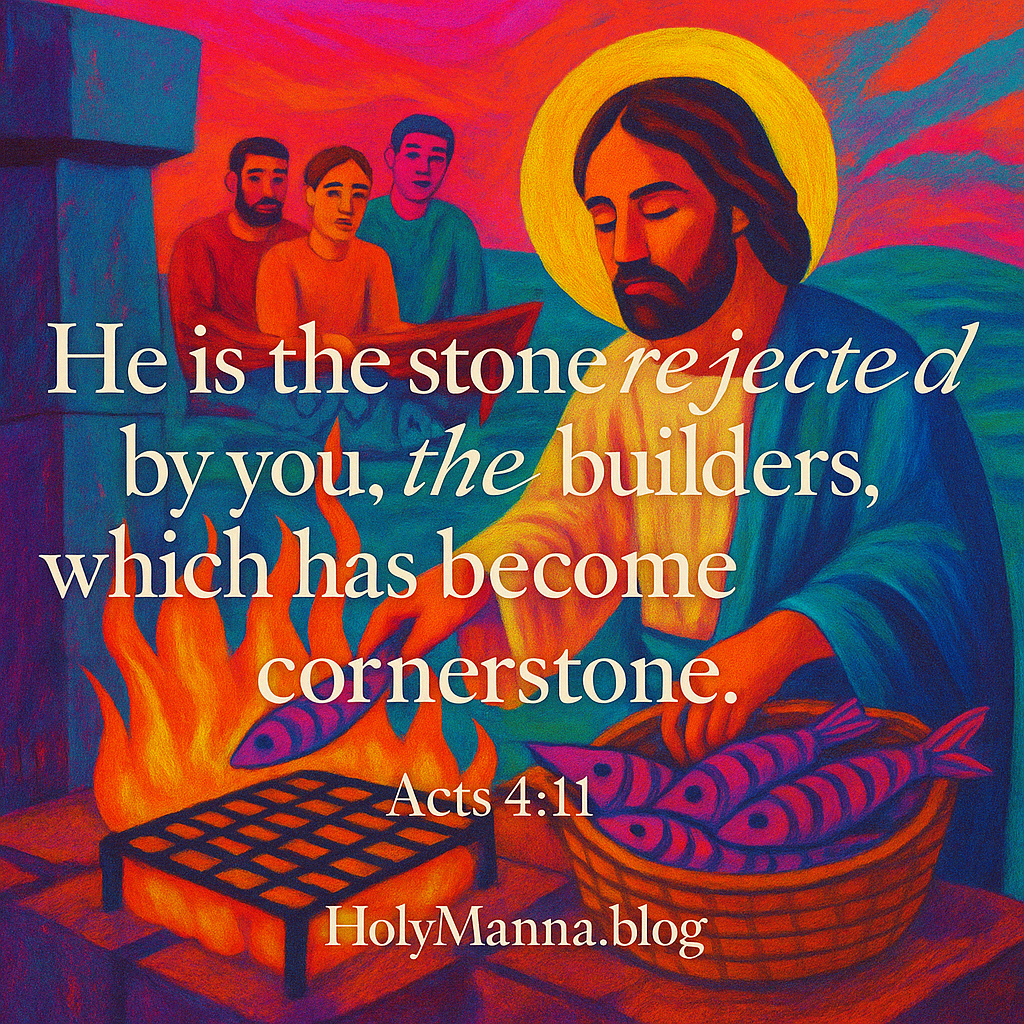
Found, Rejected, Revealed
Have you ever built something—whether a life, a relationship, or a dream—only to find that what you thought was solid wasn’t strong enough to hold it all together? Today’s readings offer us a powerful invitation to reevaluate the foundation of our lives, pointing us toward the one true cornerstone: Jesus Christ, crucified and risen. In the wake of Easter joy, the Church calls us to reflect not only on the victory of the resurrection but on the Person of the Risen Lord—who He is, how He saves, and how He continues to reveal Himself in the everyday lives of His disciples.
The central theme threading through Acts 4:1-12, Psalm 118, and John 21:1-14 is this: Jesus Christ, the stone rejected by men, has become the cornerstone of our salvation and mission. In Acts, Peter and John stand boldly before the Sanhedrin, declaring that the healing of a crippled man was done “in the name of Jesus Christ the Nazorean whom you crucified, whom God raised from the dead” (Acts 4:10). This declaration echoes the words of Psalm 118: “The stone the builders rejected has become the cornerstone” (Psalm 118:22). The Gospel completes this theme with the intimate, post-resurrection appearance of Jesus by the Sea of Tiberias, where He nourishes and re-commissions His apostles in love.
These passages are steeped in religious and historical significance. Peter’s speech occurs in the Temple precincts of Jerusalem—ground zero for both Jewish worship and early Christian persecution. The Sanhedrin’s resistance reflects a broader rejection of Jesus by many religious leaders of His time, yet the apostles proclaim that He alone is the source of healing and salvation. Meanwhile, Psalm 118 was a processional hymn sung during major Jewish feasts like Passover—now reframed in the light of Christ’s resurrection as a song of triumph. And at the Sea of Tiberias, we see the tender mercy of Jesus continuing to unfold: He is not only risen but actively rebuilding His Church from the ashes of fear and failure. What foundations is Christ reestablishing in your life today?
First Reading – Acts 4:1-12
Bold Witness Before the Builders
The Acts of the Apostles, often called the Gospel of the Holy Spirit, chronicles the explosive growth of the early Church after Pentecost. Written by St. Luke, this book follows the apostles—particularly Peter and Paul—as they proclaim the risen Christ and establish Christian communities across the Roman world. Today’s passage places us in Jerusalem, shortly after the miraculous healing of a lame beggar at the Temple gate by Peter and John. The very heart of Jewish worship has now become the stage for a showdown between the old order and the newborn Church. The apostles, untrained men from Galilee, are now boldly preaching salvation in Jesus—a name that threatens the religious elite. This reading reminds us that the cornerstone of faith is not built on human power or institutional prestige, but on the rejected and resurrected Christ. Are we willing to proclaim the name of Jesus, even in places where it is not welcome?
Acts 4:1-12
New American Bible (Revised Edition)
1 While they were still speaking to the people, the priests, the captain of the temple guard, and the Sadducees confronted them, 2 disturbed that they were teaching the people and proclaiming in Jesus the resurrection of the dead. 3 They laid hands on them and put them in custody until the next day, since it was already evening. 4 But many of those who heard the word came to believe and [the] number of men grew to [about] five thousand.
Before the Sanhedrin. 5 On the next day, their leaders, elders, and scribes were assembled in Jerusalem, 6 with Annas the high priest, Caiaphas, John, Alexander, and all who were of the high-priestly class. 7 They brought them into their presence and questioned them, “By what power or by what name have you done this?” 8 Then Peter, filled with the holy Spirit, answered them, “Leaders of the people and elders: 9 If we are being examined today about a good deed done to a cripple, namely, by what means he was saved, 10 then all of you and all the people of Israel should know that it was in the name of Jesus Christ the Nazorean whom you crucified, whom God raised from the dead; in his name this man stands before you healed. 11 He is ‘the stone rejected by you, the builders, which has become the cornerstone.’ 12 There is no salvation through anyone else, nor is there any other name under heaven given to the human race by which we are to be saved.”
Verse-by-Verse Exegesis
Verse 1 – “While they were still speaking to the people, the priests, the captain of the temple guard, and the Sadducees confronted them”
The apostles are interrupted mid-sermon, a sign of the religious leaders’ growing unease. The Sadducees, who denied the resurrection of the dead, were especially disturbed by the message of Christ’s resurrection, which undermined their authority and theology.
Verse 2 – “Disturbed that they were teaching the people and proclaiming in Jesus the resurrection of the dead.”
Teaching in the Temple was reserved for the qualified elite. That Peter and John, mere fishermen, were doing so was both a religious and political provocation. Their message—that Jesus is risen and that this changes everything—was the real scandal.
Verse 3 – “They laid hands on them and put them in custody until the next day, since it was already evening.”
The religious authorities resort to force, imprisoning the apostles as a means of silencing them. But the apostles’ imprisonment cannot contain the Gospel—foreshadowing how persecution will often be the soil in which the Church grows.
Verse 4 – “But many of those who heard the word came to believe and the number of men grew to about five thousand.”
Despite opposition, the Word bears fruit. This mirrors Isaiah’s promise: “So shall my word be… it shall not return to me void” (Isaiah 55:11). The Church, like a mustard seed, is expanding rapidly through the proclamation of the name of Jesus.
Verse 5 – “On the next day, their leaders, elders, and scribes were assembled in Jerusalem”
This is a formal convening of the Sanhedrin—the highest Jewish tribunal. The apostles are being judged by the same body that condemned Jesus. The setting evokes Christ’s own trial, and now His followers face the same scrutiny.
Verse 6 – “With Annas the high priest, Caiaphas, John, Alexander, and all who were of the high-priestly class.”
These powerful names reflect continuity with the passion narrative. Caiaphas presided over Jesus’ trial (see John 18:13), and now he confronts Peter, who once denied Christ in fear but now speaks with Spirit-filled boldness.
Verse 7 – “They brought them into their presence and questioned them, ‘By what power or by what name have you done this?’”
This question unintentionally opens the door to evangelization. In Scripture, a name reveals essence and authority. The Sanhedrin’s demand sets the stage for Peter to proclaim the saving name of Jesus.
Verse 8 – “Then Peter, filled with the Holy Spirit, answered them, ‘Leaders of the people and elders:’”
Peter’s courage is not his own—it is the fruit of Pentecost. The Holy Spirit empowers him to speak truth with clarity and love. This is a fulfillment of Jesus’ promise: “When they hand you over… the Spirit of your Father will speak through you” (Matthew 10:19–20).
Verse 9 – “If we are being examined today about a good deed done to a cripple, namely, by what means he was saved,”
Peter reframes their interrogation: Why are you putting us on trial for healing someone? His rhetorical strategy is brilliant—he leads them to the inescapable conclusion that their opposition is to a work of mercy.
Verse 10 – “Then all of you and all the people of Israel should know that it was in the name of Jesus Christ the Nazorean whom you crucified, whom God raised from the dead; in his name this man stands before you healed.”
This is the heart of the Christian proclamation: the crucified and risen Jesus is the source of all healing and salvation. Peter pulls no punches—he names their sin, but also announces God’s mercy.
Verse 11 – “He is ‘the stone rejected by you, the builders, which has become the cornerstone.’”
Quoting Psalm 118, Peter directly accuses the Sanhedrin—the “builders” of Israel—of rejecting the very foundation of God’s plan. The image of the cornerstone is prophetic: Jesus is the foundation upon which the new Temple—the Church—is built.
Verse 12 – “There is no salvation through anyone else, nor is there any other name under heaven given to the human race by which we are to be saved.”
This is one of the most definitive declarations in all of Scripture. Salvation is found in Christ alone. As the Catechism teaches: “He is the one mediator between God and men” (CCC 480). In a pluralistic world, this truth remains both radical and essential.
Teachings from the Church
The Catechism of the Catholic Church teaches with clarity: “Since the Word became flesh and dwells among us, he is the one, perfect and unsurpassable Word of the Father. In him, he said everything; there will be no other word than this one” (CCC 65). This underscores Peter’s bold claim in verse 12—Jesus is not one of many paths to God. He is the Way. The early Church was unapologetically exclusive about salvation in Christ, not from arrogance, but because of the uniqueness of the Incarnation and Resurrection.
St. John Chrysostom, preaching on this passage, reminds us: “The Apostles did not speak of philosophy or reasoning, but declared what they had seen and experienced. Their power was in the truth, and the truth is Christ.” Peter’s transformation—from a man who denied Christ three times to one who now proclaims Him before the Sanhedrin—is a testament to the grace of Pentecost. His boldness challenges us: Do we believe that the Holy Spirit can transform our fear into courage?
Historically, the persecution of the Church in Jerusalem became the seed of its global mission. Tertullian famously said: “The blood of the martyrs is the seed of the Church.” The apostles’ witness in this moment—public, unwavering, and centered on the name of Jesus—set the tone for the Church’s evangelical mission through every age, including our own.
Reflection
This reading calls us to examine the foundation of our own lives. Is Jesus truly the cornerstone upon which we build our identity, our decisions, and our mission? Peter’s courage did not come from human strength but from the Holy Spirit—do we invite the Spirit to speak through us, especially in uncomfortable situations? Like the apostles, we may face rejection or ridicule, especially when we speak the name of Jesus in a secular culture. But the promise remains: “There is no other name… by which we are to be saved”. This truth is not meant to be hidden, but proclaimed with joy and conviction. Where is God asking you to proclaim His name today, even at a cost? Let us ask for the boldness of Peter, and the faith to build our lives on Christ, the cornerstone who was rejected—yet has become our salvation.
Responsorial Psalm – Psalm 118:1-2, 4, 22-27
The Song of the Cornerstone
Psalm 118 is a triumphal hymn of thanksgiving that was traditionally sung during major Jewish feasts such as Passover, often during processions leading into the Temple. Its verses overflow with praise for God’s enduring mercy and saving power. For centuries, Israel sang this Psalm to celebrate the Lord’s deliverance from enemies and exile, but the early Church recognized its deeper, prophetic fulfillment in the death and resurrection of Jesus Christ. Today’s selected verses powerfully align with the theme of Jesus as the cornerstone—once rejected, now exalted—and express the joy and awe that spring from encountering the risen Lord. In the context of Easter, this Psalm becomes a liturgical and personal celebration: “This is the day the Lord has made”, the day of resurrection, the dawn of new life, and the foundation of our hope.
Psalm 118:1-2, 4, 22-27
New American Bible (Revised Edition)
Hymn of Thanksgiving
1 Give thanks to the Lord, for he is good,
his mercy endures forever.
2 Let Israel say:
his mercy endures forever.
4 Let those who fear the Lord say,
his mercy endures forever.
22 The stone the builders rejected
has become the cornerstone.
23 By the Lord has this been done;
it is wonderful in our eyes.
24 This is the day the Lord has made;
let us rejoice in it and be glad.
25 Lord, grant salvation!
Lord, grant good fortune!
26 Blessed is he
who comes in the name of the Lord.
We bless you from the house of the Lord.
27 The Lord is God and has enlightened us.
Join in procession with leafy branches
up to the horns of the altar.
Verse-by-Verse Exegesis
Verse 1 – “Give thanks to the Lord, for he is good, his mercy endures forever.”
This opening refrain is both a command and a confession of faith. The Hebrew word for “mercy” is hesed, meaning steadfast love or covenantal loyalty. The psalmist invites us to respond to God’s goodness with gratitude, acknowledging that His love is not fleeting but eternal.
Verse 2 – “Let Israel say: his mercy endures forever.”
The community of Israel, chosen and formed by God, is called to proclaim this truth collectively. This verse emphasizes communal worship and reminds us that recognizing God’s enduring mercy is not just personal, but ecclesial—a shared testimony among God’s people.
Verse 4 – “Let those who fear the Lord say, his mercy endures forever.”
This call widens the circle beyond Israel to all God-fearing people. In Christian interpretation, this points to the Gentiles being invited into the covenant through Christ. The Church, born from the side of Christ on the Cross, includes all who revere the Lord.
Verse 22 – “The stone the builders rejected has become the cornerstone.”
This verse is a direct prophecy fulfilled in Jesus Christ. The “builders”—the religious authorities—rejected Him, yet God chose Him as the foundational stone of salvation. Peter quotes this verse in Acts 4:11, testifying to its Christological significance.
Verse 23 – “By the Lord has this been done; it is wonderful in our eyes.”
This is not human accomplishment—it is divine intervention. The resurrection is the Lord’s doing, and it inspires wonder. The Greek word for “wonderful” (thaumastos) denotes something that causes awe and reverence. The Paschal Mystery is God’s masterpiece.
Verse 24 – “This is the day the Lord has made; let us rejoice in it and be glad.”
This is the Church’s Easter anthem. The “day” is not just a 24-hour period but the age of salvation inaugurated by Christ’s resurrection. Every Sunday—the Lord’s Day—is a mini-Easter, a renewal of joy in the Risen One.
Verse 25 – “Lord, grant salvation! Lord, grant good fortune!”
This is a liturgical plea, known in Hebrew as Hosanna. It was shouted by the crowds on Palm Sunday as Jesus entered Jerusalem. The psalmist cries out for divine rescue and blessing, pointing to our dependence on God’s saving action.
Verse 26 – “Blessed is he who comes in the name of the Lord. We bless you from the house of the Lord.”
This verse was also used during Jesus’ triumphal entry and echoes in every Mass before Communion: “Blessed is he who comes in the name of the Lord”. It acknowledges Jesus as the anointed one, welcomed into the Temple of our hearts.
Verse 27 – “The Lord is God and has enlightened us. Join in procession with leafy branches up to the horns of the altar.”
This verse depicts a celebratory procession, reminiscent of the Feast of Tabernacles and Palm Sunday. “Enlightened” evokes the illumination of Christ, the Light of the world. The leafy branches symbolize joy and victory, culminating in sacrifice at the altar—ultimately fulfilled in the Cross and the Eucharist.
Teachings from the Church
The Catechism of the Catholic Church teaches that the Psalms are the heart of the prayer of the people of God, both in the Old and New Covenants: “The Psalms both nourish and express the prayer of the People of God… The Psalms are an essential and permanent element of the prayer of the Church” (CCC 2586). Psalm 118 is one of the most often-quoted Psalms in the New Testament, used by Jesus and the apostles to interpret His Passion and Resurrection.
St. Augustine saw in this Psalm a vision of Christ’s victory: “The Lord rose again, and this is the day. Let us rejoice and be glad, for we have been led back to life, back to hope, back to the cornerstone”. His reflection shows how this Psalm is not just a song of the past, but a living prayer of the present. The verse about the rejected stone becoming the cornerstone reminded the early Christians that their suffering had meaning because they were united to Christ, the rejected one who was glorified.
Historically, this Psalm was sung during the construction and dedication of the Temple, but the early Christians applied it to the Church, the new Temple built on Christ. The Council of Trent affirmed that this Psalm prefigures the Church’s liturgy, where Christ is present in Word and Sacrament. The verses are prayed during Easter liturgies and the Liturgy of the Hours, forming the rhythm of the Church’s thanksgiving and mission.
Reflection
This Psalm reminds us that we are part of a sacred procession that leads not just to a temple of stone, but to the living Christ, the cornerstone of our faith. Are we willing to rejoice in the day the Lord has made, even when we don’t feel joyful? The Psalmist teaches us that joy is not rooted in circumstances but in salvation. Do we bless those who come in the name of the Lord in our lives, or do we reject the ways Christ approaches us through others? Each time we sing this Psalm at Mass, we are being invited to see with Easter eyes—to marvel that God has chosen the rejected, the broken, and the crucified as the foundation of glory. Today, will you join the procession with your leafy branch in hand, offering yourself at the altar of God’s mercy?
Holy Gospel – John 21:1-14
Breakfast with the Cornerstone
The Gospel of John offers a deeply theological and symbolic portrait of Jesus as the incarnate Word, the Lamb of God, and the revealer of the Father. Today’s passage, set after Jesus’ resurrection, recounts His third appearance to the disciples by the Sea of Tiberias. It is a moment overflowing with meaning: the renewal of Peter’s calling, the abundance of divine provision, and the Eucharistic intimacy of a meal shared with the Risen Lord. In contrast to the darkness of Peter’s earlier denial, this encounter takes place at dawn—symbolizing a new beginning not only for him, but for the Church that he will help shepherd. This Gospel scene ties powerfully into the day’s overarching theme: Jesus Christ, the rejected stone, has become the cornerstone. Here, that cornerstone reveals Himself quietly, personally, and powerfully—calling His disciples back into mission, fellowship, and trust.
John 21:1-14
New American Bible (Revised Edition)
The Appearance to the Seven Disciples. 1 After this, Jesus revealed himself again to his disciples at the Sea of Tiberias. He revealed himself in this way. 2 Together were Simon Peter, Thomas called Didymus, Nathanael from Cana in Galilee, Zebedee’s sons, and two others of his disciples. 3 Simon Peter said to them, “I am going fishing.” They said to him, “We also will come with you.” So they went out and got into the boat, but that night they caught nothing. 4 When it was already dawn, Jesus was standing on the shore; but the disciples did not realize that it was Jesus. 5 Jesus said to them, “Children, have you caught anything to eat?” They answered him, “No.” 6 So he said to them, “Cast the net over the right side of the boat and you will find something.” So they cast it, and were not able to pull it in because of the number of fish. 7 So the disciple whom Jesus loved said to Peter, “It is the Lord.” When Simon Peter heard that it was the Lord, he tucked in his garment, for he was lightly clad, and jumped into the sea. 8 The other disciples came in the boat, for they were not far from shore, only about a hundred yards, dragging the net with the fish. 9 When they climbed out on shore, they saw a charcoal fire with fish on it and bread. 10 Jesus said to them, “Bring some of the fish you just caught.” 11 So Simon Peter went over and dragged the net ashore full of one hundred fifty-three large fish. Even though there were so many, the net was not torn. 12 Jesus said to them, “Come, have breakfast.” And none of the disciples dared to ask him, “Who are you?” because they realized it was the Lord. 13 Jesus came over and took the bread and gave it to them, and in like manner the fish. 14 This was now the third time Jesus was revealed to his disciples after being raised from the dead.
Verse-by-Verse Exegesis
Verse 1 – “After this, Jesus revealed himself again to his disciples at the Sea of Tiberias. He revealed himself in this way.”
The word “revealed” (Greek: ephanerōsen) implies a divine manifestation. Jesus is no longer constrained by earthly limits—He appears when and how He wills. The Sea of Tiberias, another name for the Sea of Galilee, was the site of many early moments of discipleship, now revisited in resurrection glory.
Verse 2 – “Together were Simon Peter, Thomas called Didymus, Nathanael from Cana in Galilee, Zebedee’s sons, and two others of his disciples.”
This listing highlights the reconstitution of the apostolic band. Each name recalls earlier doubts, missions, or revelations. They are being gathered once more—not just as friends, but as pillars of the Church.
Verse 3 – “Simon Peter said to them, ‘I am going fishing.’ They said to him, ‘We also will come with you.’ So they went out and got into the boat, but that night they caught nothing.”
Peter’s return to fishing may symbolize a temporary return to his former life—perhaps out of uncertainty. The fruitlessness of the night echoes Jesus’ words: “Apart from me, you can do nothing” (John 15:5). Without the risen Christ, their efforts are empty.
Verse 4 – “When it was already dawn, Jesus was standing on the shore; but the disciples did not realize that it was Jesus.”
“Dawn” signals hope and revelation. Jesus often appears in moments of unrecognition, gradually opening eyes and hearts. His presence on the shore evokes God’s faithful waiting, like the father in the parable of the prodigal son.
Verse 5 – “Jesus said to them, ‘Children, have you caught anything to eat?’ They answered him, ‘No.’”
“Children” is a tender term (Greek: paidia)—a term of affection and guidance. Jesus asks a question not for information but for formation, prompting the disciples to recognize their own emptiness and need.
Verse 6 – “So he said to them, ‘Cast the net over the right side of the boat and you will find something.’ So they cast it, and were not able to pull it in because of the number of fish.”
Obedience leads to abundance. The miracle parallels Luke 5, where Jesus first called Peter. The overflowing net symbolizes the fruitfulness of mission when rooted in the direction of Christ.
Verse 7 – “So the disciple whom Jesus loved said to Peter, ‘It is the Lord.’ When Simon Peter heard that it was the Lord, he tucked in his garment, for he was lightly clad, and jumped into the sea.”
John, the beloved disciple, recognizes Jesus first—discernment flows from intimacy. Peter, ever impetuous, responds with passion. His jump into the sea recalls his earlier attempt to walk on water. Love propels him toward the Lord he once denied.
Verse 8 – “The other disciples came in the boat, for they were not far from shore, only about a hundred yards, dragging the net with the fish.”
The image of the net full of fish has often been seen as a symbol of the Church: universal, abundant, and united. The disciples work together to bring the catch in, foreshadowing the apostolic mission.
Verse 9 – “When they climbed out on shore, they saw a charcoal fire with fish on it and bread.”
The “charcoal fire” (Greek: anthrakian) appears only twice in the Gospels—here and at Peter’s denial (John 18:18). This sets the stage for Peter’s restoration. The bread and fish evoke Eucharistic overtones: Christ not only provides but prepares a meal.
Verse 10 – “Jesus said to them, ‘Bring some of the fish you just caught.’”
Jesus includes the disciples in the meal He is preparing. Grace invites participation. Their contribution matters, even though it was enabled by His word.
Verse 11 – “So Simon Peter went over and dragged the net ashore full of one hundred fifty-three large fish. Even though there were so many, the net was not torn.”
The precise number—153—has been interpreted in various ways, often symbolizing the fullness of the nations. St. Jerome said it represented all known species of fish, i.e., the universality of the Gospel. The unbroken net signifies the unity of the Church.
Verse 12 – “Jesus said to them, ‘Come, have breakfast.’ And none of the disciples dared to ask him, ‘Who are you?’ because they realized it was the Lord.”
The meal is an invitation to communion, reminiscent of the Last Supper. The disciples’ silence is reverent—filled with awe. Recognition of the risen Lord brings not chatter, but adoration.
Verse 13 – “Jesus came over and took the bread and gave it to them, and in like manner the fish.”
This verse mirrors Eucharistic language: “took… gave…”. Jesus, the servant and host, feeds His disciples. This meal is sacramental in tone—a sign of restoration, community, and divine hospitality.
Verse 14 – “This was now the third time Jesus was revealed to his disciples after being raised from the dead.”
John emphasizes that these appearances are intentional revelations. Each one builds the faith and mission of the early Church. Jesus continues to reveal Himself, especially through Word, Sacrament, and service.
Teachings from the Church
The Catechism of the Catholic Church teaches: “The Resurrection above all constitutes the confirmation of all Christ’s works and teachings… It proves definitively that he was divine” (CCC 651). This Gospel scene confirms that Jesus, in His glorified body, remains intimately involved with His disciples—not as a distant figure, but as a loving Lord who prepares breakfast on the shore. His post-resurrection appearances are not mere visions, but real encounters that shape the apostolic mission and the sacramental life of the Church.
St. Gregory the Great reflects: “The Lord appeared on the shore, but the disciples were at sea; for he shows himself to those who are settled in the quiet of contemplation, but not to those who are tossed by the storm of action”. Yet in this passage, we see Jesus bridging both worlds—calling the active disciple (Peter) and the contemplative (John), and uniting them in one mission. This beautiful harmony reminds us that the Church needs both action and contemplation, service and intimacy with God.
This passage also has strong Eucharistic overtones. The Risen Christ does not merely appear—He feeds. As the Catechism states: “The Eucharist is ‘the source and summit of the Christian life’” (CCC 1324). This meal on the shore is a foretaste of the heavenly banquet and a reminder that Jesus nourishes His Church with more than words—He gives Himself. The setting by the sea, the number of fish, the net, and the shared meal all signify the missionary and sacramental character of the Church.
Reflection
Have you ever found yourself toiling all night, only to come up empty? This Gospel passage reminds us that it is not our effort, but our obedience to Christ that brings fruitfulness. Jesus still calls us, still provides for us, still prepares a place for us at His table. Are you attentive to His voice on the shore of your daily life, or are you too preoccupied with empty nets? Peter’s leap into the water shows that love does not wait for certainty—it moves. What holds you back from jumping into deeper intimacy with Christ? And perhaps most beautifully, Jesus does not scold His disciples—He feeds them. He restores them. He calls them again. Will you allow Him to nourish and re-commission you today, no matter how unworthy or uncertain you feel? Let us bring Him the little fish of our efforts and trust that in His hands, they will become a feast.
Built Upon the Stone They Rejected
Today’s liturgy draws our gaze to the cornerstone—Jesus Christ, crucified and risen—who was once rejected but now reigns as the unshakable foundation of our salvation. In Acts, we see Peter standing boldly before the religious authorities, declaring that “there is no salvation through anyone else”. This fearless proclamation springs from the resurrection power of Christ and the indwelling of the Holy Spirit. Psalm 118 then bursts forth in song, celebrating the same truth: “The stone the builders rejected has become the cornerstone”—a verse both prophetic and fulfilled in the Passion and Resurrection. And in The Gospel of John, we witness the tender power of the risen Jesus revealing Himself once again—not in glory or thunder, but through abundance, a meal, and quiet presence. He meets His disciples at dawn and feeds them with love, drawing them back to Himself and into mission.
The thread tying these readings together is not just theological but deeply personal: Jesus is the cornerstone not only of the Church, but of your life. He is the One who saves, who restores, who builds. He is the Lord who sees us when we labor in vain, who calls us from the shore, who feeds us and sends us. He is the God who transforms fear into courage, emptiness into abundance, rejection into redemption.
What are you building your life on today? If anything other than Christ holds first place, it will crumble. But when we build on Jesus—the stone once rejected but now exalted—we find stability, healing, and mission. Will you allow Him to be your cornerstone? Will you let Him rebuild the broken places, renew your calling, and invite you to breakfast on the shore of mercy? Today, rejoice in the day the Lord has made, and with hearts full of gratitude, run to the One who is always waiting with love.
Engage with Us!
We’d love to hear how today’s Scriptures are speaking to your heart. Share your thoughts, prayers, or personal reflections in the comments below—your voice might inspire someone else on their journey of faith! Take a moment to sit with these questions and let the Word of God shape your heart.
First Reading – Acts 4:1-12
Have I ever hesitated to speak the name of Jesus out of fear or discomfort? How is the Holy Spirit inviting me to be bold in my faith today, even when it’s unpopular or inconvenient?
Responsorial Psalm – Psalm 118:1-2, 4, 22-27
What does it mean for me personally that Jesus is the cornerstone? Can I recognize moments when God turned my rejection or failure into something beautiful and foundational?
Holy Gospel – John 21:1-14
What “empty nets” am I struggling with right now? How is Jesus calling me from the shore of my routine into deeper trust, intimacy, and mission with Him?
Let’s walk this journey together—step by step, word by word, with hearts rooted in the Cornerstone. May you go forth today living a life of faith, building everything you do with the love and mercy that Jesus has shown us.
Follow us on Instagram and Facebook for more insights and reflections on living a faith-filled life.

 Holy Manna!
Leave a comment