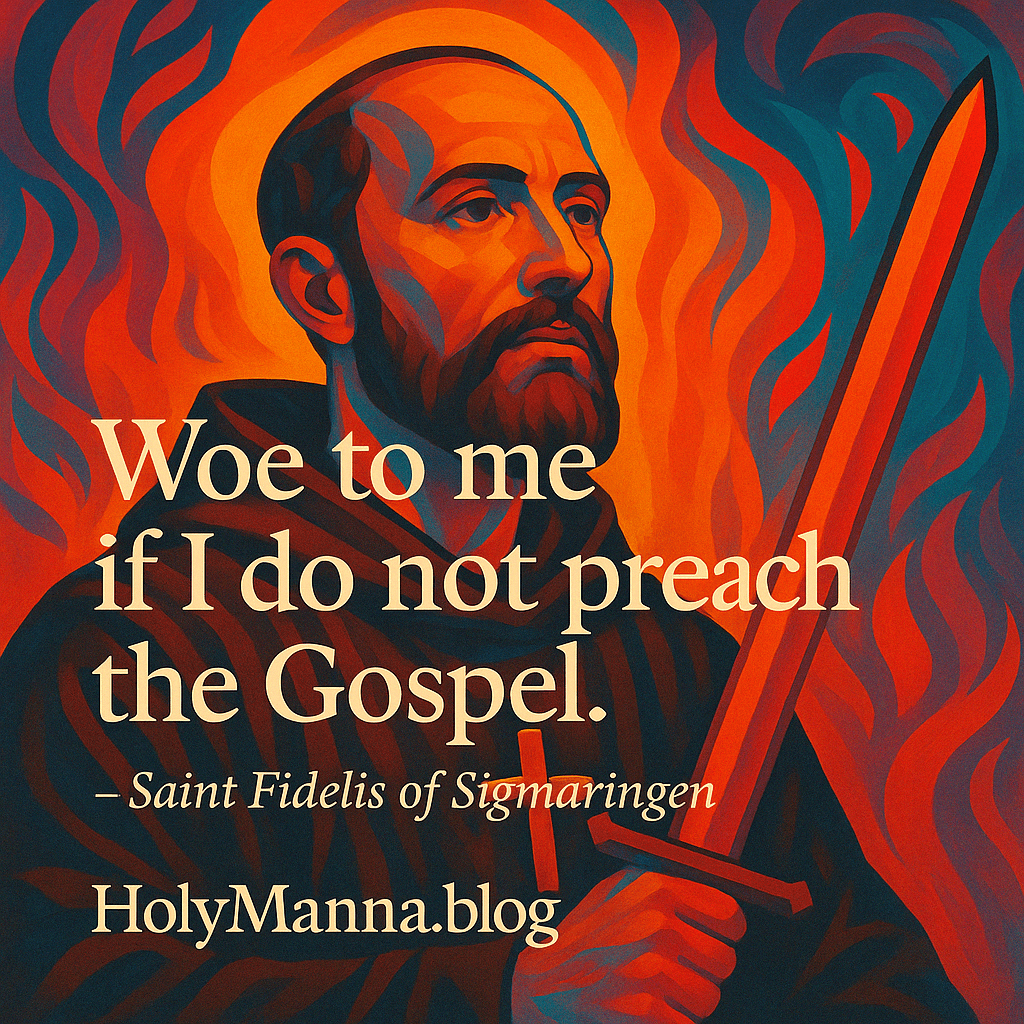
A Saint Set Ablaze
In an era torn by theological division and violent upheaval, Saint Fidelis of Sigmaringen emerged as a fiery beacon of truth, mercy, and sacrifice. A Capuchin friar with a scholar’s mind and a martyr’s heart, he became one of the great saints of the Counter-Reformation, giving his life in defense of the Catholic faith. Fidelis is celebrated for his unwavering fidelity to Christ, his tireless missionary zeal, and his fearless confrontation with heresy—not with hatred, but with holiness. His canonization in 1746 confirmed what countless Catholics already believed: that here was a man consumed by the love of Christ, whose blood became the seed of renewed faith in a fractured land. His life is a clarion call to courage, his death a solemn hymn of love, and his memory an invitation to live more boldly for God.
From Robes of Law to the Habit of Humility
Born Mark Rey in 1577 in the small town of Sigmaringen, in what is now Germany, the future saint grew up in a devout Catholic household. Raised in an age when Europe was being ripped apart by religious wars and the rise of Protestant sects, Mark was surrounded by the urgent need for truth and unity in faith. He excelled in his studies and went on to earn a doctorate in law and philosophy from the University of Freiburg, where he also taught moral philosophy. As a lawyer, he gained a rare reputation for integrity, refusing to take bribes and often representing the poor and defenseless without charge. He was known even then as the “advocate of the poor.”
But while his legal work was noble, Mark longed for something deeper, something eternal. He grew increasingly disillusioned with the corruption and compromises he saw in worldly courts. Moved by grace and the example of the saints, he discerned a calling to religious life. In 1612, he entered the Capuchin Franciscan Order, taking the religious name Fidelis, meaning “faithful.” From that moment, he dedicated his life entirely to preaching the Gospel, especially in areas where the Catholic faith had been weakened or rejected.
His eloquence in preaching, coupled with his burning charity and deep prayer life, made him a powerful missionary. The Sacred Congregation for the Propagation of the Faith recognized his talents and sent him as a missionary to the Calvinist stronghold of Graubünden in Switzerland. There, he tirelessly preached the truth of the Catholic Church, bringing hundreds back into full communion with Rome—not through coercion, but through compelling arguments and gentle love. His sermons, rooted in The Catechism and the Scriptures, thundered with truth but flowed with mercy.
The Fire of Grace
While Saint Fidelis was not known for sensational miracles like levitation or bilocation, the conversions that followed his preaching were nothing short of miraculous. In a region steeped in hostility toward the Church, his words penetrated hearts of stone. Hardened Calvinists wept at his sermons. Lapsed Catholics returned to confession after decades. Many attributed these graces not only to his rhetorical gifts, but to his intense prayer life and severe personal mortifications.
It was said that when he preached, “his face glowed with a heavenly light.” He seemed to know the secret struggles of his listeners. His guidance in the confessional brought about healing of spirit and sometimes even healing of body. Although undocumented in official canonization processes, these quiet wonders—the transformation of souls, the restoration of families, the mending of wounds between enemies—testify to the hidden power of grace that poured through him.
Fidelis also had a prophetic spirit. Before departing for his final mission, he reportedly told his companions, “This day I shall begin to be a martyr.” These words would soon come true.
Blood on the Sanctuary
His success in winning souls back to the Catholic Church soon attracted fierce backlash. The Calvinist authorities in Graubünden saw him not just as a threat to their theology, but to their control. He received repeated death threats. Friends begged him to leave. But Saint Fidelis refused to abandon his flock. His answer was firm: “Woe to me if I do not preach the Gospel.”
On April 24, 1622, after celebrating Mass and preaching in the town of Seewis, he was attacked by a mob of armed Calvinists as he left the church. They demanded that he renounce the Catholic faith. His answer echoed through the valley: “I came to extirpate heresy, not to embrace it. I will not renounce the Catholic faith. The Catholic religion is the faith of all ages.”
They struck him with a sword, beating and stabbing him until he collapsed, praying for their forgiveness. His final act was an imitation of Christ’s own mercy: to bless those who killed him. His body, later recovered by local Catholics, was found to be incorrupt and surrounded by an aura of peace. The blood of this martyr did not cry out for vengeance—it cried out for conversion.
The Echo of a Martyr
In the years following his death, Saint Fidelis’ reputation for holiness only grew. Miraculous healings were reported at his tomb. Children were cured of illness. The blind regained sight. Despairing souls found peace. His intercession became especially powerful in cases of religious confusion, doubt, and persecution.
Pilgrimages to the site of his martyrdom began almost immediately, and many Calvinists who had once reviled him began to re-examine their faith. The veneration of his relics spread across Europe, particularly among the Capuchins, who honored him as the protomartyr of their Order. His body now rests in the Capuchin church in Chur, Switzerland, a sacred site that continues to inspire devotion today.
In 1746, Pope Benedict XIV canonized him, officially declaring what the faithful already knew: that this humble friar, this preacher of truth, this fearless martyr, now stood among the saints of heaven, interceding for the Church he died defending.
Living Fidelity
Saint Fidelis of Sigmaringen is not just a hero of history—he is a model for our times. In a world where truth is often diluted and compromise is celebrated, he reminds us to be steadfast in our convictions. His life teaches us that fidelity to Christ may demand sacrifice, but it also bears eternal fruit. He invites us to ask: Am I willing to be faithful, even when it’s hard?
We don’t need to face swords to be martyrs. We are called to be “white martyrs” every day by resisting sin, standing for truth, and loving with radical mercy. We can learn from Fidelis to combine deep study of the faith with deep love for souls. To pray with intensity and act with courage. To preach with fire and live with joy.
Let us walk in his footsteps, offering our lives in service, in truth, in faith. And like him, may we be fidelis—faithful—to the end.
💬 Engage with Us!
Have you ever faced opposition for your faith? How do you respond with truth and love?
🕯️ Reflection Questions:
- Where in my life is God asking me to be more faithful, even when it’s uncomfortable or risky?
- How can I witness to the truth of the Gospel in my workplace, friendships, or social media presence?
- What can I learn from Saint Fidelis about combining courage with compassion in difficult conversations?
Let’s walk together in faith, encouraging each other to stay true, to love well, and to do everything with love, just as our Lord Jesus Christ did.
Saint Fidelis, pray for us! 🌟
Follow us on Instagram and Facebook for more insights and reflections on living a faith-filled life.

 Holy Manna!
Leave a comment