Called to Witness the Restoring Love of the Risen Christ
Have you ever experienced something so powerful, so life-changing, that you just had to share it? Today’s readings immerse us in that kind of moment—the awe and trembling that come with encountering the Risen Jesus and realizing that He has not only conquered death, but is inviting you to live in the power of His Resurrection. From the temple portico in Jerusalem to the intimate Upper Room, the Word of God draws us into a divine drama where healing, forgiveness, and mission are born from the pierced hands of Christ.
The central theme that unites today’s passages is restoration through the Risen Christ, leading us to repentance and sending us forth as witnesses. In Acts of the Apostles, Peter proclaims that the healing of the crippled man was made possible by faith in the name of Jesus—the very one whom the people had rejected, but whom God raised from the dead. Psalm 8, in poetic wonder, reminds us of the dignity God has bestowed upon humanity: “You have made him little less than a god, crowned him with glory and honor” (Psalm 8:6). This inherent dignity is now redeemed and elevated through Christ’s Resurrection. Finally, in The Gospel of Luke, the Risen Jesus appears to His disciples not as a ghost, but in His glorified body—offering peace, dispelling doubt, and commissioning them to preach “repentance, for the forgiveness of sins” (Luke 24:47).
Historically, these texts come from a post-Resurrection community grappling with wonder, fear, and the responsibility of witness. Luke, who authored both the Gospel and Acts, was writing to a people learning to live between the Resurrection and Christ’s return. The Jewish listeners of Peter’s speech would have deeply understood references to Moses and the prophets, yet struggled to reconcile this “suffering Messiah” with their long-held hopes. The early Christian communities were not only being transformed internally but also beginning to face external pressures. And yet, through it all, the same message rings out: Christ is risen, and now you are part of His redeeming mission. What does it mean to witness to the Resurrection in your life today?
First Reading – Acts 3:11–26
Healed in His Name: The Power and Promise of Repentance
The Acts of the Apostles, written by St. Luke, is often referred to as the “Gospel of the Holy Spirit,” as it captures the birth and explosive growth of the early Church after Christ’s Ascension. Today’s passage takes place immediately after the dramatic healing of a man who had been crippled from birth—a miracle performed through Peter and John outside the Temple gate. The setting is “Solomon’s Portico,” a colonnade where Jesus had once taught and where early Christians often gathered. For a Jewish audience, the location and the miracle would have carried profound Messianic implications. This was no ordinary healing. Peter uses the crowd’s amazement to proclaim that this act was not by human power or piety but by faith in the name of Jesus—the same Jesus whom the people had denied and delivered to death. This speech is not merely a defense; it is an altar call. It invites Israel to repentance, highlighting God’s faithfulness and mercy in fulfilling His covenant and sending the promised Messiah. In light of today’s theme, this reading is foundational: it reveals the restorative power of Christ’s Resurrection and calls us to become witnesses of that healing through conversion and proclamation.
Acts 3:11-26
New American Bible (Revised Edition)
Peter’s Speech. 11 As he clung to Peter and John, all the people hurried in amazement toward them in the portico called “Solomon’s Portico.” 12 When Peter saw this, he addressed the people, “You Israelites, why are you amazed at this, and why do you look so intently at us as if we had made him walk by our own power or piety? 13 The God of Abraham, [the God] of Isaac, and [the God] of Jacob, the God of our ancestors, has glorified his servant Jesus whom you handed over and denied in Pilate’s presence, when he had decided to release him. 14 You denied the Holy and Righteous One and asked that a murderer be released to you. 15 The author of life you put to death, but God raised him from the dead; of this we are witnesses. 16 And by faith in his name, this man, whom you see and know, his name has made strong, and the faith that comes through it has given him this perfect health, in the presence of all of you. 17 Now I know, brothers, that you acted out of ignorance, just as your leaders did; 18 but God has thus brought to fulfillment what he had announced beforehand through the mouth of all the prophets, that his Messiah would suffer. 19 Repent, therefore, and be converted, that your sins may be wiped away, 20 and that the Lord may grant you times of refreshment and send you the Messiah already appointed for you, Jesus, 21 whom heaven must receive until the times of universal restoration of which God spoke through the mouth of his holy prophets from of old. 22 For Moses said:
‘A prophet like me will the Lord, your God, raise up for you
from among your own kinsmen;
to him you shall listen in all that he may say to you.
23 Everyone who does not listen to that prophet
will be cut off from the people.’
24 Moreover, all the prophets who spoke, from Samuel and those afterwards, also announced these days. 25 You are the children of the prophets and of the covenant that God made with your ancestors when he said to Abraham, ‘In your offspring all the families of the earth shall be blessed.’ 26 For you first, God raised up his servant and sent him to bless you by turning each of you from your evil ways.”
Detailed Exegesis
Verse 11 – “As he clung to Peter and John, all the people hurried in amazement toward them in the portico called ‘Solomon’s Portico.’”
The healed man physically clings to the apostles, a symbol of newfound dependence on Christ through His Church. His healing becomes a living testimony that draws the crowd—not unlike how the Church, through her sacraments and witness, draws souls through the visible signs of God’s grace.
Verse 12 – “When Peter saw this, he addressed the people, ‘You Israelites, why are you amazed at this, and why do you look so intently at us as if we had made him walk by our own power or piety?’”
Peter deflects attention from himself to Christ, modeling true apostolic humility. Miracles are not for spectacle but for revelation—pointing beyond the apostles to the living God. How often do we mistakenly place our trust in human leaders, forgetting the true source of power?
Verse 13 – “The God of Abraham, [the God] of Isaac, and [the God] of Jacob, the God of our ancestors, has glorified His servant Jesus whom you handed over and denied in Pilate’s presence, when he had decided to release him.”
Peter connects Jesus to the patriarchs, grounding Christian faith in Jewish tradition. Jesus is not a rupture but the fulfillment. By calling Him God’s servant, he evokes Isaiah’s Suffering Servant, whose mission is to redeem Israel through suffering.
Verse 14 – “You denied the Holy and Righteous One and asked that a murderer be released to you.”
Peter is direct, convicting the crowd of their past actions, not to shame but to awaken them. The contrast is stark: they exchanged the Holy and Righteous One for a criminal. This verse reflects how sin blinds us to truth, preferring darkness to light.
Verse 15 – “The author of life you put to death, but God raised him from the dead; of this we are witnesses.”
The paradox is chilling and profound. They killed the very author of life—a title that emphasizes Jesus’ divine authority. Yet death is not the final word. Resurrection vindicates Jesus, and the apostles now step into their role as bold witnesses.
Verse 16 – “And by faith in his name, this man, whom you see and know, his name has made strong, and the faith that comes through it has given him this perfect health, in the presence of all of you.”
Faith is the vehicle of healing. The name of Jesus is not a magic word; it is a confession of divine authority. This verse invites us to examine how much we truly trust in the name of Jesus in our own infirmities—spiritual or physical.
Verse 17 – “Now I know, brothers, that you acted out of ignorance, just as your leaders did.”
Peter shows pastoral mercy, acknowledging that their sin stemmed from ignorance. This echoes Christ’s own words from the Cross: “Father, forgive them, they know not what they do” (Luke 23:34). Mercy does not ignore sin, but it opens the door to repentance.
Verse 18 – “But God has thus brought to fulfillment what he had announced beforehand through the mouth of all the prophets, that his Messiah would suffer.”
Suffering is not a detour in God’s plan—it’s the pathway. The Messiah’s passion was foretold, demonstrating the consistency of God’s salvific plan from the prophets to Christ.
Verse 19 – “Repent, therefore, and be converted, that your sins may be wiped away.”
This is the heart of the speech—a call to metanoia, a radical turning toward God. Conversion is more than behavior change; it is a reorientation of the soul. Sin is not just forgiven; it is wiped away, indicating total renewal.
Verse 20 – “And that the Lord may grant you times of refreshment and send you the Messiah already appointed for you, Jesus.”
Repentance leads to refreshment—a spiritual renewal that only Christ can bring. This line points both to the immediate grace of conversion and the eschatological hope of Christ’s return.
Verse 21 – “Whom heaven must receive until the times of universal restoration of which God spoke through the mouth of his holy prophets from of old.”
Jesus’ Ascension is part of the divine timeline. The universal restoration refers to the eventual renewal of all creation, aligning with Paul’s vision in Romans 8. Christ reigns now, but His return will complete the restoration.
Verse 22 – “For Moses said: ‘A prophet like me will the Lord, your God, raise up for you from among your own kinsmen; to him you shall listen in all that he may say to you.’”
Peter quotes Deuteronomy 18:15, identifying Jesus as the promised prophet like Moses. Listening to Jesus is no longer optional—it is salvific. To reject Him is to reject the very voice of God.
Verse 23 – “Everyone who does not listen to that prophet will be cut off from the people.”
There are consequences for ignoring the call of Christ. The covenant has always required response. This verse affirms that salvation is offered freely, but not without the necessity of obedience.
Verse 24 – “Moreover, all the prophets who spoke, from Samuel and those afterwards, also announced these days.”
Peter emphasizes that all of salvation history points to this moment. The Resurrection is not a surprise—it is the fulfillment. The early Church viewed prophecy not as vague poetry, but as divine preparation for Christ.
Verse 25 – “You are the children of the prophets and of the covenant that God made with your ancestors when he said to Abraham, ‘In your offspring all the families of the earth shall be blessed.’”
Peter ties the audience to Abraham’s blessing. This new covenant in Christ is not a break from Israel, but the fulfillment of God’s promise to bless all nations through Abraham’s lineage.
Verse 26 – “For you first, God raised up his servant and sent him to bless you by turning each of you from your evil ways.”
Christ’s Resurrection is not just victory over death; it is a personal call to transformation. The blessing comes not through comfort, but through conversion. True blessing is a turning away from sin.
Teachings
The Catechism of the Catholic Church affirms the apostolic message of repentance and restoration found in this reading. It teaches: “The call of Christ to conversion continues to resound in the lives of Christians. This second conversion is an uninterrupted task for the whole Church” (CCC 1428). Peter’s call to the Israelites is echoed in every age—the Church is missionary because the message of mercy is eternal.
St. Cyril of Jerusalem, writing in the fourth century, emphasized that the miracle of healing was not the end goal but a sign pointing to Christ: “Faith in the name of Jesus has given him perfect health. The name of Jesus is great and glorious, and it works wonders in those who believe in it.” For Cyril, as for Peter, miracles are windows into divine truth—not mere spectacles, but summons to believe.
Historically, this reading also underscores the identity of the early Church as deeply Jewish in character. Christianity was not a new religion but the flowering of God’s covenant with Israel. Peter’s reference to Moses, the prophets, and Abraham reminds us that God’s plan of salvation is continuous and coherent, a truth reflected throughout the Church’s liturgy, teaching, and sacramental life.
Reflection
This reading challenges us to examine our relationship with the name of Jesus. Do we call upon Him with living faith, expecting Him to act? Like the healed man clinging to Peter and John, we must cling to Christ and His Church, recognizing that true healing comes only from Him. If there are areas in our lives that remain paralyzed—by fear, addiction, bitterness, or unbelief—then today is the day to turn toward Jesus and allow His name to make us strong.
Repentance is not just for the great sinners “out there”; it is a daily invitation for each of us. What areas of your life need a fresh turning toward the Lord? What sins remain unconfessed, what relationships unreconciled? The promise remains: “Your sins may be wiped away” (Acts 3:19). Through the Sacrament of Reconciliation and the daily renewal of our hearts, we are restored to communion and joy.
Finally, we are not healed for ourselves alone. Just as Peter and John used the miracle as a springboard to preach Christ, we too are called to witness. How can you share your testimony of Christ’s healing in your life? Who needs to hear your story of hope, of forgiveness, of restoration? Let today’s reading be both a comfort and a commission: to be made new and to make Him known.
Responsorial Psalm – Psalm 8:2, 5–9
Crowned with Glory: The Wonder of Human Dignity Before God
In today’s Responsorial Psalm, we are invited to contemplate the mystery of God’s grandeur and our astonishing place within it. Psalm 8 is a hymn of praise, attributed to King David, and is one of the few psalms that speaks exclusively to the majesty of creation and humanity’s role within it. Composed during a time when the ancient Israelites were surrounded by polytheistic cultures that often deified the sun, moon, and stars, this psalm stands apart: it doesn’t worship the heavens, but rather the One who made them. The psalmist is overwhelmed by the realization that the Creator of the vast cosmos has bestowed such incredible dignity and authority upon humankind. In the context of today’s theme of restoration and witness, Psalm 8 reminds us that humanity, though broken by sin, is redeemed and crowned anew in Christ, the perfect man, through whom all creation is being restored.
Psalm 8:2, 5-9
New American Bible (Revised Edition)
2 O Lord, our Lord,
how awesome is your name through all the earth!
I will sing of your majesty above the heavens
5 What is man that you are mindful of him,
and a son of man that you care for him?
6 Yet you have made him little less than a god,
crowned him with glory and honor.
7 You have given him rule over the works of your hands,
put all things at his feet:
8 All sheep and oxen,
even the beasts of the field,
9 The birds of the air, the fish of the sea,
and whatever swims the paths of the seas.
Detailed Exegesis
Verse 2 – “O Lord, our Lord, how awesome is your name through all the earth! I will sing of your majesty above the heavens.”
The psalm opens with a declaration of the universal majesty of God. The repetition of “Lord” reflects both God’s personal covenant name (YHWH) and His sovereign kingship. To declare His name “awesome… through all the earth” is to recognize that God’s authority transcends borders and peoples. The psalmist sets the stage for a meditation on divine transcendence and human responsibility.
Verse 5 – “What is man that you are mindful of him, and a son of man that you care for him?”
Here the tone shifts to awe-filled humility. The psalmist contemplates humanity’s seeming insignificance in the grand cosmos. And yet—God is mindful. The phrase “son of man” can be read on two levels: poetically, it means all humanity; prophetically, it points forward to Christ, the Son of Man, who fully reveals God’s love and care. How often do we pause to marvel that God notices us at all?
Verse 6 – “Yet you have made him little less than a god, crowned him with glory and honor.”
This verse expresses one of the most elevated views of humanity in all of Scripture. Despite our frailty, we are made in the imago Dei—the image of God—and are crowned with divine favor. In light of Christ’s Resurrection, this verse takes on deeper meaning: Jesus, the New Adam, restores our lost dignity and exalts human nature by uniting it to the divine.
Verse 7 – “You have given him rule over the works of your hands, put all things at his feet.”
God entrusts creation to humanity as stewards, not owners. The language of dominion must be understood through the lens of responsibility and care. In Ephesians 1:22, Paul applies this verse to Christ, stating: “He put all things beneath his feet and gave him as head over all things to the church.” Thus, what was originally spoken of Adam is now perfectly fulfilled in Jesus.
Verse 8 – “All sheep and oxen, even the beasts of the field,”
The psalm continues listing the scope of man’s entrusted dominion. Domestic animals like sheep and oxen were central to ancient agrarian life, representing sustenance and livelihood. Man’s role as steward includes the care and ethical treatment of all life under his charge.
Verse 9 – “The birds of the air, the fish of the sea, and whatever swims the paths of the seas.”
The psalm ends where it began—with awe at the vastness of creation and the astonishing fact that God has given us a place of honor within it. The repetition of imagery from the Genesis creation account reinforces the idea that God’s original design is one of order, beauty, and harmony—a design restored and fulfilled in the risen Christ.
Teachings
The Catechism of the Catholic Church affirms this exalted vision of humanity in its teaching on human dignity: “Of all visible creatures only man is ‘able to know and love his creator’. He is ‘the only creature on earth that God has willed for its own sake’, and he alone is called to share, by knowledge and love, in God’s own life” (CCC 356). Psalm 8 reveals that man is not a cosmic accident, but a being of eternal worth, crowned with glory through God’s love.
St. John Paul II, in his reflections on the Theology of the Body, draws heavily from Psalm 8 to explore the sacredness of the human body and vocation: “Man cannot live without love. He remains a being that is incomprehensible for himself… if he does not encounter love, if he does not experience it and make it his own” (TOB, January 16, 1980). This intrinsic yearning for love and communion is not a weakness but a reflection of the divine image.
The Church Fathers, including St. Gregory of Nyssa, also saw in this psalm the anticipation of the Incarnation. Gregory wrote, “The true greatness of man is seen not in his dominion over creatures but in his capacity to become God-like through grace”. In Christ, the Son of Man, humanity is raised above even the angels—not through pride, but through participation in divine life. This teaching reinforces the psalm’s portrayal of man as majestic, yet dependent upon God.
Reflection
Psalm 8 invites us to pause and ask: Do I live like someone crowned with glory and honor? In a world that often reduces human value to utility or achievement, today’s psalm proclaims something radically different: that you are known, loved, and entrusted with divine purpose. This truth reshapes how we view not only ourselves but others—especially the poor, the unborn, the elderly, and the forgotten.
We are also reminded of our call to stewardship. How do I care for the world entrusted to me—my relationships, my time, my talents, and even creation itself? The dignity of dominion is not permission for exploitation, but a summons to love and responsibility. In Christ, dominion becomes service, and authority becomes gift.
Finally, this psalm draws us into worship. When was the last time you were awestruck by God’s creation or His mindfulness toward you? Make time today to look at the stars, the sea, or even the face of another person, and whisper in your heart: “O Lord, our Lord, how awesome is your name through all the earth!” (Psalm 8:2). Let reverent wonder become the doorway to deeper love.
Holy Gospel – Luke 24:35–48
The Risen One in Our Midst: Peace, Presence, and Proclamation
The Gospel of Luke is renowned for its rich storytelling, pastoral warmth, and emphasis on the mercy and mission of Christ. Today’s Gospel takes place on Easter Sunday evening, immediately following the encounter on the road to Emmaus. The disciples, still stunned by reports of the empty tomb and personal appearances of the Risen Jesus, are now gathered in Jerusalem. As the Emmaus travelers share how they recognized Jesus in the breaking of the bread, He suddenly appears in their midst. This moment is a turning point. What had been whispered rumors of resurrection is now gloriously confirmed by Jesus Himself. Historically and theologically, this appearance affirms both the physical reality of the Resurrection and the continuation of Christ’s mission through the Church. It fits perfectly into today’s overarching theme of restoration through the Risen Christ, leading to repentance and sending us forth as witnesses. Jesus doesn’t just offer proof of life after death—He offers peace, healing, and purpose.
Luke 24:35-48
New American Bible (Revised Edition)
35 Then the two recounted what had taken place on the way and how he was made known to them in the breaking of the bread.
The Appearance to the Disciples in Jerusalem. 36 While they were still speaking about this, he stood in their midst and said to them, “Peace be with you.” 37 But they were startled and terrified and thought that they were seeing a ghost. 38 Then he said to them, “Why are you troubled? And why do questions arise in your hearts? 39 Look at my hands and my feet, that it is I myself. Touch me and see, because a ghost does not have flesh and bones as you can see I have.” 40 And as he said this, he showed them his hands and his feet. 41 While they were still incredulous for joy and were amazed, he asked them, “Have you anything here to eat?” 42 They gave him a piece of baked fish; 43 he took it and ate it in front of them.
44 He said to them, “These are my words that I spoke to you while I was still with you, that everything written about me in the law of Moses and in the prophets and psalms must be fulfilled.” 45 Then he opened their minds to understand the scriptures. 46 And he said to them, “Thus it is written that the Messiah would suffer and rise from the dead on the third day 47 and that repentance, for the forgiveness of sins, would be preached in his name to all the nations, beginning from Jerusalem. 48 You are witnesses of these things.
Detailed Exegesis
Verse 35 – “Then the two recounted what had taken place on the way and how he was made known to them in the breaking of the bread.”
The Emmaus disciples bear witness to their experience. Their hearts had burned as Jesus opened the Scriptures, but they recognized Him in the breaking of the bread—an unmistakable Eucharistic reference. This verse affirms that Jesus reveals Himself most intimately in Word and Sacrament.
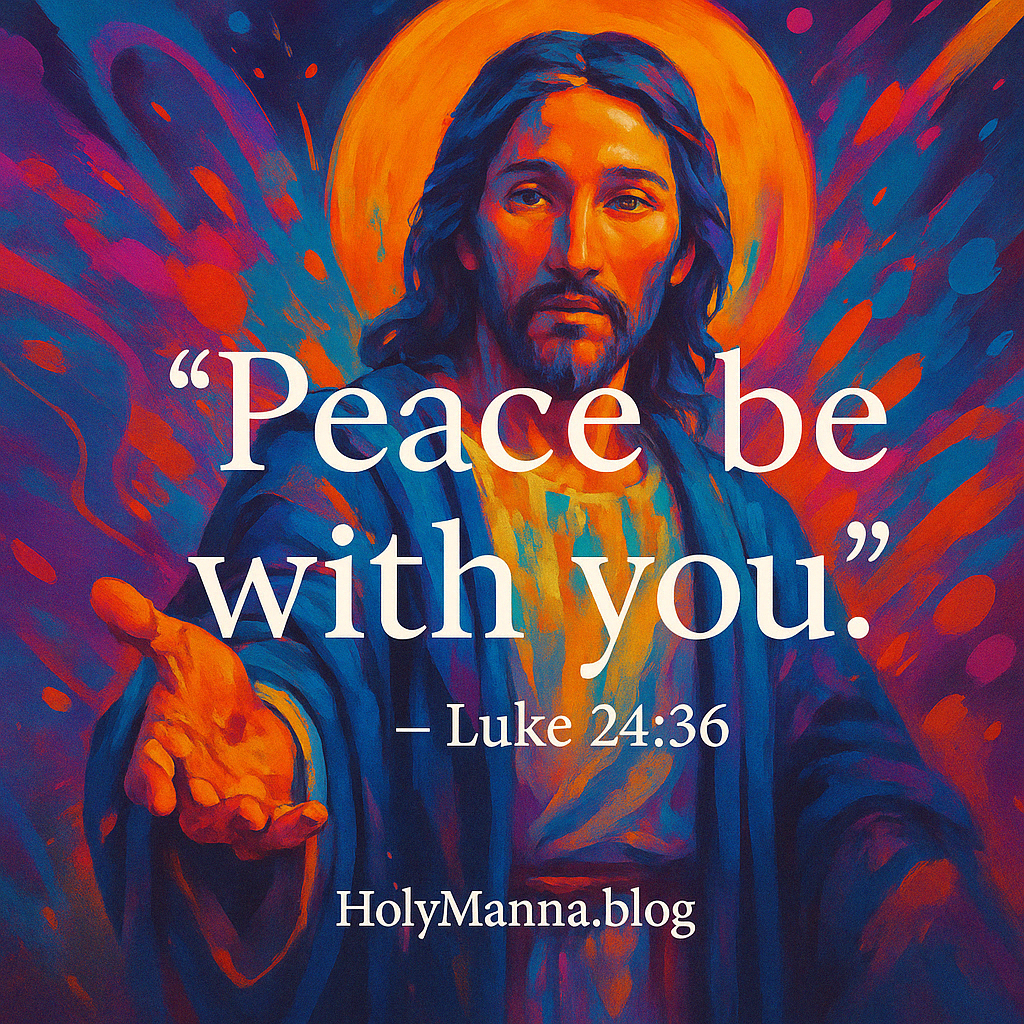
Verse 36 – “While they were still speaking about this, he stood in their midst and said to them, ‘Peace be with you.’”
Jesus appears, unbound by physical limitations, yet fully present. His first words are “Peace be with you”—not condemnation for their doubt, but peace. This echoes the divine mercy of God who always initiates reconciliation. Christ’s peace is not mere comfort but wholeness and restoration.
Verse 37 – “But they were startled and terrified and thought that they were seeing a ghost.”
Even with the witness of others, the disciples are overwhelmed by fear. Their reaction reminds us that even those closest to Jesus struggled to grasp the Resurrection. This fear is part of the human condition that Jesus has come to transform.
Verse 38 – “Then he said to them, ‘Why are you troubled? And why do questions arise in your hearts?’”
Jesus reads their hearts. His gentle questioning invites self-examination. He doesn’t scold; He shepherds. Like a good teacher, He draws out their inner struggle and prepares to resolve it not with rebuke, but with presence.
Verse 39 – “Look at my hands and my feet, that it is I myself. Touch me and see, because a ghost does not have flesh and bones as you can see I have.”
Jesus invites them to touch His wounds—the proof of His sacrifice and the continuity between crucifixion and resurrection. The Church has always defended the bodily Resurrection, and this verse is a cornerstone of that doctrine. He is not a ghost or symbol—He is risen in the flesh.
Verse 40 – “And as he said this, he showed them his hands and his feet.”
This simple act speaks volumes. Jesus doesn’t hide His wounds; He shows them. In fact, His wounds become the very means of recognition and reassurance. Do we hide our wounds, or allow Christ to reveal His glory through them?
Verse 41 – “While they were still incredulous for joy and were amazed, he asked them, ‘Have you anything here to eat?’”
This verse captures the beautiful paradox of faith: joy mixed with disbelief. Jesus asks for food not because He needs it, but to demonstrate His true, risen body. He meets their doubts with tangible love.
Verse 42 – “They gave him a piece of baked fish;”
This seemingly mundane detail is deeply theological. In early Christian art, the fish symbolized Christ. The act of eating affirms both the humanity of the risen Jesus and His communion with the disciples.
Verse 43 – “He took it and ate it in front of them.”
Jesus eats before them, not just to prove His reality, but to restore fellowship. Sharing a meal with someone in Jewish culture signified peace, unity, and covenant. This moment anticipates the Eucharistic table where Christ continues to dine with His people.
Verse 44 – “He said to them, ‘These are my words that I spoke to you while I was still with you, that everything written about me in the law of Moses and in the prophets and psalms must be fulfilled.’”
Jesus ties His Resurrection to Scripture. The law, prophets, and psalms refer to the three divisions of the Hebrew Bible—He fulfills all of them. The Risen Christ is not a surprise interruption; He is the fulfillment of all God’s promises.
Verse 45 – “Then he opened their minds to understand the scriptures.”
Understanding Scripture is a grace. Christ Himself must “open our minds.” This verse emphasizes the Church’s teaching that Scripture is most fruitfully interpreted within the light of Christ and His Spirit. Do we invite Him to open our minds when we read His Word?
Verse 46 – “And he said to them, ‘Thus it is written that the Messiah would suffer and rise from the dead on the third day’”
Jesus reiterates the divine necessity of His Passion. Suffering is not a failure but the means of victory. The Resurrection on the “third day” fulfills typological foreshadowings such as Jonah and Hosea, affirming God’s plan across history.
Verse 47 – “And that repentance, for the forgiveness of sins, would be preached in his name to all the nations, beginning from Jerusalem.”
This is the mission statement of the Church: preach repentance and forgiveness in Jesus’ name. It begins in Jerusalem—the place of betrayal and crucifixion—proving that grace starts where sin abounded. But it doesn’t stay there. It moves outward to all nations.
Verse 48 – “You are witnesses of these things.”
With this declaration, Jesus entrusts His mission to the disciples. Their job is not to remain in wonder but to witness. The Greek word for “witnesses” is martyres, from which we get martyr. This verse contains both calling and cost.
Teachings
The Catechism of the Catholic Church emphasizes the historical and bodily reality of Christ’s Resurrection: “The Resurrection of Jesus was a real event, with manifestations that were historically verified, as the New Testament bears witness” (CCC 639). Today’s Gospel directly affirms that reality through Jesus’ appearance, His invitation to touch His wounds, and His act of eating with His disciples. These details combat any notion that the Resurrection was a symbolic or spiritual idea alone.
Furthermore, the Church teaches that Christ’s post-Resurrection appearances are not mere closures to the Gospel narrative—they inaugurate the Church’s mission: “The risen Christ… gives them the mission to proclaim in his name to all nations the conversion that brings the forgiveness of sins” (CCC 981). This corresponds to verse 47 and underscores the importance of evangelization as an expression of Easter joy.
St. Leo the Great, in a fifth-century Easter homily, proclaimed: “The Resurrection of the Lord is the foundation of our faith and the confirmation of our hope. Without it, the passion of Christ would not have brought salvation.” Jesus’ Resurrection not only validates His divinity but also restores our dignity. Through the wounds He shows and the peace He gives, we are made whole and are commissioned to bring that wholeness into the world.
Reflection
This Gospel reminds us that Jesus still enters our locked rooms—our places of fear, shame, and doubt—and says: “Peace be with you.” Where do you need that peace today? Do you welcome the Risen Lord into your heart, or are you still startled and terrified, thinking He must be a ghost? Let Him show you His wounds. Let Him remind you: He is real. He is with you. He is for you.
Jesus then invites us to deeper understanding. Do you let Him open your mind to the Scriptures? His Word is not a puzzle to be solved alone but a divine mystery to be unveiled through prayer, study, and sacramental life. Approach the Bible not as a textbook but as a living encounter with the Risen Word.
Finally, you are called to be a witness. Not because you’re perfect, but because you have seen and been forgiven. How are you witnessing to the Resurrection in your daily life? Who around you needs to hear that repentance leads to forgiveness, and that Jesus is truly alive? Go out, even if trembling, and proclaim what you have seen and heard: “You are witnesses of these things.” (Luke 24:48)
Living as Easter Witnesses
Today’s readings paint a breathtaking picture of what it means to live in the light of the Resurrection. In Acts, we saw the miraculous healing of a crippled man—not through Peter’s power, but through faith in the name of Jesus. Peter’s bold proclamation calls us to repentance, reminding us that conversion is the gateway to refreshment and renewal. In Psalm 8, we were reminded of the astonishing dignity bestowed upon humanity—“You have made him little less than a god, crowned him with glory and honor”—a dignity that is restored and fulfilled in the Risen Christ. And in The Gospel of Luke, Jesus enters the Upper Room, speaks peace into fear, reveals His wounded yet glorified body, and commissions His disciples to preach “repentance, for the forgiveness of sins… to all the nations” (Luke 24:47).
These are not isolated stories. They form a single movement: from encounter to healing, from wonder to understanding, and finally—from restoration to mission. We are not merely passive recipients of grace; we are called to be “witnesses of these things” (Luke 24:48). Jesus shows us that His wounds are not erased by the Resurrection—they are glorified. Our wounds, too, can become signs of grace when we let Him enter and speak “Peace be with you” into our hearts.
So today, take a moment to ask yourself: Where in my life do I need restoration? How is Jesus calling me to repentance, healing, and mission? Then, filled with the peace of the Risen Lord and renewed by His Word, go out and be a living witness. Speak His name. Share your joy. And never forget the dignity you carry: you have been crowned with glory and honor to proclaim the glory of the One who lives forever.
Engage with Us!
We’d love to hear how today’s readings spoke to your heart. The beauty of Scripture is that it meets each of us uniquely, wherever we are on our journey. What moved you? What challenged you? Where did you feel the Lord whispering peace or calling you to action? Share your thoughts in the comments below—your reflection could be the light someone else needs today!
Reflection Questions:
First Reading – Acts 3:11–26
What does Peter’s call to repentance stir in you today? How have you experienced healing or restoration through faith in the name of Jesus? Are there any areas where you feel called to witness more boldly to the Risen Christ?
Responsorial Psalm – Psalm 8:2, 5–9
Do you live with the awareness that you are crowned with glory and honor? How does this psalm reshape your understanding of human dignity—your own and that of others? In what ways can you better honor the stewardship God has entrusted to you?
Holy Gospel – Luke 24:35–48
Where in your life is Jesus saying, “Peace be with you”? How can you let Him open your mind to the Scriptures this week? What practical steps can you take to be a witness of repentance and forgiveness to those around you?
May these readings fill you with the peace, purpose, and courage that only the Risen Lord can give. Go forth today and live your faith with joy, humility, and bold love—doing everything with the mercy Jesus has shown us. You are witnesses of these things.
Follow us on Instagram and Facebook for more insights and reflections on living a faith-filled life.

 Holy Manna!
Leave a comment